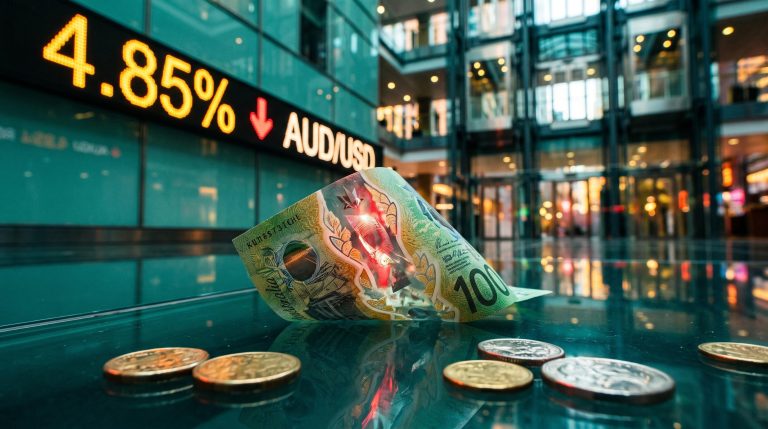
The Reserve Bank of Australia lifted the cash rate today, and the usual reaction is to brace every part of your portfolio for damage. Some of your holdings may actually benefit. The Board raised the cash rate by 25 basis points to 4.85% on 3 November 2026, its fifth hike of 2026, on a 6-3 vote. The 10-year government bond yield sits near 5.1%.
A rate rise does not affect everything equally. Miners, insurers and household-facing retailers can move in opposite directions on the same announcement.
Where each holding started matters as much as where rates are heading. A stock that has already fallen hard faces a different test from one priced for perfection.
Here is a sector-by-sector way to think about positioning when rates are rising. You will also get a clear picture of what bonds can and cannot do for you at today’s yields. This is general education, not personal advice.
What a rate hike changes for an Australian portfolio, and why sectors react differently
Every rate hike works through one mechanism. Money becomes more expensive to borrow, and cash and bonds pay you more for doing nothing risky.
That one change has three effects. A company’s future earnings are worth less today, because they are measured against a higher discount rate, which is the return you could earn elsewhere and use to value money arriving in the future. Borrowing costs climb. Households with mortgages have less to spend.
The RBA has now lifted the cash rate from 4.60% to 4.85%, taking 2026 tightening to 125 basis points. Reuters described it as the highest cash rate since 2008. The Board pointed to persistent inflation, higher oil and commodity prices linked to Middle East tensions, and firms raising or planning to raise prices.
The Board’s rationale The revised inflation outlook and continuing upside risks meant “further tightening in financial conditions” was warranted to return inflation to target.
Two details matter for you. Three Board members wanted to hold, and Reuters reported that the RBA dropped its earlier reference to raising rates further if necessary. The path ahead is less certain, not more.
Markets had already priced most of the RBA decision to 4.85%, with 25 of 28 economists expecting it, so the real surprise for your portfolio sat in whether the Board left the door open to a move towards 5.10%.
The 10-year yield eased to roughly 5.10% from 5.16% after the decision, according to Morningstar/Dow Jones, having closed at 5.12% on 2 November, according to Trading Economics.
A hike changes the terms every asset in your portfolio is priced on. The useful question is which of your holdings gain from it and which are exposed. Three questions guide the rest of this piece:
- Who earns more on cash and bonds?
- Who relies on distant growth?
- Who depends on stretched households?
When big ASX news breaks, our subscribers know first
Miners and rising rates: who is exposed when growth slows?
“Miners” is not one bet. Miners usually handle rate rises well when economic growth is strong. Hikes driven by inflation during slower growth are the harder setup, and that describes 2026.
Juniors and developers
Junior explorers and mine developers sit at the painful end. Most pay no dividends, and their value rests on mines that may produce cash years from now. A higher discount rate shrinks that distant value, and project finance costs more.
John Forwood of the Lowell Resources Fund told Stockhead on 12 October 2026 that rising bond yields had hit junior resources stocks particularly hard. The ASX Junior Resources Index was down about 11% from the start of September.
A stronger US dollar added pressure. Hebe Chen of Vantage told the SMH on 14 October 2026 that miners were caught in a broad sell-off across gold, silver, copper and iron ore, though she described copper’s longer-term structural story as intact.
Cash-generative producers
Established producers with low debt and offshore earnings can hold up far better. Morgans told The Nightly on 28 October 2026 that investors should favour miners and companies with offshore earnings as higher rates squeeze households. It noted that non-mining industrial profits had been roughly flat for two years, against a long-run growth rate of 6-7%, and highlighted gold miners Evolution Mining and Ramelius Resources.
Even big names are not immune day to day. BHP fell 1.4% in the 2 November session as commodity prices declined, according to the ABC.
| Miner type | Rate sensitivity | Why | Example factor |
|---|---|---|---|
| Juniors and explorers | High | Non-yielding, valued on distant growth | Index down about 11% since September |
| Leveraged developers | High | Higher project finance costs | Construction funding needs |
| Low-debt producers | Lower | Current cash flow, offshore earnings | Commodity price can outweigh rates |
| Gold and copper exposures | Varies | Commodity outlook drives earnings | Copper structural story intact |
Commodity prices can overpower the rate effect, so a gold producer’s earnings can rise while sector valuations shrink. For your portfolio, checking balance sheet strength and commodity exposure matters more than owning mining as a theme.
Why higher rates can help insurers, and where the benefit stops
Insurers sit on the other side of the first question: they earn more on cash and bonds. The reason is a pool of money called the float, which is the premiums an insurer holds between collecting them and paying claims.
- Premiums arrive first. Customers pay before any claim is made.
- The money is invested. Insurers place much of it in bonds and other fixed income.
- Maturities are reinvested. As older bonds mature, the money goes into new bonds at today’s higher yields.
- Income builds over time. As low-yielding securities roll off, investment income can rise even if underwriting margins stay flat.
QBE shows this at work. Its 1H2026 report on 13 August 2026 recorded investment income of $828 million, a 2.3% return. Its core fixed-income yield exited the half at 4.1%, about 40 basis points higher, and return on equity (ROE), a measure of profit relative to shareholders’ funds, was 17.7%.
The float reinvestment benefit is already visible beyond QBE, with Suncorp reporting net investment returns of $553 million for FY26, though how long the benefit lasts depends on where yields settle.
Investment income is only half the story. QBE’s ex-catastrophe claims ratio, the share of premiums paid out in everyday claims, rose to 61.8% from 61.5%, reflecting claims inflation and large individual events.
The other risks to watch:
- Catastrophes: floods, storms and fires can wipe out investment gains. KPMG’s 2026 insurance analysis flagged worsening disaster risk and persistent inflation.
- Duration marks: existing bonds lose market value when yields rise, before reinvestment catches up.
- Pricing limits: regulators, politics and customer affordability can cap premium rises.
- Credit exposure: corporate bonds and equities can still default or fall.
Insurers trade slightly below their long-run average forward price-to-earnings (P/E) ratio despite a roughly 20% sector rally.
For you, insurers are a rate beneficiary through reinvestment income. The claims side decides whether that benefit reaches earnings.
Harvey Norman and JB Hi-Fi: how much bad news is already priced in?
Retailers answer the third question: who depends on stretched households? “Priced in” means the share price already reflects the weakness investors expect. A lower valuation only helps you if the actual outcome is no worse than feared.
| Company | Latest result | Forward P/E | Housing sensitivity | Latest trading signal |
|---|---|---|---|---|
| JB Hi-Fi | FY2026 sales $11.06B, NPAT $489.9M | About 16-17.7x | Lower | Q1 FY2027 Australia comparable sales -1.4% |
| Harvey Norman | FY2026 profit before tax $790.29M | Roughly 10-13x, depending on source | Higher | System sales up 3.1% in FY2026 |
The case that bad news is priced in
JB Hi-Fi reported record FY2026 results on 17 August 2026: sales up 4.8%, EBIT (earnings before interest and tax) up 5.8% to $734.4 million, NPAT up 6.0%, and dividends of 337 cents a share. Its forward P/E of about 16-17.7x sits modestly above a cited specialty-retail average of 14x.
Harvey Norman’s profit before tax rose 4.9% on 28 August 2026, and 10.9% to $654.69 million excluding specified items. Its multiple sits roughly between 10x and 13x.
The case that it is not
Strong results did not protect the shares. The Australian reported that JB Hi-Fi fell 12.31% on 17 August because record numbers still missed expectations, and Harvey Norman fell 4.56% that day.
Rate rises reach spending with a delay, so recent profits may reflect earlier resilience. JB Hi-Fi Australia’s Q1 FY2027 comparable sales fell 1.4%, total sales slipped 0.4% and The Good Guys fell 0.4%, while New Zealand grew 10.7%. Reporting on 9 September 2026 said Harvey Norman is more exposed to housing, since weaker property prices hit furniture, appliance and renovation spending.
Household weakness is already visible in the data, with consumer sentiment at its lowest since the early-1990s recession and national dwelling values down six straight months, which is the pressure retailers now have to absorb.
A lower multiple is a cushion, not a floor. The next trading updates will test whether the market’s caution goes far enough.
Rotation out of US tech and the role of bonds: a framework for balance
The same forces hitting retailers are moving money across global markets, and that brings the bond question into focus.
Why the rotation is happening
Higher discount rates reduce the value of distant tech earnings. Crowded positioning, a preference for earnings certainty and the pull of income have pushed money toward financials and defensives. Global X reported weak technology and strong utilities, healthcare and staples in October 2026, Cutcher described a similar pattern on 12 October, and ShareCafe reported US investors rotating into defensives on 3 November.
Australia’s low tech weighting means local banks, insurers and staples can attract that money. The rotation can reverse quickly if inflation falls and yields drop.
How bond yield scenarios work
A fixed-rate bond pays a set coupon. When market yields rise, the bond’s price falls so its return matches new bonds, and when yields fall, its price rises. Duration, which measures how sensitive a bond’s price is to yield changes, decides how big that move is.
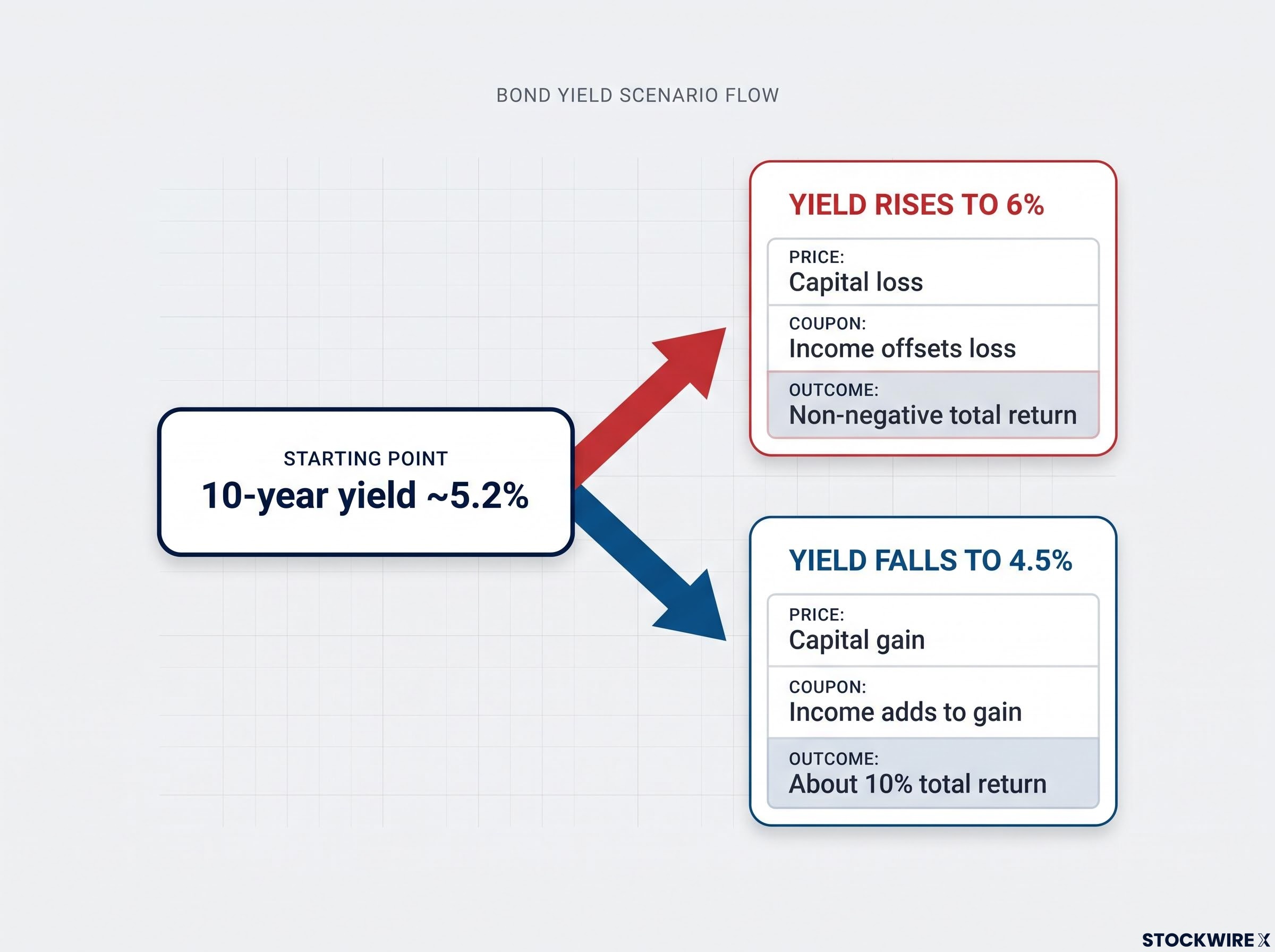
Two scenarios were modelled from a 10-year yield of about 5.2%. These are illustrative, not forecasts.
| Yield move | Price effect | Coupon effect | Approximate outcome |
|---|---|---|---|
| Rises to 6% | Capital loss | Income offsets the loss | Non-negative total return |
| Falls to 4.5% | Capital gain | Income adds to the gain | About 10% total return |
Past performance does not guarantee future results. Financial projections are subject to market conditions and various risk factors.
VanEck and BlackRock make a similar point: higher starting yields give you more income to absorb price falls. Holding a bond to maturity largely removes interim price risk if the issuer pays, while selling early locks in any gain or loss. Bond ETFs are available on platforms such as Moomoo.
Bonds can play three roles for you:
- Income: contractual coupon payments.
- Diversification: high-quality government bonds may behave differently from shares, especially when growth weakens.
- Liquidity and stability: short-duration securities reduce volatility, though they still lose value when rates rise.
At current yields, bonds can cushion your portfolio in both scenarios. Long-duration holdings carry more short-term price risk, so the 2026 problem is one of transition, and your duration choice matters.
Putting it together: sector tilts and bond balance in a 4.85% cash-rate world
The three questions give you a working map. Sort miners by balance sheet and commodity exposure, not by label. Treat insurers as reinvestment-income stories that only pay off if claims stay contained. View Harvey Norman and JB Hi-Fi as a contest between compressed valuations and mortgage stress. Use bonds for income and balance, with duration matched to how much price movement you can tolerate.
Watch four things next: the RBA’s following move after its softer guidance, the retailers’ trading updates, insurer claims ratios and the 10-year yield.
Your next step is to line up your own holdings against these sensitivities and see where the exposure really sits.
This article is for informational purposes only and should not be considered financial advice. Investors should conduct their own research and consult with financial professionals before making investment decisions.