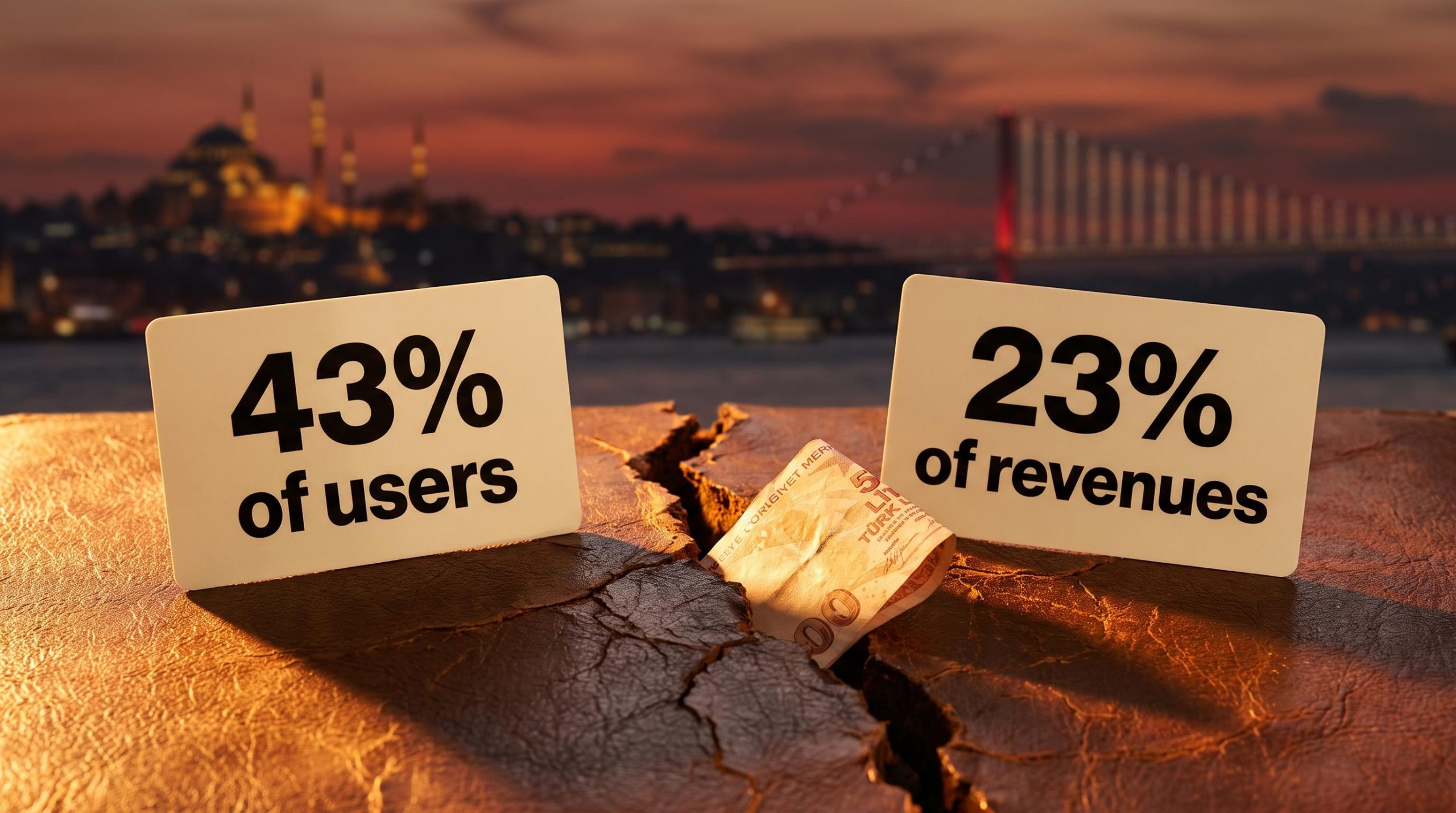
Turkey accounts for roughly 43% of Kaspi.kz’s active users. It generates only about 23% of the company’s revenues, and that share is falling.
That gap is the first thing an investor should notice about Kaspi’s Turkish expansion, and it is the first thing the company’s own growth narrative does not explain. The push into Turkey is running ahead of schedule: the Hepsiburada acquisition closed in January 2025, Turkish regulators approved the Hepsi Bank banking deal in June 2026, and Kaspi has committed roughly USD 300 million to capitalise that bank from 2027. Yet as the Turkish user base swells, the financial signal from Turkey is moving in the opposite direction.
This is a case where the growth story and the financial story have started to diverge. What follows here separates the two, walking through the three fault lines beneath the headline expansion: foreign-exchange translation drag, deteriorating revenue quality, and understated credit risk. The purpose is to give you the tools to decide for yourself whether Turkey is a long-run asset or a near-term earnings liability.
How currency collapse is hollowing out Turkey’s revenue contribution
Start with the arithmetic. According to Kaspi’s own company disclosures, Turkish users make up approximately 43% of the total active base, yet contribute only around 23% of revenues, down from roughly 25% the year before. A near-majority of the users, less than a quarter of the money, and the money share shrinking.
The core divergence 43% of active users. 23% of revenues. And falling.
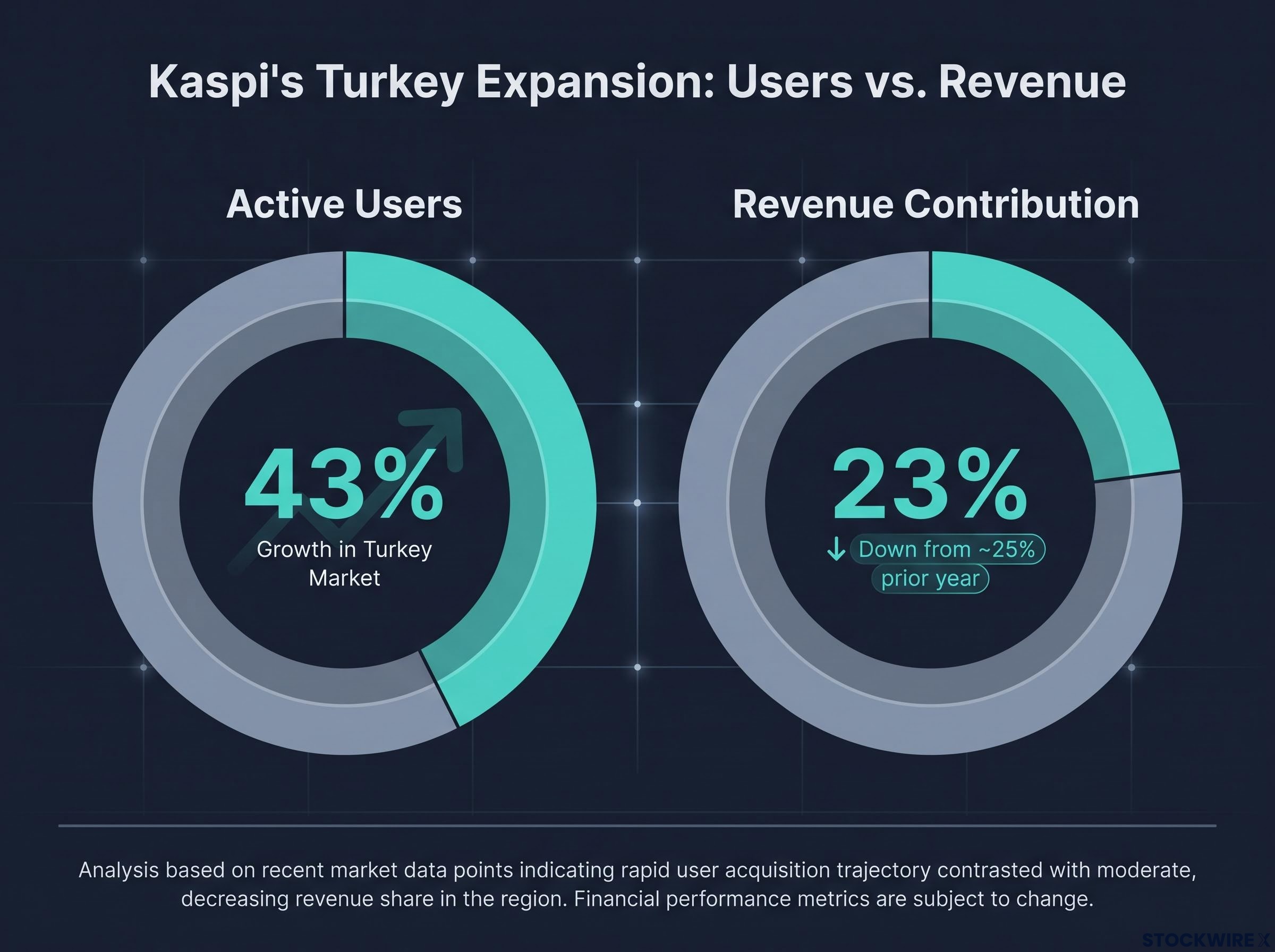
The temptation is to read this as an engagement problem or a monetisation failure. It is neither. The mechanism sits in the exchange rate.
Turkish revenues are earned in Turkish lira. They are then reported in Kazakhstani tenge and US dollar terms. Over the prior year, the lira fell approximately 30% against the tenge, which means that even lira revenue growing at a healthy nominal pace can translate into a shrinking hard-currency contribution once it lands in the reported accounts.
This is the structural trap of expanding into a depreciating-currency market. You can add users, grow local sales, and expand payment volumes, and still watch your reported revenue share erode because the currency those sales are booked in is losing value faster than the business is growing.
Lira depreciation mechanics operate through the CBRT’s funding channel as much as through the headline policy rate, and investors monitoring Kaspi’s translation drag need to track both: a 300-basis-point shift in effective funding costs can alter carry positioning and lira volatility without any change to the 37% benchmark that appears in most macro summaries.
| Metric | Prior year | Most recent period |
|---|---|---|
| Turkish share of active users | Rising toward ~43% | ~43% |
| Turkish share of revenues | ~25% | ~23% |
| TRY/KZT movement | Baseline | ~30% depreciation |
The practical takeaway is direct. If you are using Turkish user counts or gross merchandise volume to judge how the expansion is progressing, you are reading the wrong dashboard. Every lira-denominated figure needs adjusting for continued structural depreciation before it tells you anything about value creation.
What the IMF’s inflation projections mean for lira-denominated growth
The forward picture does not offer relief. The IMF April 2026 World Economic Outlook projects Turkey’s average inflation at approximately 28.6% in 2026 and 21.4% in 2027. The IMF 2025 Article IV Consultation, released 13 February 2026, puts end-2026 inflation at around 23% year-on-year.
The IMF 2025 Article IV Consultation on Turkey places end-2026 inflation at approximately 23% year-on-year, a figure that anchors the forward case for persistent lira depreciation and keeps the translation drag on Kaspi’s Turkish revenues a multi-year structural feature rather than a temporary headwind.
Even at what the original analysis called “historically low” forecasts for Turkey, that is inflation running far above the roughly 12% Kazakhstan recorded in 2025. Persistent inflation of that magnitude keeps downward pressure on the currency, which means the translation drag is not a one-quarter headwind. It is a multi-year feature of the Turkey segment, and you should model it as one.
When big ASX news breaks, our subscribers know first
The revenue quality problem hiding behind the headline numbers
The currency effect is only the first layer. Underneath it, the group’s revenue mix is shifting in a way that makes the Turkey risk worse, not better.
The clearest signal is fee revenue. According to Kaspi’s annual filings, fee-based income fell approximately 44% between 2024 and 2025. No public explanation from management or analysts accounts for the size of that drop, which is itself worth pausing on.
A standalone red flag Fee revenue fell approximately 44% between 2024 and 2025, with no public explanation for the magnitude.
Fee revenue is the lower-risk kind: payments, marketplace commissions, transaction charges. It does not depend on borrowers repaying loans. As that revenue shrinks, something else is filling the gap.
That something is consumer lending. Fintech interest revenue, the income Kaspi earns from consumer loans, now accounts for roughly one-third of total revenues. The three indicators together tell a consistent story about where the business is heading:
- Fee revenue down approximately 44% year on year, eroding the lower-risk income base.
- Fintech interest revenue now around one-third of total revenues, deepening reliance on consumer credit.
- Hepsi Bank set to be capitalised with USD 300 million from 2027 to originate loans in Turkey.
That is a business trading lower-risk income for higher-risk income. When a company loses fee revenue at that pace while leaning harder on loan interest, its earnings become more sensitive to whether borrowers keep paying, and that sensitivity is a leading indicator of the risk profile.
Now layer Turkey on top. From 2027, Hepsi Bank begins originating loans in a market where the IMF projects 23-28.6% inflation for 2026, against Kazakhstan’s roughly 12%. The group’s credit exposure is set to increase at precisely the moment when the macro conditions in its newest lending market remain difficult. Before that third layer of credit risk arrives, the honest question is why the mix is already shifting this way.
What Kaspi’s own loan staging data reveals about reported credit risk
Kaspi’s most recent annual filing cites a non-performing loan ratio of approximately 6%. Two things about that figure matter more than the number itself.
First, it has been trending upward. Second, and more importantly, it explicitly excludes Turkey. That is a deliberate disclosure choice, and it becomes material the moment Hepsi Bank starts writing loans from 2027.
To understand why the 6% may not be the full picture, you need to know how Kaspi sorts its loan book. Under IFRS 9, the accounting standard governing how banks classify loans, the portfolio splits into three stages.
- Stage 1 covers current loans in good standing.
- Stage 2 covers loans showing early signs of deterioration.
- Stage 3 covers loans that are effectively non-performing.
The headline NPL ratio typically reflects Stage 3. But the way a company decides when a loan migrates from Stage 1 into Stage 2, and how it treats those Stage 2 balances, can change the effective picture considerably even when the reported ratio looks contained.
An independent recalculation using Kaspi’s own filed Stage 1/2/3 data applies a consistent treatment across the split and arrives at a materially higher figure.
The analytical finding Recalculated on Kaspi’s own staging data, the effective NPL ratio sits closer to 9%, roughly three percentage points above the disclosed 6%.
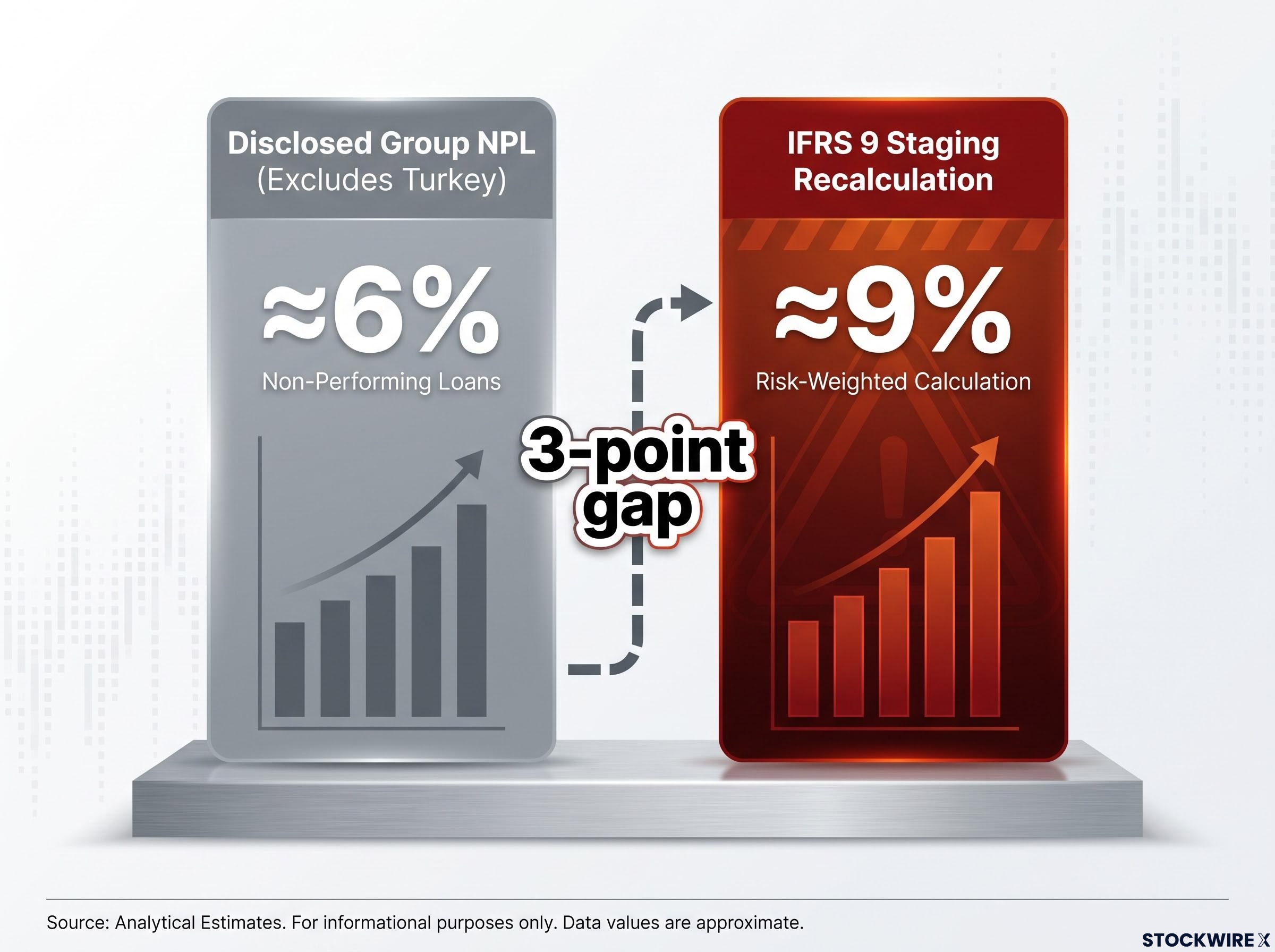
That three-point gap is not a rounding difference. It reflects methodological choices in how Stage 2 loans are handled, and it should factor directly into how you assess whether Kaspi is provisioning enough against future losses. In emerging-market consumer finance, the disclosed NPL ratio is usually the starting point for credit analysis, not the conclusion. Reading the staging methodology is what separates a surface look from an informed one.
| Approach | Scope | Implied ratio |
|---|---|---|
| Disclosed group NPL | Excludes Turkey | ~6% |
| IFRS 9 Stage 1/2/3 recalculation | Consistent staging treatment | ~9% |
Why the Turkey exclusion matters more from 2027
While Hepsi Bank operates at limited scale, leaving Turkey out of the headline ratio has modest near-term impact. That changes once the USD 300 million capitalisation is deployed and lending volumes grow, with shopping loans as the initial product from 2027.
At that point, Turkish credit performance becomes a genuine driver of group credit quality. The problem for investors is that current filings contain no Turkish NPL data at all, which means there is no baseline for Turkish borrower quality before the loan book scales. You will be watching the credit story develop without a reference point for what “normal” looks like.
What the emerging-market playbook says about where this goes next
Kaspi is not the first fintech to grow users in a high-inflation market ahead of its credit stress. The pattern is well documented, and looking at it lets you see the shape of what may be coming before it arrives in Kaspi’s numbers.
- Brazil: Large consumer-fintech players saw rapid card and account growth coincide with rising delinquencies and provisioning through inflationary and recessionary episodes. Higher cost of risk eventually revealed that headline user metrics were not translating into value.
- Argentina: Instalment credit attached to major e-commerce platforms was taken up strongly, but chronic inflation and peso depreciation forced repeated repricing and heavy provisioning, with segment profitability lagging user growth.
- Cross-border EM banking: Banks expanding into neighbouring high-inflation economies routinely reported impressive early customer acquisition, then recognised FX losses, rising NPLs, and regulatory stress in their segment notes.
Across these cases, stress becomes visible in a recognisable sequence rather than all at once. The order matters because it tells you where to look first.
- Segment-level ROE and cost-of-risk metrics turn first, showing the economics weakening before the headline does.
- Stage 2 balances grow, signalling early loan deterioration that has not yet hit Stage 3.
- Management guidance shifts toward “de-risking” and tightened underwriting language.
- Headline NPL ratios deteriorate, the last and most public indicator to move.
Apply that framework to Kaspi today. The 43%/23% user-revenue gap and the upward-trending NPL ratio are consistent with the early phase of this sequence, the part that precedes full recognition of credit stress. With Hepsiburada acquired in January 2025 and Hepsi Bank closed in July 2026, the Turkey cycle is still young.
The value here is a concrete watchlist. Rather than waiting for a headline NPL deterioration that historically arrives late, you can monitor Stage 2 balance growth, segment ROE, and cost-of-risk commentary, which is where the analytical edge in emerging-market fintech tends to sit.
Early credit stress signals follow a consistent sequence across consumer-lending markets: distressed debt exchange activity and tightening bank standards typically appear in the data months before NPL ratios move, which is precisely why monitoring Kaspi’s Stage 2 balance growth and cost-of-risk commentary matters more than waiting for the disclosed headline ratio to deteriorate.
What these fault lines mean for how investors should read the next 18 months
The bull case for Turkey is real and deserves a fair hearing. Turkey’s population is more than four times Kazakhstan’s, giving Kaspi a far larger addressable market. It has acquired an established e-commerce user base through its roughly 86.7-86.74% stake in Hepsiburada, and it now holds a banking licence through Hepsi Bank. That combination is genuine long-run optionality.
The Turkey rehabilitation trade thesis, in which investors re-enter at valuations discounted to worst-case assumptions and bet on orthodox monetary policy persisting, is the other side of the analysis here: it is a legitimate framework, but it applies to the equity market broadly rather than to Kaspi’s segment-level credit risk specifically, and conflating the two obscures where the real uncertainty sits.
The bear case is equally precise. The FX translation drag is structural rather than a single-quarter event. The revenue mix is shifting toward credit-sensitive income. And the NPL methodology gap means investors are working with a floor on credit risk, not a ceiling.
The transparency question The critical issue is not whether Turkey becomes a large market. It is whether Kaspi’s current disclosures give investors enough transparency to price the transition risk. Right now, they do not.
The USD 300 million Hepsi Bank capitalisation from 2027 is the event that turns Turkey from a marketplace play into a credit play. That is the fulcrum on which the whole analysis turns.
Three metrics to watch in upcoming Kaspi filings
- Whether Turkish segment revenue appears as a formal percentage in the next 6-K or annual report, rather than being inferred.
- Hepsi Bank’s initial loan staging data once origination begins in 2027, which will provide the first baseline for Turkish borrower quality.
- Whether the NPL ratio disclosure scope is revised to include Turkey.
Monitoring these triggers, rather than the headline user and revenue figures, is what will tell you whether the expansion is creating value or simply deferring credit recognition.
A compelling market, a fragile financial story
Three fault lines run beneath the headline expansion, and they are not equal in kind. The FX translation drag is structural. The revenue quality deterioration, marked by that 44% fee revenue decline, is underexplored and unexplained. And the gap between the disclosed 6% NPL ratio and the recalculated 9% is methodological, not marginal.
The bull case on market size and platform positioning is legitimate. But it is an argument about future optionality, not about current financials. The 43%/23% user-revenue gap makes that distinction impossible to ignore.
This analysis does not resolve whether Kaspi’s Turkey bet will succeed. It establishes something more useful: that the metrics currently disclosed do not let investors evaluate it responsibly, and that gap is itself a material finding.
The 2027 Hepsi Bank ramp-up is the fulcrum. The quality of Turkey-segment disclosures over the next two or three filing cycles will decide whether the growth story reasserts itself or the credit story takes over.
This article is for informational purposes only and should not be considered financial advice. Investors should conduct their own research and consult with financial professionals before making investment decisions. Past performance does not guarantee future results, and financial projections are subject to market conditions and various risk factors.