In September 2026, the Bank of Japan raised its policy rate to a 31-year high, and the Yen still fell.
That is not a glitch in the market’s wiring. It is the direct result of the gap between what the BoJ is doing and what the US Federal Reserve has already done. USD/JPY, the pair that tracks the dollar against the Yen, is the world’s most watched carry-trade barometer, and reading it means understanding how interest-rate differentials steer global capital.
After this, you will have a working mental model for why a central bank raising rates is not the same thing as a currency strengthening. You will also know what would actually need to change for the Yen to recover in a durable way, rather than a temporary bounce. The short version: watch the gap, not the headline.
The interest-rate gap that keeps the Yen trapped
Start with the numbers, because the logic falls out of them on its own. As of 18 September 2026, the BoJ policy rate sits at 1.25%, a 31-year high. As of 16 September 2026, the US federal funds target range sits at 3.75%-4.00%.
Subtract one from the other and you get a differential of roughly 250-275 basis points, according to LSEG data from September 2026. A basis point is one-hundredth of a percentage point, so that gap is about 2.5 to 2.75 full percentage points.
The gap between 1.25% and 3.75%-4.00% looks like a simple arithmetic problem, but central bank rate mechanics govern how that spread transmits through interbank lending costs, deposit rates, and ultimately asset prices across every major market simultaneously.
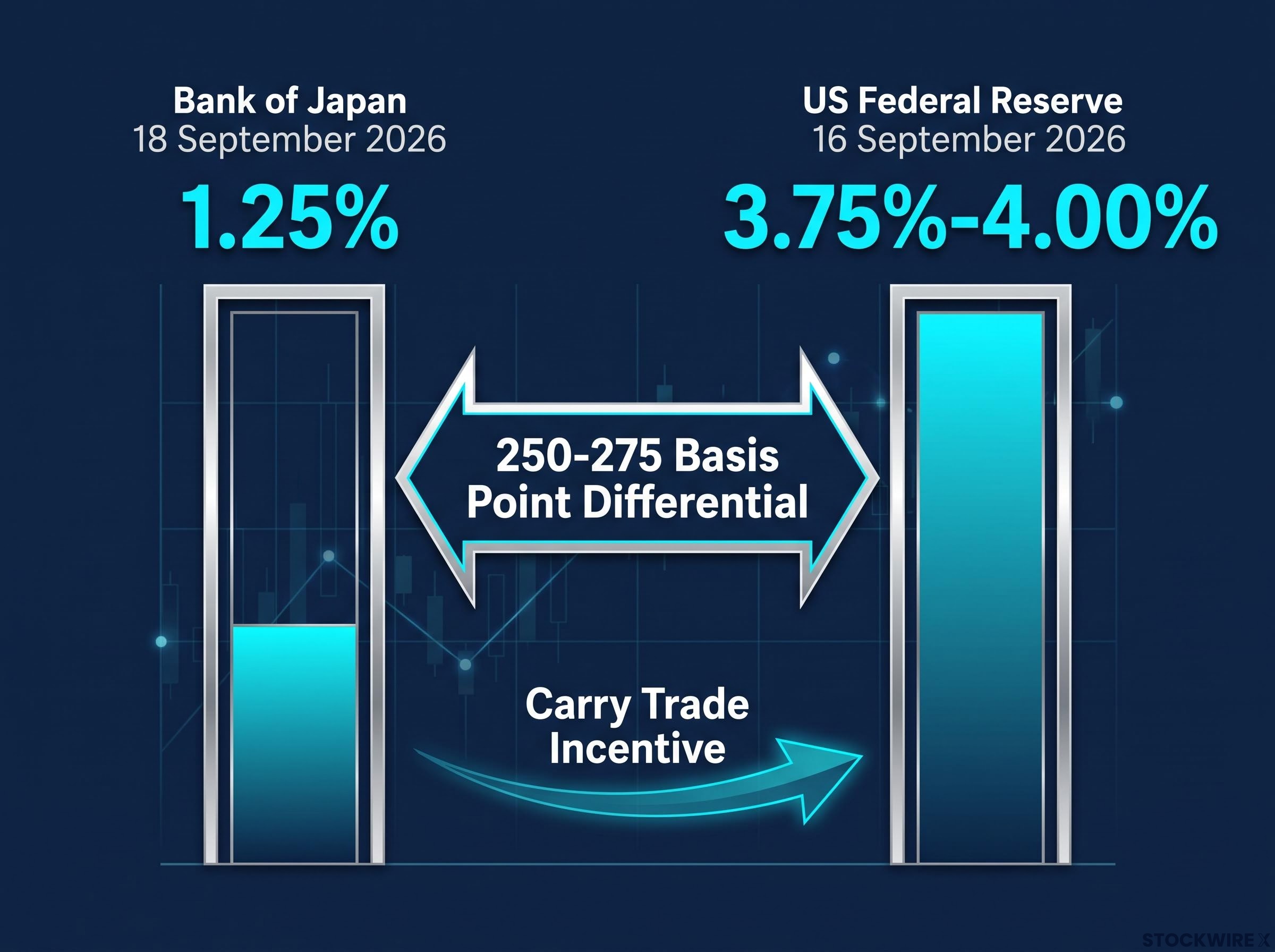
Now ask what a global investor does with that gap. Money borrowed in Yen costs very little. Money parked in US dollar assets, including Treasuries, earns considerably more. The incentive runs in one direction only.
That is the carry trade, and it is the engine of Yen weakness.
LSEG analysts noted that the policy-rate differential still provides “a meaningful incentive to fund positions in yen and invest in US dollar-denominated assets.”
The pull of US assets was reinforced by yields themselves. At the time of the source reporting, the 10-year US Treasury yield held around 5.25%, after an intraday peak of 5.34%, its highest reading since 2002. Higher yields make the dollar side of the trade even more rewarding.
| Central Bank | Current Policy Rate | Rate Since |
|---|---|---|
| Bank of Japan | 1.25% | 18 September 2026 |
| US Federal Reserve | 3.75%-4.00% | 16 September 2026 |
The point to hold onto is this. Even after the BoJ’s most significant tightening in three decades, the arithmetic still makes it rational to borrow in Yen and invest in dollars. Union Bancaire Privée (UBP) frames the Yen’s “core problem” as exactly this wide rate gap, which keeps carry trades attractive no matter how many small steps the BoJ takes.
Why carry trades make rate gaps a currency problem
The mechanics are simple. You borrow where rates are low, invest where rates are high, and pocket the spread between the two. When Yen funding is cheap and dollar assets pay more, that spread is worth chasing.
Every time an investor does this, they sell Yen to buy dollars, adding to the downward pressure. Scaled across global markets, that constant selling is why the Yen stays soft.
There is a sharp edge to it, though. When conditions shift suddenly, those trades unwind, investors buy Yen back fast, and the currency can strengthen violently in a short window. That is why USD/JPY doubles as a risk sentiment barometer, and why a crowded carry trade is a source of fragility as much as a source of weakness.
When big ASX news breaks, our subscribers know first
Why the Bank of Japan is moving so slowly
If closing the gap would fix the Yen, why does the BoJ not just hike faster? Because it is boxed in by four pressures operating at once, none of which it can simply ignore.
- Moderating inflation. LSEG analysts described Japanese inflation as “moderating rather than accelerating,” which removes the urgency for aggressive hikes.
- Fragile domestic demand. The economy is not yet robustly self-sustaining, so fast tightening risks real damage.
- Negative real rates. Even at 1.25%, real rates (the policy rate minus inflation) remain negative, meaning policy is still technically accommodative.
- Political and fiscal resistance. Japan’s Cabinet Office reportedly urged the BoJ to weigh the cumulative impact of prior rate increases before moving again.
These are not failures of nerve. They are competing claims on a difficult balance sheet.
The internal picture confirms it. At the very meeting that produced the September hike, two policymakers argued for staying patient, according to Reuters’ coverage. Gradualism is not just a market impression; it has formal support inside the Bank.
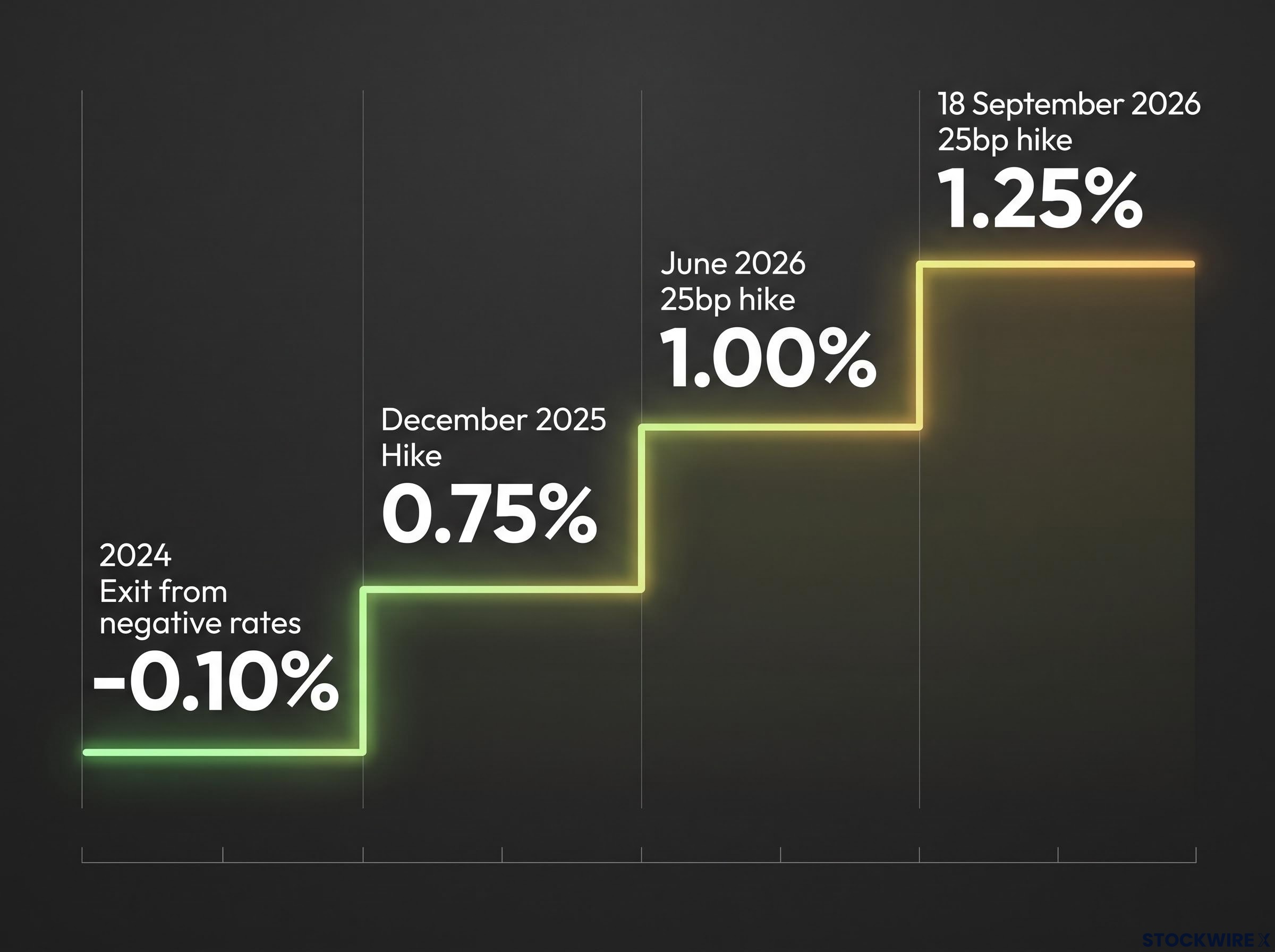
| Date | Policy Rate Decision | Rate Level |
|---|---|---|
| 2024 | Exit from negative rates | -0.10% |
| December 2025 | Hike | 0.75% |
| June 2026 | 25bp hike | 1.00% |
| 18 September 2026 | 25bp hike | 1.25% |
The real-rates paradox is the crux. The BoJ has travelled from -0.10% in 2024 all the way to 1.25%, a genuinely large move, yet because inflation has risen too, real rates are still below zero. In real terms, the Bank is still supporting the economy, not restraining it.
The data underneath this is mixed rather than booming. Japan’s Q3 2026 Tankan all-industries business conditions reading hit 21, a 35-year high, up from 18 in Q2. But firms expected the figure to slip back to 15 in Q4, signalling softer conditions ahead.
UBP’s own assessment is that BoJ rates should sit closer to 1.35%, implying at least one more 25-basis-point hike was warranted by October 2026. Even that view, which calls for more tightening, is a story of inches, not leaps.
The BoJ rate hike path to a projected 1.75% by April 2027 is complicated by a planned food consumption tax cut that could mechanically suppress headline CPI by up to 1.5 percentage points, meaning the Bank faces a closing window to build rate credibility before the distortion arrives.
What this means for you is straightforward. The BoJ is navigating a trap where moving too fast risks a domestic economy that cannot yet carry itself, so the gap with the Fed is unlikely to close quickly regardless of intentions. Weakness is the predictable output, not the anomaly.
What currency intervention can and cannot do
Here is where many readers expect the rescue. Japan intervenes, the Yen jumps, problem solved. In the short run, that story has some truth to it.
Intervention can move USD/JPY. Fitch Ratings identified coordinated US-Japan intervention, combined with credible hawkish communication from BoJ Governor Kazuo Ueda, as the conditions under which the pair moved toward Fitch’s end-2026 forecast of 156. When Tokyo and Washington act together and the central bank signals resolve, the currency responds.
Intervention works best under a specific set of conditions:
- Coordination with US authorities rather than unilateral action by Japan
- Credible, hawkish central bank communication alongside the operation
- A rapid depreciation that threatens financial stability, giving authorities a clear trigger
Notice what is missing from that list: anything that changes the carry trade itself. That is the limitation.
UBP captured the problem in the title of its own report, describing the situation as a “yen rescue that can’t beat fundamentals.”
Intervention is most accurately read as a ceiling on how far USD/JPY can run in the short term, not a durable reversal. It does not touch the rate differential, so the moment the pressure of an intervention fades, the same incentive to borrow Yen and buy dollars is still sitting there.
For investors wanting to separate genuine systemic stress from headline noise when carry trades reverse, our deep-dive into yen carry trade unwind diagnostics covers the three-question framework that routes attention toward position size, intervention coordination, and fundamental shift rather than short-term price moves.
Verbal intervention and the Takaichi ceiling
Authorities do not always need to spend a single Yen to move the market. Verbal warnings function as soft intervention. By injecting uncertainty about when real action might follow, officials raise the cost of holding speculative short-Yen bets.
That dynamic was live in early October 2026. Prime Minister Sanae Takaichi stated publicly that the Yen’s current undervaluation was a problem, and traders grew reluctant to push USD/JPY above an intraday high near 158.44. On 1 October 2026, the pair traded in a 157.56-158.22 range and closed near 157.56-158.01, retreating from its peak without any confirmed Yen-buying operation taking place.
For you, the practical read is this. Watching for intervention signals, verbal warnings and official statements on currency levels, is useful as a tactical gauge of short-term ceilings. It tells you almost nothing about the structural direction, which stays governed by the rate gap from section one.
What would actually change the Yen’s structural trajectory
So what would it take for the Yen to recover for real? The honest answer is a genuinely open question, shaped by the same differential that has driven everything so far.
The base case among most analysts is continued weakness. LSEG’s summary is blunt on this point.
LSEG analysts concluded that “the structural case for a relatively weak yen remains intact,” given the rate gap, moderating inflation, and fragile domestic demand.
UBP reaches a similar place from a different angle: as long as carry trades stay attractive and Japanese real rates stay negative, the Yen is vulnerable, particularly if the Fed holds its rate high and delays cuts. The FOMC held at 3.75%-4.00% as of September 2026, and July 2026 minutes pointed to sustaining a restrictive stance until inflation is durably at target. The evidence that incremental BoJ moves are not enough is already on the record: even after the hike to 1.25%, Reuters noted the Yen weakened to a two-week low.
There is a credible counter-narrative, though. Fitch Ratings argues that rate differentials, taken in isolation, would actually “imply a stronger yen against the dollar,” and that market positioning and structural factors are also at work. On that reading, some of the Yen’s weakness is sentiment-driven, which means it could correct faster than the rate arithmetic alone suggests. Fitch does judge a return to 2019 USD/JPY levels unlikely.
These are the variables worth tracking:
- The pace of future BoJ hikes, with UBP arguing at least one more 25-basis-point move was warranted by October 2026
- The US inflation trajectory and Fed guidance, which determine when the gap might narrow from the American side
- Whether any further intervention is coordinated with the US Treasury rather than unilateral, since coordination is what gives it real force
The takeaway is calibrated, not predictive. The Yen’s recovery is less about whether the BoJ wants to tighten and more about whether the differential narrows fast enough to kill the carry incentive, which depends on factors outside the BoJ’s direct control.
A stronger Yen requires more than a determined central bank
Step back and the three forces in this article stop looking like separate problems. The rate gap, BoJ gradualism, and the limits of intervention are a single system, each one reinforcing the others. The gap creates the carry incentive, gradualism keeps the gap open, and intervention can cap the symptom without touching the cause.
That is why a stronger Yen is a checklist, not a single lever. Even Fitch’s relatively optimistic end-2026 forecast of 156 is conditional, requiring coordinated intervention and hawkish BoJ signalling to work together. The BoJ’s own benchmark for faster normalisation, the sustainable achievement of its 2% inflation target, has not been decisively met.
The 250-275 basis-point differential is the structural anchor, and it would need to compress materially for the Yen’s condition to change.
For readers wanting a sharper picture of where institutional forecasts diverge on the yen, our full explainer on the Japanese yen outlook examines the State Street versus J.P. Morgan split, GPIF repatriation mechanics, and the coordinated US-Japan intervention record that shapes the bull case.
The durable insight is simple enough to carry into the next headline. Track the gap between the two central banks’ rates, not the absolute level of either rate on its own, because the gap is what drives carry flows and therefore currency direction. The rate differential is the signal, intervention is the noise, and gradualism is the constraint.
This article is for informational purposes only and should not be considered financial advice. Investors should conduct their own research and consult with financial professionals before making investment decisions. Past performance does not guarantee future results, and financial projections are subject to market conditions and various risk factors. These statements are speculative and subject to change based on market developments.