
HUB24‘s price-to-sales ratio sits at 20.65x, roughly 55% above its five-year historical average of 13.32x. Yet the share price hovers only about 10.6% above its 52-week low. That gap between a stretched valuation multiple and a subdued share price is the analytical puzzle worth unpacking. For Australian investors evaluating ASX growth stocks, wealth management platforms like HUB24 occupy an unusual space: profitable, recurring-revenue businesses with genuine structural tailwinds that nonetheless carry multiples most value screens would reject outright. Understanding what drives that premium, and whether it holds up under scrutiny, matters more now that broad multiple re-rating across the market has stalled. This article walks through what HUB24’s current P/S ratio actually signals, what the business fundamentals and competitive moat contribute to the case, and how to frame valuation multiples as one input among several rather than a verdict in isolation.
ASX growth stock discounts and premiums do not exist in isolation from global repricing cycles; Morningstar data from March 2026 showed growth equities trading at a 21% discount to fair value, a level recorded less than 5% of the time since 2011, which provides context for why broad multiple re-rating across the market has stalled.
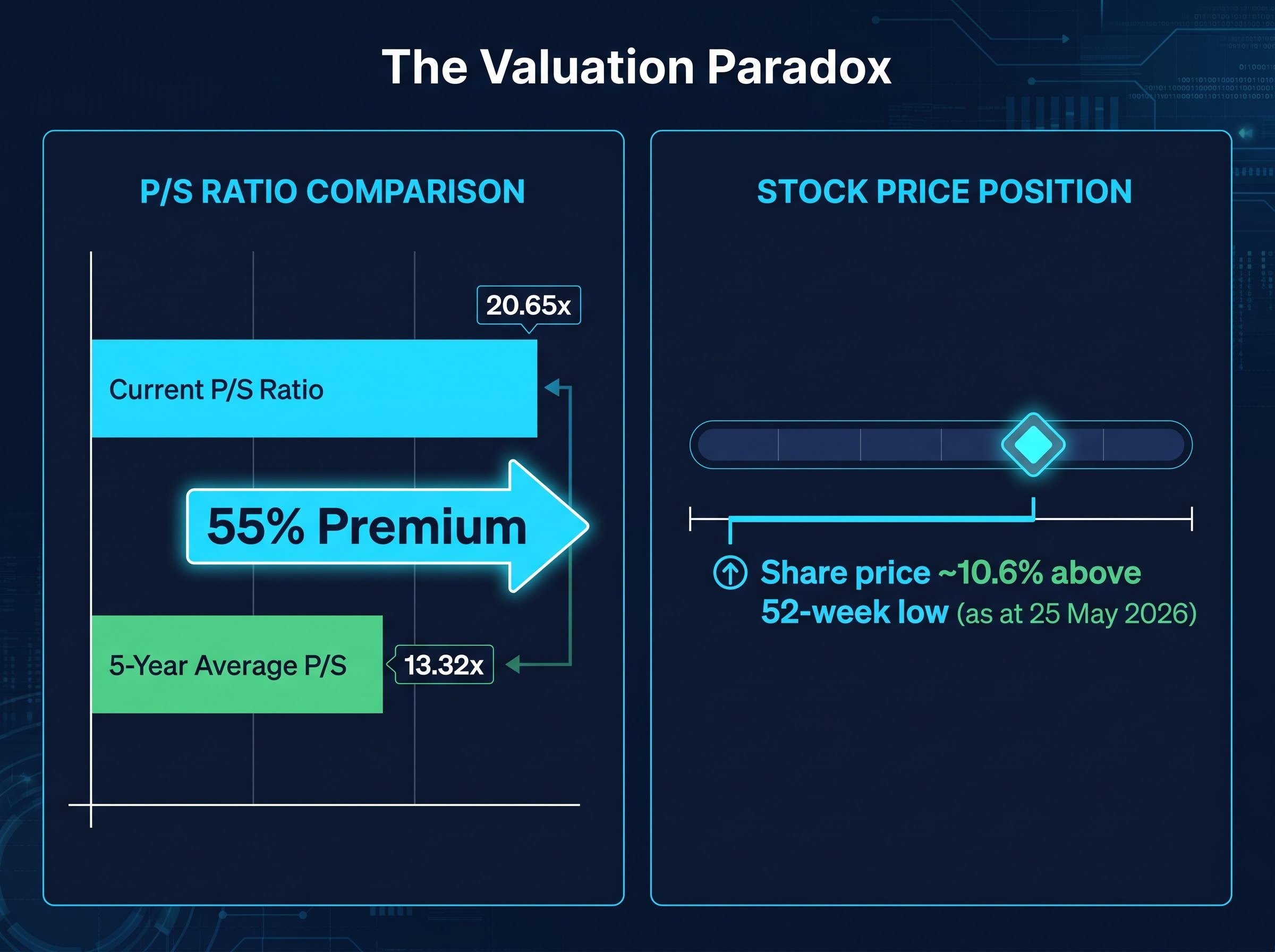
What a 55% premium to historical average actually tells you
The number looks alarming on first pass. A 55% premium to a five-year average implies the market is paying materially more per dollar of revenue than it has at any sustained point in HUB24’s recent history, and that alone is enough to trigger a sell signal on most screening tools.
But a premium to historical average is a question, not an answer.
Price-to-sales ratio measures a simple relationship between two variables:
- Market capitalisation: the total value the market assigns to all outstanding shares
- Trailing twelve-month revenue: the total revenue the business generated over the prior twelve months
The ratio tells you how much the market is willing to pay for each dollar of revenue. P/S is often a more appropriate lens for growth companies than price-to-earnings, because earnings can be distorted by reinvestment, depreciation schedules, and one-off charges, while revenue captures top-line momentum more cleanly.
HUB24’s current P/S ratio of 20.65x compares with a five-year historical average of 13.32x, a premium of approximately 55%.
That premium could reflect a genuine re-rating of the business’s growth quality, a recognition by the market that HUB24’s revenue trajectory has structurally improved. Or it could reflect temporary overreach. The number alone cannot distinguish between those two readings. What follows is the analysis that can.
When big ASX news breaks, our subscribers know first
The business behind the multiple: what HUB24 actually does and why its revenue model matters
HUB24 operates three integrated products. The HUB24 platform provides investment administration and portfolio management for financial advisers and their clients. Class handles self-managed super fund (SMSF) administration. myprosperity delivers client-facing digital portals for personal wealth management. Together they form an ecosystem rather than three standalone offerings: advisers build workflows, compliance reporting, and client portals across all three, creating a unified technology stack for their practice.
That ecosystem structure matters for valuation. It means revenue is not earned from one-off transactions or project delivery. It is earned from ongoing platform fees tied directly to growing funds under administration (FUA) balances.
| Metric | H1 FY26 | Year-on-year growth |
|---|---|---|
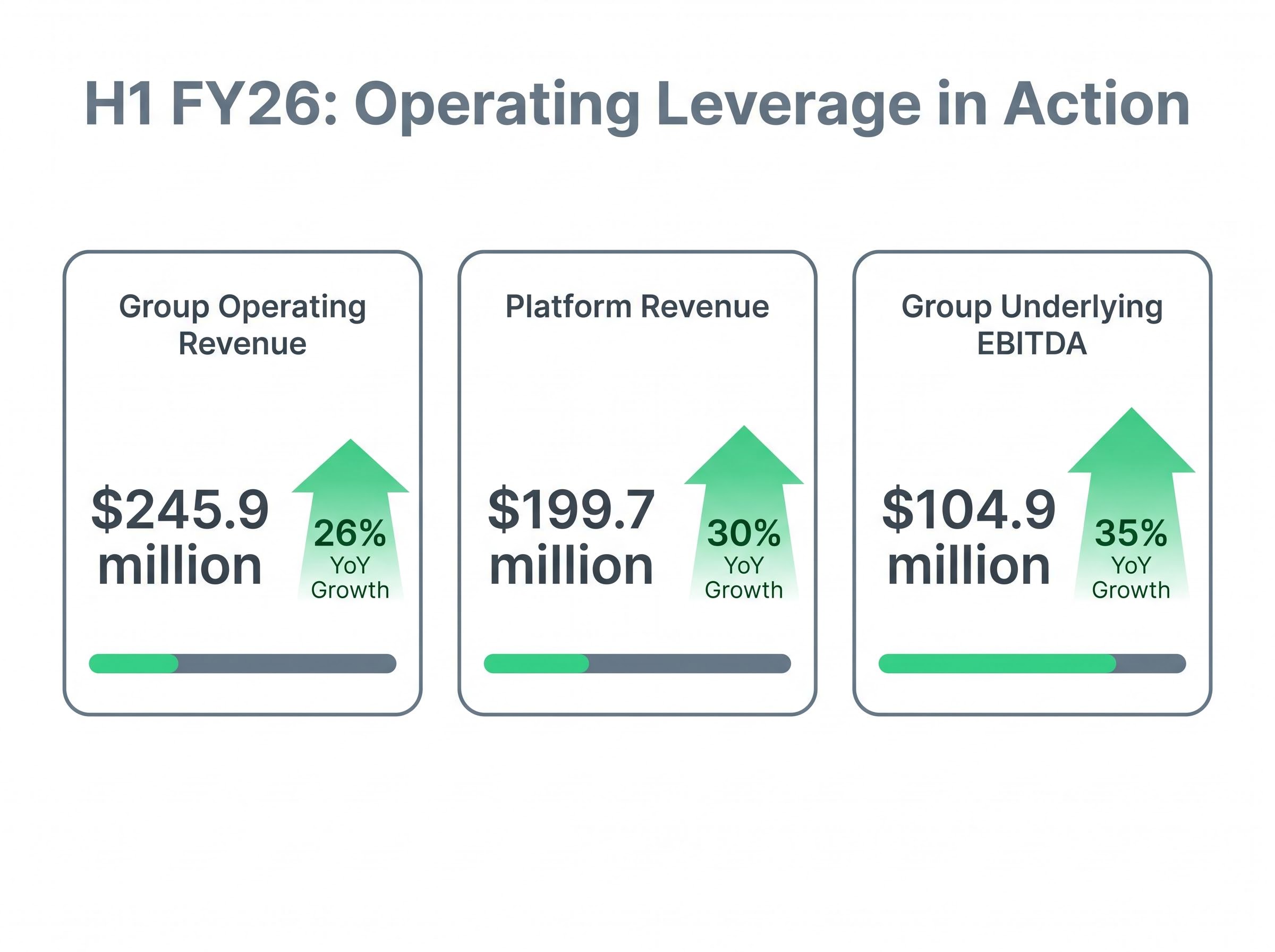
| Group operating revenue | $245.9 million | 26% |
| Platform revenue | $199.7 million | 30% |
| Group underlying EBITDA | $104.9 million | 35% |
Why recurring revenue changes the valuation calculus
The table above contains a signal that matters more than any single line item: EBITDA grew at 35% while revenue grew at 26%. That gap is operating leverage in practice. As FUA grows, platform revenue grows proportionally, but the cost base does not scale at the same rate. Each additional dollar of FUA generates incremental revenue at a higher margin than the last.
This is why a 20.65x P/S multiple on a capital-light, recurring-revenue platform business cannot be compared directly to the same multiple on a company with project-based or inventory-dependent revenue. The revenue quality is structurally different. Platform FUA reached $127.8 billion as at 31 March 2026, providing the base from which that leverage compounds.
SaaS valuation benchmarks like the Rule of 40, which combines a company’s revenue growth rate with its profit margin into a single score, help contextualise why capital-light, recurring-revenue platforms command materially higher revenue multiples than businesses with project-based or inventory-dependent revenue structures.
Competitive positioning as a moat: adviser satisfaction, brand reputation, and switching costs
A premium multiple demands a premium franchise. The evidence for HUB24’s competitive moat is specific and measurable rather than asserted.
HUB24 was named Overall Best Platform in the Adviser Ratings 2024 Financial Advice Landscape Report. It achieved strong rankings for Overall Satisfaction and Brand Image in the Wealth Insights 2024 Platform Service Level Report. Morningstar assigns the company a narrow moat rating, meaning it identifies structural competitive advantages that are expected to persist for at least a decade, though not indefinitely.
The moat expresses itself in inflow numbers. In Q2 FY26 (October to December 2025), HUB24 reported record net inflows of $5.6 billion. Q3 FY26 net inflows were $4.0 billion, up 9% on the prior corresponding period excluding large migrations. Platform FUA grew 25% year-on-year as at 31 March 2026.
Q2 FY26 delivered record net inflows of $5.6 billion, the strongest quarter in HUB24’s history.
The switching-cost dynamic strengthens the picture. Advisers who build compliance workflows, data feeds, client portals, and reporting across HUB24’s integrated ecosystem face real friction in migrating to a competitor. That friction underpins the recurring-revenue assumption that supports the multiple.
Key moat indicators in summary:
- Adviser satisfaction: Overall Best Platform (Adviser Ratings 2024), strong rankings (Wealth Insights 2024)
- Sustained above-system net inflows across consecutive quarters
- Integrated ecosystem creating measurable switching costs
- Morningstar narrow moat rating
The structural tailwinds driving HUB24’s growth runway
Much of HUB24’s trajectory is being carried by forces larger than any single platform. Three structural tailwinds, ordered by magnitude, underpin the growth runway:
- Legacy FUA migration. Australian financial press and industry commentary consistently identify the ongoing migration of funds under administration from bank-owned and institution-linked legacy platforms to independent, open-architecture platforms like HUB24 and Netwealth. This transition still has years to run, given the scale of FUA remaining on older systems.
- Quality of Advice Review reforms expanding the addressable market. The government’s response to the Quality of Advice Review continued to progress through 2024-2025, with proposed changes aimed at reducing documentation burdens on advisers and enabling technology-driven advice delivery.
- Adviser professionalisation driving platform switching upward. After years of adviser exits following the Royal Commission, numbers have stabilised. Remaining advisers increasingly target higher-balance clients and invest in practice technology, favouring platforms with superior functionality over pure price competition.
What the Quality of Advice Review means for platforms
The mechanism is specific. Reduced documentation requirements lower the cost of delivering advice. Technology-enabled advice provisions allow broader institutional provision of simple financial guidance. Both expand the pool of FUA that could flow through modern platforms. For HUB24, which has invested heavily in integrated workflow tools, compliance reporting, and digital client portals, the reforms are positioned to benefit platforms with scalable infrastructure already in place.
The Australian Treasury’s Quality of Advice Review response confirms that the Delivering Better Financial Outcomes package targets reduced documentation requirements and expanded technology-enabled advice delivery, changes that structurally increase the pool of FUA flowing through modern platforms with scalable compliance infrastructure already in place.
Where the caution is warranted: rate sensitivity, de-rating risk, and the limits of P/S analysis
The preceding sections built the case for a premium. Intellectual honesty requires equal attention to the conditions under which that premium unravels.
Higher interest rates structurally compress valuations for long-duration growth stocks. The mechanism is straightforward: when rates rise, the discount rate applied to future earnings increases, reducing the present value of the earnings stream that justifies a high multiple today. HUB24 is a profitable compounder, not a loss-making speculative name, but it is not immune to this force.
Morningstar has warned that further multiple expansion is less likely in a higher-rate environment and that investors should be cautious about extrapolating past years’ re-rating.
The AFR has separately flagged that any meaningful slowdown in net inflows could trigger a sharp de-rating, given how much of the valuation rests on sustained growth assumptions.
Multiple compression risk is particularly acute for platform businesses because broker consensus buy ratings tend to lag the price action, meaning the technical warning signals often appear months before analysts revise their targets downward, as occurred across ASX SaaS stocks during the September to December 2025 sell-off.
Q3 FY26 provided a taste of what market headwinds look like in practice. Negative market movements of $4.1 billion offset the quarter’s $4.0 billion in net inflows, leaving platform FUA broadly stable quarter-on-quarter despite strong organic activity. The share price sitting approximately 10.6% above its 52-week low (as at 25 May 2026) is a further signal that the market is not uniformly bullish.
Key risk factors:
- Rate sensitivity compressing the present value of future earnings
- De-rating risk if net inflow momentum slows
- Market volatility offsetting organic FUA growth, as seen in Q3 FY26
- Share price proximity to 52-week low indicating cautious market sentiment
Past performance does not guarantee future results. Financial projections are subject to market conditions and various risk factors.
How to use valuation multiples without being fooled by them
The P/S ratio is a screening tool, not a verdict. It identifies whether a stock deserves closer scrutiny. It does not tell an investor whether to buy or sell.
A four-metric valuation framework covering revenue trajectory, profit expansion trend, return on equity direction, and operating leverage provides a more structured lens for platform businesses where trailing price-to-earnings ratios are distorted by reinvestment cycles and depreciation schedules.
The analytical framework that emerges from broker and industry commentary suggests a three-step approach for platform businesses carrying elevated multiples:
- Identify what drives revenue and whether it is recurring. A high P/S on project-based revenue carries different risk to a high P/S on fee-based, FUA-linked revenue. The business model determines whether the multiple is structurally supported.
- Assess whether the competitive moat supports the growth trajectory. Adviser satisfaction rankings, sustained above-system net inflows, and ecosystem switching costs are the qualitative evidence that the recurring-revenue assumption holds.
- Monitor the leading indicator, not the static multiple. For platform businesses, net inflow trajectory is the single most important forward-looking metric. The P/S ratio tells you where the market prices the stock today; net inflows tell you whether the growth that justifies that price is accelerating, stable, or fading.
The metrics that matter more than the headline ratio
Net inflow trajectory reveals demand momentum. Operating leverage (EBITDA growing faster than revenue) reveals margin expansion. FUA growth rate reveals compounding scale. Together, these three signals make a P/S multiple legible rather than abstract.
As Stockhead’s sector analysis noted, not all high P/S multiples are created equal: profitable compounders with recurring revenue and dominant market positions sit in a fundamentally different category to loss-making growth names trading on future promise alone. The five-year average of 13.32x serves as a relative benchmark for HUB24’s own history, not an intrinsic value anchor.
For investors seeking to move beyond screening, discounted cash flow or dividend discount model analysis represents the logical next step in building a full valuation view.
The premium is real, but so are the conditions that would end it
HUB24’s 55% premium to its historical P/S average reflects genuine business quality: recurring, fee-based revenue growing at 30% year-on-year, EBITDA margins expanding through operating leverage, a measurable competitive moat in adviser satisfaction and switching costs, and structural industry tailwinds with years still to run. This is not speculative froth applied to a loss-making concept.
The premium is conditional, however, not permanent. It holds as long as net inflows remain strong, operating leverage continues to materialise, and legacy FUA migration persists. A sustained slowdown in any of these would challenge the growth assumptions the multiple encodes.
Investors evaluating HUB24 or comparable growth stocks on the ASX are not simply buying today’s revenue multiple. They are making a judgement about how long the growth runway extends and whether the competitive moat will hold across that runway. The P/S ratio frames the question. The analysis above provides a structure for answering it.
This article is for informational purposes only and should not be considered financial advice. Investors should conduct their own research and consult with financial professionals before making investment decisions.