Roughly 60% of contractors reported at least one project cancellation in 2026, a notable jump from the year before. That is not the texture of a routine soft patch. It is a signal that something has shifted in how home improvement projects are being funded, approved, and actually started.
Citi analysts spent two days in Minneapolis at the HIRI Home Improvement Insights Summit on 29-30 September 2026, and the consensus they brought back was blunt: demand is expected to stay stagnant for the next 12 months, with the risk of that drag extending into 2027.
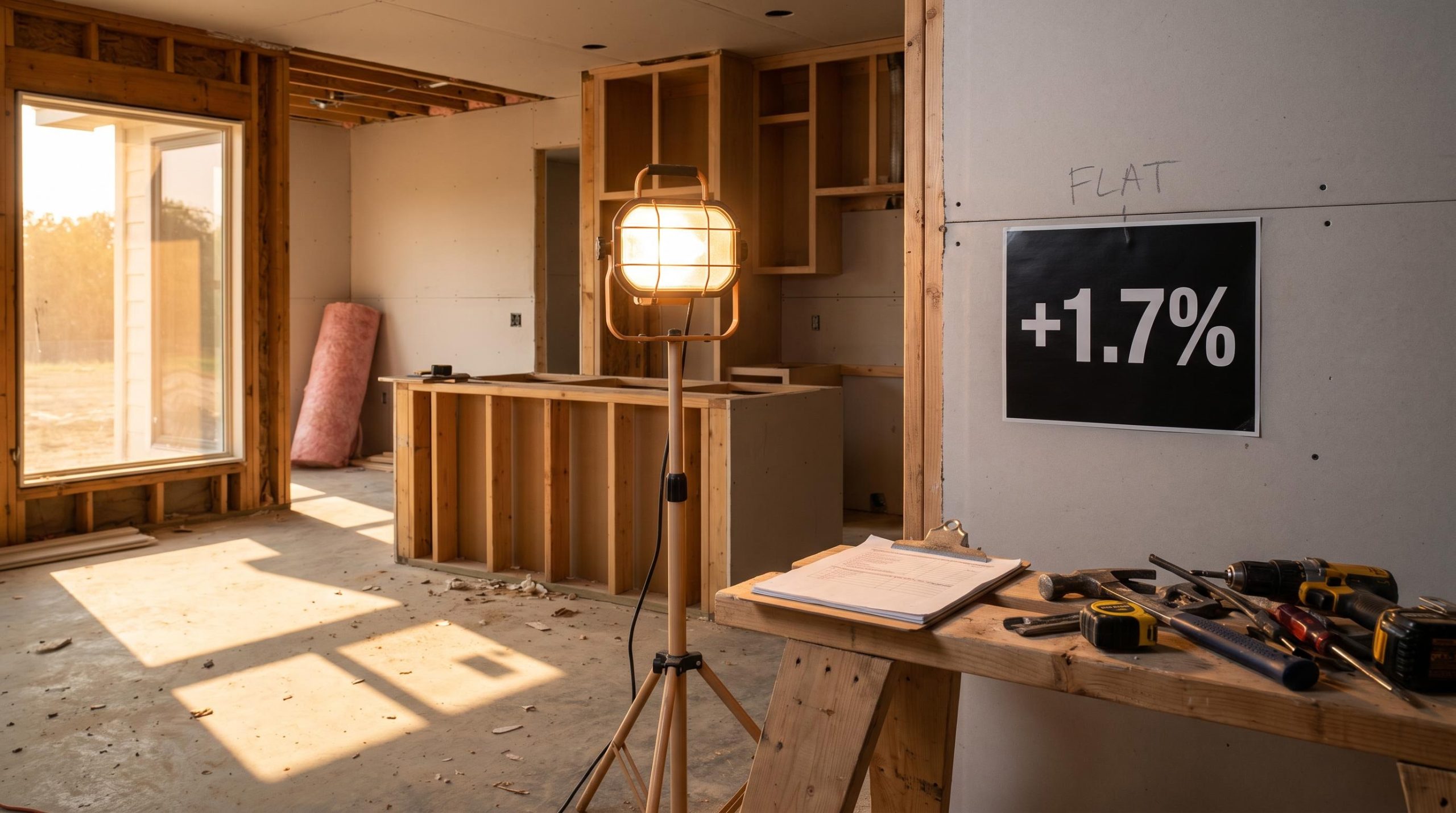
The retailer numbers tell the same story from a different angle. Home Depot just posted plus-1.7% comparable sales for Q2 fiscal 2026, its best in years. Lowe’s managed plus-0.2%. These are not collapse figures. But they are not recovery figures either.
That gap, between “not collapsing” and “actually recovering,” is exactly where the investor decision sits. This analysis separates the near-term headwinds likely to persist through 2027 from the structural supports that make the longer-horizon recovery thesis credible, so you can assess what you are actually waiting for if you hold Home Depot, Lowe’s, or adjacent equities today.
What the Q2 2026 numbers are actually telling investors
Read the two sets of results side by side and a single picture emerges, not two separate scorecards. Both retailers are operating well below their structural potential, and the comparable-sales line is where that shows up most clearly.
Comparable sales strip out new store openings and currency effects to show whether existing stores are genuinely selling more. That is the number that reveals underlying demand, and on that measure the sector is barely moving.
Home Depot’s $47.9 billion in Q2 total sales was up 5.7% year on year, which looks healthy until you notice the comp was just plus-1.7% overall and plus-1.3% in the US. The headline growth is being carried by factors other than existing-store demand.
Home Depot investor relations materials for Q2 fiscal 2026 confirm the $47.9 billion total sales figure and the flat-to-up-2% full-year comparable-sales guidance range that management reaffirmed alongside its characterisation of frozen housing market conditions.
| Retailer | Q2 Comparable Sales | Q2 Total Sales | Full-Year Comp Guidance | Key Management Characterisation |
|---|---|---|---|---|
| Home Depot | +1.7% (US +1.3%) | $47.9B (up 5.7%) | Flat to up 2% (reaffirmed) | “Frozen housing market conditions”; customers favour small projects |
| Lowe’s | +0.2% | $26.0B (up from $24.0B) | Revised down to flat | “Persistent DIY macro pressures” offsetting Pro strength |
What makes the 1.7% figure worth pausing on is the context from Home Depot CFO Richard McPhail.
CFO context Home Depot’s plus-1.7% comparable-sales gain is the strongest since fiscal Q3 2022, achieved, in the company’s own framing, under “frozen housing market conditions.”
When a sub-2% comp counts as the best result in nearly four years, the sector’s baseline has clearly reset. The big pandemic-era projects are done, and what remains is a slower, maintenance-led demand profile.
Lowe’s sharpens that read. Its full-year outlook was trimmed to $92.0 billion, the bottom of its prior range, and comparable-sales guidance was cut from flat-to-up-2% all the way down to flat. Yet online sales jumped 15.7% in the quarter.
That combination tells you something specific. Spending is fragmenting into smaller, more transactional online purchases rather than returning to the large, committed projects that drive meaningful comp growth. Pro and home services held up; the DIY homeowner did not.
For anyone weighing an entry point, these numbers define the floor of the recovery, not the ceiling. The more telling detail is what is absent: neither retailer committed to a single 2027 figure. What is left out of guidance matters here as much as any beat or miss.
When big ASX news breaks, our subscribers know first
How a frozen housing market turns retail resilience into investor frustration
The sector’s problem is not retail execution. It is a pipeline problem, and it starts upstream of the stores entirely.
When people stop moving house, they stop commissioning large remodels. CNBC’s coverage of Home Depot’s quarter described exactly this, noting the retailer “did not see customers returning to big projects” amid “frozen housing market conditions.” Fewer transactions mean fewer kitchens torn out, fewer extensions started, fewer high-ticket jobs that move the comp line.
The 10-year Treasury yield near 5% is the mechanism behind frozen housing market conditions that Home Depot’s own CFO has flagged, because mortgage rates track long-end Treasury yields rather than the Fed funds rate, meaning Fed cuts alone cannot unlock the transaction volumes the sector needs.
That does not mean spending stops. It changes shape. Homeowners staying put keep doing the necessary upkeep, repairs, maintenance, the jobs that cannot wait. That sustains some revenue. It does not deliver the project mix that drives growth.
The HIRI Summit survey data puts numbers on the decision happening at kitchen tables across the country. Roughly one-third of homeowner projects are currently being postponed or scrapped, according to a homeowner survey cited at the summit.
Demand weakness is not confined to home improvement: big-ticket consumer durables across the broader sector are under pressure, with Whirlpool’s North American operating profit collapsing 96% in Q1 2026 as its CEO characterised conditions as comparable to the 2008 financial crisis, a read that reinforces the idea that homeowner caution runs well beyond housing-specific sentiment.
The contractor signal Around 60% of contractors reported at least one project cancellation, a notable rise on the prior year, according to a contractor survey referenced at the HIRI Summit.
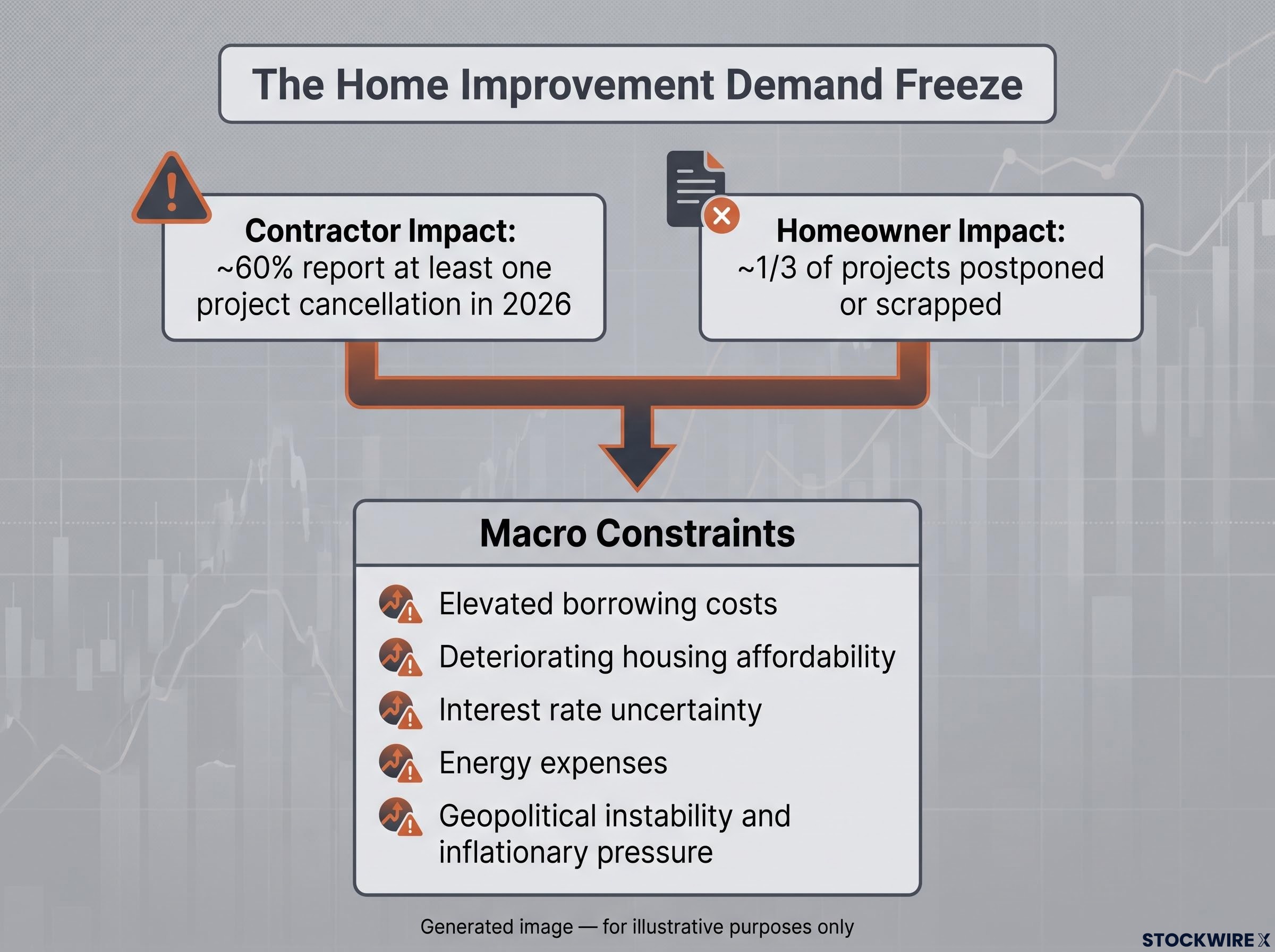
A rising cancellation rate matters more than a slow one. It tells you the pipeline is not merely sluggish, it is actively being dismantled at the point of commitment. A demand recovery therefore requires a reversal in homeowner decision-making, not just more foot traffic through the stores.
Citi’s analysts attributed the freeze to a stack of macro constraints, not a single trigger.
- Elevated borrowing costs, making financed projects more expensive to justify
- Deteriorating housing affordability, keeping transaction volumes low
- Interest rate uncertainty, discouraging commitment to large spend
- Energy expenses, squeezing discretionary household budgets
- Geopolitical instability and inflationary pressure, feeding general caution
This is why Lowe’s guidance cut should be read as a behavioural story rather than a retailer-specific stumble. The DIY customer pulled back while Pro and home services held firm, which is precisely what you would expect when the constraint is homeowner confidence and financing, not store performance.
The practical takeaway for positioning is that the recovery trigger sits outside the retailers themselves. Tracking housing transaction volume and the mortgage-rate path will give you earlier warning of a turn than waiting for a comparable-sales figure to inflect.
The structural case for the sector, and why it is not a 2026 story
Underneath the freeze sits a genuinely favourable long-run setup. The structural supports are real, well-documented, and worth understanding before deciding whether to stay engaged with the sector.
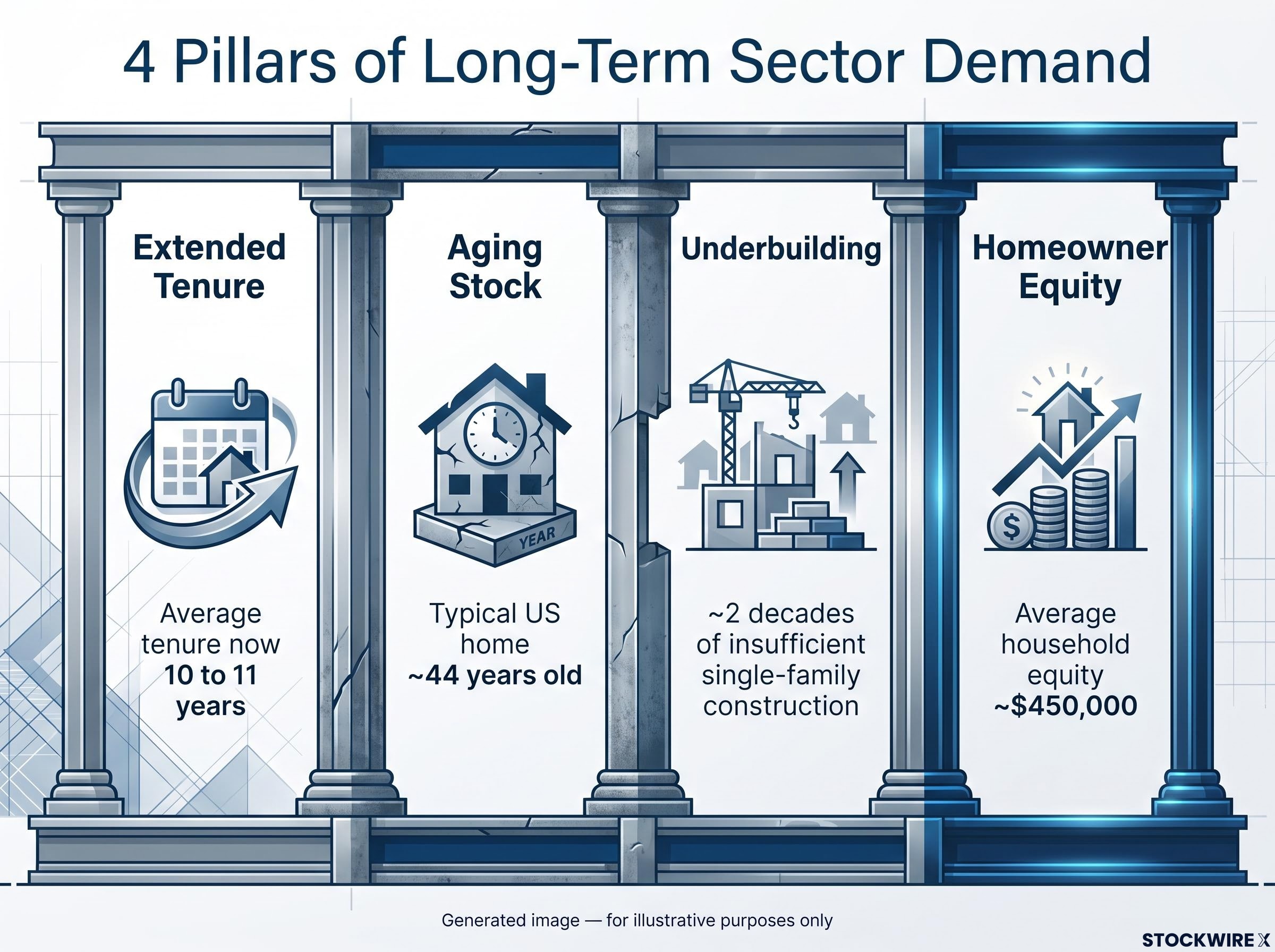
There are four, and they compound over time rather than arriving as a single catalyst.
- Extended homeowner tenure. Americans are staying in their homes longer, which tends to lift renovation and maintenance spending over the years. The average tenure is now roughly 10 to 11 years, up from a prior norm nearer seven to eight. (This tenure figure is an unverified estimate and should be treated as indicative rather than confirmed.)
- Aging housing stock. Older homes generate more maintenance and repair demand simply by existing. The typical US home is estimated at around 44 years old on average. (Also an unverified estimate; treat with appropriate caution.)
- Structural underbuilding. The US has run roughly two decades of insufficient single-family construction, which supports long-term demand fundamentals.
- Substantial homeowner equity. Average household equity sits at approximately $450,000, a large latent pool of potential spending capacity. (This figure is an unverified estimate and should be read as directional.)
The underbuilding point carries the most analytical weight because it came from a credible source rather than a survey estimate.
The relationship between the housing market and economy is less tightly coupled than historical cycles suggest: housing’s direct GDP contribution has shrunk to the low single digits from a pre-GFC peak near 6.5%, which is part of why retailer resilience and broader economic stability can coexist with a demand freeze in renovation spending.
On structural underbuilding Roughly two decades of insufficient single-family housing construction underpins long-term demand, according to a National Association of Home Builders economist cited at the HIRI Summit.
Here is the tension you need to hold. These supports are real, but they are not investable on a 2026 timeline. The clearest evidence of that is management’s own guidance.
If Home Depot and Lowe’s genuinely expected structural tailwinds to show up soon, you would see it in the forecasts. Instead you get flat-to-up-2% comps at Home Depot and a revised flat comp at Lowe’s. Insiders are not pricing these forces into the near term.
Consider the gap between $450,000 in average equity and flat comp guidance. That equity is a latent resource, not an active one. Homeowners hold the collateral; they lack the confidence or the incentive to commit it to major projects while rates stay elevated. The structural case is the reason to stay engaged, but treating it as a near-term catalyst is how investors end up sitting in underperformance longer than they planned.
What the HIRI Summit outlook means for how investors should frame 2027
Move from what is happening to what to do with it. The summit gives you a baseline expectation, and the two retailers give you two different reads on conviction.
The summit consensus Economists at the HIRI Summit broadly expect demand to remain stagnant over the 12 months following the 29-30 September 2026 event, which runs to roughly late 2027. No reviewed source projected a sharp near-term inflection.
The two management postures diverge in a way that is worth reading closely. Home Depot reaffirmed its range of 2.5% to 4.5% total sales growth and flat-to-up-2% comps, a cautiously optimistic stance. Lowe’s moved to the bottom of its range at $92.0 billion with flat comps, a more risk-aware one.
Neither is a bullish signal. One is “steady as she goes,” the other is “we are bracing.” Both imply the same underlying expectation: no dramatic turn this year.
Lowe’s 15.7% online growth and its resilient Pro segment are the bridge revenue holding the business together while the DIY homeowner waits for a macro unlock. They cushion the business; they do not replace the high-ticket demand the sector needs.
What should you actually watch? Three variables will decide whether 2027 delivers a recovery or another year of drift.
- Housing transaction volume. More moves mean more large remodels. This is the single clearest leading indicator of a demand turn.
- Mortgage rate trajectory. A sustained decline in the 30-year fixed rate is what would thaw both transactions and financed projects.
- Pro segment durability. Pro and services are the bridge revenue; if that weakens, the floor under the sector moves lower.
The most revealing detail in the August 2026 materials is a silence. Neither Home Depot nor Lowe’s offered any formal numeric 2027 guidance.
That absence is itself information. Management is not confident enough in the trajectory to commit to forward numbers, which means that buying the sector today is buying a thesis, not a guidance range. Size accordingly, monitor the right indicators, and do not be surprised if 2027 looks more like 2026 than the consensus recovery narrative suggests.
Positioning in a sector where the recovery thesis is real but the timing is not
Strip the analysis down and the core tension is clean. The structural supports are real and well-documented. The near-term catalysts are absent or entirely macro-dependent. And management guidance from both retailers confirms that insiders are not expecting a sharp inflection through 2026.
This makes the investor decision a timeline question, not a quality question. The sector’s eventual recovery is not in serious dispute. Whether it becomes earnings-visible in 2027 or later depends on housing turnover and the rate environment, variables that sit outside the retailers’ control.
For an investor holding Home Depot or Lowe’s today, the honest framing is that you are paying for a recovery the companies themselves have not guided to yet. That makes the indicators outside the income statement the most important things to track.
A more constructive stance would be warranted on a few specific, observable triggers:
- A material, sustained improvement in existing home sales volume
- A durable decline in the 30-year fixed mortgage rate
- Evidence that DIY comparable-sales trends are inflecting positively at either retailer
Note that current mortgage-rate and existing-home-sales figures were not part of this research package, so these are indicators to source and track independently rather than numbers quoted here.
For investors sourcing current mortgage rate and home sales figures independently, our deep-dive into the tariff data lag affecting housing indicators explains why every housing, confidence, and price reading published before October 2026 should be treated as a pre-tariff baseline, a critical caveat when interpreting any data pulled to track the recovery signals outlined above.
In the meantime, Lowe’s Pro segment and online channel remain the most defensible near-term revenue streams in the sector. The framework that matters is the distinction between “the recovery thesis is intact” and “the recovery is imminent.” The first is well supported. The second is not, and knowing the difference is what lets you decide whether to add, hold, or reduce.
This article is for informational purposes only and should not be considered financial advice. Investors should conduct their own research and consult with financial professionals before making investment decisions. Past performance does not guarantee future results, and forward-looking statements are speculative and subject to change based on market and company developments.