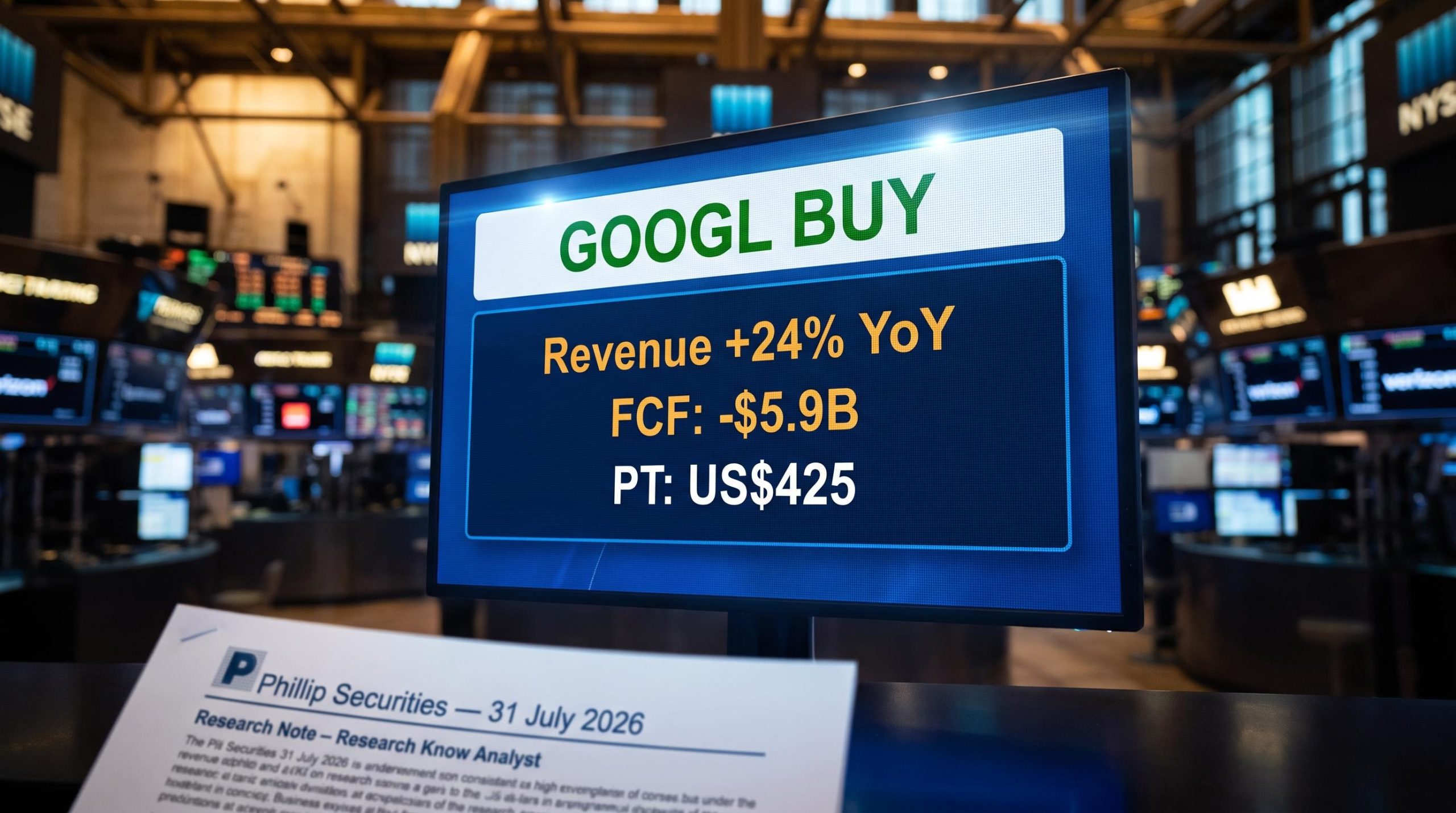
A Wall Street analyst just raised their conviction on Alphabet to BUY while simultaneously cutting the price target. That is not a typo, and it is not a contradiction, but it is a signal worth understanding before taking a position.
On 31 July 2026, Phillip Securities Research analyst Serena Lim Yi Qi upgraded Alphabet from Accumulate/Neutral to BUY, trimming the DCF-based target from US$450 to US$425 in the same note. Beneath that surface tension sits a specific argument about how to value a company printing 24% revenue growth while simultaneously generating its first negative free cash flow quarter since its 2004 IPO. The driver of both dynamics is the same: AI capital expenditure at a scale the company has never attempted before.
Here is the internal logic of this call, the Q2 2026 numbers that anchor it, and the specific variables that determine whether the BUY thesis holds or breaks down over your investment horizon. This is the kind of Alphabet stock analysis that separates a well-reasoned position from a headline reaction.
What Alphabet’s Q2 2026 results actually show beneath the headline growth
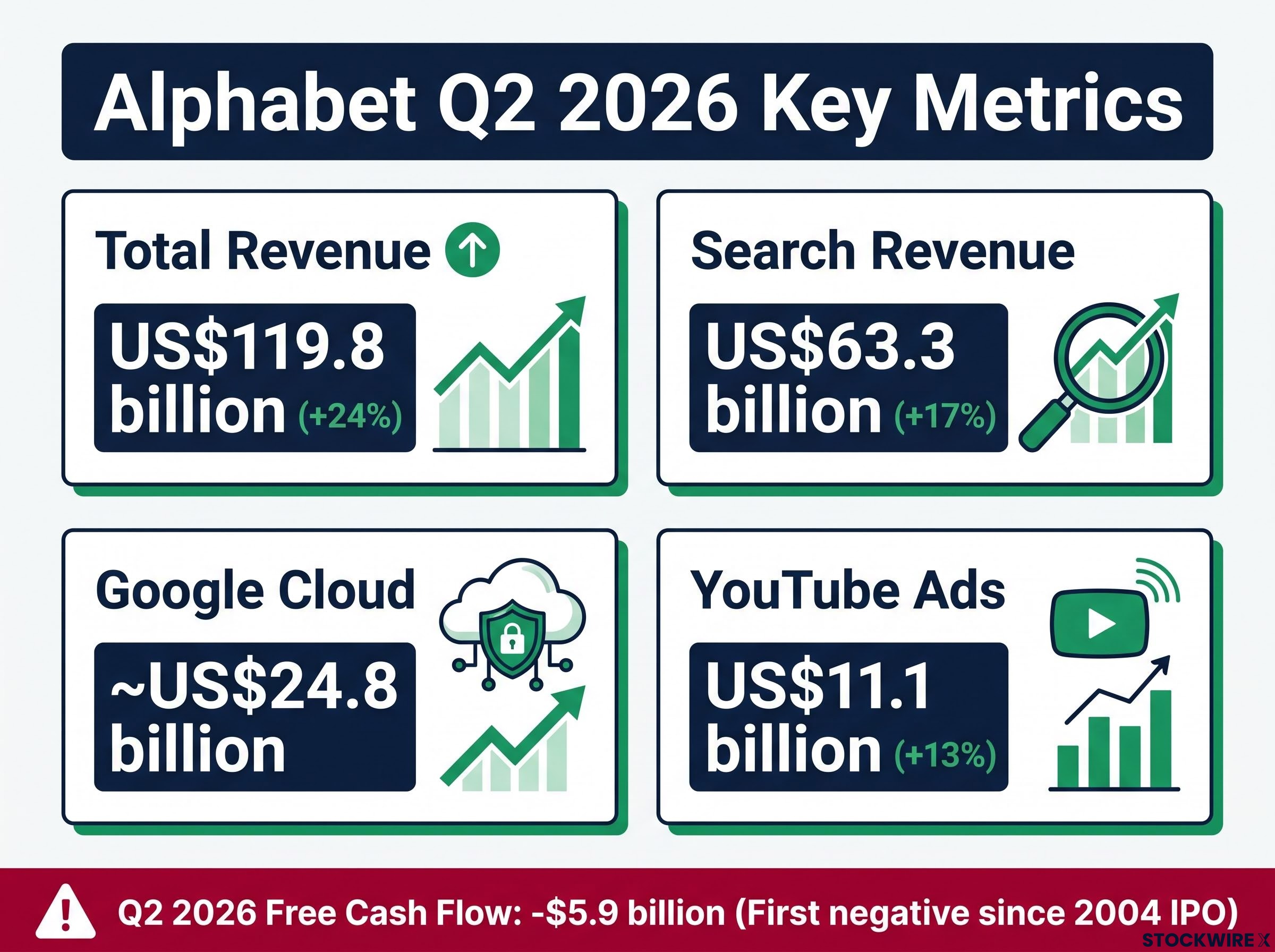
The operating picture is strong by any conventional measure. Alphabet’s Q2 2026 results, released on 22 July 2026, beat consensus modestly on revenue and delivered clean profit growth:
- Total revenue: US$119.8 billion, +24% year-on-year
- Adjusted profit after tax and minority interest: US$35 billion, +24% year-on-year
- Search revenue: US$63.3 billion, +17% year-on-year
- YouTube advertising revenue: US$11.1 billion, +13% year-on-year
Both the revenue and profit figures came in at notable proportions of full-year estimates, with revenue tracking at 45% of the annual forecast and profit at 42%. Both tracking comfortably.
EPS clarification: Alphabet reported GAAP earnings per share of $9.11, which was boosted by a large one-time gain on equity securities. Adjusted EPS came in at approximately $2.85, which beat consensus estimates of approximately $2.89 on an adjusted basis. The GAAP figure is not directly comparable to adjusted consensus, and conflating the two produces a misleading read on the quarter.
Advertising and cloud as the twin growth pillars
Gemini integration across Search, YouTube Shorts, and connected TV is the structural driver behind advertising momentum. Since the product’s 2025 launch, AI Mode inference costs have fallen to their lowest recorded level, a development that points to strengthening monetisation efficiency as the model continues to scale.
The number of paid clicks expanded by +13% year-on-year, the third straight quarter in which that metric has grown at double-digit rates. Retail and finance verticals led Search demand, and the FIFA World Cup 2026 contributed a notable boost, with the tournament generating peak Search volumes and YouTube’s strongest-ever viewership numbers as the platform held official broadcasting rights.
Google Cloud revenue reached approximately US$24.8 billion, with strong year-on-year growth driven primarily by enterprise demand for AI products and services, according to Phillip Securities’ analysis. Cloud growth is largely attributable to external monetisation of Alphabet’s AI capabilities, not just internal use.
Google Cloud’s 82% surge to US$24.8 billion in Q2 2026, accelerating from 63% growth in Q1, is the sharpest single-quarter validation that Alphabet’s AI infrastructure spending is generating real commercial returns rather than deferred optionality.
The income statement alone would never generate an upgrade debate. The investment question is entirely about what sits below the operating line in the cash flow statement.
When big ASX news breaks, our subscribers know first
How record AI capital expenditure pushed Alphabet’s cash flow into negative territory
Alphabet’s free cash flow turned negative for the first time since its 2004 IPO.
That is the single data point driving the target price reduction. Free cash flow came in at approximately -$5.9 billion in Q2 2026, according to Phillip Securities’ note. Not because the core business deteriorated, but because Alphabet raised its full-year 2026 capital expenditure guidance to $195-$205 billion, above prior expectations.
The spending is concentrated across four categories:
| Capex category | Strategic purpose | Expected monetisation pathway |
|---|---|---|
| Large-scale data centres | AI training and inference capacity | Cloud AI services, Search, Workspace |
| Specialised AI hardware | Purpose-built computing for AI workloads | Lower per-unit compute costs at scale |
| Network and storage infrastructure | Supporting cloud AI service delivery | Enterprise cloud revenue growth |
| Proprietary silicon | Custom chips for optimised AI processing | Structural cost advantage over competitors |
The timing mismatch is straightforward: cash leaves the balance sheet in the quarter the infrastructure is built; cash returns gradually as AI capabilities are monetised across Search, Cloud, YouTube, and Workspace. For you as an investor, the question is not whether the cash is leaving but whether the assets being built will generate returns that justify the outlay. That is an asset-quality question, not a cash-flow-health question.
How heavy AI capital expenditure interacts with DCF valuation models
Your instinct is probably that higher capex should push a target price lower, full stop. The DCF mechanics (discounted cash flow, a method of valuing a company by estimating all the cash it will generate in the future and discounting it back to today’s value) make this more nuanced than that.
Terminal value assumptions typically drive 60-80% of a DCF model’s total output, which explains why Phillip Securities could cut near-term free cash flow forecasts by a meaningful margin while leaving the BUY rating intact: the long-run value estimate dominates the arithmetic.
- Near-term FCF inputs revised down: Lower free cash flow projections in 2026 reduce the present value of the explicit forecast period
- Terminal value thesis unchanged: Long-run growth and margin assumptions beyond 2026 remain intact in Phillip Securities’ model
- Net present value effect: The near-term reduction is partially offset by the unchanged long-term assumptions
- Implied target price: US$425, a modest 5-6% reduction from the prior US$450 target
- Upside versus current price: The revised target still implies meaningful upside from the 31 July 2026 trading price, supporting the BUY rating
Phillip Securities revised its FY2026 outlook downward, cutting the revenue forecast by around 2% and the profit forecast by around 4%.
Why the profit cut is steeper than the revenue cut
Supply-chain constraints in advanced AI hardware are the specific mechanism delaying margin expansion. Extremely high capex and capacity build-out push some margin benefits into later years rather than eliminating them. The target price cut tells you the path to intrinsic value is slower than modelled in the prior note. The BUY rating tells you the destination remains compelling enough that the delay does not change the investment decision at current prices.
This is a timing issue, not a thesis issue. Margin expansion is deferred, not cancelled.
How Alphabet’s layered AI ecosystem compounds earnings power across multiple revenue streams
The BUY thesis is not a single-product bet. It is a position on a vertically integrated AI stack that compounds across four layers simultaneously:
| Integration layer | Specific assets / capabilities | Monetisation mechanism |
|---|---|---|
| Models (Gemini) | Integrated across Search, YouTube, Cloud, Workspace | Feature velocity and new product revenue |
| Cloud AI | Enterprise AI products and services | External monetisation (~US$24.8B revenue) |
| Infrastructure | Data centres, network, storage | Capacity and cost advantage at scale |
| Proprietary silicon | Custom AI chips and optimised facilities | Per-unit compute cost reduction over time |
Phillip Securities characterises the investment horizon for full AI capex returns as 10-15 years. Google Cloud’s strong year-on-year growth is early evidence that Alphabet is successfully monetising its AI capabilities externally, not just using them internally to defend the advertising franchise.
Infrastructure and silicon as the durable moat
Data-centre scale and custom silicon create barriers that competitors cannot easily replicate without matching multi-year spending commitments at comparable scale. AI Mode’s declining inference costs are early empirical evidence that the scale-cost dynamic is already working.
If custom silicon and scale drive inference costs down materially over the next three to five years, the current capex programme will look like a capital allocation masterstroke in retrospect. The question for you is whether your investment horizon is long enough to benefit from that outcome.
How AI-driven advertising momentum reshapes the near-term revenue picture
The capital expenditure and valuation argument addresses what Alphabet is spending. The advertising data reveals what AI is already earning.
- Total advertising revenue: +14% year-on-year
- Search: US$63.3 billion, +17% year-on-year; retail and finance leading verticals
- YouTube: US$11.1 billion, +13% year-on-year
- Paid clicks: +13% year-on-year, third consecutive quarter of double-digit growth
- AI Mode inference costs: at lowest point since the 2025 product launch
Three consecutive quarters of double-digit paid-click growth tells you the AI advertising thesis is not speculative. It is already in the revenue numbers.
The FIFA World Cup 2026 provided a concrete illustration of how Alphabet’s platform breadth translates into advertising revenue concentration. Record Search activity combined with YouTube’s highest viewership figures as official broadcasting partner, funnelling advertiser spend across both surfaces simultaneously.
YouTube Shorts and connected TV monetisation represent the growth frontier within the advertising segment, where AI-driven targeting and content recommendation are accelerating revenue. That distinction matters for how much terminal-value risk you are actually taking on when considering a position. AI is not a purely future story for Alphabet; it is already a present revenue driver.
What the Phillip Securities call means for investors weighing Alphabet at current prices
The core bull case requires two simultaneous bets: that the AI infrastructure investment is value-creating at the returns Alphabet’s management is implying, and that the advertising and cloud businesses compound through the investment phase without structural deterioration.
The specific risks that could break the thesis are equally concrete: capex overruns beyond the $195-$205 billion guidance range, supply-chain constraints extending the margin recovery timeline further, or a structural shift in the advertising market (antitrust action, AI-native search competitors) that weakens the Search monetisation base.
Two live antitrust proceedings sit outside the DCF model entirely; their potential remedies, ranging from behavioural restrictions to structural divestitures of Chrome, Android, or ad tech assets, represent a binary risk layer that no discounted cash flow framework can fully price.
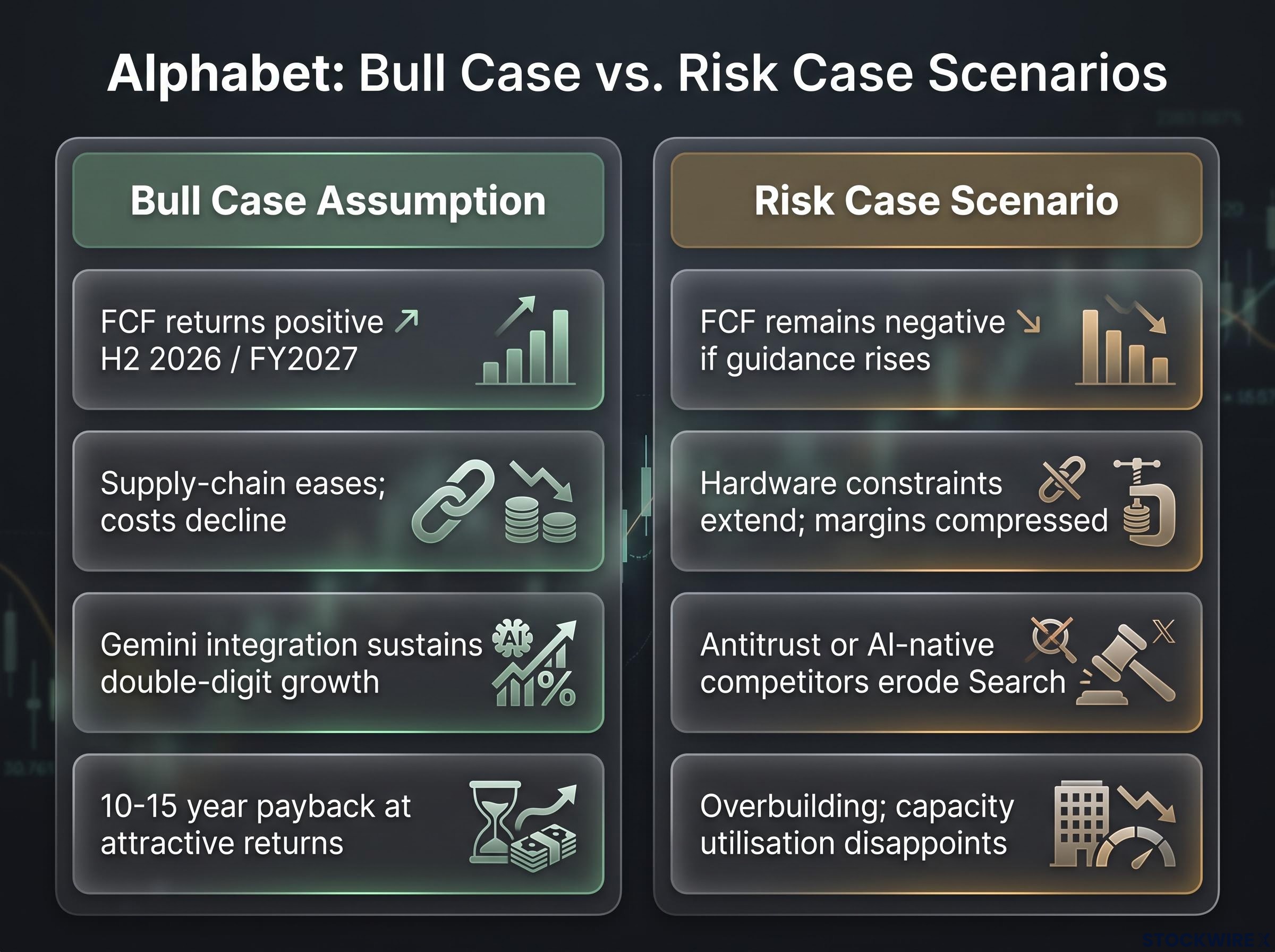
| Factor | Bull case assumption | Risk case scenario |
|---|---|---|
| FCF trajectory | Returns to positive in H2 2026 or early FY2027 | Remains negative if capex guidance rises again |
| Margin recovery | Supply-chain eases; per-unit costs decline | Hardware constraints extend; margins compressed longer |
| Advertising durability | Gemini integration sustains double-digit growth | Antitrust or AI-native competitors erode Search share |
| AI infrastructure returns | 10-15 year payback at attractive returns on capital | Overbuilding; capacity utilisation disappoints |
Your decision variables come down to four questions, in order of priority:
- Time horizon: Do you have the multi-year patience the thesis requires?
- FCF tolerance: Can you hold a position in a company with temporarily negative free cash flow?
- View on AI capex returns: Do you believe the infrastructure being built will generate attractive long-run returns?
- View on advertising durability: Do you believe Search and YouTube’s monetisation base remains structurally sound?
The Phillip Securities call is internally consistent and well-anchored in the data. Whether it matches your situation depends on your answers to those four questions.
This article is for informational purposes only and should not be considered financial advice. Investors should conduct their own research and consult with financial professionals before making investment decisions.
A path adjustment, not a destination change: what to watch from here
Phillip Securities frames the call as a “path adjustment, not a destination change”, per the 31 July 2026 analyst note by Serena Lim Yi Qi.
Three forward-looking variables will tell you whether the BUY thesis is tracking as expected or deteriorating:
- Free cash flow trajectory: FCF came in at approximately -$5.9 billion in Q2 2026. Watch for a return to positive in H2 2026 or FY2027. Any upward revision to the $195-$205 billion capex guidance would extend the pressure timeline.
- Operating margin recovery: Supply-chain constraints in AI hardware are the stated reason for the steeper profit forecast cut. Improvements in hardware availability and per-unit compute costs will appear in operating margins before they show in FCF.
- AI Mode monetisation rate and Cloud growth: AI Mode inference costs are already at their lowest since the 2025 launch; the rate of further decline is a margin proxy. Google Cloud’s strong year-on-year growth will either accelerate or decelerate as enterprise AI demand matures.
If FCF turns positive in Q3 or Q4 2026 while Cloud growth holds strong, the Phillip Securities thesis will have its first real-world validation. If capex guidance rises again or FCF remains negative through year-end, the timeline assumption in the BUY call will need reassessment.
You do not need to make a permanent commitment to the thesis today. You need to know which signals to track. Those three variables give you the framework.
For investors exploring how the diversified AI platform thesis compares to a pure-play semiconductor position at current valuations, our full explainer on Alphabet versus Nvidia as AI investments examines how Gemini, Waymo, and Cloud exposure change the risk-return profile relative to owning the leading chip supplier directly.
Past performance does not guarantee future results. Financial projections are subject to market conditions and various risk factors.