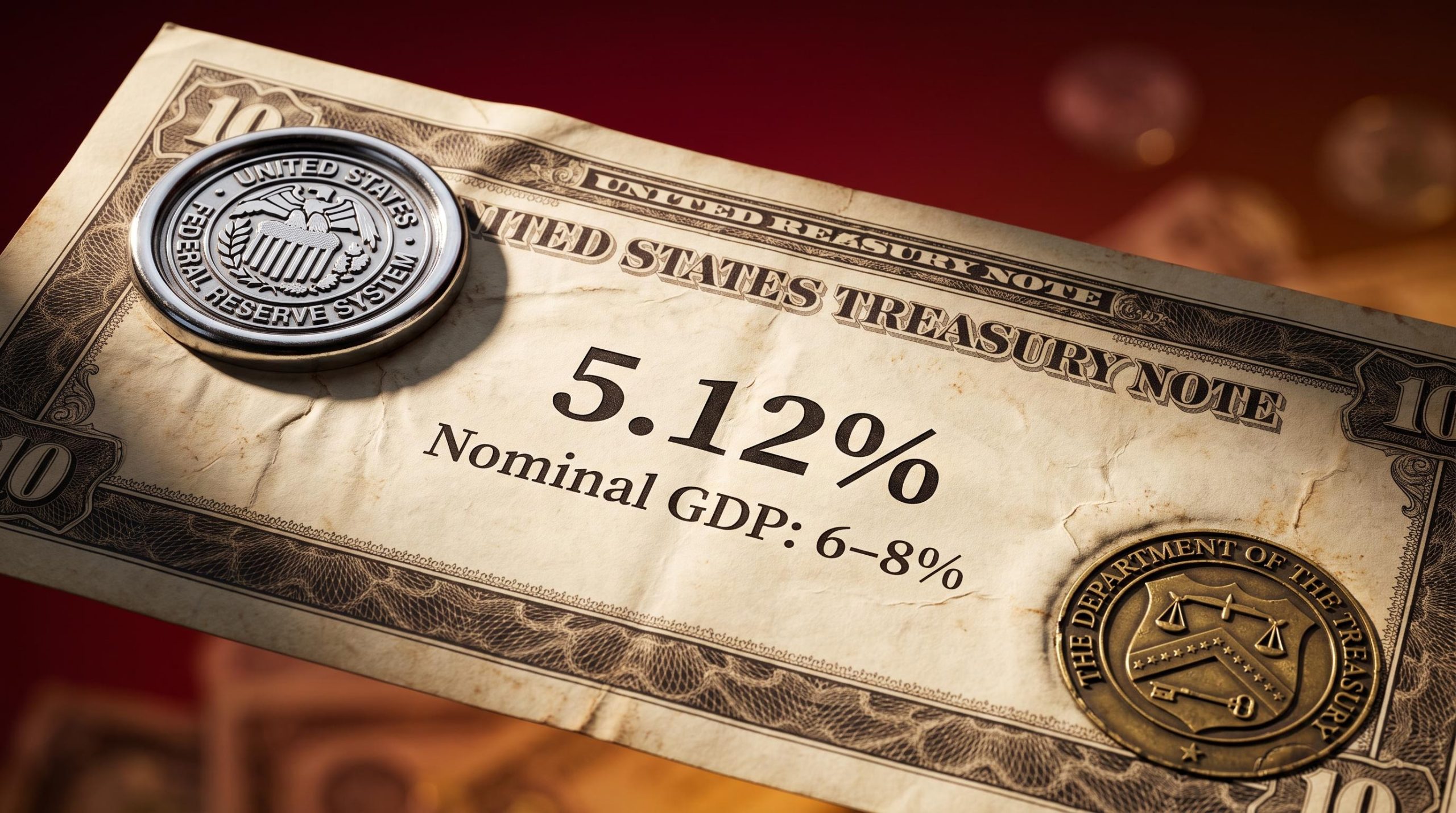
The 10-year Treasury yield sits at 5.12% while nominal GDP runs at roughly 6-8% annualised. That gap is the battlefield.
On one side stands Federal Reserve Chair Kevin Warsh, who wants rates set by the market and yields left to settle where they will. On the other stands Treasury Secretary Scott Bessent, who is reaching for tools to hold the long end down and protect what he characterises as three concurrent asset bubbles.
This is not a theoretical spat between two officials. Their positions are structurally opposed, and the instruments Bessent is deploying, Treasury General Account drawdowns and an informal twist operation, are finite by design. The outcome will shape the environment for every yield-sensitive asset you hold.
After this piece, you will know whether Bessent’s toolkit can actually move the long end of the curve, why the Fed holds the structural card, and the exact macro scenario that would have to materialise for Treasury to prevail.
Two officials, one irreconcilable problem
Strip away the personalities and what remains is a logic problem with no middle ground.
Warsh’s philosophy is that interest rates should be market-determined, with reduced balance sheet intervention and less forward guidance from the central bank. That posture points in one direction: higher yields across maturities, wherever the market decides they belong.
Warsh’s confirmation in a 54-45 Senate vote committed him publicly to aggressive balance sheet reduction and higher-for-longer rates, giving markets an unusually clear read on the institutional posture now sitting across the table from Bessent.
Bessent’s objective is the opposite. He wants to suppress long-end yields specifically because rising rates threaten what he views as three inflated asset markets, and he is prepared to use Treasury’s own machinery to keep borrowing costs down.
Michael Pinto of Pinto Portfolio Strategies frames the two goals as mutually exclusive. Fighting inflation requires letting rates rise. Protecting asset prices requires holding them down. You cannot do both at once.
The two objectives cannot be satisfied simultaneously: combating inflation demands higher rates, while shielding asset markets demands lower ones. One official has to give ground.
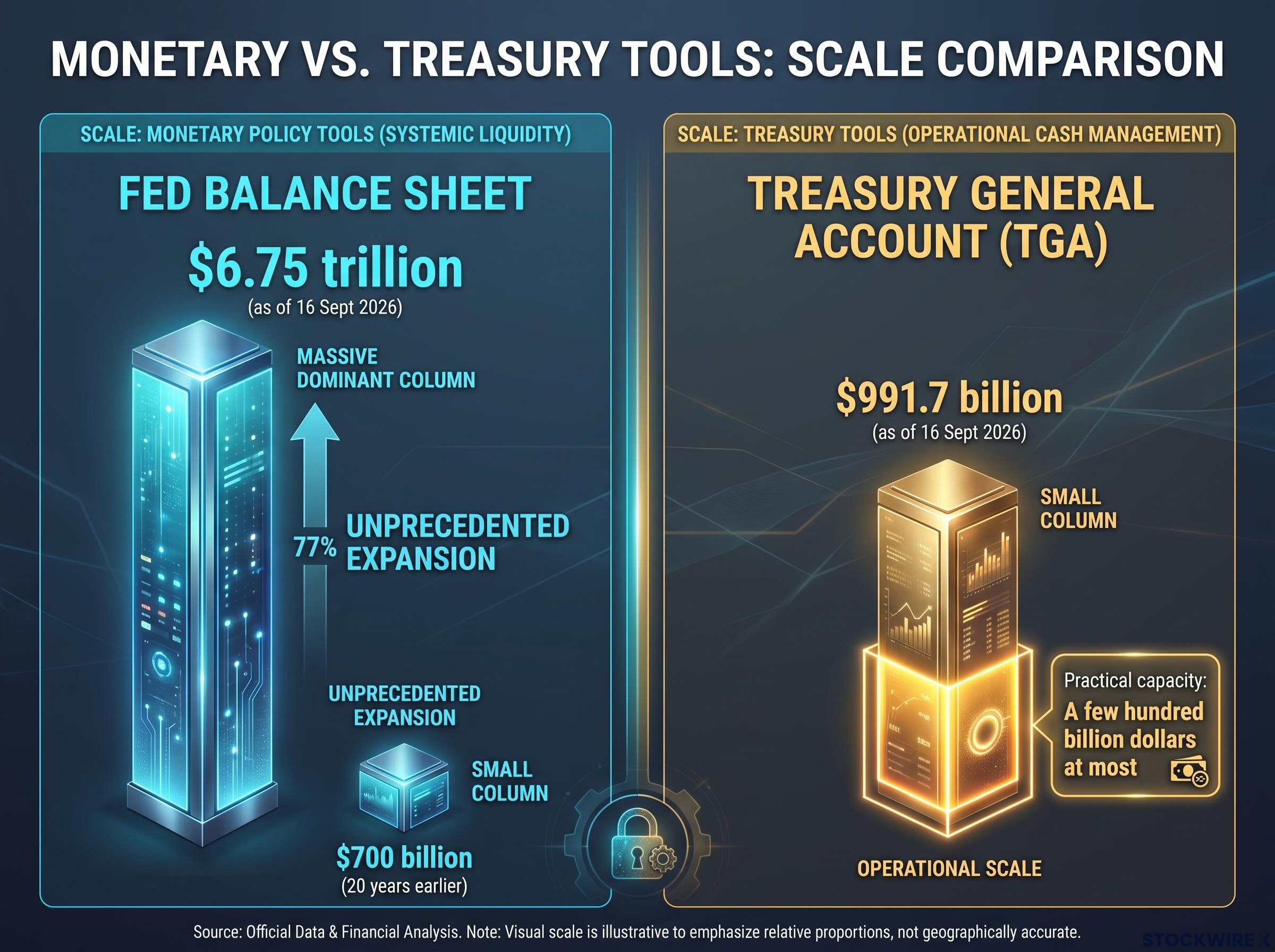
The numbers frame the stakes. The 10-year Treasury yield sits near 5.12% and the 30-year near 5.40% as of 24 September 2026. The Fed’s balance sheet stood at roughly $6.75 trillion on 16 September 2026, against about $700 billion some 20 years earlier, a measure of how far monetary firepower now dwarfs anything Treasury can muster.
One detail sharpens the picture. The current Federal Open Market Committee is operating without a single dissenting vote, which analysts consider unusual.
That absence of dissent tells you Warsh is working with full institutional coherence behind him. When you are assessing who holds structural authority in a sustained standoff, an aligned committee is not a footnote. It is the difference between a chair with a mandate and a chair with a faction.
When big ASX news breaks, our subscribers know first
What Bessent is actually trying to do with the long end
Before rendering any verdict, it is worth walking through Bessent’s toolkit mechanically, so you can judge the logic yourself.
The first mechanism is TGA deployment. The Treasury General Account is the government’s operating cash balance held at the Fed, the account from which federal obligations are paid. Bessent’s idea is to use that cash to buy long-duration debt, injecting liquidity into the market and shrinking the supply of long-term Treasuries investors have to absorb. Less supply, in theory, means lower yields at the long end.
The account currently holds about $991.7 billion as of 16 September 2026 (FRED series WDTGAL), close to the roughly $950 billion the original analysis cited at the interview date.
Here is the constraint that matters. The TGA cannot be run to zero, because it is the operational payment mechanism for every Treasury obligation. Practical deployment capacity is estimated at a few hundred billion dollars at most.
Understanding that ceiling tells you something decisive. Even if Bessent executes flawlessly, he is working with a tool that runs out. Any yield suppression it produces is temporary by construction, not because of political will but because of arithmetic.
The Operation Twist precedent and what it actually moved
The second mechanism is an informal Operation Twist: selling short-dated Treasuries while buying long-dated paper to flatten the curve, without needing the Fed to participate.
The original Twist in 1961 saw Treasury and the Fed coordinate to sell short-term securities and buy longer ones. Academic work since has generally concluded the effect on long-term yields was small.
The modern version, the Maturity Extension Program run under then-Chair Ben Bernanke in 2011-2012, held the balance sheet roughly constant while shifting its composition toward longer maturities. Event-study analyses found noticeable but moderate declines in 10-year yields around the announcements.
Eric Swanson of the Federal Reserve Bank of San Francisco finds that maturity-extension programmes can move long-term yields by tens of basis points around announcements, but the effects are modest and depend heavily on expectations and market conditions. Work by Joseph Gagnon and Brian Sack points to the same portfolio-balance channel: reducing the supply of long-duration paper compresses term premia, but only to the extent that private investors cannot easily substitute other assets. In deep, liquid markets, they can.
| Tool | Mechanism | Historical precedent | Estimated yield impact |
|---|---|---|---|
| TGA deployment | Use Treasury cash to buy long-duration debt, cutting available supply | No direct precedent at scale; account serves as payment mechanism | Temporary; capacity capped at a few hundred billion dollars |
| Informal Operation Twist | Sell short-dated debt, buy long-dated paper to flatten the curve | 1961 original; 2011-2012 Maturity Extension Program under Bernanke | Tens of basis points around announcements; modest and condition-dependent |
For anyone assessing whether Treasury can credibly hold the long end down, the mechanics point one way. The strategy has a built-in expiry date, whatever the political appetite behind it.
Bessent’s approach to informal yield curve control differs from formal YCC on three dimensions: no published yield targets, finite capped operations that expire automatically, and no Federal Reserve participation or unlimited purchase backstop, distinctions that matter precisely because signalling cannot substitute for mechanical firepower at scale.
Why the structural forces are stacked against Treasury
Set the Warsh-Bessent conflict aside for a moment. The forces pushing yields higher operate independently of it, and they would persist even if Bessent’s tools were unlimited.
The first is the gap between yields and nominal growth. Benchmark Treasury yields historically tend to trade in line with nominal GDP growth. In Q2 2026, current-dollar GDP grew at an 8.02% annualised rate, with year-over-year growth near 6.56%. Against a 10-year yield of 5.12%, that leaves a meaningful gap.
A 5.12% ten-year yield against nominal GDP growth of 6-8% is not equilibrium. History says yields close that gap by rising, not by Treasury willing them lower.
The three structural headwinds are worth naming plainly:
- The nominal GDP gap, with yields at 5.12% sitting well below nominal growth of 6-8%, implying upward pressure over time.
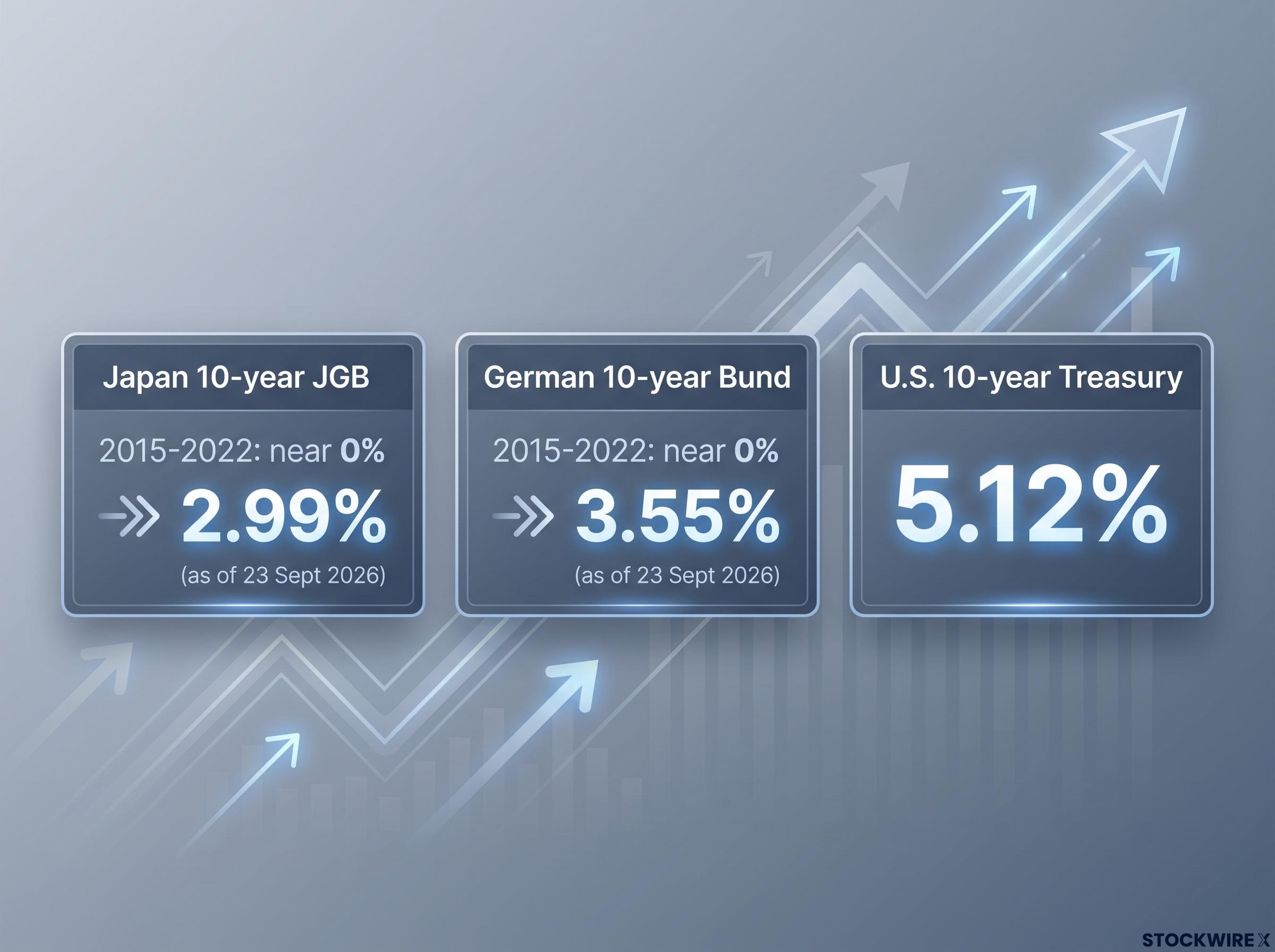
- The collapse of global zero-rate anchors, with the Japan 10-year JGB at 2.99% and the German 10-year Bund at 3.55% as of 23 September 2026, both near 0% from roughly 2015 through 2022.
- Foreign creditor withdrawal, as central banks and sovereign funds reduce Treasury exposure amid reserve diversification and concerns over sanctions policy and dollar weaponisation.
That JGB and Bund data matters more than it looks. For nearly a decade, near-zero yields abroad made U.S. Treasuries the obvious destination for global savings. That external demand is structurally gone, and no domestic debt-management operation can recreate it.
The carry trade unwind and what it removes from Treasury demand
The yen carry trade worked on a simple logic: borrow yen at near-zero cost, buy U.S. Treasuries, and pocket the interest differential.
With the JGB now at 2.99%, that differential has collapsed and the trade is becoming unprofitable. Research from J.P. Morgan, Nomura, and HSBC has emphasised that when the cost of hedging dollar exposure eats most of the yield pickup, unhedged or domestic alternatives become more attractive, cutting Treasury demand further.
This is a structural removal of demand, not a temporary positioning shift. The U.S. fiscal deficit currently runs above 6% of GDP, and as foreign official flows recede, domestic investors, pensions, insurers and funds, must absorb more duration. That raises term premia and leaves yields more sensitive to every fiscal and political headline. The BIS and large asset managers debate whether the withdrawal is structural or cyclical, but the direction of pressure is not in dispute.
The yen carry trade unwind is not simply a positioning story: Scotiabank’s base-case modelling links the fiscal-driven term premium environment to approximately 4% dollar depreciation by end-2026, meaning the same forces compressing Treasury demand from abroad are simultaneously eroding the dollar’s ability to attract the capital flows that would normally offset that withdrawal.
For anyone holding yield-sensitive positions, the takeaway is uncomfortable. Even a perfectly executed Treasury intervention would be running against global forces that have repriced sovereign bonds across every major economy.
The scenarios in which Bessent could still win
None of this makes a Treasury victory impossible. It makes it conditional. The honest question is which conditions.
Three scenarios, in ascending order of what they would require:
- A disinflationary recession. Falling growth and inflation expectations would make lower long-end yields market-consistent rather than coerced, and Bessent’s toolkit plus TGA deployment could hold funding costs down without a market backlash. This is the environment where his strategy is genuinely viable.
- Fiscal dominance with political pressure. If deficits stay above 6% of GDP and interest expenses keep climbing, projected by one unverified estimate toward $2.7 trillion annually if yields hold near current levels, political pressure on the Fed becomes a structural force in its own right.
- Explicit yield-curve control. The most extreme option, where the central bank formally caps yields, as the wartime Fed and later the Bank of Japan both did.
The academic grounding for the second scenario comes from Eric Leeper and the Sargent-Wallace framework.
“Unpleasant monetarist arithmetic” describes the point at which persistent deficits force the central bank to accommodate government financing, subordinating monetary policy to fiscal reality.
Larry Summers, Narayana Kocherlakota, and scholars at the Brookings Institution and Peterson Institute have all warned that pressure on the Fed to cap yields or coordinate with Treasury is a genuine risk, not a hypothetical, given the current deficit path.
History offers a cautionary marker. The Bank of Japan defended a yield cap for years, yet the JGB now trades at 2.99% after that control gave way. Yield suppression can hold for longer than markets expect, but when it breaks, it tends to break sharply. That is the shape of the fiscal dominance tail risk.
The practical value here is a watchlist. Track three live signals: the direction of U.S. inflation expectations, the pace of fiscal deficit expansion, and any sign of escalating political pressure on the Fed. Those variables tell you whether the base case or the tail risk is the one resolving.
What the Fed’s structural authority actually means for rate-sensitive portfolios
Pinto’s conclusion that the Fed wins structurally carries a direct portfolio implication. The base case is that long-end yields stay elevated or move higher, not that Treasury suppression holds.
The research desks quantify the upside for Treasury in modest terms. J.P. Morgan, Goldman Sachs, and Barclays broadly agree that TGA and twist operations affect yields at the margin and temporarily, particularly in the front end and the 5-10-year sector, before term premia reassert once issuance resumes. That is a basis-point story, not a structural shift.
Former Fed officials Bill Dudley, Jeremy Stein and Brian Sack reinforce the point: Treasury debt-management operations complement monetary policy but cannot substitute for it, and pushing TGA or twist operations too far risks destabilising bill markets.
The clearest illustration of the asymmetry is scale. The Fed’s balance sheet stands near $6.75 trillion, against roughly $700 billion two decades ago, the machinery behind years of QE-driven yield suppression. Treasury’s practical TGA ceiling is a few hundred billion dollars. That gap is why structural authority runs in one direction, and it is the asymmetry to carry into your duration positioning.
The Fed’s MBS portfolio adds another layer to this asymmetry: $1.93 trillion in agency mortgage-backed securities with a weighted average life near 8.8 years represents a structural constraint on balance sheet normalisation that reinforces why meaningful QT is unlikely before the mid-2030s, leaving the Fed’s firepower in a different form than the clean policy lever the headline balance sheet figure implies.
Track these three variables as live signals:
- Inflation expectations: the trajectory of market-based and survey measures, which determines whether lower yields are market-consistent or coerced.
- Debt-service cost trajectory: the pace of rising interest expense and the political response to it, the trigger for any fiscal dominance scenario.
- Fed independence signals: any formal or informal sign that the central bank’s autonomy is being compromised.
The disinflationary scenario remains a real possibility and would call for a different response, so the framework has to hold both cases. Positioning built on the assumption that Treasury can sustain long-end suppression is being made against the structural evidence reviewed here.
This article is for informational purposes only and should not be considered financial advice. Investors should conduct their own research and consult with financial professionals before making investment decisions. Past performance does not guarantee future results, and financial projections are subject to market conditions and various risk factors. These statements are speculative and subject to change based on market developments.
Warsh holds the structural card, but the game is not over
The asymmetry is clear. Warsh’s control over short-term rates and the balance sheet gives the Fed the upper hand in any sustained conflict with Treasury over the long end, and the 5.12% ten-year yield sits well above where a few-hundred-billion-dollar TGA ceiling could hold it.
That conclusion reverses under specific conditions: persistent fiscal dominance, a disinflationary shock that makes lower yields market-consistent, or explicit political interference with Fed independence. The 1951 Treasury-Fed Accord is the baseline here. When inflation and credibility were at stake, institutional dynamics resolved in favour of Fed autonomy, though the resolution was neither painless nor quick.
The 2.99% JGB, reached after years of defended yield-curve control, is the reminder that suppression can hold longer than expected before it snaps.
“Fed wins structurally” is not the same as “yields stay put tomorrow.” The directional conclusion is durable. The open question is the timeline and the path of adjustment, and the three monitoring variables are how you watch it unfold.