The Federal Reserve raised interest rates last week for the first time since 2023, and one Scandinavian bank thinks that was just the beginning. Nordea’s strategists are telling clients to prepare for two more hikes, even as most polled economists still expect the Fed to hold. The bank’s reasoning is blunt: US monetary policy is “not yet sufficiently restrictive.”
That call matters well beyond the institution making it. With headline inflation running at 3.4% and unemployment sitting at 4.1%, the inputs behind Nordea’s forecast are real and publicly verifiable. Whether two more hikes actually land is not an academic parlour game. It shapes mortgage rates, equity valuations, and the cost of credit for millions of American households and businesses.
This piece hands you the tools to evaluate the Nordea call on your own terms. It lays out the evidence for the hawkish case, the counterarguments that challenge it, and what the two-hike scenario would mean in practice. You will leave with a clear sense of where the weight of evidence sits and what to watch next as the Fed rate hike predictions play out.
What the latest data actually shows: inflation and jobs in September 2026
Every forecaster working the US rate question is looking at the same two numbers. Get those numbers right, and you can judge any forecast that builds on them, including Nordea’s.
The first is inflation. The second is the state of the jobs market. Both sit in a zone that makes the Fed’s next move genuinely contested rather than obvious.
| Indicator | Latest value | Month-on-month | Fed benchmark | Source |
|---|---|---|---|---|
| Headline CPI (August 2026) | 3.4% YoY | +0.4% | 2% target | BLS |
| Core CPI (August 2026) | 2.4% YoY | +0.3% | 2% target | BLS |
| Unemployment (August 2026) | 4.1% | 7.0m unemployed | Near full employment | BLS |
Inflation: above target but is it stuck?
The Bureau of Labor Statistics (BLS) published the August 2026 CPI report on 11 September 2026. Headline inflation came in at 3.4% year-on-year, up 0.4% on the month. Core inflation, which strips out volatile food and energy prices, ran at 2.4% year-on-year, up 0.3% on the month.
Neither figure is alarming. Both remain stubbornly above the Fed’s 2% target. Nordea describes this inflation as persistent rather than transitory, with few signs of near-term relief.
The gap between the two figures is where the debate begins. Core at 2.4% sits far closer to target than headline at 3.4%, which raises the question the rest of this analysis explores: is the overshoot fading, or is it settling in?
Labour market: near-full employment and the wage pressure risk
The jobs data tells its own story. The BLS released the August 2026 figures on 4 September 2026, showing unemployment steady at 4.1%, with 7.0 million Americans out of work.
Fed officials have assessed the economy as running at or near full employment. That is the label economists apply when nearly everyone who wants a job can find one, leaving little slack in the system.
Here is the tension for the reader to hold. If job creation continues at the current pace, unemployment could compress further, and a tighter labour market is precisely the condition that feeds wage pressure. That mechanism is what the next section unpacks. The 16 September 2026 FOMC decision to lift the target range to 3.75%-4.00%, the first hike since 2023, tells you the Fed itself is taking that risk seriously.
When big ASX news breaks, our subscribers know first
The mechanism: how a tight job market keeps prices elevated
A 4.1% unemployment rate is not a neutral data point. To understand why, it helps to follow the chain that links a tight jobs market to sticky inflation, one link at a time.
It starts with real wages. When past inflation erodes what a pay cheque actually buys, workers push for higher wages to recover lost purchasing power. Research from the European Central Bank (ECB) identifies exactly this real-wage catch-up as one of the main drivers of post-pandemic services inflation, describing it as a “second-round effect” where wages chase prices that have already risen.
Firms then pass those higher wage costs into the prices they charge. According to International Monetary Fund (IMF) research, there is strong pass-through from local labour market tightness to service-sector wage growth, and from those wages into local services inflation.
The tighter the labour market, the more forcefully this works. A New York Fed staff report models how a high vacancy-to-unemployment ratio, meaning many job openings relative to available workers, forces firms to bid up wages to recruit and retain staff. Those higher costs then flow through to consumer prices.
Minneapolis Fed work adds the self-reinforcing twist. When inflation erodes real wages, workers intensify their on-the-job search for better pay, which tightens the labour market further and pushes wages higher still.
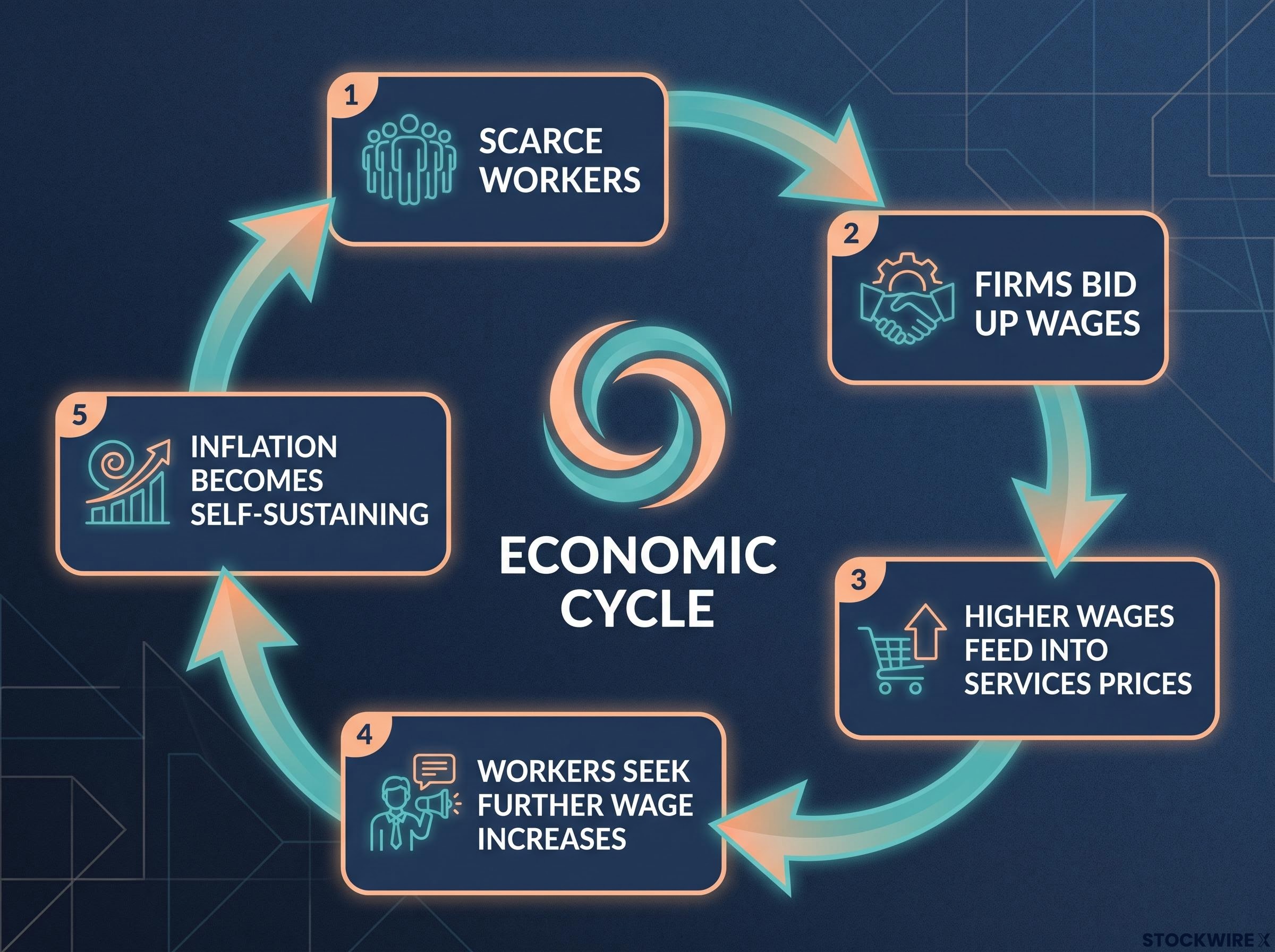
Here is the full transmission chain:
- A tight labour market leaves firms competing for scarce workers.
- Firms bid up wages to fill vacancies.
- Higher wages feed into services prices.
- Workers seek further wage increases to recover lost purchasing power.
- Left unchecked, inflation becomes self-sustaining.
The ECB’s work on nonlinear Phillips curves sharpens the warning. When the labour market is slack, inflation barely responds to wage movements. Once tightness passes certain thresholds, both wages and inflation accelerate rapidly, which makes a late policy response far more costly.
There is a structural layer too. The OECD Employment Outlook 2025 notes that minimum-wage increases and renegotiated collective agreements keep exerting upward pressure on wages even as headline tightness eases.
This is the logic that leads Nordea to its central conclusion.
Nordea’s strategists argue that resilient US growth, persistent inflation, and continued labour-market strength mean policy is “not yet sufficiently restrictive.”
For you, the takeaway is a test rather than a verdict. If wages accelerate from here, the Nordea call gains real credibility. If wage growth softens, the case weakens, and existing tightening may do the work on its own.
What Nordea is actually forecasting, and where it sits on the institutional spectrum
Nordea’s two-hike call is not a verdict handed down from on high. It is one credible point on a wide spectrum, and it helps to see exactly where it sits.
How Nordea’s view shifted in 2026
The striking thing is how recently Nordea changed its mind. This was not a long-standing hawkish stance.
Back on 23 January 2026, in its “Global economic outlook”, Nordea expected all major central banks, the Fed included, to “stand still in 2026”. Its forecast put the Fed funds upper-end target at 3.75% for end-2026, with no hikes projected at all.
By 2 September 2026, that had changed materially. In “Economic outlook: Global Resilience”, Nordea revised its Fed funds upper-end forecast to 4.25% for 2026, pencilling in additional tightening.
On 18 September 2026, via FXStreet, the bank made the position explicit. Its strategists said they “maintain our forecast for two more hikes”, with risks “tilted to the upside”. The revision was driven by incoming data, not ideology, which is precisely what you want to see in a forecast worth taking seriously.
Where the broader consensus stands
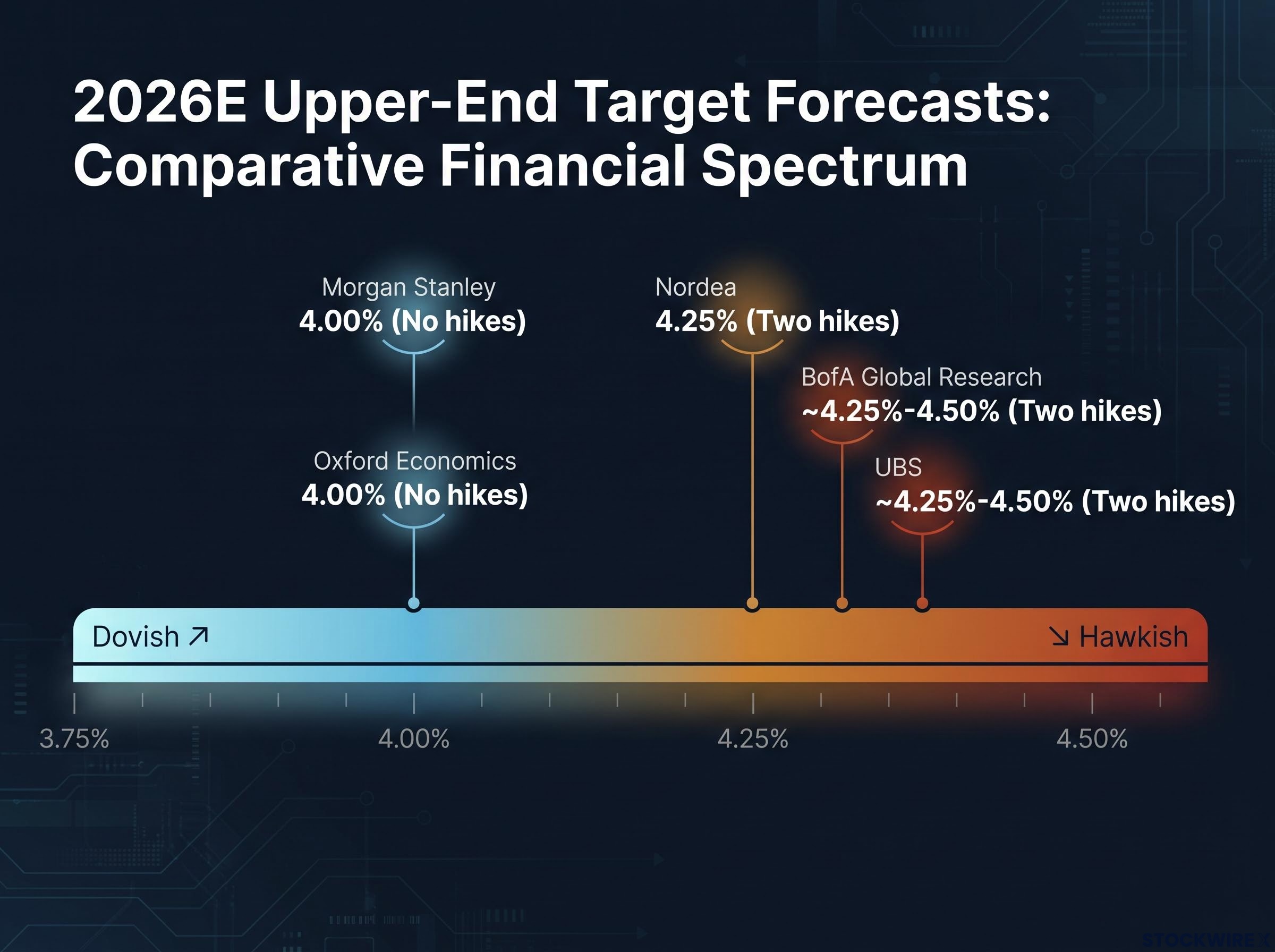
Zoom out, and Nordea occupies the hawkish end of a broad range.
| Institution | 2026E upper-end target | Additional hikes projected | Risk skew |
|---|---|---|---|
| Nordea | 4.25% | Two | Toward more hikes |
| BofA Global Research | ~4.25%-4.50% | Two | Hawkish |
| UBS | ~4.25%-4.50% | Two (Sep, Dec) | Hawkish |
| Morgan Stanley | 4.00% | None (two 2027 cuts) | Dovish |
| Oxford Economics | 4.00% | None (“very unlikely”) | Dovish |
The figures for UBS and BofA come via secondary sourcing and have not been independently confirmed, so treat them as indicative rather than settled.
At the dovish end, Morgan Stanley projects no hikes in 2026 and two cuts in 2027. Bernard Yaros of Oxford Economics put it plainly in March 2026: “a rate hike this year seems very unlikely.”
The Fed’s own June 2026 dot plot gives the two-hike scenario institutional grounding without locking it in: nine of nineteen policymakers projected at least one increase by end-2026. Yet Reuters polls through the middle of the year found most economists expecting a hold, even as futures markets priced at least one hike.
That divergence is itself the signal. It tells you the Fed’s next move is genuinely data-dependent, not pre-determined. A forecast sitting at the hawkish edge of the range deserves different scrutiny than a Wall Street consensus would, so calibrate your conviction accordingly.
The counterarguments: why a majority still favour a hold
The honest position after weighing the hawkish case is not certainty. The case against further hikes is strong, and it deserves its full form.
The most practically important argument is about timing. Rate hikes do not bite immediately.
BIS research finds that GDP typically troughs 16-20 quarters after the start of a tightening cycle, while non-performing loans begin rising eight quarters after hikes and peak 12-20 quarters later.
The Bank for International Settlements (BIS) also finds that the probability of a financial crisis rises by 1-2 percentage points in the first one to two years after a tightening cycle begins. The implication is uncomfortable. The full weight of the hikes already delivered has not yet hit credit quality or the wider economy, so piling on more stacks future risk onto a cycle whose costs are still unfolding.
Then there is the recession calibration. A CNBC Fed survey in mid-September 2026 put the average probability of a recession over the next 12 months at 29%, a figure that climbs if two more hikes land.
The three principal risks to further tightening are worth isolating:
- Lagged macro effects: past hikes are still working through GDP and credit, per BIS research.
- Financial stability risk: credit spreads and crisis probability rise for years after a cycle starts.
- Recession probability: a ~29% average odds of downturn within a year, rising with each additional hike.
Morgan Stanley argues that current rates are already high enough to slow growth, and that extra hikes risk a harder landing than necessary. Oxford Economics makes the parallel point that additional tightening would raise recession risk unnecessarily given how restrictive policy already is.
History cuts both ways. The 1994-95 Fed cycle is often cited by the St. Louis Fed as a successful soft landing precisely because the Fed paused at the right moment. Dallas Fed research frames the current episode as more cyclical and shock-driven than structural, arguing that if inflation expectations stay anchored, prices can revert without another Volcker-era shock.
The structural camp is not silenced by this. Eco3min’s historical audit of Fed rate decisions puts the 1970s at -4.53 percentage points against the 2020s at -4.13, a reminder that insufficiently restrictive policy has a track record. But that gap is narrower today, which stops the structural worry from being overstated.
For you, the counterargument is not simply “the other side”. It is the framework for understanding what could make the Nordea forecast wrong, and the conditions under which the Fed pauses instead.
What would two more hikes actually change, and what signals to watch
The debate stops being abstract the moment you translate it into rates you actually pay.
Two more 25bp hikes would lift the Fed funds upper bound to 4.50%, the highest level since before the 2020 easing cycle. That flows directly into mortgage rates, corporate borrowing costs, and the discount rates that anchor equity valuations. If you carry variable-rate debt or hold long-duration bonds, this is the number that moves your outcome.
The unresolved core is whether the inflation overshoot is structural or cyclical. PIMCO argues the current stance is roughly one standard deviation looser than the 1973-1982 period, and RBC Economics warns that demographic ageing, immigration constraints, and reshoring could keep core inflation above 3% for most of 2026. If they are right, two hikes may not be enough. If the Dallas Fed and Morgan Stanley are right that the overshoot is cyclical and fading, two hikes would be excessive.
Three signals that will confirm or challenge the Nordea call
You do not have to wait for the FOMC statement to update your view. Three data streams will tell you which way the wind is blowing.
- Non-farm payrolls and unemployment: a further compression below 4.1% strengthens the wage-pressure case. A hawkish read is a tight, still-hiring labour market. A dovish read is softening job creation and a rising jobless rate.
- Services CPI: if services prices hold above 3% month-on-month through Q4, the structural inflation argument gains ground. A hawkish read is sticky services; a dovish read is services prices finally breaking lower.
- Fed communications and the November dot plot: any upward shift in the median dot or hawkish statement language would confirm expectations are recalibrating toward Nordea’s view. A dovish read is a flat or lower dot and softer language.
The June 2026 dot plot, with nine of nineteen policymakers projecting at least one more hike, already gives this scenario a foothold inside the Fed itself. If the October and November payroll reports stay strong and services CPI refuses to break lower, the odds of at least one further hike rise materially, and Nordea’s forecast edges toward base case.
The call is credible, but far from settled
Nordea’s argument holds together. Inflation persists above the 2% target, the labour market is running at or near full employment, and the Fed has already resumed hiking after its pause. Together, those point to a policy stance the bank argues is still insufficiently restrictive.
The counterweight is equally real. BIS lag research shows the full cost of past hikes has not yet landed, a 29% average recession probability hangs over the next year, and the majority of economists still favour a hold. A data-dependent Fed will weigh all of it.
So the honest read is this. The Nordea forecast is a well-reasoned position grounded in real data, not a consensus view. Whether it proves correct will hinge on the labour market and inflation readings of the next two to three months, which is exactly where your attention belongs.
This article is for informational purposes only and should not be considered financial advice. Investors should conduct their own research and consult with financial professionals before making investment decisions. Past performance does not guarantee future results. Financial projections are subject to market conditions and various risk factors, and forward-looking forecasts are speculative and subject to change based on economic developments.