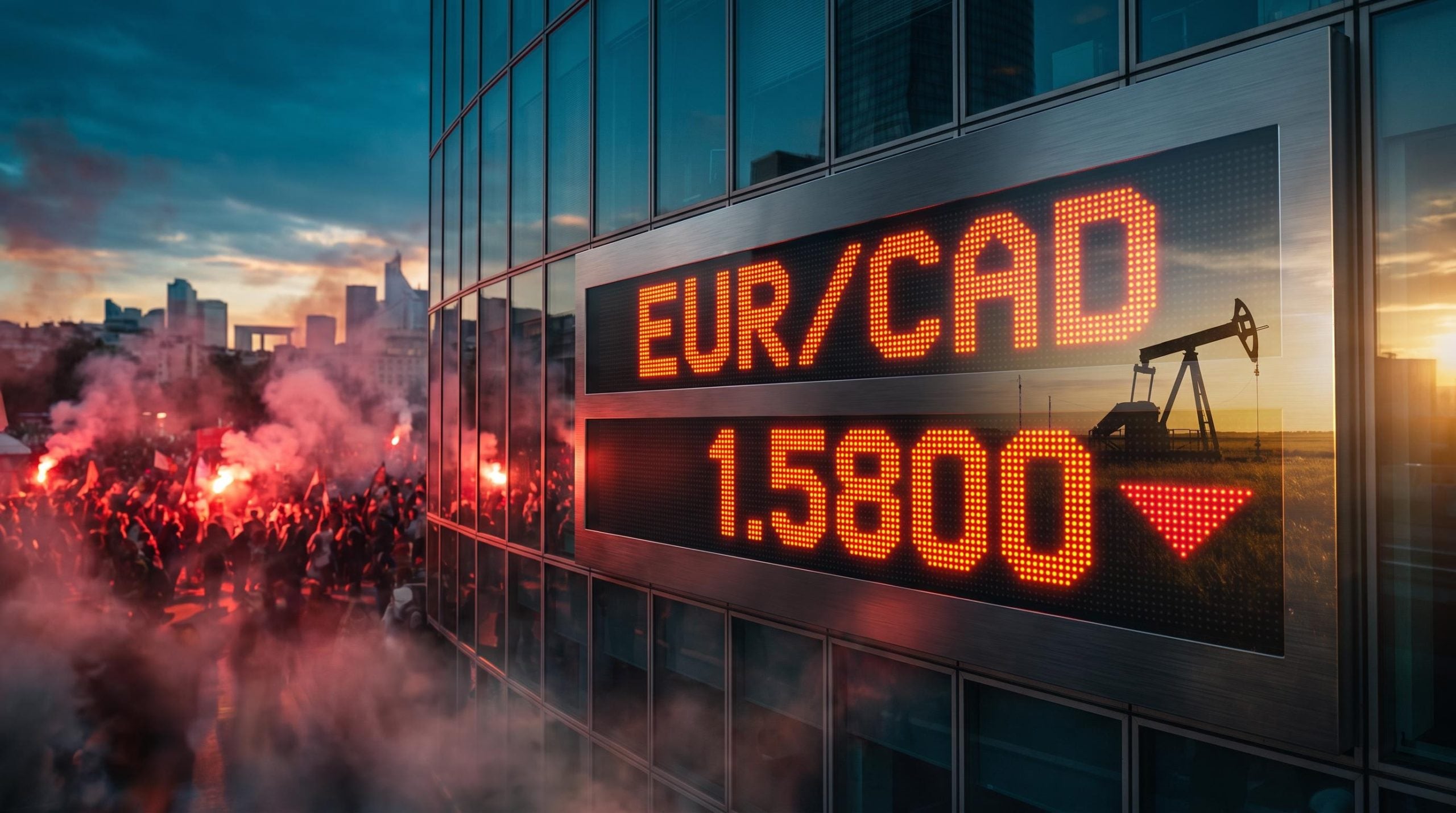
EUR/CAD slid toward 1.5800 on Monday, 19 October 2026, even though a slump in oil should have hit the Canadian dollar and pushed the cross higher. That makes this week’s EUR/CAD forecast harder to read than the chart suggests. One shock is dragging the pair down, another is pushing it up, and the net move hides both.
The pair opened with a bearish gap near 1.5805, having traded closer to 1.5940-1.5960 earlier in October. The slide did not start this morning.
Three forces are colliding this week. Cost-of-living unrest has spread through France and other European countries. Brent has fallen after Washington paused its Russia sanctions. The Bank of Canada (BoC) is due to decide on rates on 28 October.
This analysis gives you a way to judge which side of the cross is doing the work at any given moment. It also sets out which variables could change the outlook from here.
Why is EUR/CAD falling when oil is also hurting the Canadian dollar?
The price action so far
The screen looks contradictory. According to Pound Sterling Live, the session opened at 1.5805, reached a high of 1.5859 and dipped to a low of 1.5789. ActionForex recorded an early low near 1.5777. The gap between those figures reflects when each source took its snapshot, not a disagreement about direction.
Context matters more than any single tick. FXStreet placed the cross near 1.5940-1.5960 on 8 and 12 October, so Monday’s move extended a decline that was already under way.
How the cross nets out two shocks
A cross rate is the price of one currency expressed in another, with no US dollar involved. EUR/CAD tells you how many Canadian dollars one euro buys. The pair can fall because the euro weakens, because the Canadian dollar (CAD) strengthens, or both.
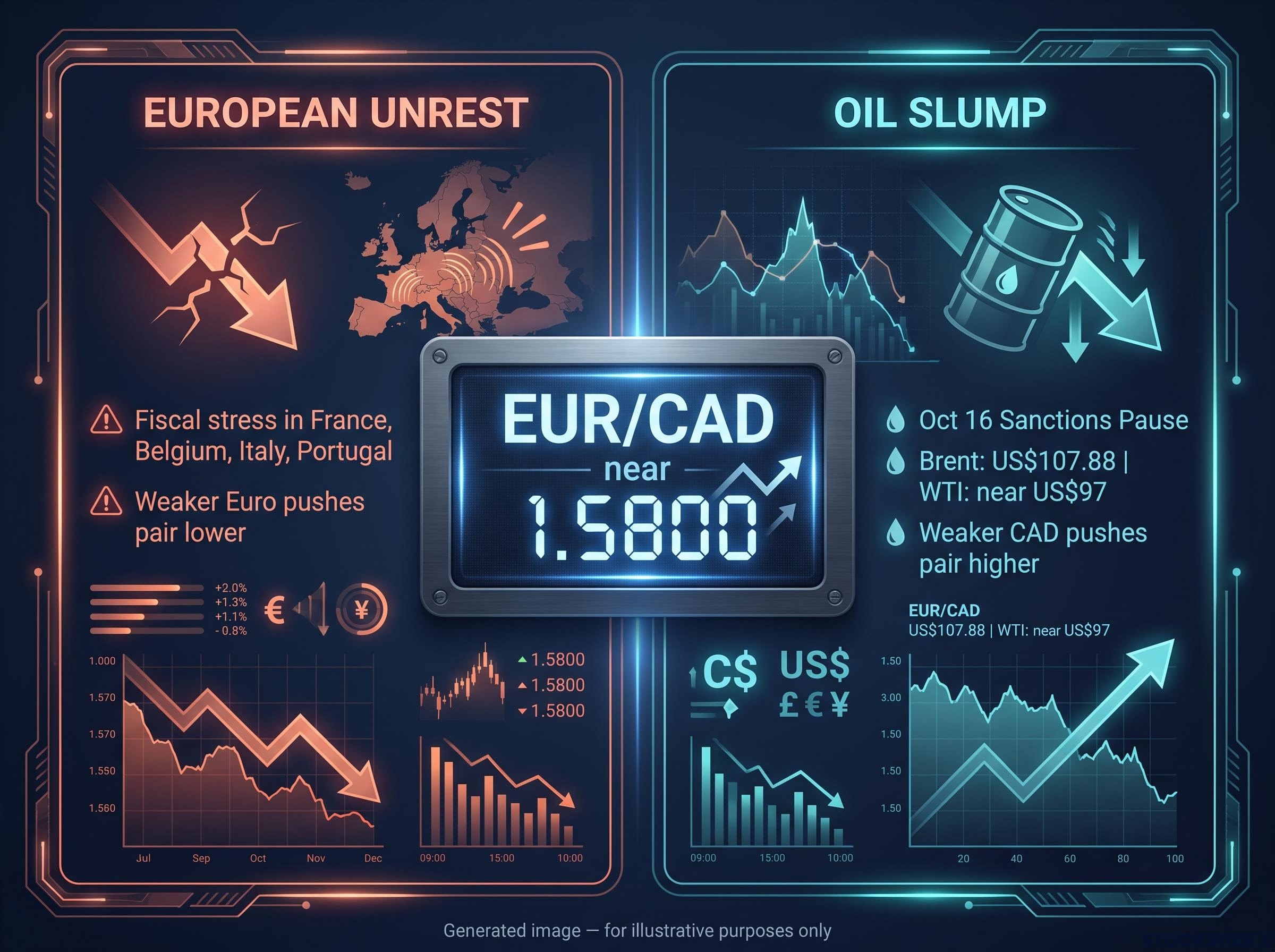
On Monday, both currencies were under pressure. TMGM described the cross as squeezed by European unrest and declining crude at the same time. Brent fell 1.80% to US$107.88 a barrel according to CNBC, while ATFX quoted US$108.43, down 1.30%, earlier in the Asian session. WTI traded near US$97.
| Driver | Currency affected | Direction of pressure | Effect on EUR/CAD |
|---|---|---|---|
| European unrest and fiscal stress | Euro | Weaker | Pushes lower |
| Lower crude after sanctions pause | Canadian dollar | Weaker | Pushes higher |
The cross fell, so the euro’s political shock outweighed the oil hit to CAD.
When you see EUR/CAD drop, ask which currency moved first. A falling cross is not a verdict on either economy.
When big ASX news breaks, our subscribers know first
How do you read the euro side of the pair?
The euro shock was the larger of the two on Monday. Here is a repeatable way to judge it: start with political risk, check European Central Bank (ECB) policy, then test both against the data.
Five ways unrest reaches the euro
Protests driven by the rising cost of living have hit France, Belgium, Italy and Portugal, with France seeing the largest demonstrations. French President Emmanuel Macron condemned the violence in a televised address on 18 October. Unrest can feed into the currency through five channels:
- Fiscal risk: protests make budget repair less credible, especially in France, where fiscal concerns were already prominent.
- Growth risk: strikes and disruption reduce activity and confidence.
- Risk premium: investors demand extra return to hold French and other vulnerable assets. A risk premium is the additional compensation investors require for taking on more uncertainty.
- ECB constraint: political stress alongside high inflation makes it harder for the ECB to support growth without damaging its inflation credibility.
- Contagion: investors may extend French stress to Italy, Portugal or Belgium.
The protests did not start the euro’s slide, though. Bloomberg reported on 5 October that EUR/USD had hit a 17-month low near 1.1161, driven mainly by France’s fiscal crisis and Spain’s snap-election risk. The unrest is better understood as a catalyst on top of an existing stress episode. Carsten Brzeski, ING Germany’s chief economist, has linked France’s turmoil to structural threats to the bloc’s stability.
The fiscal channel is visible in bond markets, where the OAT-Bund spread has crossed 130 basis points for the first time since the 2012 crisis and French 10-year yields have hit their highest level since 2002.
ING’s range view Chris Turner, ING’s head of global markets research, expects EUR/USD to stay capped within a 1.10-1.15 range over the next two quarters, given the broader policy and yield environment.
Fundamentals that anchor the euro
The euro is shared by 20 EU countries. Germany, France, Italy and Spain make up 75% of the eurozone economy. The ECB’s main job is price stability, which it defines as 2% inflation. Higher interest rates usually support a currency, and a trade deficit (importing more than you export) usually weighs on it. Check these three readings:
- ECB rate path: a 25 basis point hike on 10 September lifted the deposit rate to 2.50%, main refinancing to 2.65% and marginal lending to 2.90%. A basis point is one hundredth of a percentage point. The ECB projects inflation at 3.0% in 2026 and 2.5% in 2027.
- HICP inflation: the Harmonised Index of Consumer Prices, the eurozone’s official inflation measure, rose to 3.3% in August from 2.9% in July. The ECB’s statistics overview shows 3.8% for September, but without full release detail, so treat that figure with caution.
- Trade balance: Eurostat recorded a €16.1 billion deficit in August, against a €10.7 billion surplus in July.
The euro has rate support that political stress is partly cancelling out. Weigh the headlines against ECB signals rather than reacting to either alone.
What do oil and the Bank of Canada mean for the Canadian dollar leg?
If the euro explains most of the move, the CAD leg explains why it was not larger.
Oil’s two-way pull on CAD
President Donald Trump signed an executive order on 16 October pausing sanctions and tariffs on Russia under the Graham Act. That law had required tariffs of up to 500% on Russian goods and up to 100% on major buyers of Russian energy. Secretary of State Marco Rubio said the administration would take up to 60 days to assess the effects. The order keeps the waiver in place until officials decide further action is needed.
The market read the pause as more Russian supply reaching global markets, which lowers the premium traders pay for supply risk. That fed directly into the CAD.
Canada earns a large share of its export income from energy. Lower crude cuts expected receipts and weakens Canada’s terms of trade, meaning the price of its exports relative to its imports. All else equal, that lifts EUR/CAD.
There is a complication. Reuters reported on 17 October that BoC Governor Tiff Macklem expected persistently high oil prices to push the bank’s inflation forecast materially higher. Higher inflation forecasts point towards tighter policy, which supports the CAD. When crude falls, that hawkish case softens. Lower oil therefore hits the CAD twice: through trade and through rate expectations.
Where the BoC debate stands
The BoC’s policy rate sits at 2.25%, with decisions due on 28 October and 9 December. August CPI ran at 3.0%. September CPI is due today. RBC expects 3.0%, while other forecasts sit near 3.2%, and the result was not available at the time of writing.
Market pricing has swung sharply. Wealth Professional cited roughly 25% odds of an October hike and 88% for December. By 17 October, Reuters showed no change priced for either meeting.
The swings in BoC hike odds reflect a Fed-BoC gap now near 175 basis points, the widest since 2022, which pressures the Canadian dollar regardless of what the bank decides on 28 October.
| Institution | Expected timing of next hike | October stance |
|---|---|---|
| RBC | 2027 | Hold |
| TD | Data-dependent | Hold as base case |
| Scotiabank | October and December pencilled in | Hike |
| National Bank | October and December pencilled in | Hike |
Pricing flips between a hike and no hike within days. Treat any CAD view as provisional until today’s CPI print and the 28 October decision are out.
What could change the EUR/CAD forecast from here?
The cross depends on which shock lasts longer. The scenarios below are a framework, not a price call.
| Scenario | Leg affected | Likely effect on EUR/CAD |
|---|---|---|
| Oil rebounds or sanctions pause reversed | CAD | Lower, as CAD gains support |
| Sanctions pause persists | CAD | Limits downside, as oil stays soft |
| French fiscal stress worsens | Euro | Lower, as a persistent risk premium builds |
| Protests fade | Euro | Oil and relative rates become the main drivers |
| Strong Canadian CPI | CAD | Lower, as BoC hike odds rise |
| ECB inflation surprise | Euro | Higher, as part of the decline could reverse |
| Safe-haven US dollar flows | Both | Ambiguous, as EUR and CAD may both weaken |
The sanctions waiver is temporary by design, so the oil discount could unwind quickly. Safe-haven flows into the US dollar are harder to read, because they can weaken both legs and leave the cross roughly unchanged.
The dated catalysts, in order:
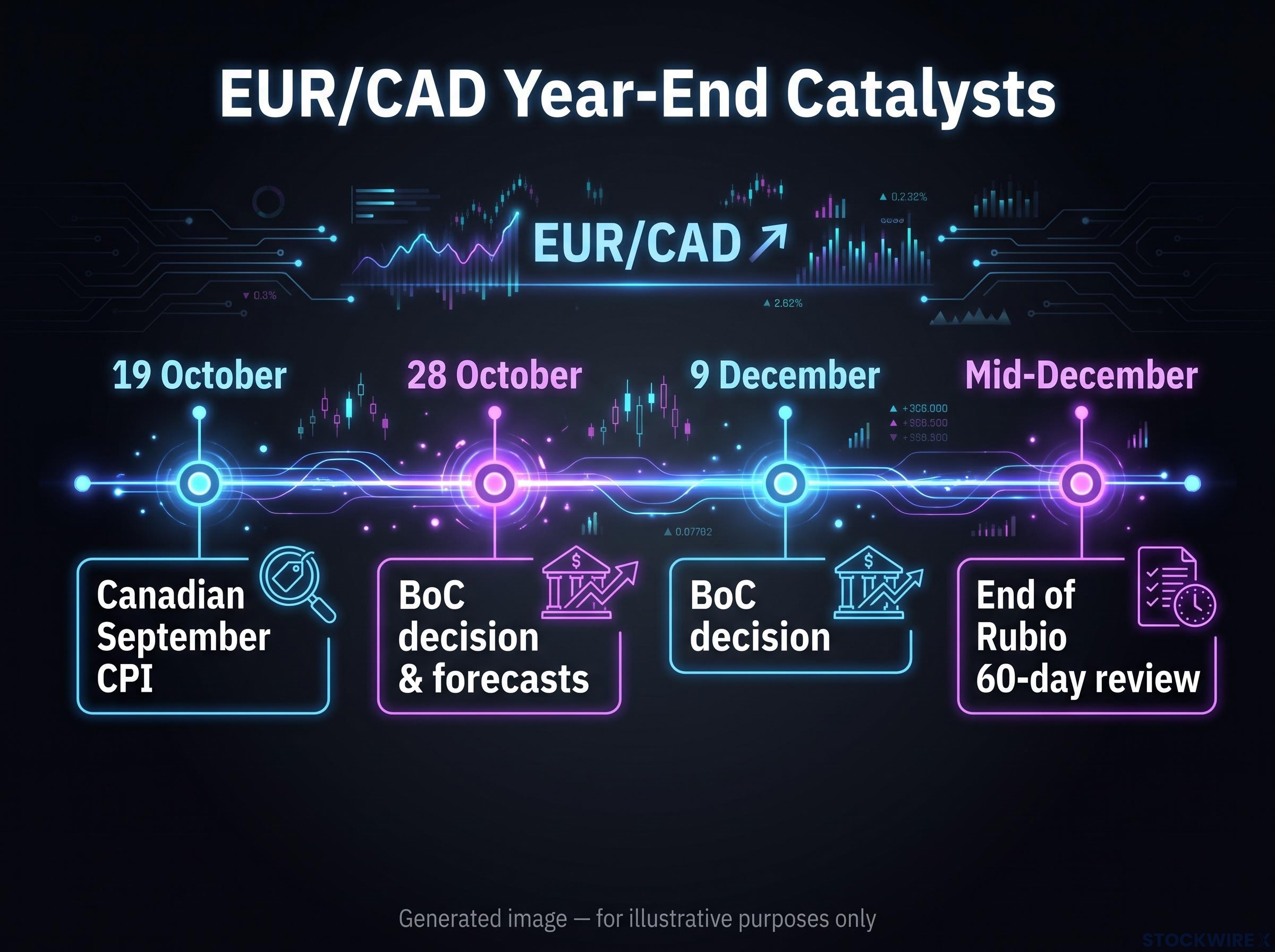
- 19 October: Canadian September CPI.
- 28 October: BoC decision, with new forecasts.
- 9 December: BoC decision.
- Mid-December (approximately): end of Rubio’s 60-day review window.
Track the oil trend and French political news side by side. Either one can take over as the main driver.
Past performance does not guarantee future results. These scenarios are speculative and subject to change as market conditions develop.
What the 1.5800 level does and does not tell you
The 1.5800 level reflects a euro risk premium outweighing an oil-driven dip in the CAD. It says nothing final about either economy, and the balance between the two shocks can shift quickly.
Three variables decide where it goes:
- Whether lower oil holds or the sanctions pause unwinds.
- The 28 October BoC decision and the CPI data feeding into it.
- France’s fiscal path and how the ECB responds to inflation.
Before the next catalyst, split any move into its euro and CAD components. Ask which shock is fading and which is building. That habit works on any non-USD pair.
This article is for informational purposes only and should not be considered financial advice. Investors should conduct their own research and consult with financial professionals before making investment decisions.