Larry Ellison set up a plan to sell $7.5 billion worth of Oracle stock. Twenty-four hours later, before a single share changed hands, he cancelled it.
The reversal landed on 12 September 2026, the same weekend Oracle’s shares had swung from a 7.8% intraday gain to close roughly 2% lower. The size of the cancelled sale, the speed of the about-turn, and Oracle’s simultaneous disclosure of an extra $700 million in restructuring costs turned a routine-looking filing into one of the year’s most scrutinised insider events.
Here is what the cancellation actually tells you about Ellison’s position, what it does not tell you, and why holding those two things apart matters before you draw any conclusion about Oracle stock.
A $7.5 billion sale plan that lasted exactly one day
The sequence is what makes this stand out, so it helps to walk through it with the clock running.
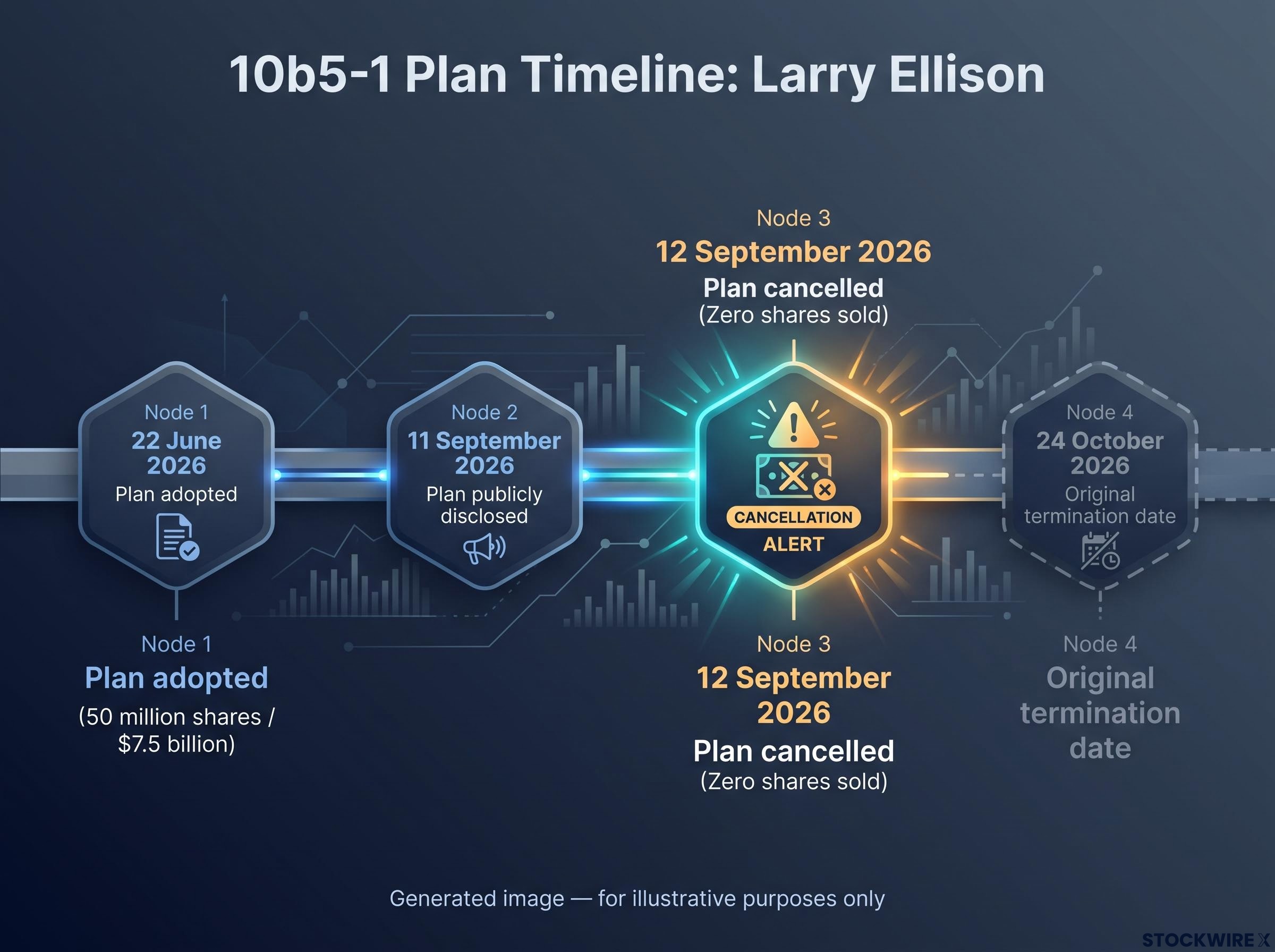
Larry Ellison, Oracle’s Executive Chairman, adopted a Rule 10b5-1 trading plan on 22 June 2026. Under that arrangement, he could sell up to 50 million Oracle shares, worth approximately $7.5 billion at prices around that time, according to Bloomberg and CNBC. The plan was set to run until 24 October 2026, subject to early termination under certain specified events.
Nothing about that is unusual on its own. Founders and executives use these plans constantly to sell stock in an orderly way.
What happened next is the unusual part.
- 22 June 2026: Ellison adopts the 10b5-1 plan
- 11 September 2026 (Friday): The plan is publicly disclosed
- 12 September 2026 (Saturday): Oracle announces the plan is cancelled, with zero shares sold
- 24 October 2026: The date the plan was originally scheduled to terminate
Oracle’s own statement left no room for interpretation on the outcome.
“No Oracle stock was sold under that plan, and he has no other plans to sell any of his Oracle stock.”
That is the anomaly in a single sentence: a plan disclosed on a Friday and scrapped by Saturday, before it ever executed. A plan cancelled before any shares move is a categorically different event from a partial sale that gets halted midway. Nothing was sold, no diversification occurred, and the compressed window between disclosure and cancellation is precisely what separates this from a routine plan withdrawal.
For anyone reading insider activity as a market signal, the exact sequence is the whole story. You are not looking at an executive who sold and stopped. You are looking at one who committed on paper and reversed within a day.
When big ASX news breaks, our subscribers know first
Why cancelling a 10b5-1 plan this fast raises regulatory eyebrows
The cancellation triggered attention not because it broke any rule, but because of what the rule it touches is designed to protect.
What Rule 10b5-1 is designed to do
A Rule 10b5-1 plan is a pre-scheduled trading arrangement. It lets a company insider commit to selling shares on a set timetable while they are not holding material non-public information, meaning private facts that could move the share price if made public.
The point is a safe harbour. By locking in the schedule while clean, the insider gains a defence against later accusations of insider trading, because the sales run automatically rather than on a fresh decision made with inside knowledge.
Recent SEC reforms added a cooling-off period, a mandatory gap between adopting a plan and the first trade under it, to close off the risk of insiders setting up and trading almost immediately. The whole architecture rests on one idea: commitment made in advance, in good faith.
Where this cancellation sits outside normal practice
That is why cancellation draws scrutiny. SEC Corporation Finance guidance (Q&A 120.18 and 120.19) states that cancelling planned transactions can call into question whether the plan was entered into in good faith, and can jeopardise the Rule 10b5-1(c) affirmative defence for other trades. Cancelling is treated as a modification that terminates the plan outright.
Academic analysis of insider abstention and Rule 10b5-1 plans has documented that cancelling a plan does not in itself trigger liability under Rule 10b-5, because terminating a plan fails the ‘in connection with’ requirement, yet serial or discretionary cancellations remain a focal point for regulators assessing whether plans were adopted in good faith.
Governance specialists take a similarly cautious line.
- A Simpson Thacher memo argues cancellations should be permitted only in unusual circumstances, and ideally only during an open trading window.
- A Harvard Corporate Governance analysis notes that serial or discretionary cancellations can undermine the perceived integrity of a plan and invite regulatory scrutiny, even when no trade occurs.
- The SEC’s Investor Advisory Committee has described the ability to cancel plans at will, even while holding inside information, as “upside-down.”
No named precedent of a same-scale, same-day cancellation was identified in the research, which is part of why the event stood out.
Here is what that means for you as a reader of these filings. No liability attaches to a cancellation with no trade behind it, so Ellison faces no legal exposure from scrapping the plan. But the SEC’s own framing treats plan cancellation as potentially inconsistent with good faith, which is why the market and financial press treated this as more than an administrative update. It is not a neutral act in the eyes of the regulator, and that framework is worth carrying into every future insider disclosure you read.
What the cancellation does and does not signal about Oracle
Pull back to the share price, and the cancellation looks like a clear positive. Then the wider picture complicates it.
Scrapping the plan removes a potential $7.5 billion block of founder selling from the market. TS2.Tech framed this as lifting a supply overhang, the technical downward pressure that hangs over a stock when investors know a large sale is coming. On that reading, the cancellation takes a ceiling off the share price in the near term.
The trouble is the rest of the insider record. According to GuruFocus, Oracle insiders registered roughly $140.2 million in net sales and zero purchases over the prior 12 months. One cancelled plan does not turn a year of net selling into a founder-confidence story.
Corporate insider selling across US markets ran at an 11:1 sell-to-buy ratio in H1 2026, the second-highest on record, with insider buying sitting near a seven-year low; Oracle’s 12-month net sale figure of approximately $140.2 million places it squarely within a broader pattern of executive caution about current valuations.
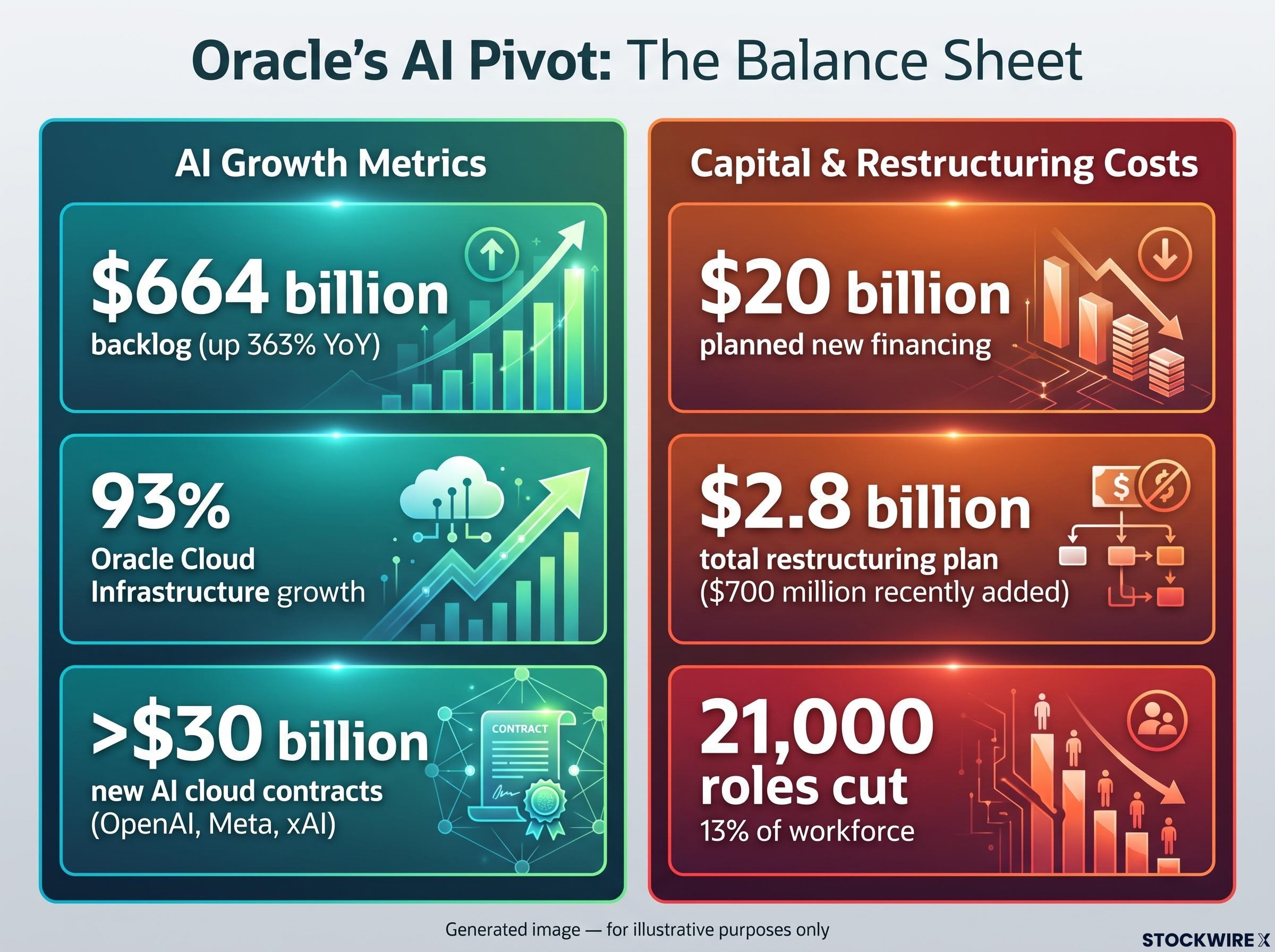
The business backdrop pulls in two directions at once. Oracle’s revenue backlog reached approximately $664 billion, up roughly 363% year-over-year, powered by more than $30 billion in new AI cloud contracts booked in a single quarter, with Oracle Cloud Infrastructure growing 93% and customers including OpenAI, Meta and xAI. Yet analyst commentary flagged that a free-cash-flow recovery remains some way off, which is why the stock reversed from +7.8% intraday to close about 2% lower on 11 September 2026, the same day Oracle disclosed an additional $700 million in restructuring costs.
Oracle Q1 2027 earnings delivered 30% year-over-year revenue growth and adjusted EPS that beat consensus by approximately 11%, but six consecutive quarters of negative free cash flow and a capital expenditure programme of up to $95 billion for the full fiscal year define the bull case’s central tension.
The cancellation “does not, however, put a dollar into Oracle’s treasury or change the capital bill behind its AI-cloud expansion.” (TS2.Tech)
| Signal | Bullish read | Counterpoint | Weight for investors |
|---|---|---|---|
| Plan cancellation | Removes $7.5B supply overhang; founder not selling | Adds no cash; may reflect optics amid restructuring | Moderate, near-term only |
| Backlog growth | ~$664B RPO, up ~363% YoY on AI demand | Signed contracts are not realised free cash flow | High, if it converts |
| 12-month insider selling | Cancellation breaks the selling run | ~$140.2M net sales, zero purchases over 12 months | Tempers the confidence read |
| Restructuring cost rise | Cost-structure improvement to fund AI | +$700M lifts total to ~$2.8B; execution risk | Watch closely |
So read the cancellation for what it is. It lifts a near-term ceiling on the share price. It does not resolve the year-long pattern of insider selling, and it does nothing for the cash-flow debate that actually moved the stock the day before. Treating one executive’s decision as a directional call on Oracle would mean ignoring both.
The risk picture retail investors need alongside the headline
Whatever you make of the cancellation, a specific set of risks sits underneath it, untouched by whether Ellison sells.
- Capital spending and financing: Oracle has flagged roughly $20 billion in planned new financing on top of existing debt to fund AI infrastructure, raising balance-sheet and execution risk.
- Restructuring execution: The 2026 Restructuring Plan totals approximately $2.8 billion, with $1.78-1.84 billion already booked and more than 21,000 roles cut, around 13% of the workforce.
- Backlog conversion timing: Management expects about half of the $664 billion backlog to convert within 36 months, but that is guidance, not a guarantee, and signed contracts are not the same as realised cash.
- Customer concentration: A large share of the AI backlog ties to a handful of major customers, OpenAI, Meta and xAI, so any change in those relationships carries outsized weight.
- Macro and regulatory risk: Anything that slows AI demand or constrains data-centre expansion weakens the case regardless of insider activity.
The customer concentration risk embedded in Oracle’s backlog is more acute than the headline figure suggests: approximately $300 billion of the $664 billion in remaining performance obligations is attributable to a single private counterparty, OpenAI, which must scale its own revenue several times over to honour those commitments.
Institutional opinion is genuinely split. Coverage referencing Oppenheimer, Guggenheim and Morgan Stanley describes a divide between aggressive AI upside scenarios and caution over debt, negative free cash flow and customer concentration. There is no consensus verdict to lean on here.
How to use insider signals without over-reading them
A plan cancellation is one data point. On its own, it is neither a buy signal nor a sell signal, and Ellison’s is no exception.
GuruFocus and Finimize both caution that the full insider picture carries more information than a single event. Twelve months of net selling worth approximately $140.2 million, with no purchases, tells you more about how Oracle insiders have actually behaved than one reversed plan does about how one of them feels.
The honest job in front of you is a financial one, not a sentiment one: assess whether Oracle’s AI backlog converts to cash fast enough to service a debt load carrying a planned $20 billion raise and a $2.8 billion restructuring charge. The cancellation does not answer that. It just removes one distraction from the question.
What the next 36 months will actually tell investors about Oracle’s AI bet
The debate opened this week gets settled by conversion, not by insider filings. The $664 billion in remaining performance obligations will either validate Oracle’s AI pivot through accelerating free cash flow, or expose the gap between contract signings and cash generation.
Four metrics will carry the answer.
- OCI revenue growth rate: Currently running at 93%. Watch whether that pace holds as the backlog scales.
- Free cash flow trajectory: The variable that reversed the stock this week. Sustained recovery is the bull case’s missing piece.
- AI contract-to-capex ratio: More than $30 billion in new AI cloud contracts landed in a single quarter, but the cost to serve them, alongside a planned $20 billion in new financing, decides whether growth pays for itself.
- Restructuring cost progress: The $2.8 billion programme is ongoing, with no completion date specified in the available reporting. Its effect on operating costs will show up in margins over coming periods.
For anyone holding Oracle stock or watching it, the honest read is narrow. The cancellation removes a near-term $7.5 billion supply overhang. It does not resolve the central question of whether Oracle’s AI revenue converts quickly enough to fund its own expansion.
That makes the next several earnings reports and interim filings far more informative than one insider disclosure. Ellison’s decision not to sell is an early data point in a long story, not the story itself.
This article is for informational purposes only and should not be considered financial advice. Investors should conduct their own research and consult with financial professionals before making investment decisions. Past performance does not guarantee future results. Financial projections are subject to market conditions and various risk factors.
One signal removed, one story far from over
Put the week together and a pattern emerges: strong quarterly results, a $700 million increase in restructuring costs, a sharp intraday share-price reversal, and a 24-hour cancellation of a $7.5 billion sale plan. That is the profile of a company deep in an aggressive pivot, not a settled investment.
The cancellation is real, and by the standards of Rule 10b5-1 governance it is unusual. But it answers a narrow question, whether Ellison will sell right now, and leaves the larger ones wide open: when does the backlog convert, can Oracle service its debt load, and does the restructuring deliver the cost savings it promises?
Those answers arrive in the numbers, not the filings. The next several Oracle earnings reports will tell you substantially more than any single insider trading disclosure ever could.
For investors wanting a broader framework for interpreting executive credibility signals, our dedicated guide to founder governance signals examines how management transparency and board structure interact to shape the market’s long-run valuation of a company’s disclosure behaviour.