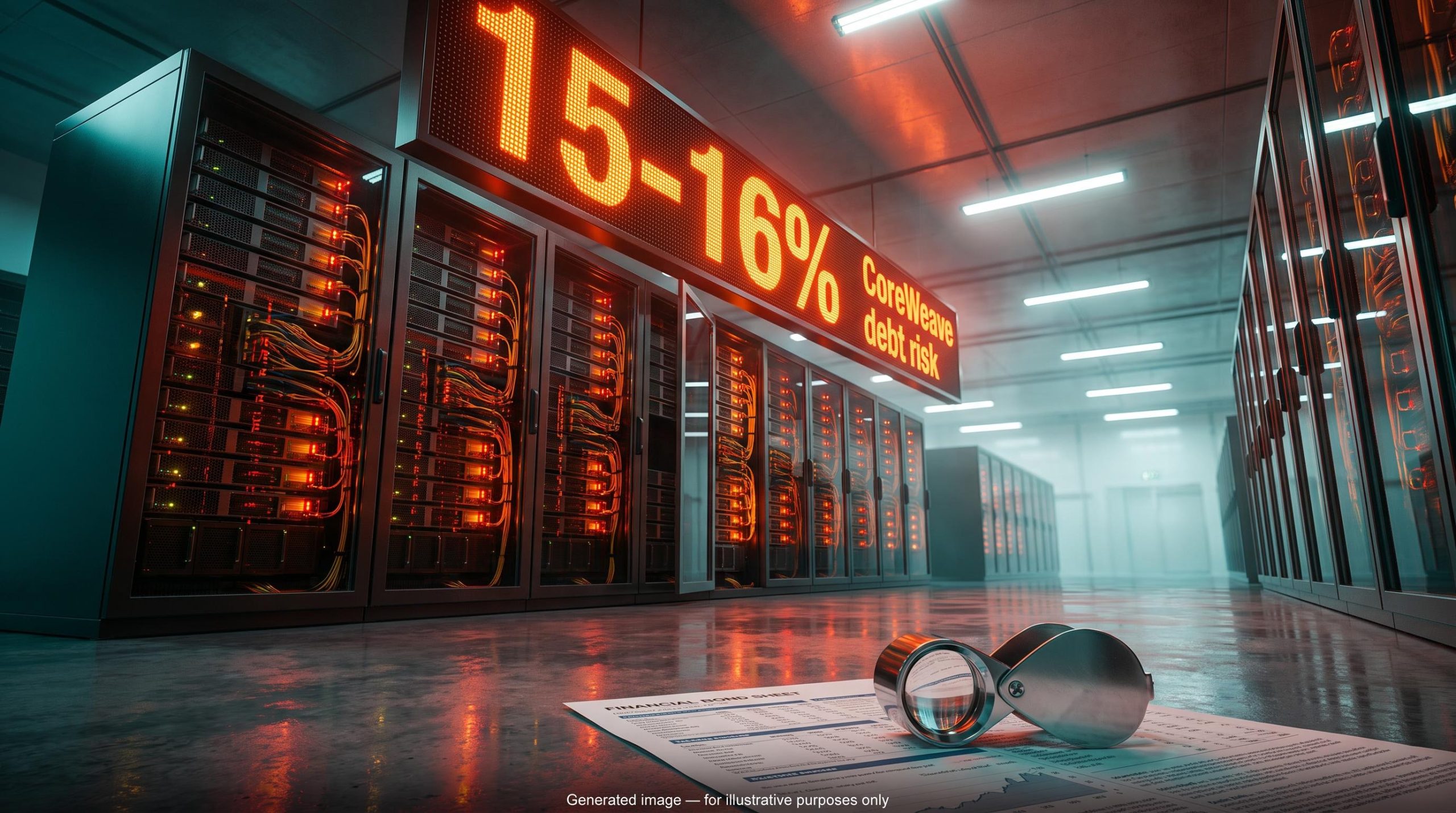
CoreWeave carries a contracted backlog of roughly $104 billion. Its longest-dated bonds trade at yields near 15-16%. Those two numbers sit side by side in almost every report on the company’s debt risk, and the backlog alone cannot settle the question they raise: who actually bears the risk if the AI buildout slows?
The question became urgent last week. CoreWeave shares fell 15.46% on 14 October 2026 and roughly 24% over the week, according to Reuters, as its bonds sold off hard.
That makes this more than a single-stock story. As of 21 October 2026, the rout is a live test of how AI infrastructure gets funded, and of how far stress can travel through that structure.
Here you will find a way to judge leverage and financing risk in any AI infrastructure stock, along with a clear line between what the evidence proves and what it only suggests.
What the CoreWeave bond rout actually tells you
Start with the market. CoreWeave’s 2031 bonds climbed to about 16% in yield, with some 2032 bonds near 14.8-15% (Reuters, CNBC). Its credit default swaps (CDS), contracts that pay out if a borrower defaults, priced at roughly 1,000-1,200 basis points, a level that signals serious default concern.
The bond market stress around CoreWeave surfaced in its 2032 notes before it showed up in the share price, with the debt trading well below par while equity investors were still weighing the backlog.
Then look at what the company owes. Reported debt was $35.6 billion at 30 June 2026, plus $16.3 billion of operating leases. Some coverage cited about $51.6 billion, which appears to fold in leases and other financing.
The interest bill is moving faster than either. Net interest expense hit $640 million in Q2 2026, up from $267 million a year earlier, and Q3 guidance sits at $860-$940 million. Revenue grew 112.3% to $2.58 billion in Q2, yet borrowing costs are compounding alongside it.
| Metric | Latest figure | Date |
|---|---|---|
| Reported debt | $35.6B | 30 June 2026 |
| Operating leases | $16.3B | 30 June 2026 |
| Q2 net interest expense | $640M | Q2 2026 |
| Q3 interest guidance | $860-$940M | Q3 2026 |
| 2031 bond yield | About 16% | 15-16 October 2026 |
| CDS | 1,000-1,200 bp | Week of 12-16 October 2026 |
HSBC analyst Abhishek Shukla puts the core problem in one comparison, reported in secondary coverage because the note itself was not publicly available.
Return versus cost HSBC estimates CoreWeave’s average return on invested capital (ROIC, the profit generated on money put into the business) at 8.9% for 2026-30. The company’s bonds yield 15-16%.
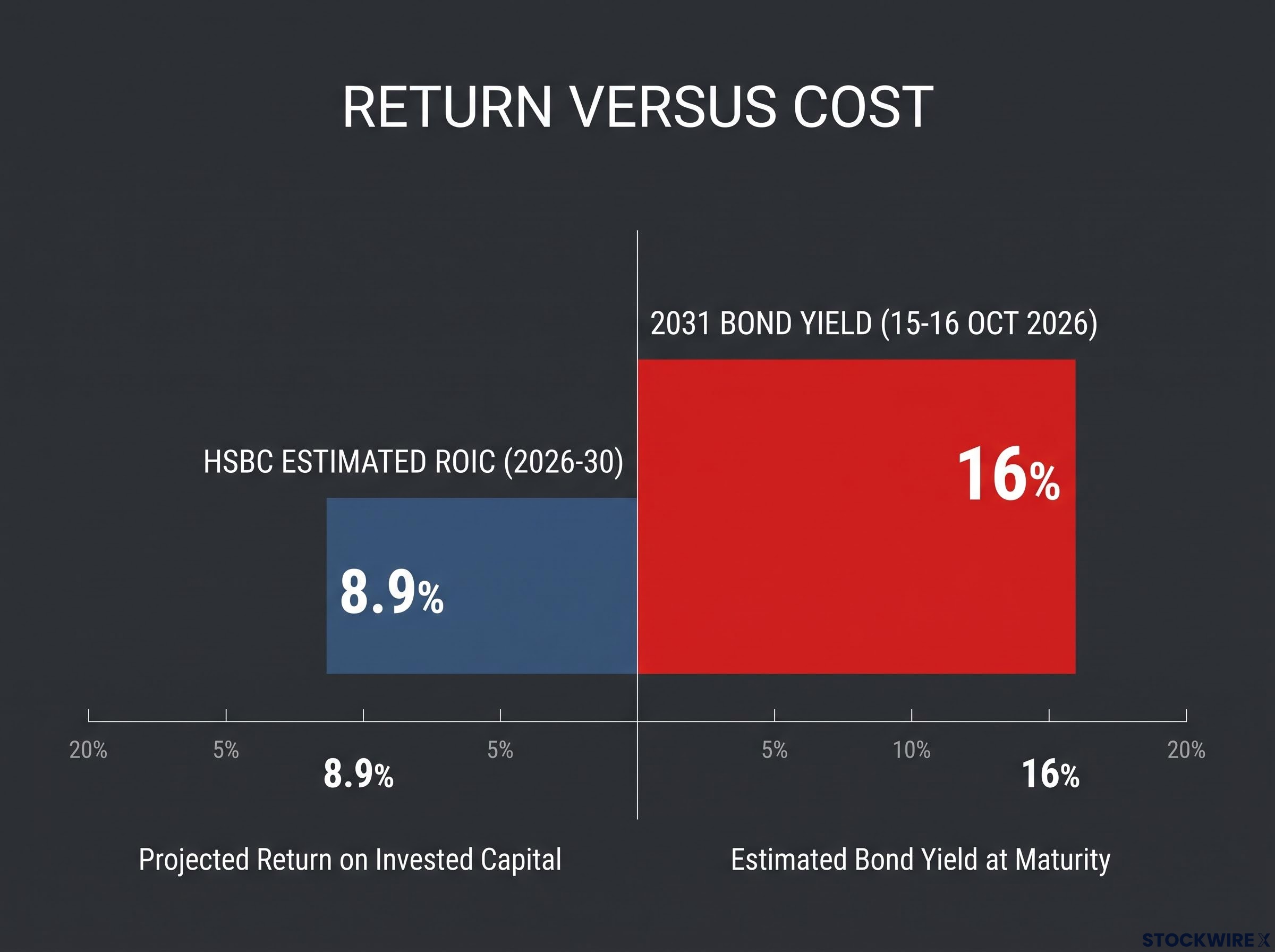
If a company borrows at 15% to build assets expected to earn under 9%, each new dollar of growth can destroy value. That tells you revenue growth on its own proves very little about financial health.
George Noble of Noble Capital Advisors goes furthest, calling CoreWeave his largest short and seeing a good chance of bankruptcy. Chamath Palihapitiya and Elon Musk amplified the bond yields publicly, but those posts were signals, not credit analysis.
When big ASX news breaks, our subscribers know first
Is the backlog a shield or a deferral of risk?
The bull case deserves a fair hearing. Deutsche Bank’s George Zelnick kept a Buy rating and $150 target after the sell-off, arguing most backlog is long-term take-or-pay (customers pay whether or not they use the capacity) and that about 60-65% sits with investment-grade customers. J.P. Morgan upgraded to Overweight with a $125 target.
| Source | Stance | Core reasoning |
|---|---|---|
| Deutsche Bank | Bullish | Take-or-pay contracts cover project costs |
| J.P. Morgan | Bullish | Demand, premium short-term contracts, backlog |
| HSBC | Bearish | 8.9% ROIC below borrowing costs |
| Reuters credit coverage | Bearish | Yields, CDS and rising interest expense |
| George Noble | Bearish | Debt, depreciation and unit economics |
The dispute turns on one question: does take-or-pay move demand risk off CoreWeave, or just push it into the future? A contract only protects the lender if the customer can and will pay.
Backlog is not cash, profit or unencumbered value. OpenAI reportedly holds up to $22.4 billion of CoreWeave contracts, a concentration that matters if one customer renegotiates or struggles. Backlog quality also depends on how much is estimates or options.
Some of the yield spike may reflect rate fears or technical selling rather than fundamentals. So treat backlog as a claim on future payments, worth only what customer credit and contract enforceability make it worth, rather than a figure to set directly against debt.
How circular financing and GPU depreciation stretch the balance sheet
To see why the backlog is harder to value than it looks, follow the money around one loop:
- Nvidia sells graphics processing units (GPUs), the chips that run AI models.
- Operators such as CoreWeave borrow to buy them.
- AI companies commit to renting that compute.
- Those commitments support more borrowing, and more Nvidia purchases.
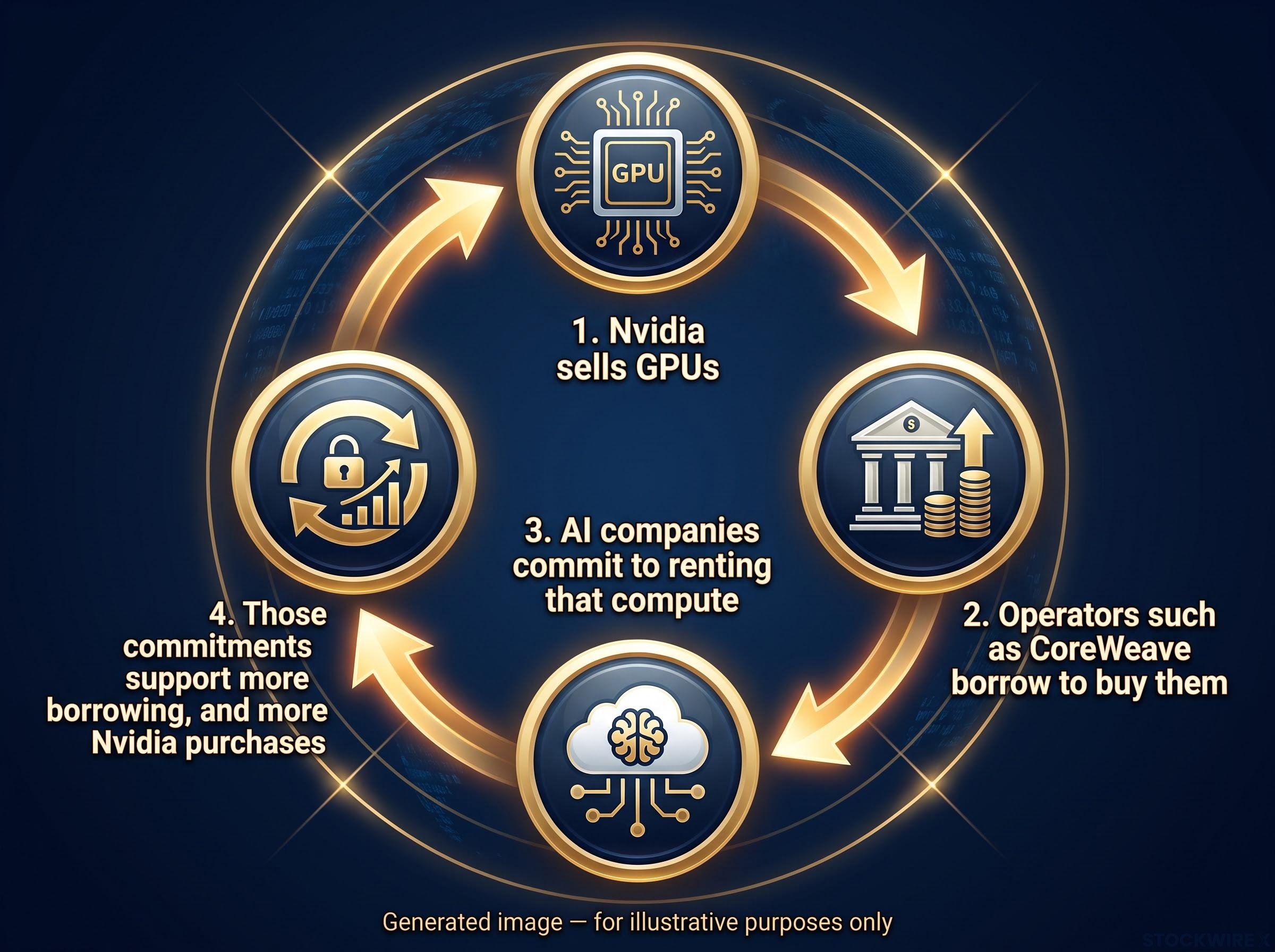
The same chip is the product, the collateral for the loan and the basis for next year’s orders. Nvidia has announced arrangements with Apollo, BlackRock, Blackstone, Brookfield, Goldman Sachs and KKR to build compute-financing platforms able to mobilise more than $500 billion of third-party capital, and has reportedly provided residual-value support (a promise about what equipment will be worth later) on some projects.
Noble argues vendor financing and related-party deals are legal under accounting rules but can obscure the real economics.
The Bank for International Settlements has flagged circular financing loops of this kind, warning that internally recognised revenue can mask how much independent end-user demand actually exists behind hyperscaler and neocloud compute deals.
Why useful-life assumptions matter
Depreciation spreads a chip’s cost over its expected working life. A longer life means a smaller annual charge and higher reported profit.
| Company | GPU useful life |
|---|---|
| CoreWeave | 6 years |
| Lambda | 5 years |
| Nebius | 4 years |
Critics argue accelerators may be economically obsolete in two to four years. A public critique attributed to Michael Burry estimates an industry-wide depreciation understatement of about $176 billion for 2026-28; it is not a filing or rating-agency figure. Older GPUs do still serve inference work, and power and facilities last decades.
Check depreciation policy before you trust any earnings multiple in this sector.
Why AI financing depends on ever-higher private valuations
The loop has an upstream source. Much of the demand comes from OpenAI and Anthropic, which burn cash and fund themselves through private rounds. Noble’s argument is that those valuations must keep rising for the structure to hold, and that slowing appreciation is the warning sign.
The marks are large. Anthropic was last valued privately at about $965 billion after a reported $65 billion round, while OpenAI is reportedly seeking funding at potentially above $1.4 trillion. Noble argues 45% revenue growth cannot justify $1.5-2 trillion.
Both firms filed confidentially for IPOs in June 2026. Reuters reports Anthropic expects a mid-November debut, with investors pushing back on a roughly $2 trillion valuation toward $1.5 trillion.
A crack in the window Nvidia-backed Australian data-centre operator Firmus withdrew its planned $5 billion IPO on 9 October 2026, citing market volatility.
None of that is collapse. It is friction, and the comparisons people reach for each fit only partly.
| Precedent | What it resembles | Where it fails |
|---|---|---|
| Dot-com telecom | Borrowing to build ahead of demand | AI compute has real current demand |
| 2006-08 housing | Long chains, optimistic collateral | No comparable household leverage |
| 1990s vendor financing | Supplier-supported sales | Nvidia has genuine outside demand |
| Data-centre leasing | Long leases, shorter contracts | Scarce power keeps sites valuable |
The demand behind the debt is itself financed by private-market optimism. A softer IPO window raises risk for every borrower downstream.
Where contagion could land, and where the evidence stops
The nearest spillover is already visible. During the rout, Reuters reported Nebius fell about 10%, and Applied Digital and IREN about 9%; no Cipher-specific move was found. From there, the channels widen:
- Peer refinancing: distressed CoreWeave yields raise borrowing costs for similar operators.
- Collateral markdowns: falling GPU values could force more equity or tighter terms.
- Delayed-draw term loans: lenders could cut or reprice later draws; JPMorgan argues this structure limits bank damage.
- Nvidia: weaker borrowers mean fewer orders and possible residual-value losses.
- Oracle: heavy capex and long leases test an investment-grade balance sheet.
- Private credit: loans are not continuously marked, so public bonds can reveal stress first; Reuters called this a stress test.
- S&P 500: tech is about 40% of the index, per Noble.
Oracle: the investment-grade version of the same question
S&P cut Oracle to BBB-, one notch above junk, on 9 July 2026. Its fiscal year ends 31 May.
| Metric | Figure |
|---|---|
| Debt (31 May 2026) | About $129.5B |
| FY2026 free cash flow | -$23.7B |
| FY2027 capex guidance | $90-95B |
| New lease commitments | About $260B, 15-19 year terms |
| Quarter to 31 August 2026 | Capex $28.5B vs operating cash flow $23.1B |
Your exposure is probably wider than the stocks you hold, because index funds, pensions and private-credit allocations can carry it indirectly. Still, no IMF, Bank of England or Federal Reserve position on this episode was found. The evidence supports repricing risk, not a systemic crisis.
For readers wanting the investment-grade case in depth, our full explainer on Oracle’s credit downgrade examines how OpenAI counterparty concentration shapes the backlog’s credit quality.
A five-question framework for judging AI infrastructure leverage
Each question below ties back to evidence already shown:
- Does return on capital beat all-in borrowing cost? CoreWeave’s 8.9% ROIC against 15-16% yields fails this test.
- How strong are contracts and customers? Investment-grade, take-or-pay backlog helps; OpenAI concentration cuts the other way.
- Are depreciation and residual values realistic? A six-year life is the longest among peers.
- How long is the refinancing runway, including leases? Fitch flags Oracle above about 3.5x EBITDA, or 4x including rents.
- How much depends on vendor or private-valuation financing? Both companies lean on AI labs whose funding rests on rising marks.
Neither scorecard is a buy or sell call. CoreWeave still has a $104 billion backlog and 112.3% revenue growth; Oracle still holds an investment-grade rating. Use the questions to separate debt funding contracted, profitable capacity from debt that needs valuations to keep climbing.
What the stress test proves, and what it does not
The evidence supports a serious debt case at 15-16% borrowing costs. It does not prove AI demand is fictional, or that a systemic crisis is underway.
Three markers will sharpen the picture: Anthropic’s reported November listing and its final price, CoreWeave’s Q3 interest expense against the $860-$940 million guidance, and Oracle’s next lease and capex disclosures. If returns stay below borrowing costs while IPO pricing softens, the bear case strengthens; if contracts hold and listings clear, the backlog earns more credit.
Your decision rests on contract enforceability, customer credit, GPU residuals, refinancing access and returns above the cost of capital.
This article is for informational purposes only and should not be considered financial advice. Investors should conduct their own research and consult with financial professionals before making investment decisions. Past performance does not guarantee future results, and forward-looking estimates cited here are subject to market conditions and change.