A 10-year Treasury yield at its highest since 2002 is supposed to punish anything that pays nothing. The 10-year closed at 5.31% (intraday high near 5.35%), and the commodities vs bond yields argument looks simple on its face: a government coupon against a barrel of oil, an ounce of gold, a tonne of copper.
Yet Brent sits near $100, gold holds around $4,167 and copper is firming.
Supply is the immediate test. The Treasury is reopening a $39 billion 10-year auction on 7 October and selling $22 billion of 30-year bonds on Thursday.
Here is a way to judge whether a given commodity is fighting yields or being carried by something stronger. It starts with why yields are rising, then tests oil, gold and copper against it.
Why are yields rising, and does the reason matter for commodities?
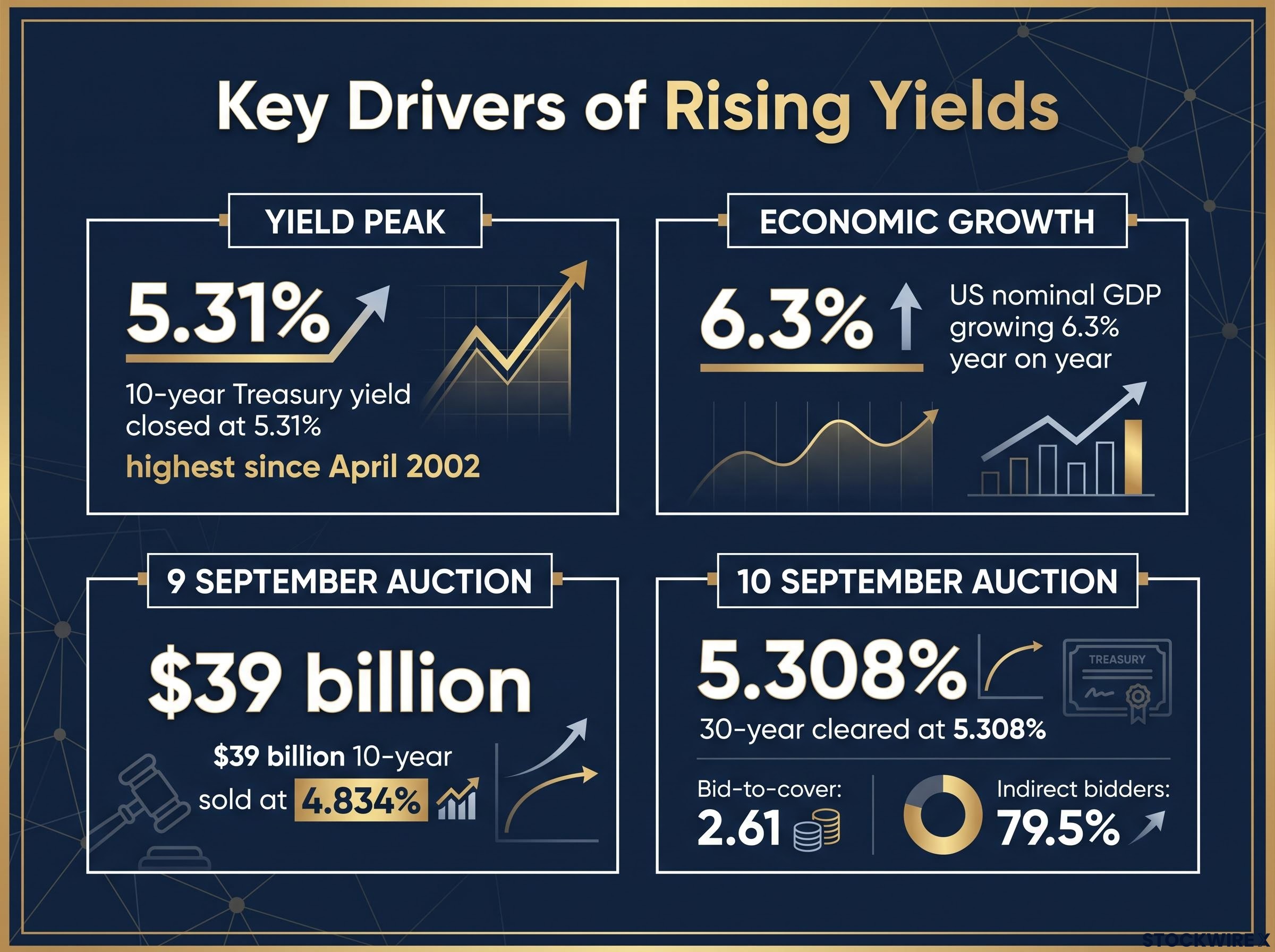
Key level The 10-year Treasury yield closed at 5.31%, its highest since April 2002.
Other sources cite a peak slightly above 5.34%; the differences are immaterial. What matters is the cause.
The four drivers
- Growth and inflation resilience: US nominal GDP is growing about 6.3% year on year, and the ISM services prices-paid reading was very strong.
- Rising term premium: the extra yield investors demand for holding long bonds is normalising after years of quantitative easing.
- Debt supply and fiscal sustainability: the 9 September 10-year auction sold $39 billion at 4.834%, the highest 10-year auction yield since August 2007. The 10 September 30-year auction cleared at 5.308%, with a bid-to-cover of 2.61 and indirect bidders taking 79.5%.
- Global portfolio and regulatory shifts: capital rules, ageing populations and higher investment needs may be lifting real yields.
Cyclical versus structural views
The cyclical camp argues long yields could retrace sharply if growth slows. The structural camp argues the equilibrium real rate and term premium will stay above 2010s levels even in a downturn. Both cases are credible.
| Factor | Yields rising on growth | Yields rising on fiscal/term-premium stress |
|---|---|---|
| Typical cause | Strong activity, sticky inflation | Heavy issuance, debt worries |
| Cyclical commodities | Generally supportive | Mixed |
| Gold | Less supported | Insurance appeal can rise |
For you, identifying the dominant cause is the most useful filter in this piece. The same 5% yield means opposite things for copper and for gold depending on where it comes from.
Economists judge debt sustainability by comparing borrowing costs with nominal growth, and the CBO projects that crossover around fiscal year 2031, which is why heavy auction supply draws so much scrutiny.
When big ASX news breaks, our subscribers know first
Can oil restocking outweigh a high-rate drag on demand?
The bullish case is easy to like. Saudi Aramco, the state producer, says stockpiles are very thin and rebuilding would take roughly two years, even if US-Iran tensions are resolved.
“Rebuilding thin inventories would take about two years, even with a US-Iran resolution.” (Saudi Aramco, paraphrased)
Near-term signals sit awkwardly beside that. Oil fell 1.9% overnight with Brent around $100, and flows through the Strait of Hormuz in a narrow window point to ample supply.
Then come the forces that could cap the story:
- Demand destruction: tight financial conditions can curb transport, petrochemical and industrial demand faster than restocking adds it.
- Supply response: OPEC+ spare capacity and US shale can return barrels if prices spike.
- Energy transition: efficiency gains and substitution from EVs and renewables limit long-term upside.
What the Aramco discount signals
Aramco set its November Arab Light price for Asia at $5 below the Oman/Dubai average, versus $2 in October. That is the widest discount since June 2020 and a six-year low for Asian pricing.
It raised northwest Europe and Mediterranean prices by $3 and left US prices unchanged. The split reads as a market-share and demand-management move in Asia, not simply a bearish signal.
For you, restocking is a floor rather than a rally catalyst. It matters most if you fear downside in energy exposure, and least if you want a breakout.
Why do central banks keep buying gold when Treasuries pay more than 5%?
Gold pays no coupon, and Treasuries now pay over 5%. The objection is fair, and it misses what central banks are buying.
The Bundesbank accepts that higher yields raise bond appeal. It argues rising debt heightens credit-risk concerns and that geopolitics shapes reserve decisions.
The Bundesbank says the case for central bank gold diversification remains strong despite higher yields (paraphrased).
Gold carries no default risk and hedges currency and inflation shocks. For some emerging-market reserve managers it is also neutral against sanctions and dollar concentration.
Central bank gold buying has run for thirteen consecutive years, a record of sustained accumulation that explains why reserve managers look past coupon income.
Gold steadied around $4,167, near multi-year highs. Exchange-traded funds (ETFs) were net buyers while hedge funds were net sellers.
| Participant | Behaviour | Horizon and yield sensitivity |
|---|---|---|
| Central banks | Emphasise diversification | Long; low sensitivity |
| ETFs | Net buyers | Medium; moderate |
| Hedge funds | Net sellers | Short; high |
The buyers that matter most are not yield-sensitive the way fast money is. The split suggests two time horizons, not a contradiction.
Three risks to the case:
- A stable, low-inflation world with credible fiscal policy favours interest-bearing assets.
- Falling inflation expectations or a dollar rally can pressure prices.
- Gold liquidity can dislocate in crises.
Treat gold as portfolio insurance, not an income substitute, and size it accordingly.
Is copper tight enough to beat high rates, and what does that mean for South32 versus BHP?
London Metal Exchange (LME) copper rose about 1.2-1.3% overnight. Supply is constrained by Chilean labour talks, Peru, permitting delays and declining ore grades.
Demand from electrification, grids and data centres could outpace new supply even at higher rates. Visible inventories have at times been low.
South32 versus BHP
South32 is the more focused copper expression, with underlying EBIT split 53% copper, 29% zinc/lead/silver and 18% manganese. BHP offers scale, iron ore-centred diversification, balance-sheet strength and often lower unit costs. Both report on a July-June financial year.
| Factor | South32 | BHP |
|---|---|---|
| Copper exposure | Higher proportional (53% of EBIT) | Lower share of mix |
| Diversification | Base metals, manganese | Iron ore, copper, coal |
| Balance sheet | Less emphasised | Stronger |
| Yield sensitivity | Higher leverage to copper | More defensive |
Higher real yields raise discount rates on long-dated projects and compress valuations for both. This is a framing for your own research, not a recommendation.
The choice is concentrated copper leverage versus a more defensive balance sheet. A rising-yield, slower-growth scenario favours the latter.
For readers weighing the supply case, our detailed coverage of copper’s record high separates tariff front-running from genuine scarcity and explains the 25-40% correction risk.
A framework for weighing commodities vs bond yields
Real yields are yields after inflation. Term premium is the extra return for locking money up long. Opportunity cost is what you give up by holding an asset that pays nothing.
High yields do not hurt every commodity equally. History is the calibration:
| Period | Backdrop | Commodity outcome | Main reason |
|---|---|---|---|
| Early 1980s | Very high real yields | Lower prices | Demand destruction, recessions |
| 2004-2007 | Rising yields | Bull markets | Robust growth, China |
| 2021-2022 | Inflation, supply shocks | Support, then pressure | Slowing growth, tighter policy |
Commodities struggled only when high yields caused recession. The risk to watch is a growth break, not the yield level.
- Ask what is driving yields: growth or fiscal and term-premium stress.
- Ask whether a physical supply constraint exists.
- Ask whether the asset serves income, insurance or growth.
What yields at 5% change for hard-asset exposure, and what they do not
Oil needs demand to survive tight conditions. Gold needs fiscal and geopolitical worry to persist. Copper needs supply tightness to outrun financing costs.
Watch the October 10-year and 30-year auction results, ISM services price readings, Chilean labour talks, US-Iran developments and central bank gold commentary.
The task is to know which question to ask of each holding, not which to buy. Past performance does not guarantee future results, and these statements are speculative and subject to change.
This article is for informational purposes only and should not be considered financial advice. Investors should conduct their own research and consult with financial professionals before making investment decisions.