


Most people assume a central bank has to tell markets where interest rates are heading, or the currency pays the price. This summer seemed to prove it. Fed Chair Kevin Warsh refused to sketch a rate path, and the dollar slid. Then the Fed raised rates in September, the dollar recovered, and Warsh’s refusal to offer guidance never wavered.
If you read Fed headlines to judge where the dollar is going, that sequence should give you pause. The Chair’s words stayed the same from June to October. The currency’s direction did not. Something other than communication was doing the work, and central bank credibility is the strongest candidate.
That is the conclusion Thu Lan Nguyen, an analyst at Commerzbank, drew in commentary published by FXStreet. In her reading, markets care far less about how a central bank talks than about whether they trust it to act.
After this, you will be able to tell what actually moves a currency when a central bank goes quiet, and which signals deserve your attention instead of the speeches.
What is forward guidance, and why do markets want it?
Your instinct probably says a clear signal beats a vague one. If the Fed tells you rates will rise twice next year, you can plan around that. Silence feels like risk.
Forward guidance is a central bank signalling the likely future path of interest rates. It became a standard Fed tool after the 2008 financial crisis, and Warsh has made a point of rejecting it.
You can see why the tool carries so much baggage once you trace how forward guidance evolved from short statements in 2002 to nearly 900 words by 2014, expanding alongside the Fed’s balance sheet.
Kevin Warsh, Fed Chair, June 2026 meeting “I can’t give any forward guidance about what we’re going to do next.”
According to Reuters, the Fed also stripped forward-looking language from its policy statement at that June meeting. At the 16 September press conference, Warsh reportedly described himself as “not in the forward guidance business”, according to the Fed’s transcript and CNBC coverage.
Guidance versus reaction function
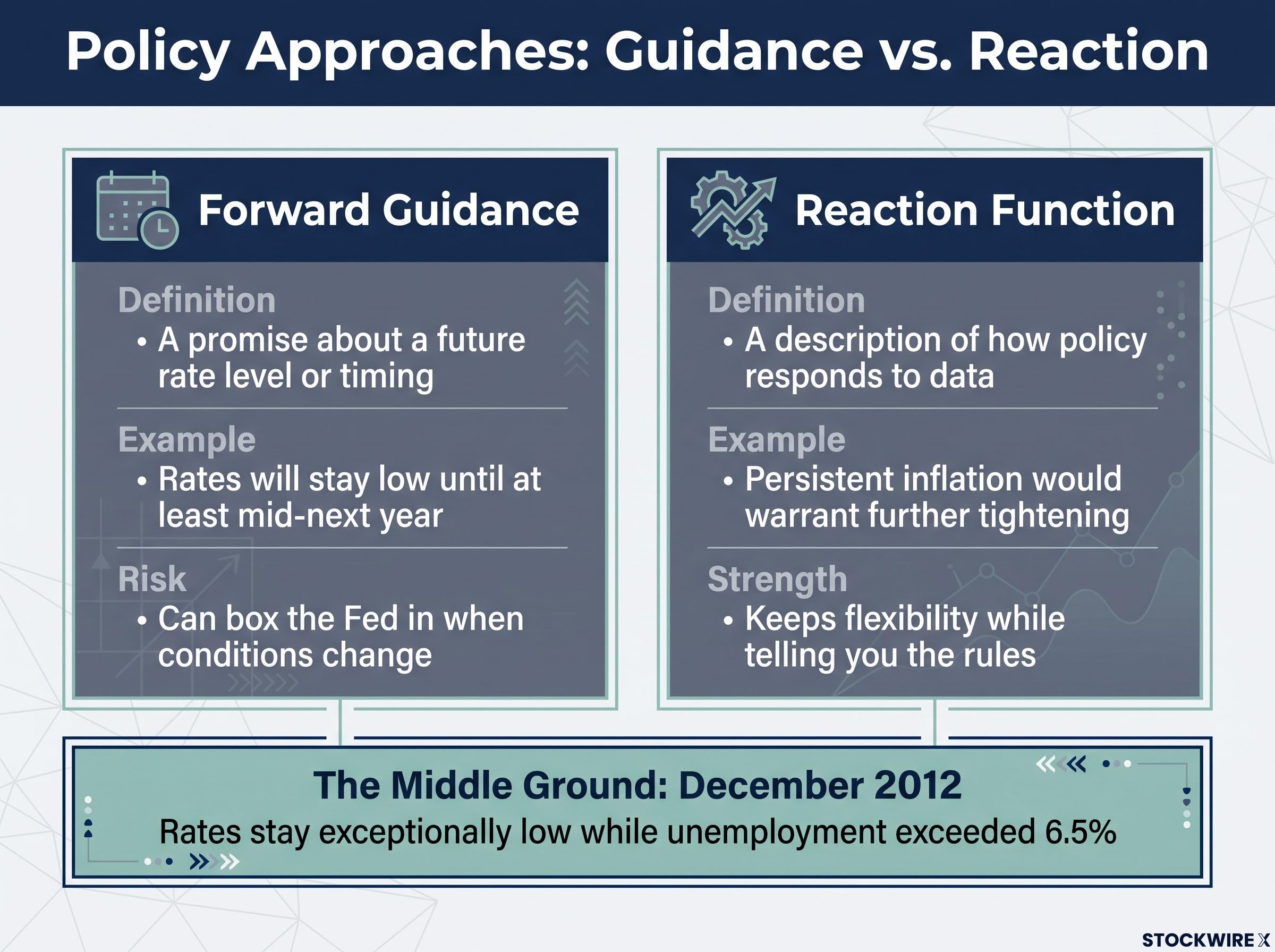
Here is the distinction that matters. Brookings economists, in a 9 July analysis, separated forward guidance from a reaction function. A reaction function is the way a central bank responds to incoming data on inflation, jobs and financial conditions.
Forward guidance:
- A promise about a future rate level or timing
- Example: “Rates will stay low until at least mid-next year”
- Risk: it can box the Fed in when conditions change
Reaction function:
- A description of how policy responds to data
- Example: “Persistent inflation would warrant further tightening”
- Strength: it keeps flexibility while still telling you the rules
The Fed’s December 2012 guidance sat between the two. It said rates would stay exceptionally low at least while unemployment exceeded 6.5%, with conditions attached. You got a threshold, not a calendar date.
Warsh’s position, as Brookings frames it, is that a reaction function is enough. So “no guidance” does not mean “no policy”. It means the Fed is asking you to read its behaviour rather than its promises.
When guidance backfires: 2013
Clear words carry their own danger. On 22 May 2013, then-Chair Ben Bernanke said asset purchases could be scaled back if the economy kept improving. Markets heard an imminent tightening signal, and Treasury yields spiked in what became known as the taper tantrum.
The Bank for International Settlements (BIS) makes the underlying point plainly: guidance works only when markets see it as a credible commitment the central bank will deliver on.
That is the lesson to carry forward. Guidance is a tool that runs on borrowed credibility. Take it away, and you find out whether the central bank had any credibility of its own.
When big ASX news breaks, our subscribers know first
How did the dollar react when Warsh declined to guide?
The summer gave markets that test in real time. Watch how the numbers moved, using the US Dollar Index (DXY), which measures the dollar against a basket of six major currencies.
| Period | DXY level or move | Likely driver | Source |
|---|---|---|---|
| Late July to early August | Fell below 100; dollar “stumbled badly” | No rate signal after the July meeting cut tightening expectations | DBS, 3 August |
| Mid-August | 99.294, a 10-week low | Fading odds of a 2026 hike as Warsh stressed data dependence | Morningstar/Dow Jones, 17 August |
| 16 September (hike) | Up 0.3% to 99.961 | Hike plus prospect of more tightening | Reuters, 16 September |
| 16 September (later trading) | Up 0.63% to 100.31 | Markets treated the decision as hawkish | Reuters, 16 September |
Note: Two Reuters reports gave different 16 September readings. The gap likely reflects snapshots taken at different times of day, not a contradiction about direction.
In August, Commerzbank’s Volkmar Baur told Morningstar/Dow Jones that rate expectations had been scaled back after July. MUFG‘s Lee Hardman and Derek Halpenny argued Warsh wanted markets to decide how policy should respond, and that markets were signalling less tightening was needed, leaving the dollar exposed.
Then the Fed acted. Cited reports say the FOMC raised rates by 25 basis points to a 3.75%-4.00% range on a 12-0 vote, its first hike since 2023.
The dollar turned.
Two explanations compete for the summer slide. Nguyen points to how hard the new Chair was to read, plus fears the administration could lean on him to keep rates artificially low. A second reading holds that no guidance combined with no tightening simply implied a lower rate path. Both describe a gap in credibility, not a shortage of words.
And here is the puzzle’s core: Warsh’s scepticism about guidance did not change between the fall and the recovery. For you as a dollar watcher, that means the reversal was markets pricing the Fed’s likely behaviour, not rewarding the Chair for talking.
Why does central bank credibility move a currency more than communication style?
If words were not the driver, what was? Credibility reaches a currency through five channels.
- Interest-rate expectations: a currency tends to strengthen when investors expect higher real rates, and the September hike lifted the implied US path.
- Anchored inflation expectations: if you believe the Fed will return inflation to 2%, expectations stay steady and later tightening can be gentler.
- The reaction function: investors need to know how the Fed will respond to inflation, jobs and shocks, even without a promised timetable.
- Institutional independence: markets mark down a central bank they think will put political demands ahead of inflation control.
- Risk premium: uncertainty about future rates raises the extra return investors demand to hold US assets, and DBS linked post-July yield curve steepening to fading confidence in Fed policy.
The inflation backdrop explains why channel two carried weight. CNBC reported August headline PCE inflation at 3.4% and core at 3.0%, both well above target. PCE, the personal consumption expenditures price index, is the Fed’s preferred inflation gauge.
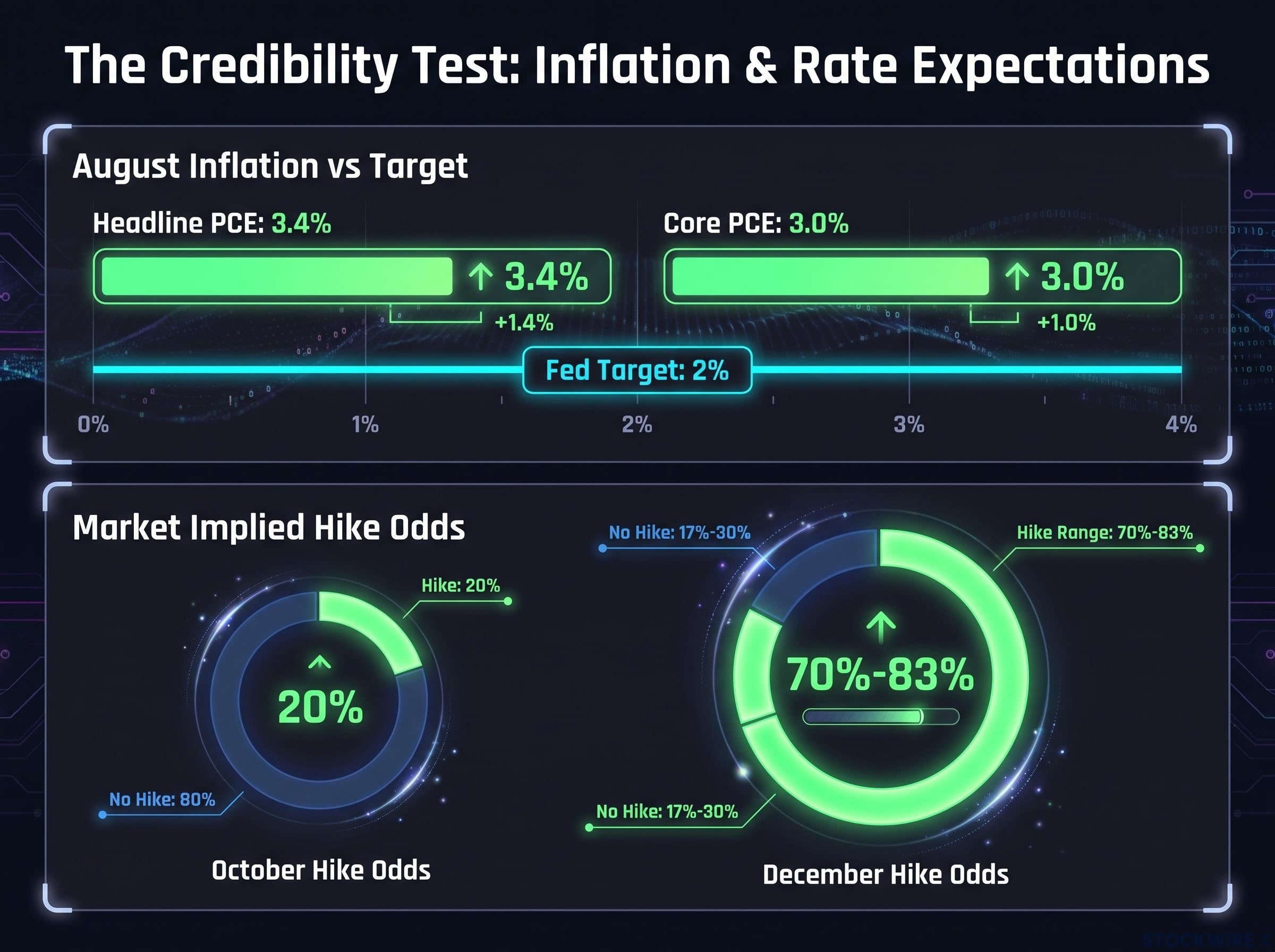
When a hike arrived against that data, it told you the Fed would respond to inflation. Nguyen argues that once markets trust a central bank to meet its mandate, the communication method becomes secondary, and Warsh’s support for the hike reinforced that trust.
Thu Lan Nguyen, Commerzbank As long as investors believe the Fed will choose correctly when it counts, they appear willing to tolerate the Chair’s reluctance to commit to a future rate path.
That tolerance shows in current pricing. Cited outlets including Investopedia and Yahoo Finance put the odds of an October hike at about 20%, with roughly 70%-83% odds for December. Markets are expecting more tightening without being told to.
The yield curve steepening after July, with long-term yields rising as short-term rates fell, shows how a credibility gap can be priced in the bond market before it shows up anywhere else.
Independence and the political premium
Independence is where credibility gets tested hardest. Reuters reported on 14 July that Warsh told Congress the Fed’s credibility is strengthened when it is, and is perceived to be, independent.
Diane Swonk of KPMG has argued that independence must be demonstrated, not asserted. That matters for your read of the dollar because fears of administration pressure for lower rates can weaken the currency before any policy changes at all.
So the signals worth watching are inflation outcomes and visible independence. Speeches matter far less.
Where does the credibility argument fall short?
The story is tidy, which is exactly why you should test it. Several things could unsettle it:
- Ambiguity can raise volatility. Economist Robin Brooks has argued that without guidance, markets may push for a hike at every meeting. The Economist warned that stressing uncertainty can itself damage credibility.
- Guidance never fully disappeared. Fed projections still pointed to one more 2026 hike, and New York Fed President John Williams said on 1 October, per The Hill, that another adjustment could suit late in the year if forecasts hold.
- One hike is not a cycle. A single move shows willingness, but not a sustained campaign like Paul Volcker’s early-1980s disinflation, the benchmark for credibility earned through action.
- The dollar answers to more than the Fed. Energy prices, geopolitics and Treasury yields all matter, and DBS cited US-Japan currency intervention alongside Fed policy.
- The boost may fade. Coverage of Commerzbank’s view describes the credibility gain as possibly temporary.
Counter-evidence is worth weighing here: the 10-year Treasury yield moved only 0.14 percentage points after the July press conference, with no bond-market dislocation reported, which complicates claims of a full credibility crisis.
What would change the picture
Inflation data are also incomplete. September CPI, the consumer price index, is due tomorrow, 14 October. These triggers would test the thesis:
- A soft inflation print that weakens the case for December
- A hold when markets are pricing a hike
- Visible political pressure on the Fed’s rate decisions
Treat the credibility reading as a framework you check against each release, not a settled law. Past performance does not guarantee future results, and market pricing can shift quickly as data arrive.
Reading the Fed when it stays quiet
The summer’s lesson is that guidance helps you understand a central bank’s reaction function, but credibility on inflation control and independence is what makes words or action move a currency durably. Warsh’s silence did not sink the dollar on its own. Doubt about what the Fed would actually do did.
The September hike settled more of that doubt than another verbal hint could have, and the dollar’s recovery reflected it.
Your next tests arrive quickly. Watch tomorrow’s CPI release, the 27-28 October meeting, and how December pricing moves. If the Fed keeps choosing correctly when it counts, tolerance should hold. If not, the silence may start to cost more.
This article is for informational purposes only and should not be considered financial advice. Investors should conduct their own research and consult with financial professionals before making investment decisions. Forward-looking statements are speculative and subject to change based on market developments.






