
The US Treasury doubled the size of its bond buyback programme two weeks ago. Yields fell for a few hours, then climbed straight back to where they started. Gold, meanwhile, crossed $4,600 per ounce.
Put those two facts side by side and you have the outline of a problem that matters well beyond the bond market. Under normal conditions, rising Treasury yields and record gold prices pull in opposite directions. Higher yields make bonds more attractive relative to gold, which pays no income. A flight to safety pushes bond prices up (and yields down) while gold rises modestly. The current setup inverts both halves of that relationship simultaneously, and the coincidence demands an explanation.
Here is what both markets are actually telling you, and what the joint signal means for where you hold risk right now. This is not a summary of the headlines. It is a framework for reading a macro environment where the two assets most investors treat as anchors are behaving in ways their models did not anticipate.
Why Treasury yields are refusing to fall
The numbers first. The 10-year Treasury yield has been trading around 4.7-4.75%, its highest level in roughly 18 months. The 30-year yield has pushed above 5.1-5.3%, territory last seen before the global financial crisis. These are not rounding errors or fleeting intraday prints. They represent a sustained, deliberate repricing.
Three structural forces are pushing yields higher:
- Persistent inflation and repriced Fed expectations. A combination of stubborn price pressures and shifting expectations for the Federal Reserve’s rate path has kept heavy selling pressure on Treasuries, with some strategists targeting 10-year yields near or above 4.75%.
- Rising fiscal deficit concerns and heavy issuance volumes. The sheer volume of debt the US government needs to sell is forcing investors to demand more compensation. Each new auction adds supply into a market already struggling to absorb it.
- Market structure dynamics. Volatility in the Treasury market has picked up, and certain yield thresholds risk triggering disorderly selling, where momentum-driven strategies and risk-management rules force additional sales into an already thin bid.
The 4.75% level on the 10-year is the threshold to watch. Multiple strategists have described it as a potential trigger for a disorderly move toward 5%, which would fundamentally reprice borrowing costs across mortgages, corporate debt, and leveraged strategies.
What makes this yield picture unusual is not the level itself but the context. Yields are rising despite slowing economic momentum, not because of it. That tells you bondholders are demanding compensation for something beyond growth risk, specifically for fiscal and inflation credibility. A technically driven selloff can reverse on a single data print. A credibility-driven one does not reverse until the underlying concern is addressed. That distinction changes how you should think about duration in your portfolio.
Bond yield mechanics — including the mathematical inverse between price and yield and the role of auction demand in continuous repricing — are the foundation for reading whether a yield move reflects growth expectations, inflation risk, or a credibility-driven fiscal premium, and the distinction determines how durable the pressure is.
When big ASX news breaks, our subscribers know first
The intervention that fixed nothing
Against that backdrop, the US Treasury took an uncommon step: it doubled its bond buyback programme from approximately $2 billion to at least $4 billion. This action arrived barely two weeks after officials had already stepped into currency markets, a pairing that points to a heightened level of institutional anxiety about the direction of US debt markets.
The yield response told the story in four steps:
- The intervention was announced.
- The 10-year yield fell to 4.64%, offering brief relief.
- Selling resumed within hours.
- Yields moved back up toward 4.7%, erasing nearly all of the intervention’s gain.
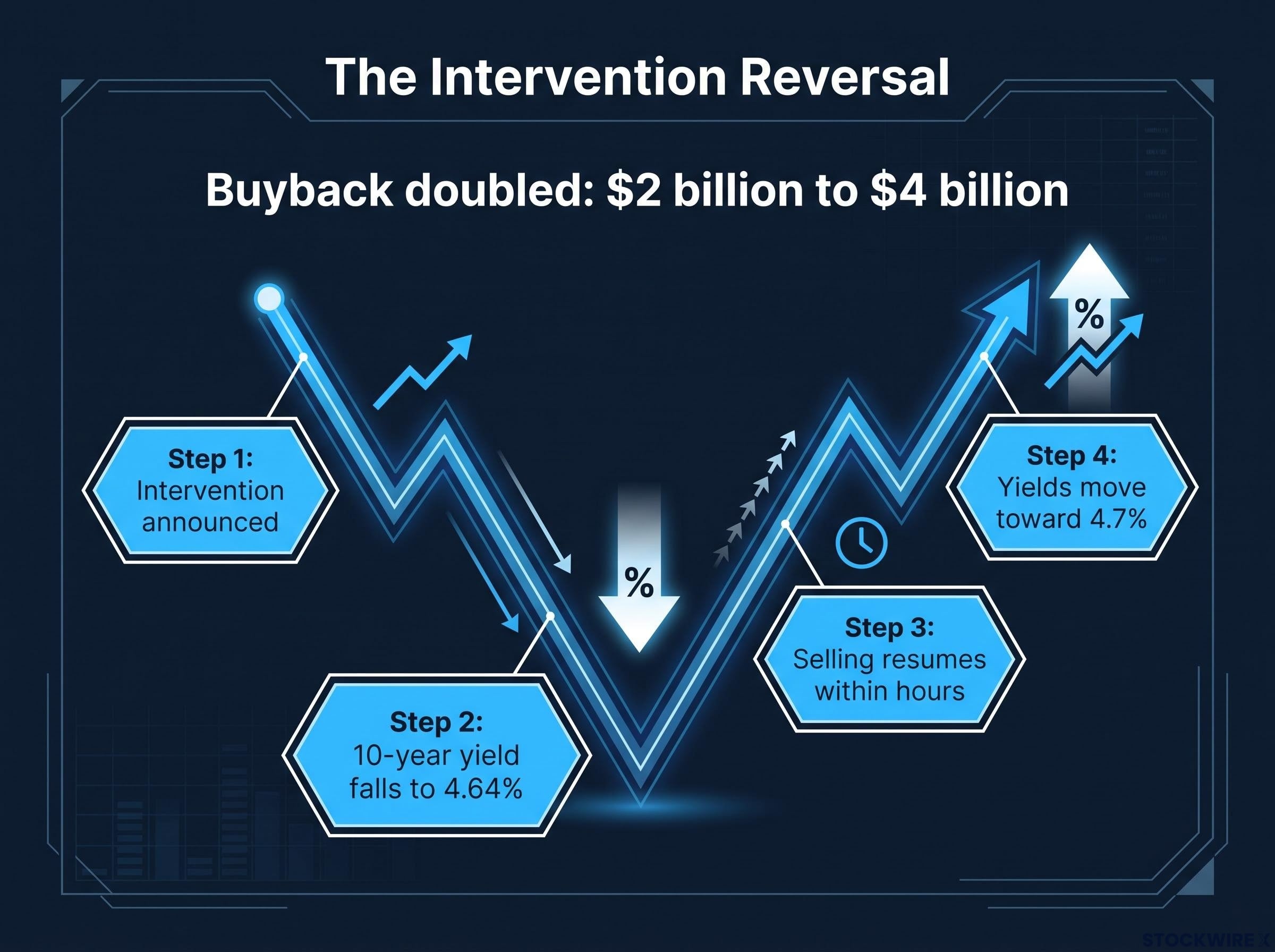
That reversal, specifically its speed, is the most important single data point in this article. Markets did not treat the Treasury’s action as a solution. They treated it as a short-term patch, absorbed the temporary liquidity, and resumed selling.
The failed buyback is the signature of a confidence problem rather than a liquidity problem: when official commentary produces a relief rally that fully reverses within a single session, technical tools have reached the limit of their effectiveness against a fiscal risk premium that buyers are pricing structurally.
Why buying bonds with borrowed money does not solve the problem
The structural flaw in the mechanism is straightforward. Each buyback is financed by raising fresh short-term debt, meaning the programme redistributes duration pressure across the yield curve rather than eliminating it. Buying long-dated bonds with proceeds from new bill issuance may ease conditions at the long end temporarily, but it tests capacity at the short end and leaves the underlying fiscal pressure, the reason yields are elevated, entirely intact.
Any scaling-up of the programme carries its own risks. Expanding buybacks means expanding short-term issuance, which can crowd out other borrowers and introduce new pressure points. The mechanism is self-limiting in a way that matters for investors: you cannot price in policy support as a durable cushion for bond losses the way you might have in earlier cycles. The intervention’s failure is direct evidence that the support mechanism is weaker than it appears relative to the fiscal pressure driving the selloff.
What gold at $4,600 is actually pricing in
The surface reading of gold’s rally is simple: fear is elevated, so investors buy the asset with no counterparty risk. That reading is not wrong, but it is incomplete.
Gold has surged from below $4,000 per ounce to approximately $4,600, near record highs. The move has occurred alongside a weaker US dollar and repeated episodes of policy instability. What makes the rally analytically significant is that it has continued to climb while real Treasury yields, nominal yields minus inflation expectations, sit at approximately positive 2%.
Historically, positive real yields of 2% weigh heavily on gold because investors can earn a real return in bonds. Gold’s persistence at record levels despite that return tells you something has changed in how a portion of the market views sovereign debt as a store of value.
The relationship between sovereign debt and gold demand has been formalised by major institutions: BlackRock, JPMorgan, and Swiss pension funds have each explicitly cited the stock-bond correlation breakdown as a reason to increase gold allocations, replacing bonds as a portfolio diversifier in a way that structurally underpins the central bank buying flows now driving price.

The traditional gold-real yield framework has broken down, and three demand drivers explain the divergence:
| Driver | What it reflects |
|---|---|
| Erosion of confidence in fiat currency and sovereign debt | A multi-year weakening of the US dollar and questions around central bank credibility are increasing demand for assets outside the debt-based financial system |
| Central bank and institutional buying | Official institutions and large allocators are diversifying away from dollar-denominated assets, even when cash and bonds offer attractive carry |
| Geopolitical and tail-risk hedging | Gold is being chosen precisely when investors worry that Treasuries, the traditional safe haven, may themselves be part of the problem |
The contrast with corporate earnings is worth noting. The bottom-up picture from earnings season has been relatively constructive. If gold were simply responding to near-term recession fear, it would likely retreat as company results stabilised. Its persistence at record levels alongside positive real yields signals structural demand for insurance against a fiscal and monetary regime that a growing segment of investors views as unstable. That is a structurally different statement than a simple recession hedge.
What it means when both safe havens move in the same direction
The joint movement of Treasury yields and gold is not a contradiction. It is a coherent signal, and understanding why it is coherent is what separates a reactive portfolio response from a strategic one.
Start with the historical baseline. In a normal flight to safety, investors buy Treasuries, pushing prices up and yields down, while gold rises modestly. The current setup does the opposite on both sides: yields are rising (indicating selling pressure on bonds) at the same time gold is rallying (indicating demand for an alternative safe asset). Three interpretations of the joint move build on each other:
- Investors are not treating Treasuries as the primary safe haven. The intervention’s rapid reversal reinforces this reading: there is no clean flight-to-safety bid for US government paper.
- Markets are demanding an inflation and fiscal premium in both asset classes simultaneously. Bondholders want more yield to compensate for fiscal risk. Gold buyers want insurance against the possibility that even those higher yields will not preserve purchasing power.
- Treasuries remain foundational to global markets, but their status as the singular, unquestioned risk-free benchmark is under structural pressure. The fact that official support could not produce a durable bid confirms the stress is structural rather than technical.
Fiscal credibility deterioration as a market-pricing event — not merely a political risk — is a conclusion BlackRock, JPMorgan, Goldman Sachs, and Bridgewater have each reached independently, all rotating away from long-duration nominal Treasuries and toward real assets and inflation-linked strategies in direct response to a structural deficit the CBO projects will push public debt to 120% of GDP by 2036.
A quasi-stagflationary backdrop: why both assets are rising together
The environment producing this joint move has a specific character. Inflation is persistent. Growth is uneven. Investors doubt policymakers’ ability or willingness to restore balance. That combination, sometimes described as quasi-stagflationary, can produce simultaneous selling in long bonds (as the market demands a higher inflation premium) and buying in gold (as currency and policy risk insurance). The two moves are internally consistent once you recognise the shared underlying cause.
The implication for your portfolio is direct: if neither Treasuries nor gold is behaving the way historical models predict, the assumptions underpinning your asset allocation need to be revisited, not just the individual positions.
Five portfolio adjustments this environment demands
The macro diagnosis above is only useful if it translates into specific decisions. Five asset-class adjustments follow from the current environment, each tied to the data already established.
- Fixed income: capture the income, manage the duration. At 4.7-5% on core maturities, Treasuries and high-grade bonds offer meaningful nominal returns. But the failed intervention means you cannot rely on policy support to cushion duration losses. Favour laddered or barbell structures tilted toward shorter and intermediate maturities. Consider Treasury Inflation-Protected Securities (TIPS), bonds whose principal adjusts with inflation, for real-return protection. The 4.75% threshold on the 10-year is your key trigger for reviewing duration sizing.
- Equities: stress-test against higher discount rates. Rising long-term yields directly increase the discount rates applied to future cash flows, compressing valuations for long-duration growth stocks. The disconnect between constructive corporate earnings and gold’s record level signals macro anxiety that has not yet fully repriced in equities. Favour quality balance sheets and be cautious with the most rate-sensitive segments of the market.
- Real estate and leveraged assets: underwrite for sustained high rates. With the 30-year above 5.1-5.3%, mortgage rates and capitalisation rates remain under pressure. This is not a brief transitional moment. Refinance risk and valuation pressure should be front and centre in underwriting.
- Gold and real assets: treat as strategic, not tactical. Gold’s resilience against positive real yields has reasserted its role as a portfolio hedge against currency and policy risk. Size positions thoughtfully given volatility and opportunity cost, but recognise the diversification value when confidence in sovereign debt is strained.
- Cash and short-duration instruments: use as dry powder. Short-term Treasuries and cash equivalents now offer relatively attractive yields with minimal duration risk. With the long end under sustained pressure, these instruments are particularly valuable on a risk-adjusted basis.
| Asset class | Current environment risk | Adjustment direction |
|---|---|---|
| Fixed income | Duration losses if 4.75% threshold breaches; policy support unreliable | Shorten duration, ladder maturities, add TIPS |
| Equities | Higher discount rates compress growth valuations; macro-micro disconnect | Favour quality, stress-test for sustained higher rates |
| Real estate and leverage | Mortgage and cap rate pressure from 30-year above 5.1% | Underwrite for sustained high rates, avoid assuming rate normalisation |
| Gold and real assets | Volatility and opportunity cost | Strategic allocation sized for regime insurance, not speculation |
| Cash and short duration | Inflation erosion over time | Attractive risk-adjusted carry; use as dry powder |
This is not a single-asset problem you solve with one trade. It is a regime-level shift that requires reviewing duration, equity valuation assumptions, leverage exposure, and hedge sizing simultaneously.
Four signals that will tell you whether this stress resolves or deepens
The analysis above describes where markets stand today. Four forward-looking indicators will tell you whether this stress eases or intensifies.
| Indicator | What to watch | Bullish signal (stress eases) | Bearish signal (stress deepens) |
|---|---|---|---|
| Treasury auction demand | Bid-to-cover ratios and tail sizes at 10- and 30-year auctions | Strong coverage, minimal tails, stable pricing | Weak demand, large tails, primary dealers absorbing excess supply |
| Inflation data and real yields | Headline CPI, core PCE, and breakeven inflation rates | Inflation moderates, real yields stabilise without gold weakening | Upside inflation surprises with limited policy response, reinforcing the quasi-stagflationary dynamic |
| Federal Reserve communication | Whether the Fed treats bond market stress as a financial-stability concern | Clear willingness to support the long end if conditions deteriorate | Reluctance to act while deficits remain elevated, leaving current pressure intact |
| Dollar behaviour | Trade-weighted dollar index and central bank reserve diversification flows | Stronger dollar and credible fiscal adjustment cool gold demand | Persistently weaker dollar and continued central bank gold buying reinforce the current pattern |
The dollar’s trajectory serves as a real-time vote on whether global investors view US fiscal and monetary policy as credible.
A fifth embedded signal sits within the Treasury’s own actions. Whether the buyback programme expands, holds steady, or quietly winds down tells you what the Treasury itself believes about market stability. Expansion requires additional short-term issuance and tests short-end capacity. A wind-down, while conserving fiscal flexibility, removes even the modest support the programme currently provides.
Each of these indicators gives you a concrete, observable test. If auction demand weakens, inflation surprises to the upside, the Fed hesitates, and the dollar continues to slide, the portfolio adjustments outlined above become more urgent, not less.
What the divergence has already decided, and what remains open
Two things are settled. The Treasury intervention’s failure confirms the bond market stress is structural rather than technical; yields will not be anchored by buybacks alone. Gold’s record level despite positive real yields of 2% confirms that a portion of the market has moved from tactical hedging to strategic repositioning away from sovereign debt as the sole safe haven.
What remains genuinely open is how far yields go, whether the Fed eventually pivots to treat bond market stress as a financial-stability issue, and whether fiscal policy adjusts in a way that restores confidence. These are not questions this article can answer. They are questions the four indicators above are designed to track.
The portfolio posture implied by what is already settled is clear: deliberate duration management, stress-tested equity valuations, and gold treated as insurance rather than speculation are not optional refinements in this environment. They are the baseline.
This article is for informational purposes only and should not be considered financial advice. Investors should conduct their own research and consult with financial professionals before making investment decisions. Past performance does not guarantee future results. Financial projections are subject to market conditions and various risk factors.