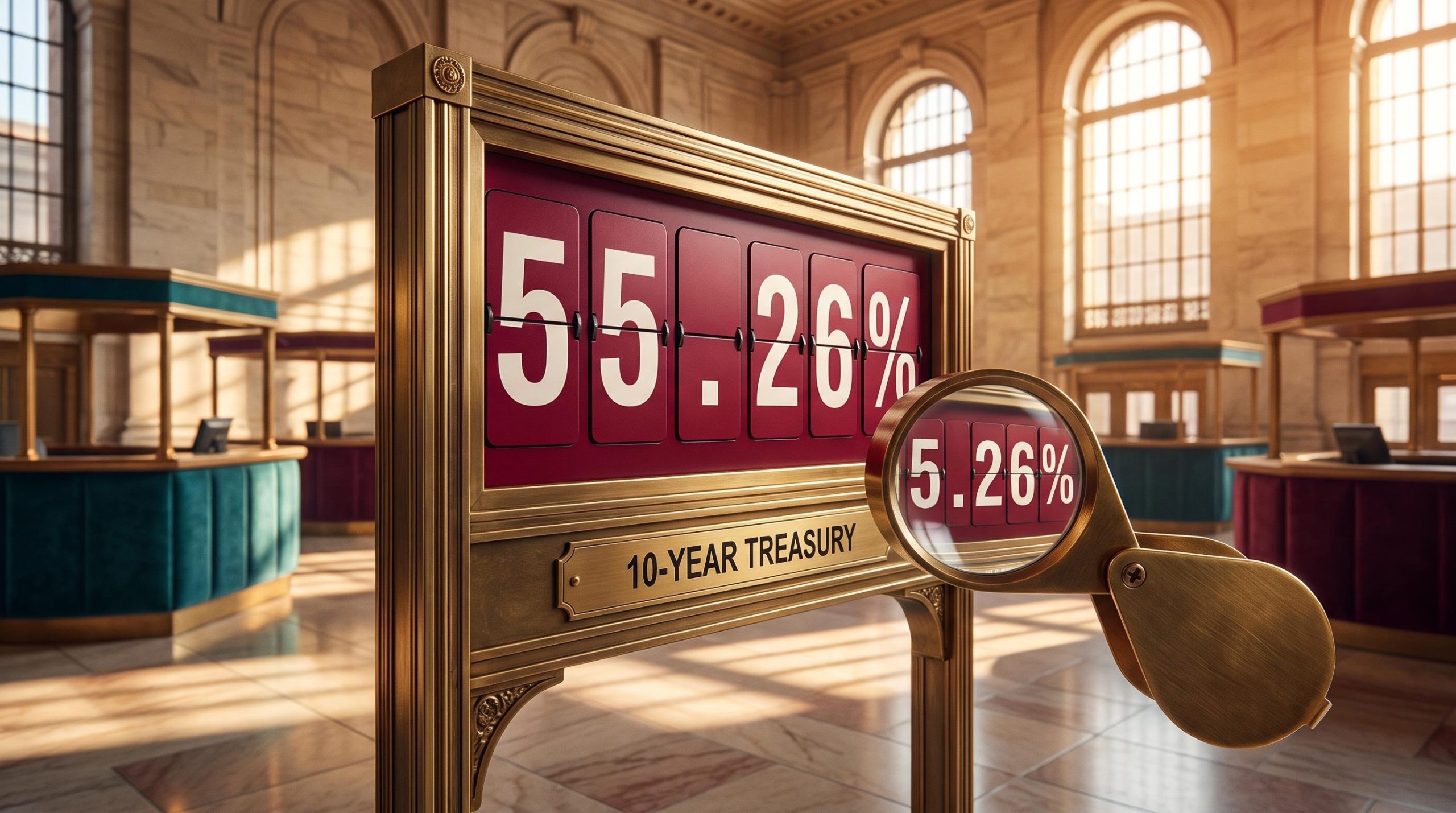
The 10-year Treasury yield sat at 5.26% on 5 October, close to two-decade highs, even though September payrolls came in at just +29K against 90K expected. Weak data was supposed to pull yields lower, and it has not.
Treasury Secretary Scott Bessent has now said publicly that he cannot control the bond market, in remarks across Axios, the New York Times and CNBC on 3-4 October. That marks a visible shift from earlier confidence that Treasury could lean on yields, and it matters because stock valuations sit directly downstream of the discount rate.
Did Bessent just concede to the bond market?
The headline version is blunt, and it is the one most readers will have seen.
“I cannot control the bond market. What I can do is encourage people to slow down and think.” Scott Bessent, Axios interview, 3 October
The fuller sequence is more layered:
- Axios, 3 October: Bessent said he cannot control the bond market and played down fears about rising yields.
- New York Times, 4 October: He clarified that his earlier “I am the house” remark meant superior information, not control over prices.
- CNBC, 4 October: He said he “cannot set the equilibrium price,” and that larger buybacks are meant to improve liquidity, not dictate yield levels.
Axios reported on 10 September that Treasury’s buyback “showdown” failed to cow the market, adding that Bessent “doesn’t have a bazooka.” Buybacks must be funded from the Treasury General Account (the government’s cash balance) or by issuing more short-term debt, which can itself push rates higher.
Treasury tripled the ceiling on its buyback operations to as much as $6 billion per auction, yet long-end yields rose afterward, suggesting the market judged the scale insufficient.
The hosts of the discussion behind this story argue Bessent still holds unused tools, the cash balance among them. On that reading, the retreat is a choice rather than a necessity, which makes it partial and strategic rather than a surrender.
What this means for you: Treasury is signalling it will stop trying to talk yields down. Treat the bond market as the setter of the price of money, and reassess how much policy protection your equity valuations quietly assume.
The Japanese repatriation dispute
Bessent told Axios there is no evidence of investors dumping Treasuries for German or Japanese bonds. The show hosts see it differently, pointing to Japanese repatriation of foreign bond holdings of roughly $18B as of 22 August and reportedly over $70B by the end of September.
Those are the hosts’ figures. The research behind this piece found no Japanese Ministry of Finance or US Treasury International Capital data to confirm or refute them, so treat them as unverified.
When big ASX news breaks, our subscribers know first
Why are yields still high when jobs and growth data are weakening?
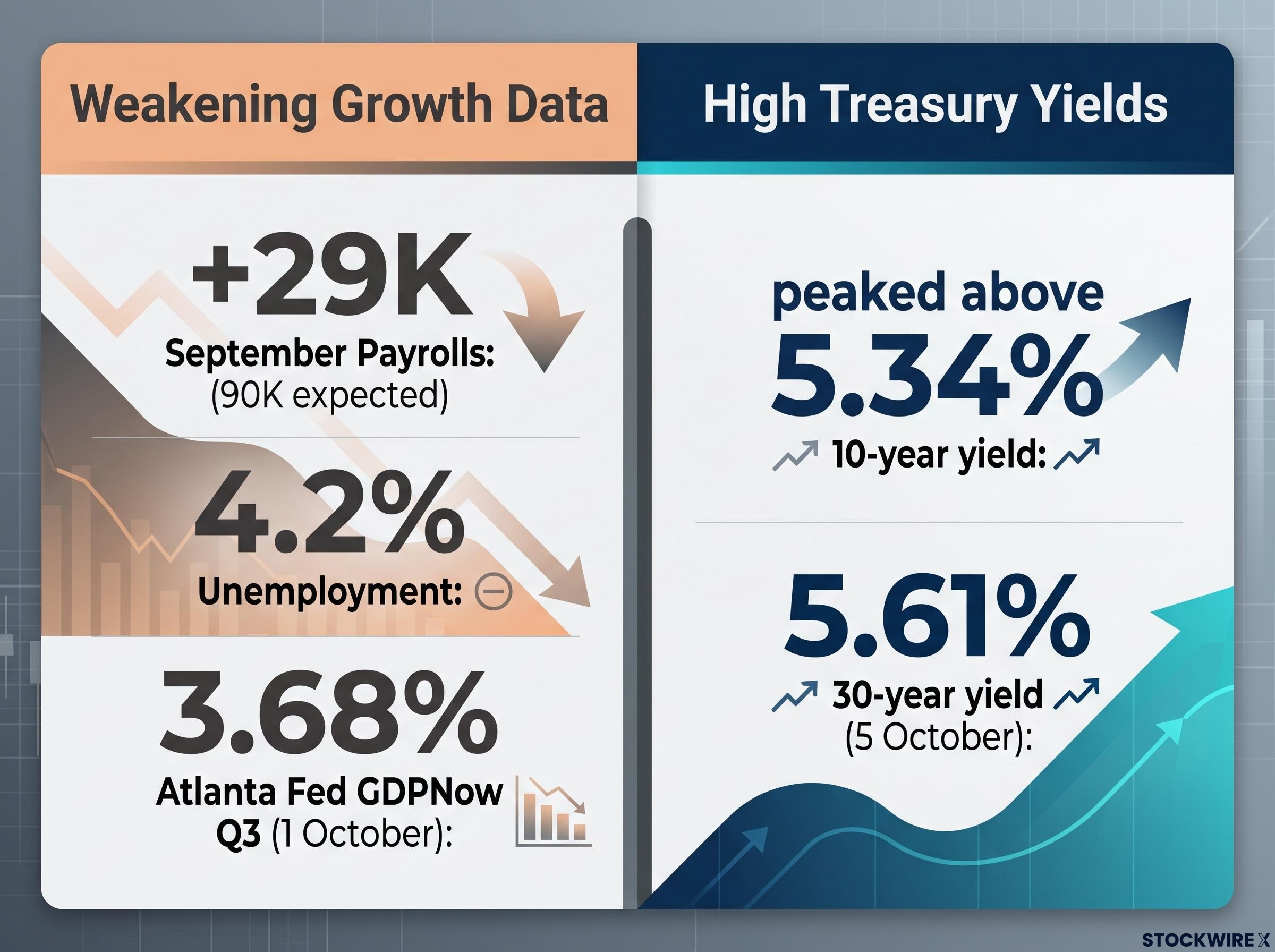
The puzzle is stark. Payrolls rose just 29K against 90K expected, unemployment sits at 4.2%, prior months were revised down, and the Atlanta Fed’s GDPNow estimate for the third quarter slipped to 3.68% on 1 October. Yet the 10-year peaked above 5.34%, its highest since 2002, and the 30-year stood at 5.61% on 5 October.
The answer sits inside the yield itself.
Real yields, breakevens and term premium in plain English
A nominal yield is the headline rate. It can be split into a real yield (the return after inflation, read from inflation-protected TIPS), breakeven inflation (the inflation rate markets expect), and a term premium (extra compensation for locking money up for years).
A rising real yield works as a higher hurdle rate. Every future company profit is discounted at a higher rate, so stocks must clear a tougher bar to justify their prices.
A rising real yield acts as the market’s repricing of money itself, and because breakevens have barely moved, the portfolio impact comes through discount rates rather than inflation fears.
| Metric | Value | Date | What it tells you |
|---|---|---|---|
| 10-year Treasury yield | 5.26% | 5 October | Headline cost of long-term money |
| 10-year TIPS real yield | 2.88% | 1 October | Most of the rise sits here |
| 10-year breakeven | 2.36% | 2 October | Inflation fears are not surging |
| ACM term premium | about 0.9% | 1 October | No blowout in compensation for risk |
Breakevens and term premium are little changed year on year, so real yields account for most of the backup. The market is charging more for money itself, which pressures valuations even if inflation is not accelerating.
Cited drivers include expectations of persistently restrictive Fed policy, fiscal and debt-supply worries, and the Iran war’s effect on deficits. The hosts also point to AI-related demand for loanable funds, though named-economist support for that link was limited.
The New York Times noted the jobs report lowered the odds of an October hike, but markets still price some chance of a December move. For yields to fall, real yields need to ease, and bad news alone has not done that.
Is this a policy turning point or another market-forced reversal?
The hosts offer a tempting comparison. Markets want evidence of a policy reaction function, meaning proof that officials adjust when pressure builds, as with the April 2025 Liberation Day tariff pause and the Fed’s move away from “transitory” in 2021-22.
These analogies come from the hosts alone. The research found no named analyst making the same comparisons, so weigh them as one interpretation.
| Episode | Trigger | Policy response | Market outcome |
|---|---|---|---|
| Liberation Day pause (April 2025) | Market pressure after tariffs | Tariff pause | Not covered in the research |
| “Transitory” shift (2021-22) | Persistent inflation | Fed dropped the term | Not covered in the research |
| Bessent retreat (October 2026) | Failed buyback rally, yield spike | Stepped back from confrontation | Unresolved |
Two readings compete:
- Orderly markets: Bessent is explaining and calibrating tools, letting rates reflect fundamentals.
- Confrontation risk: Axios suggests open confrontation could itself raise term and risk premia.
The term premium near 0.9% suggests a policy-uncertainty premium has not yet blown out. The key point for you is that a retreat only becomes a sentiment turning point if yields actually stop rising. Treat the analogy as a hypothesis to monitor, not a settled signal.
What do hike cycles and high real yields historically mean for stock returns?
The general pattern is reassuring. Absent back-to-back Fed hikes, markets have historically produced positive 12-month returns, and the hosts note hike cycles often bring 2-3 months of stock weakness. Broad indices have often stayed positive but more volatile when growth and earnings are solid, and weaker when hikes meet slowing growth.
This cycle is less comfortable. The S&P 500 opened the week near 7,787, but the hosts describe gains propped up by tech, with the equal-weight S&P and Russell down meaningfully since mid-August. Data centre buildout carries growth while consumers are squeezed.
Precedents include the early-1980s bond bear market, 1994 and parts of 2022. These are general historical patterns, not forecasts.
Rising real yields lift equity discount rates mechanically, and long-duration growth and technology shares have historically carried the greatest sensitivity to that move.
Where the risks concentrate
With the 10-year above 5.3% at its peak and about 5.2% after the jobs report, five risks stand out:
- Valuation compression: a higher risk-free rate squeezes multiples, especially for long-duration growth and tech.
- Debt supply: higher federal interest costs and a higher equity risk premium.
- Sector divergence: pressure on borrowers, relief for lenders.
- Macro risk: a weak labour market plus high long rates can weigh on housing, capex and credit.
- Policy uncertainty: the failed buyback rally adds Treasury reaction risk on top of Fed decisions.
| Sector | Pressure from high yields | Historical tendency |
|---|---|---|
| Long-duration tech | Multiple compression | Vulnerable to rate spikes |
| Utilities, REITs, levered firms | Higher financing costs | Often lag |
| Banks and insurers | Wider margins if credit holds | Can benefit from a steeper curve |
Your exposure to long-duration tech and rate-sensitive sectors determines how much of this you carry. Check concentration rather than reacting to the index level.
What to watch now that Treasury has stepped back
The through-line is a Treasury retreat, a real-yield-driven backup, and a fragile labour market. Five signposts will show which way it breaks:
- Real yields versus breakevens: a fall in real yields is what relief would look like.
- Term premium: a move above 0.9% would signal rising policy-uncertainty pricing.
- Fed meetings: late October and December.
- Japanese flow data: the repatriation question remains unresolved.
- The Iran war’s fiscal path: deficits feed long-end yields.
None of this settles the call, and the evidence will arrive in data, not headlines. Judge your own exposure against these markers before the next move.
Investors exploring how to price policy risk should read our deep-dive into the Fed’s forward guidance shift, which shows why every FOMC meeting is now live.
This article is for informational purposes only and should not be considered financial advice. Investors should conduct their own research and consult with financial professionals before making investment decisions. Past performance does not guarantee future results, and these statements are speculative and subject to change based on market developments.