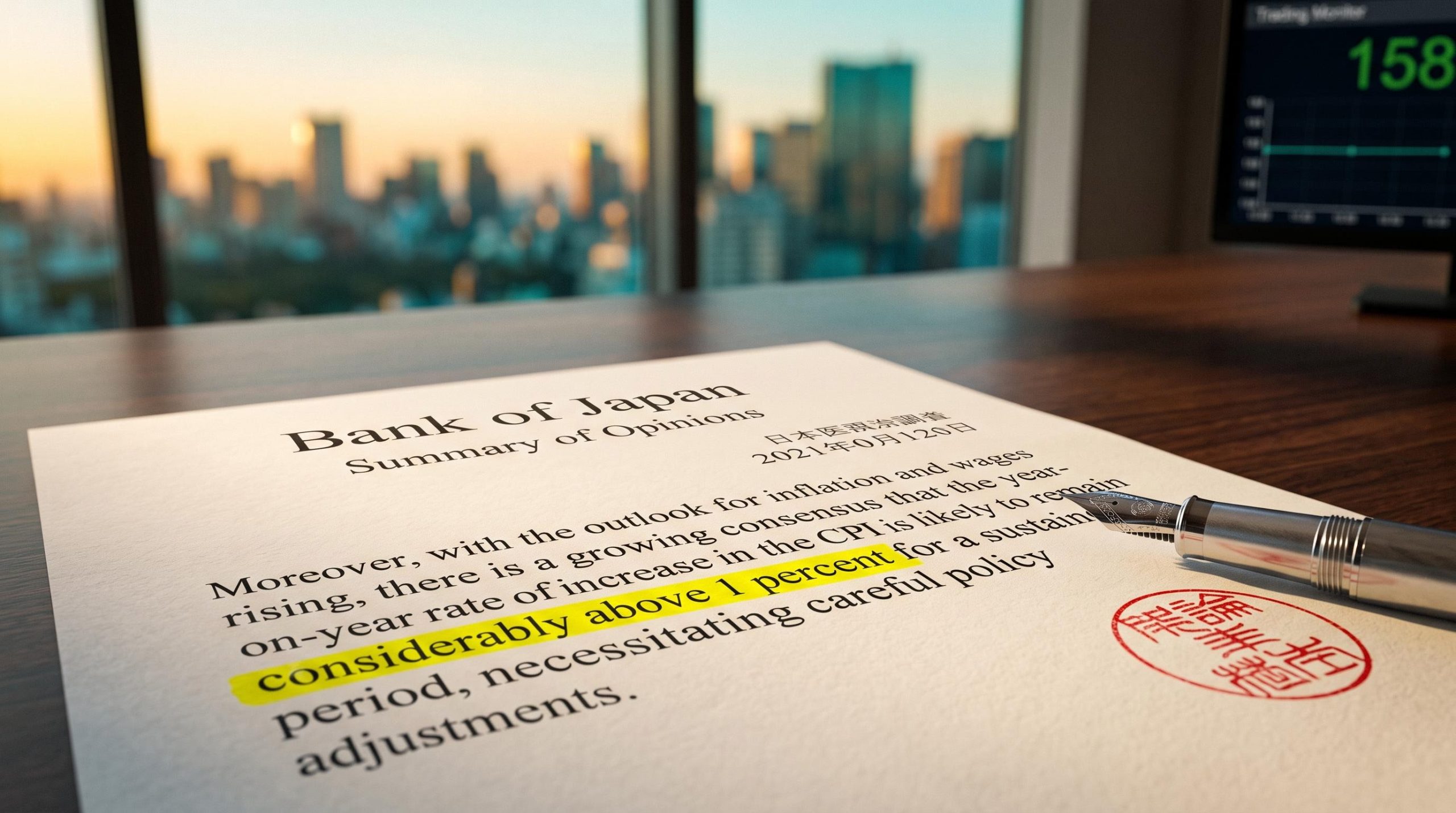
The Bank of Japan held its policy rate at 1.25% on 30 October 2026, an apparently quiet decision passed by an 8-1 vote. The board’s Summary of Opinions, published around 10 November, tells a different story. Read closely, it argues for another BoJ rate hike, and soon.
The currency market barely moved. USD/JPY sat near 158 after the release. That gap between a hawkish document (one that leans towards higher rates) and a flat yen is the signal many readers are missing.
The Summary matters because it is where board members speak more freely. The official statement records the decision. The Summary, released without names attached, records the arguments behind it, and those arguments often point to where policy goes next before any vote does.
Here is how to read the split between hawks and doves, why the board’s idea of a “neutral” rate is so contested, and why the yen stayed weak when the words suggested it should rally.
What the October Summary reveals about a divided board
The headline was a hold. The hold came after two moves in quick succession: 25 basis points in June and another 25 basis points in September 2026, which took the rate from 1.00% to 1.25%. A basis point is one hundredth of a percentage point, so 25 basis points equals 0.25%.
The June hike to 1.0% came with a 7-1 vote and a bond tapering schedule, a pairing that set the template for the gradual tightening the October Summary now seeks to accelerate.
The case for moving faster
The hawkish opinions in the Summary pile up one after another:
- Underlying inflation is approaching or has reached the 2% price goal.
- The Bank should raise rates “whenever possible” without being overly cautious.
- Japan has entered a stage that calls for quicker increases towards neutral.
- Reaching neutral early would leave the Bank free to respond with either hikes or cuts.
- Past hikes have not fully worked through, and financial conditions remain accommodative, meaning borrowing is still cheap enough to support activity.
- The next hike is expected to cause no significant net harm to the economy.
Board member Hajime Takata went furthest. He proposed lifting the rate to 1.50% at the October meeting, arguing that underlying inflation had reached 2% and the pace should accelerate. His was the lone dissent, but two other opinions also backed reaching neutral relatively soon.
The key phrase: The Summary said the neutral rate is likely “considerably above 1 percent.”
The case for waiting
The cautious camp was much smaller:
- One member favoured holding to examine economic and price risks further.
- One member flagged some economic softness and called for careful monitoring.
- One member warned that a future hike could weigh on the economy and depress inflation.
Even the middle ground leaned towards tightening. One opinion suggested watching financial conditions for several months after each hike, which reads as a call for spacing rather than stopping.
A single dissent backed by several supportive opinions tells you the October hold was a pause in a tightening cycle, not a change of direction. Your base case should be further hikes.
When big ASX news breaks, our subscribers know first
Where is neutral, and why does the answer matter?
“Considerably above 1 percent” sounds like a clear marker. The neutral rate is the interest rate that neither stimulates nor restrains the economy. If neutral sits well above 1.25%, the hawks can argue policy is still loose and more hikes are warranted.
The wording has also shifted. In July 2024, the Summary placed neutral at “at least around 1%”. By October 2026, the board was describing it as considerably higher. The goalposts have moved up.
Widen the lens, though, and the precision fades. BoJ staff calculations, reported by Reuters, put the nominal neutral range at roughly 1.1% to 2.5%. That band is wide enough to describe today’s rate as almost neutral or as well below it.
Mari Iwashita of Nomura Securities told Reuters on 2 November 2026 that the BoJ probably still sees its rate some distance below neutral, which supports hikes towards 1.75% by around March 2027. Nomura expects moves in December 2026 and March 2027, and has said near-term hikes will be driven more by risks than by the BoJ’s central forecast. These projections are forecasts and depend on market conditions and incoming data.
| Interpretation | Evidence | Caveat |
|---|---|---|
| Neutral only somewhat above 1% | July 2024 Summary: at least around 1%, with timely but gradual hikes | Moving too fast could damage a fragile recovery |
| Neutral considerably above 1% | October 2026 Summary | No precise endpoint, so markets may overread a commitment to rapid hikes |
| Wide staff range | BoJ staff estimate of 1.1%-2.5% (Reuters) | Poor timing tool; unclear how restrictive 1.25% is |
| Delay is also risky | Takata and others: financial conditions remain accommodative | Waiting could entrench inflation expectations and wage demands |
Because neutral is a range rather than a number, treat hawkish language as a direction of travel, not a timetable. The pace will depend on the data, and that brings the argument to wages and prices.
Can wages and inflation carry faster hikes?
The inflation numbers give the hawks solid ground. Underlying measures accelerated sharply between August and September.
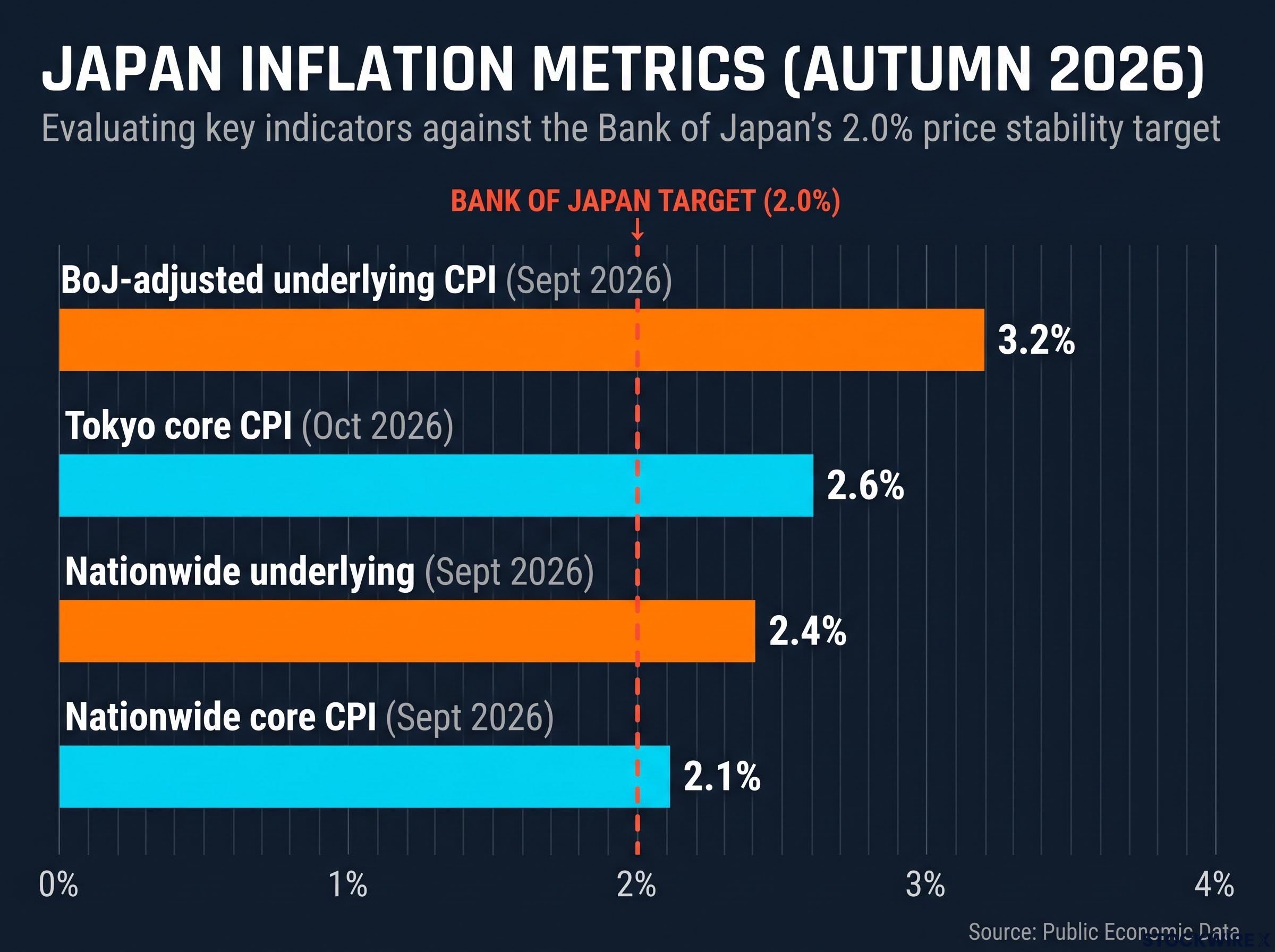
All key underlying inflation measures in Japan have surpassed the Bank of Japan’s 2% target, with the BoJ-adjusted underlying CPI reaching 3.2% in Sept 2026.
| Indicator | Latest figure | Period |
|---|---|---|
| Nationwide core CPI (ex fresh food) | 2.1% | September 2026 |
| Nationwide underlying (ex fresh food and fuel) | 2.4% (1.9% in August) | September 2026 |
| BoJ-adjusted underlying CPI | 3.2% (2.6% in August) | September 2026 |
| Tokyo core CPI | 2.6% | October 2026 |
| Shunto settlement (Rengo) | 5.01% | 2026 round |
CPI, the consumer price index, tracks the price of a basket of everyday goods and services. A reading above 2% on underlying measures is exactly what the BoJ spent a decade trying to achieve.
The doves have a counterpoint. Part of the strength may come from imported costs, food, energy or temporary policy effects rather than from domestic demand. Inflation driven by those factors can fade without any help from rate hikes.
Shunto and the 2027 wage round
Shunto is Japan’s annual spring wage negotiation between unions and employers. The 2026 round settled at 5.01%, according to the Rengo union federation, with small and medium employers at 4.69%. It was the third straight year above 5%, after 5.10% in 2024 and 5.25% in 2025.
The Summary flagged next year’s negotiations as worth close attention. One member expected wage growth next year to be only a little higher than this year’s, with a low risk of second-round effects. Second-round effects occur when higher prices push up wages, which then push prices higher again.
Three years of 5%-plus settlements give the hawks real evidence. The next shunto round is the variable that decides whether the pace of hikes speeds up.
How did the BoJ get here? A short policy history since 2013
Today’s 1.25% looks modest next to US rates. Set against the BoJ’s own past, it marks the end of a long unwinding:
- April 2013: Quantitative and qualitative easing (QQE) began, with large-scale purchases of Japanese government bonds and other assets to fight persistently low inflation.
- January 2016: A rate of -0.10% was applied to part of banks’ current-account balances held at the BoJ.
- September 2016: Yield curve control (YCC) arrived, a policy of capping the 10-year bond yield, which was targeted at around 0%.
- 19 March 2024: The BoJ ended negative rates and YCC, setting the overnight rate at about 0-0.10%.
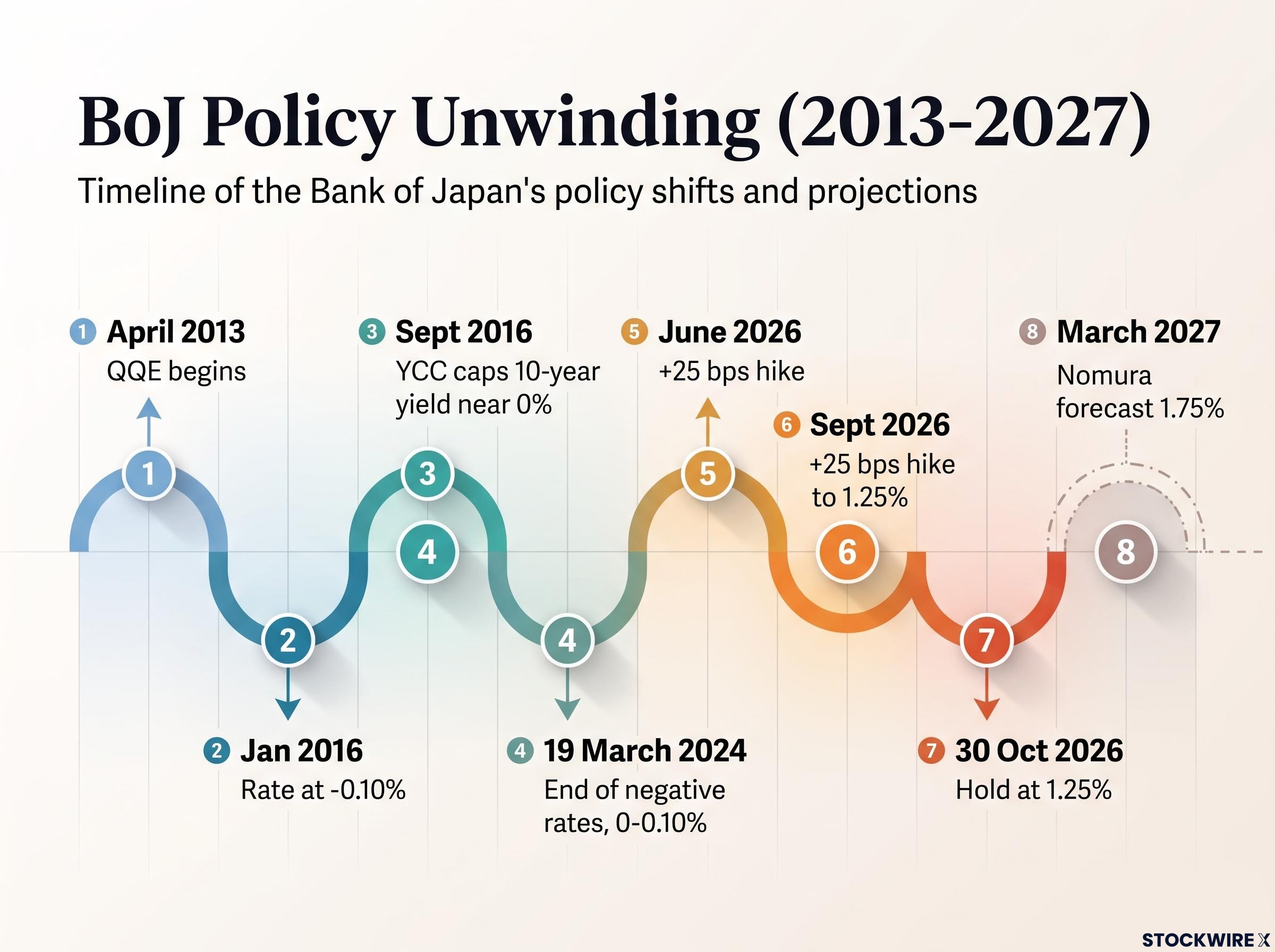
After a decade of negative and near-zero rates, the Bank of Japan hiked to 1.25% in Oct 2026, with a Nomura forecast suggesting 1.75% by March 2027.
The BoJ’s mandate is price stability around 2% inflation. Years of stimulus weakened the yen, especially in 2022 and 2023 as other central banks raised rates sharply. A weak yen and high global energy prices then lifted inflation above 2%, and the prospect of rising wages helped convince the Bank to start unwinding.
Each step since has been gradual. That is why a 25 basis point pace still counts as measured. After more than a decade of extraordinary easing, you should read even small moves as regime signals, which explains the attention this Summary is drawing.
Why did the yen stay weak near 158 despite a hawkish Summary?
USD/JPY rose 0.12% to about 158.07 after the release, according to FXStreet. A hawkish document, and the yen still slipped. The mechanics explain why.
How the transmission works
- Rate differentials: The gap between US and Japanese rates drives demand for each currency. In March 2024 the Federal Reserve sat at 5.25%-5.50% while the BoJ’s rate was still negative.
- Carry trades: Investors borrow in a low-yielding currency such as the yen, convert it and invest in higher-yielding assets. Reuters reported a three-month dollar-yen carry trade yielded roughly 5% annualised at that point.
- Expectations: Carry positions react to expected policy changes and volatility, not just current rates. Expected BoJ hikes and Fed cuts helped lift the yen about 13% in one month in 2024, with Japan’s overnight rate at only 0.25% (Reuters).
- Why the yen stays weak: A 25 basis point hike only modestly narrows the dollar’s yield advantage. Doubts about BoJ speed, high Treasury yields or low volatility can all keep carry trades alive.
The speed matters most: James Malcolm of UBS argued during the 2024 tightening episode that the speed at which rate differentials change matters more than the absolute level of Japanese rates.
What 2024 shows about timing
The March 2024 exit did not rescue the yen, because the gap stayed wide. On 31 July 2024, the BoJ hiked and Governor Kazuo Ueda left the door open to more, and the yen hit its strongest level against the dollar since March. That month’s Summary placed neutral at “at least around 1%” with timely, gradual hikes. In August, expected BoJ hikes combined with expected Fed cuts triggered a sharp carry unwind.
October 2026 lacked that combination. The 8-1 hold and a still-large US yield advantage kept carry demand intact. If you trade or hedge yen exposure, watch for shifts in expected differentials rather than the Summary’s tone alone, because the yen moves when the gap is expected to narrow quickly.
Investors weighing how disorderly a reversal could get will find our deep-dive into yen carry trade risk, which applies a three-question framework to separate real stress from headline noise.
Three signals that will decide the next BoJ rate hike and the yen’s response
The board is leaning towards higher rates. The destination is uncertain, the wage backdrop is supportive but unproven, and the yield gap still favours the dollar. Turning a hawkish Summary into a market-moving one requires one of those pieces to shift.
Three variables will tell you whether it does:
- The December meeting: Whether the board follows Nomura’s expected path towards 1.75% by March 2027, or waits as the cautious minority prefers.
- The 2027 shunto outlook: Early signals on whether settlements hold above 5% or soften towards the modest growth one member expects.
- The speed of US-Japan convergence: Whether Fed expectations and BoJ moves combine to narrow the differential quickly, the condition that moved the yen in 2024.
When all three point the same way, the yen is likely to respond. Until then, the direction is set but the timing remains open.
Rising domestic yields also give Japanese institutions a reason to repatriate capital, and shifts in global capital flows of that kind can keep Treasury and European yields structurally higher.
This article is for informational purposes only and should not be considered financial advice. Investors should conduct their own research and consult with financial professionals before making investment decisions.