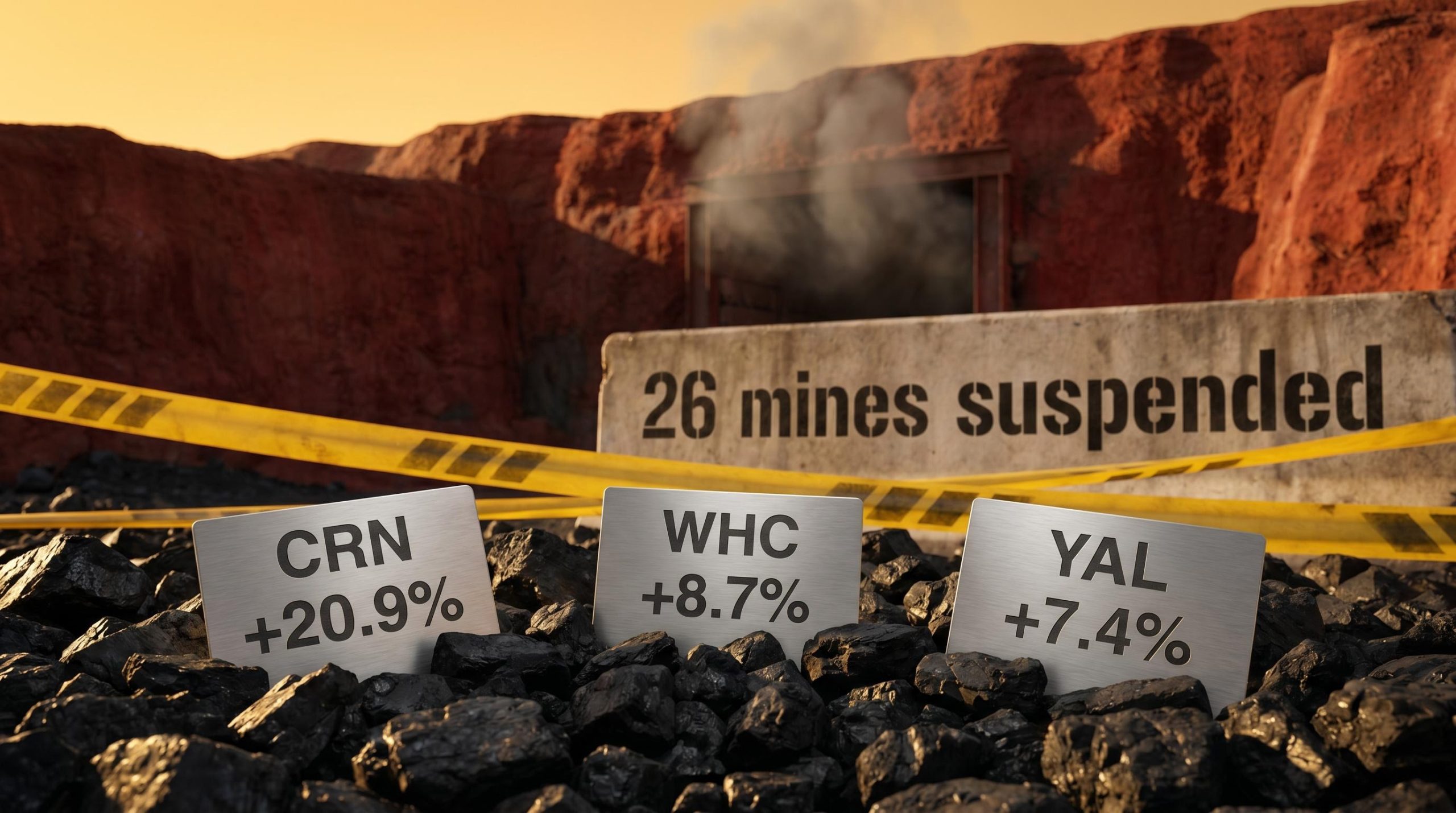
Three Australian coal stocks recorded gains of between 7% and 21% in a single session on 25 May 2026 after 26 coal mines in China’s Shanxi province were suspended following a fatal gas explosion, representing an estimated 25.6 million tonnes per annum of production capacity pulled offline with no resumption date announced. Supply shocks originating in China’s domestic coal sector have a direct transmission mechanism to Australian export pricing and ASX coal equity valuations. Shanxi ranks as one of China’s top two coal-producing provinces by volume, making safety-driven suspensions there structurally significant rather than merely regional. The timing matters: Australia restored coal trade with China in 2023 and exported approximately 52 million tonnes in that calendar year, positioning Australian producers as a natural swing supplier when Chinese domestic output tightens. This analysis explains how the suspension translates into a potential pricing and earnings tailwind for Australian coal producers, why China’s post-accident regulatory process tends to extend outages well beyond the initial shutdown, and what investors in WHC, YAL, and CRN should monitor in the weeks ahead.
What happened in Shanxi and what is currently offline
A fatal gas explosion in Shanxi province triggered an immediate regulatory response: the suspension of 26 coal mines across the region. According to Mysteel data, the combined production capacity of the affected mines is approximately 25.6 Mtpa, the market’s working estimate for the volume of supply now at risk.
No official resumption schedule has been announced as of 26 May 2026. That absence is the detail that elevates this from a routine safety halt to a supply event with market-moving potential.
25.6 Mtpa of Shanxi coal production capacity is currently suspended, according to Mysteel, with no official resumption date announced.
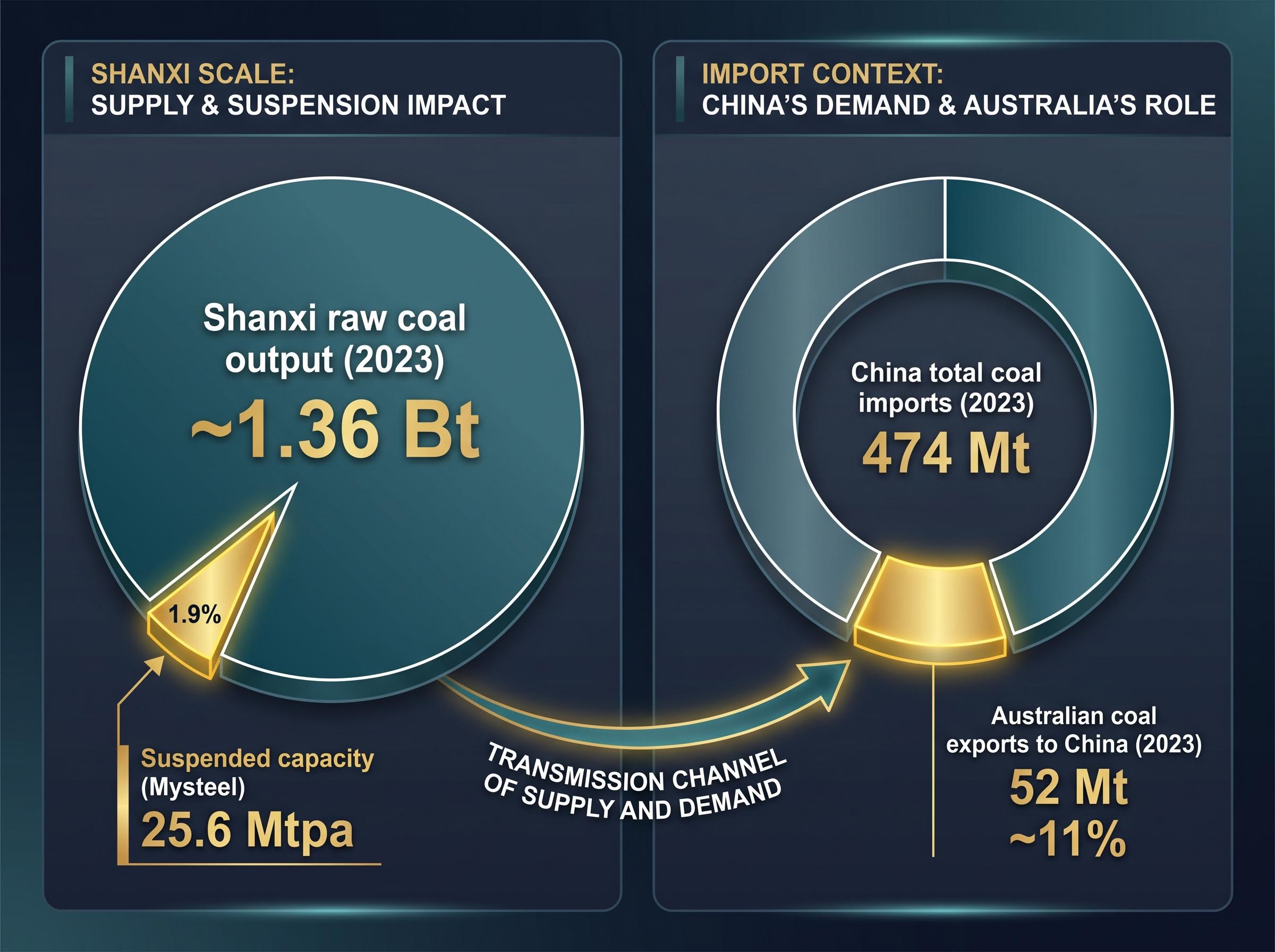
The scale of the disruption sits within a province that produced approximately 1.36 billion tonnes of raw coal in 2023, accounting for roughly 28-30% of China’s national output, according to National Bureau of Statistics data reported by China Energy News on 8 March 2024. The suspended capacity represents approximately 1.9% of Shanxi’s annual output.
Key facts of the event:
- 26 coal mines suspended following the fatal explosion
- 25.6 Mtpa combined production capacity offline (Mysteel)
- Shanxi accounts for approximately 28-30% of China’s national coal production
- No resumption date has been announced
When big ASX news breaks, our subscribers know first
Why Shanxi supply disruptions reach global seaborne coal markets
Shanxi’s structural role in China’s energy supply chain explains why a provincial safety event moved ASX coal equities within hours. The province’s 1.36 billion tonnes of raw coal output in 2023 made it one of only two provinces (alongside Inner Mongolia) that anchor China’s domestic coal supply, according to China Energy News, citing NBS data. A disruption of meaningful scale in either province creates a national supply gap that China’s import market is called upon to fill.
That import market reached an all-time high in 2023. Reuters reported on 12 January 2024 that China’s total coal imports hit approximately 474 million tonnes that year. Australia’s share of that total was approximately 52 million tonnes, or roughly 11%, according to Reuters reporting on 14 February 2024. This position was re-established after Beijing lifted the informal ban on Australian coal imports in 2023, making Australian producers a direct beneficiary when domestic Chinese supply tightens.
For investors wanting to understand the diplomatic architecture underpinning Australia’s coal export recovery, our dedicated guide to what Beijing actually confirmed at the May 2026 summit separates the verified commitments from unsubstantiated claims, and examines why the standing bilateral trade councils created at the summit may matter more to sustained Australian commodity access than any single headline figure.
The transmission channel runs in a straight line: a domestic Chinese shortfall reduces availability for power generators and steelmakers, seaborne prices firm as buyers compete for cargoes, and Australian FOB export pricing responds. The supply chain geometry makes the price response rational rather than speculative.
| Metric | Value |
|---|---|
| China total coal imports (2023) | 474 Mt |
| Australian coal exports to China (2023) | 52 Mt |
| Australia’s share of China’s coal imports | ~11% |
| Shanxi raw coal output (2023) | ~1.36 Bt |
| Suspended capacity (Mysteel) | 25.6 Mtpa |
How China’s post-accident safety regime extends mine suspensions far beyond the initial shutdown
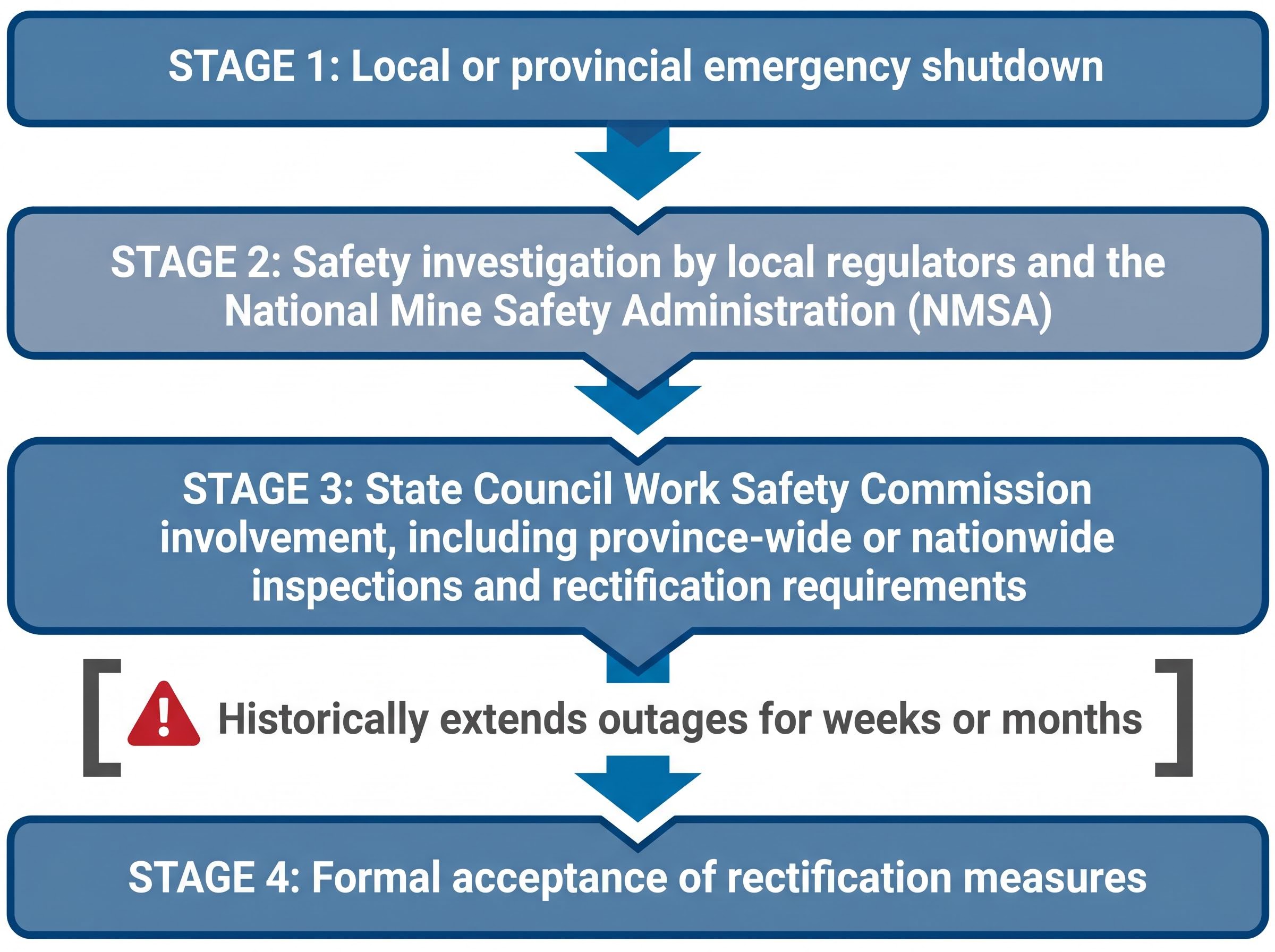
Investors pricing in a short-term disruption should consider the regulatory process that follows a fatal mining accident in China. The standard sequence involves four stages, each adding potential weeks or months to the timeline before affected mines can resume operations:
- Local or provincial emergency shutdown immediately after the accident
- Safety investigation by local regulators and the National Mine Safety Administration (NMSA)
- For accidents classified as major: State Council Work Safety Commission involvement, including province-wide or nationwide inspections and rectification requirements
- Formal acceptance of rectification measures by regulators before any mine is permitted to resume
The third stage is where outages extend most significantly. Reuters reported on 12 January 2022 that safety inspections and rectification requirements kept some Shanxi and Shaanxi mines offline for several months beyond the initial halt, constraining supply during peak demand periods. The South China Morning Post reported on 20 August 2021 that a State Council-ordered nationwide work-safety inspection saw some targeted mines “remain shut for months” pending rectification and approval.
The Global Times reported on the Shanxi accident that a State Council investigation team was immediately dispatched to conduct a rigorous inquiry and order production suspensions for rectification, a response pattern that, based on historical precedent, marks the beginning of a regulatory process measured in weeks or months rather than days.
The South China Morning Post reported on 3 November 2023 that after serious accidents, regional production curbs and safety checks typically persisted for “weeks or months” when State Council inspections were initiated.
The absence of a resumption announcement is consistent with the process being in its early investigation phase, which is historically the most uncertain and longest stage. For investors, this regulatory reality means the supply disruption is unlikely to resolve over a matter of days.
How ASX coal stocks responded and what the initial moves signal
The ASX response on 25 May 2026 was immediate and differentiated across the three most directly exposed coal producers.
| Stock | Ticker | Single-Day Move | Coal Type Exposure |
|---|---|---|---|
| Coronado Global Resources | CRN | +20.9% | Metallurgical |
| Whitehaven Coal | WHC | +8.7% | Thermal and metallurgical |
| Yancoal Australia | YAL | +7.4% | Thermal |
Coronado’s 20.9% gain was more than double the moves in WHC and YAL. The dispersion reflects how investors are differentiating within the sector. CRN’s pure metallurgical coal exposure positions it as the most directly leveraged to any tightening in Chinese steelmaking coal supply, while WHC’s blended thermal and metallurgical portfolio and YAL’s predominantly thermal positioning attracted more moderate re-ratings.
Initial equity moves in supply-shock events often overshoot. The more durable signal will come from whether seaborne benchmark prices follow through in subsequent sessions. As of 26 May 2026, the AUD/USD rate stood at 0.7171, a variable that matters for translating any USD-denominated coal price gains into AUD earnings for these producers.
Commodity risk premiums generated by supply disruptions follow a consistent pattern across energy markets: the initial equity and futures re-rating typically outpaces confirmed physical market tightening, with the durability of the premium then determined by how quickly alternative supply routes activate and whether the disruption cascades into downstream industrial production data.
Key variables investors should track in the weeks ahead
The initial equity re-rating has occurred. What determines whether these gains hold, extend, or reverse comes down to three variables:
- State Council involvement: Confirmation that the State Council Work Safety Commission has initiated a formal review would signal a multi-week to multi-month outage based on precedent documented by Reuters and the South China Morning Post across 2021-2024
- Seaborne benchmark price movement: As of 26 May 2026, no independent pricing data confirms that thermal or metallurgical coal benchmarks have moved in response to the Shanxi suspension. The equity re-rating is currently running ahead of confirmed pricing evidence, which introduces near-term volatility risk
- Official resumption notices: Any communication from Shanxi provincial regulators specifying a timeline or conditions for mine resumption would materially alter the supply-disruption thesis
Currency and earnings translation
Coal benchmarks are priced in USD. With the AUD/USD at 0.7171 as of 26 May 2026, a 10% rise in USD-denominated coal prices would translate to approximately 10% uplift in AUD-denominated earnings before hedging effects. This is a secondary variable, but one that matters for precise earnings estimate revisions. A weaker Australian dollar would amplify the earnings benefit; a stronger one would partially offset it.
The Shanxi suspension is a catalyst, not a structural shift, for Australian coal producers
The supply disruption thesis is grounded in documented precedent. Chinese safety-driven suspensions have historically tightened domestic supply and supported seaborne coal prices, and the regulatory process that follows fatal accidents has consistently extended outages well beyond initial shutdowns.
The thesis holds most strongly under two conditions: an extended State Council review stretching across multiple weeks or months, and confirmation that seaborne benchmark prices have responded in sessions following the initial equity move. Without the second condition, the CRN +20.9%, WHC +8.7%, and YAL +7.4% gains of 25 May 2026 represent a re-rating on anticipation rather than confirmed earnings uplift.
The disruption is real and precedent-supported, but the equity move has front-run the pricing confirmation. The distinction between a durable earnings tailwind and a single-session re-rating event will be determined in the sessions ahead.
The 25.6 Mtpa figure represents approximately 1.9% of Shanxi’s 2023 output, sufficient to tighten domestic balances if the outage extends, but not sufficient on its own to reshape the global seaborne market. Australia’s 52 million tonne export baseline to China is the volume from which any incremental demand would flow. Investors who entered positions before the 25 May 2026 session are now evaluating a different risk and reward profile than those considering entry after the initial move.
Investors evaluating whether to add to WHC, YAL, or CRN positions after the 25 May re-rating will find our deep-dive into the commodity supercycle debate directly relevant; it examines whether the 136% surge in mining ETF assets under management over twelve months reflects genuine structural demand from AI infrastructure, electrification, and grid buildout, or a positioning overshoot that leaves late entrants exposed to a crowded trade reversal.
This article is for informational purposes only and should not be considered financial advice. Investors should conduct their own research and consult with financial professionals before making investment decisions. Past performance does not guarantee future results. Financial projections are subject to market conditions and various risk factors.