
Australian bank stocks have generated reliable franked dividends for decades, but the analytical habits most retail investors bring to evaluating them stop at the price-to-earnings ratio. That is precisely where the most important questions begin. With the big four collectively representing roughly 30% of the ASX by market capitalisation, and with net interest margin (NIM) headwinds, regulatory scrutiny of fee income, and genuine cultural divergence between the banks now visible in financial results, the qualitative layer of analysis has never mattered more. In May 2026, valuations across the sector sit in a narrow band, making the non-numerical differences between banks the primary driver of long-term relative returns. What follows is a structured qualitative framework for evaluating the big four before buying, and a clear-eyed view of when an ETF is actually the better answer.
Why the numbers alone will mislead you on bank stocks
Standard valuation models give investors a numerical anchor. They do not capture the variables that most affect whether a bank grows or erodes earnings over a decade. The price-to-earnings ratio and the dividend discount model (DDM), a method for estimating a stock’s value based on the present value of its expected future dividends, are backward-looking inputs. Both embed assumptions about NIM, fee income, and credit quality that require independent qualitative verification.
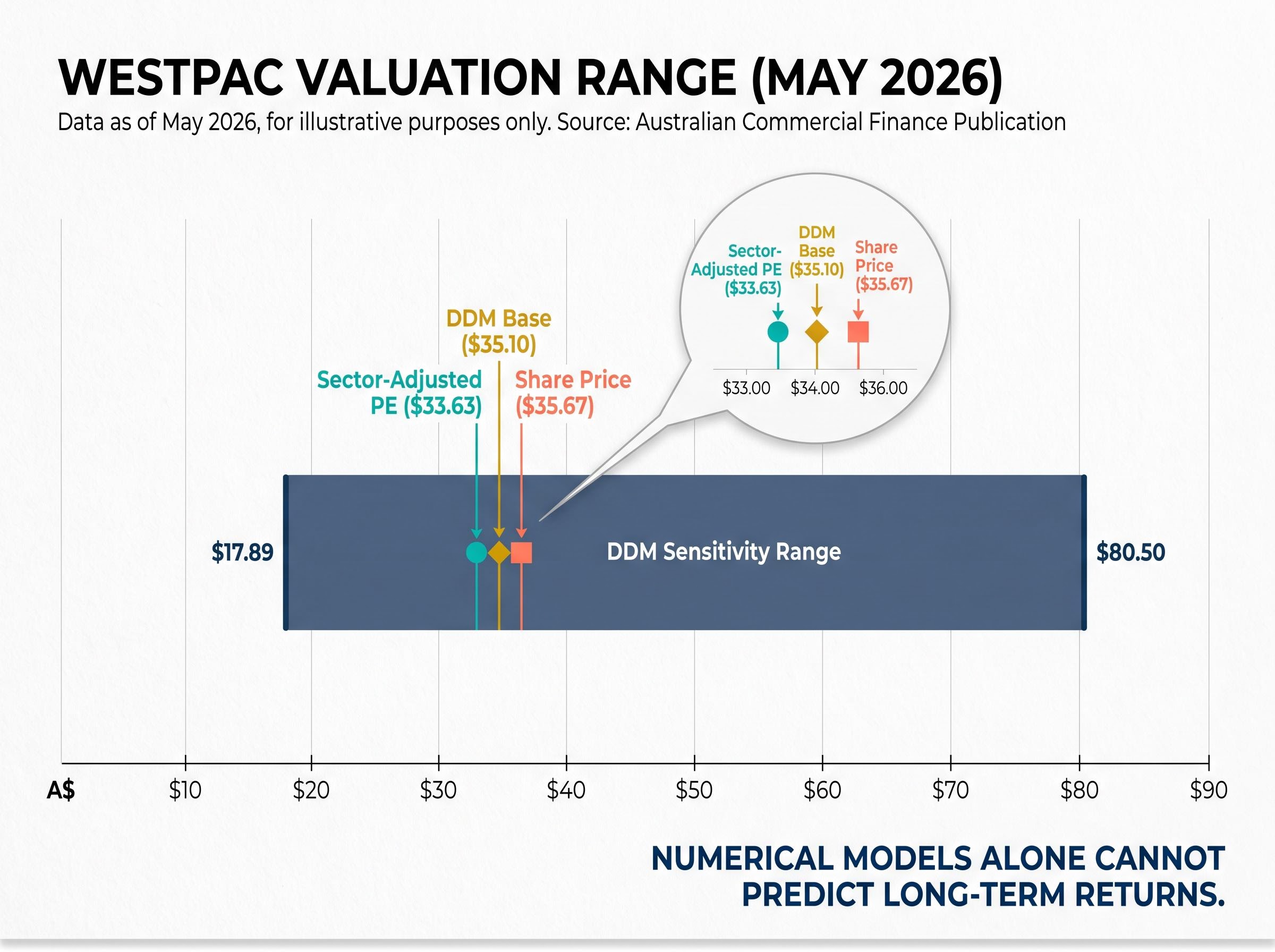
Consider Westpac. It trades at approximately 18.6x trailing earnings against a sector average of roughly 18x, producing a sector-adjusted valuation of about $33.63 against a May 2026 share price of $35.67. That looks like a modest premium. A DDM approach returns a base valuation near $35.10, which appears to confirm the market’s pricing.
The DDM’s sensitivity range tells a different story. Depending on the growth and discount-rate assumptions used, the same model produces valuations ranging from $17.89 to $80.50, a spread so wide it exposes how little the model alone can tell an investor.
Because the big four are so closely valued, the differentiation between them is almost entirely qualitative: NIM trajectory, regulatory exposure, management execution, and portfolio concentration. Those are the subjects that follow.
For investors who want to build the quantitative foundation before applying this qualitative framework, our dedicated guide to ASX bank stock valuation methods walks through PE, price-to-book, DDM, and DCF in detail, covering why each carries specific limitations for banks where earnings can be distorted by credit cycles, remediation charges, and regulatory capital changes.
When big ASX news breaks, our subscribers know first
Net interest margins: where the easy gains are already behind us
The intuitive assumption is straightforward: higher interest rates benefit banks. They did. During the Reserve Bank of Australia’s rate-hike cycle of 2022-2023, NIMs expanded sharply across the sector. That tailwind has largely played out.
| Bank | FY24 NIM range | NIM trajectory | Primary future NIM driver |
|---|---|---|---|
| CBA | 1.90-1.95% | Flat to slightly lower | Mortgage competition, deposit switching |
| Westpac | 1.85-1.90% | Stabilising | Business lending offset by mortgage pressure |
| NAB | 1.72-1.78% | Stabilising | Business and institutional mix |
| ANZ | 1.65-1.75% | Stabilising | Deposit pricing discipline, cost reduction |
CBA retains the strongest NIM, reflecting its deposit franchise and pricing power. ANZ sits at the bottom, though its May 2026 half-year result showed a cost-to-income ratio falling to approximately 49-50% and return on equity (ROE) rising to roughly 10-11%, with NIM described as “stabilising.” NAB management noted in December 2024 that deposit margin compression had “largely played out.”
Two structural pressures keep NIM capped across the sector:
- Back-book mortgage repricing competition, where existing borrowers negotiate or refinance to match the discounts offered to new customers
- Deposit switching into higher-yielding term products, which raises funding costs and compresses the spread banks earn
Investors who extrapolate the 2022-2023 NIM expansion forward will significantly overestimate future earnings-per-share growth. The easy margin gains are already in the numbers.
What regulatory risk actually means for bank earnings
Regulation is not a background concern for bank investors. It is an active earnings headwind, particularly for the non-interest income streams that banks have historically relied on to diversify revenue.
The structural decline began with the Hayne Royal Commission. All four banks have since exited large parts of wealth management and financial advice, removing what were once meaningful fee-income lines. ASIC and APRA enforcement through 2024-2025 on fees-for-no-service and remediation costs reinforced the exit.
Three regulatory pressure points remain in order of earnings materiality:
- Wealth and advice fee income: Structurally lower, with remediation costs still flowing through and a chilling effect on launching high-fee products under bank brands
- Payment systems and merchant fees: The RBA’s interchange fee caps and ongoing review of card payments regulation put structural pressure on merchant acquiring revenue, even as electronic payment volumes grow
- Consumer Data Right (CDR) and switching: Ongoing CDR expansion through 2024-2025 increases product comparison and customer mobility, compressing cross-sell economics and limiting fee-based revenue growth
The direction of travel is toward lower fees, not higher
The Financial Accountability Regime (FAR), which strengthens personal accountability for bank executives around conduct and product design, limits how aggressively banks can launch products with complex or opaque fee structures. The CDR continues to erode the information asymmetry that supported higher fees.
The strategic response, growing transaction banking, foreign exchange, and SME services, involves equally competitive and scrutinised revenue lines. Westpac’s approximately $153 million support package for regional in-person banking illustrates the reputational and political exposure that further constrains pricing decisions. Investors who underwrite bank earnings on the assumption that non-interest income will grow steadily are likely to be disappointed.
Morgans’ simultaneous sector-wide sell ratings on all four major banks, issued ahead of the May 2026 reporting season, reflected the same convergence of stretched valuations, rising provisions, and deteriorating household credit quality that makes the qualitative layer of bank analysis so consequential; by April 2026, the firm was forecasting total Big Four provisions rising from approximately $2.4 billion in FY25 to $5.5 billion by FY27.
Reading management quality and corporate culture across the big four
The four banks are not interchangeable franchises with slightly different multiples. They are organisations at genuinely different points on a cultural trajectory, and the investor question is not just “which is best now” but “which trajectory is most likely to close or widen the valuation gap over the next decade.”
| Bank | CEO and tenure | Cultural assessment | Key risk | Turnaround upside |
|---|---|---|---|---|
| CBA | Matt Comyn (since 2018) | Best-in-class execution and risk culture | Already priced for quality | Low |
| Westpac | Peter King (since 2020) | Repair and turnaround; improving but under scrutiny | AUSTRAC legacy, operational risk | Medium-High |
| NAB | Ross McEwan (since 2019) | Steady, business-bank-centric; fewer recent missteps | Lacks CBA’s technology advantage | Low-Medium |
| ANZ | Nuno Matos | Active transformation; “reset then outperform” | Execution slippage | Medium-High |
CBA under Matt Comyn has been widely assessed as having executed the most credible cultural reset post-Royal Commission, with AFR and Morningstar commentary through 2024-2025 citing its technology platform and disciplined risk culture. The premium multiple reflects that perception. NAB under Ross McEwan is described as steady and relationship-focused, particularly in SME and business banking, with no high-profile misconduct since 2024. ANZ’s recent half-year result showed ROE improvement to approximately 10-11% from a prior 6-7% range, signalling meaningful operational progress under its current leadership.
The core investor question for the sector: can Westpac and ANZ close the execution and culture gap enough to justify their valuation discounts versus CBA, or will the gap persist?
Culture is not a soft metric. It shows up in remediation costs, regulatory capital requirements, customer retention, and the quality of revenue growth. For a ten-plus year holding period, management execution matters more than the current-year earnings delta.
The concentration problem most ASX investors already have
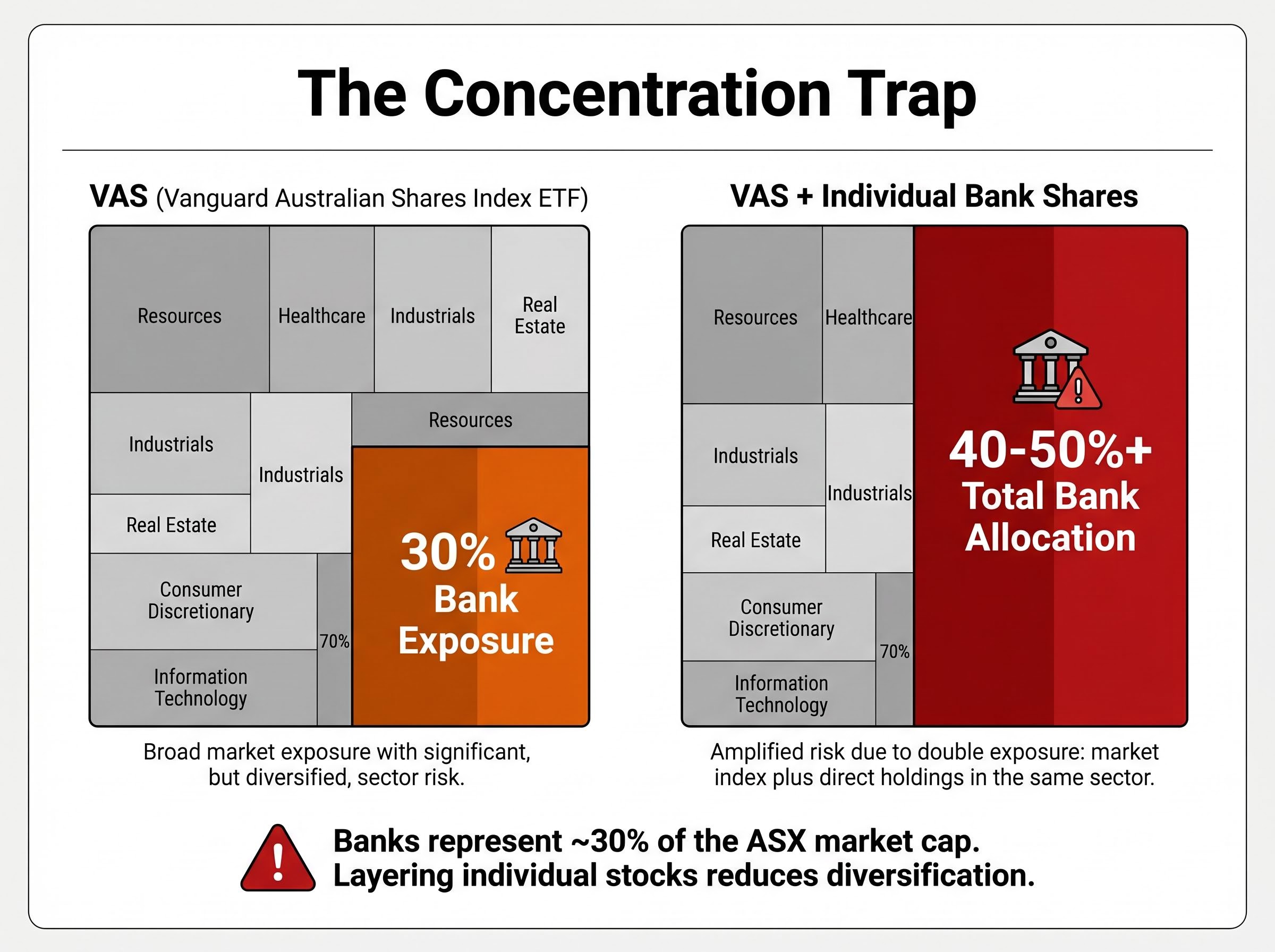
Banks represent approximately 30% of ASX market capitalisation. An investor holding VAS (Vanguard Australian Shares Index ETF) or any broad Australian index product is already running a significant bank position before buying a single bank share.
That creates a three-way risk convergence in any portfolio with additional bank stock positions:
- Housing cycle exposure: Bank earnings are closely tied to Australian housing and domestic credit growth. APRA and the RBA have warned through 2024-2025 financial stability statements about high household debt levels and housing price sensitivity. A concentrated bank portfolio is effectively a leveraged bet on Australian housing remaining benign.
- Regulatory intervention risk: Because the big four are systemically important, political and regulatory willingness to intervene in pricing, capital requirements, and conduct is high. Upside is capped by scrutiny; downside is magnified if banks misstep.
- Competitive erosion: Macquarie and smaller banks continue gaining share in home loans and deposits, aided by digital offerings and open banking. The big four’s oligopoly economics could gradually erode without a single dramatic event.
APRA’s System Risk Outlook from November 2025 specifically identifies high household debt and housing price sensitivity as systemic vulnerabilities in the Australian financial system, providing the regulatory basis for treating concentrated bank exposure as a structural portfolio risk rather than a cyclical one.
Bank dividends, while attractive for their franking credits, are not guaranteed. They were cut during COVID, and APRA retains powers to limit payout ratios in stress scenarios. Income investors relying on bank dividends carry simultaneous capital and income risk in a downturn.
When owning more bank stocks makes your portfolio less diversified
The layering problem is straightforward. VAS at roughly 30% bank exposure plus individual bank positions can push total bank allocation well above 40-50% of a domestic equity portfolio without the investor noticing. Setting an explicit maximum bank allocation, as a portfolio-construction discipline rather than a market call, is one of the simplest risk-management steps available to Australian retail investors.
Investors who want to understand exactly how index construction mechanics translate VAS’s 30% bank weighting into their total portfolio exposure will find our full explainer on cap-weighted versus equal-weighted ETFs useful, covering how the top 10 ASX 200 companies account for 48.6% of the index in May 2026 and why equal-weight alternatives like MVW produce structurally different sector tilts that affect bank concentration in ways the fund name alone does not signal.
Stock picking versus VAS: a framework for making the actual decision
The question of individual bank shares versus a broad ETF is not philosophical. It is a function of two conditions: whether genuine valuation dispersion exists between the banks, and whether the investor has the willingness and capacity to actively monitor qualitative changes in NIM, culture, and regulation.
A three-step decision framework applies:
- Assess monitoring capacity. Tracking bank-specific developments (APRA actions, NIM disclosures, management changes, regulatory shifts) requires ongoing attention. Investors unwilling or unable to do so are better served by the diversified franked income VAS already provides, which captures the bank dividend stream without idiosyncratic risk.
- Check for genuine valuation dispersion. It currently exists. Morningstar’s 2024-2025 analysis rated both ANZ and Westpac as four-star undervalued, while CBA’s persistent premium multiple leads most analysts to argue against paying up for quality in this sector specifically. Westpac’s dividend of approximately $1.54 per share, roughly a 3.85% yield, remains a reference point for income-targeting investors.
- Decide on core-only or core-plus-satellite. A middle path uses VAS for diversified franked income with a considered tilt to one or two undervalued majors for investors who have completed the qualitative work. The tilt is earned through analysis, not defaulted to.
Owning a bank-heavy ETF and then adding individual bank shares does not diversify a portfolio. It concentrates it further.
The stock selection odds on the ASX are structurally more difficult than most retail investors assume; a Morningstar Australia analysis found that only 36% of the 210 largest ASX companies outperformed the ASX 300 index over 15 years, with just 10 stocks generating 56% of all wealth created, a distribution that reinforces why the decision to tilt toward individual bank shares rather than index exposure needs to rest on genuine qualitative edge rather than familiarity or yield-chasing.
Qualitative analysis is not optional for long-term bank investors
PE ratios and DDM models are starting points, not conclusions. The qualitative layer, NIM trajectory, regulatory environment, culture, and concentration, is where long-term returns are actually made or lost.
The practical takeaway for each factor is specific. NIM is structurally capped, so do not extrapolate rate-cycle gains. Regulatory direction is toward fee compression, so stress-test non-interest income assumptions. Culture and management execution are measurable through cost-to-income trends, remediation history, and APRA scrutiny levels. Concentration in the ASX already skews most portfolios toward bank risk before a single individual bank share is purchased.
The investor posture that follows is binary. Either commit to ongoing qualitative monitoring of the banks held in a portfolio, or own the index and accept the diversified exposure it provides. Defaulting to individual bank picks without the analytical work this framework describes is the most common and least-discussed source of uncompensated risk in Australian retail portfolios.
This article is for informational purposes only and should not be considered financial advice. Investors should conduct their own research and consult with financial professionals before making investment decisions. Past performance does not guarantee future results.