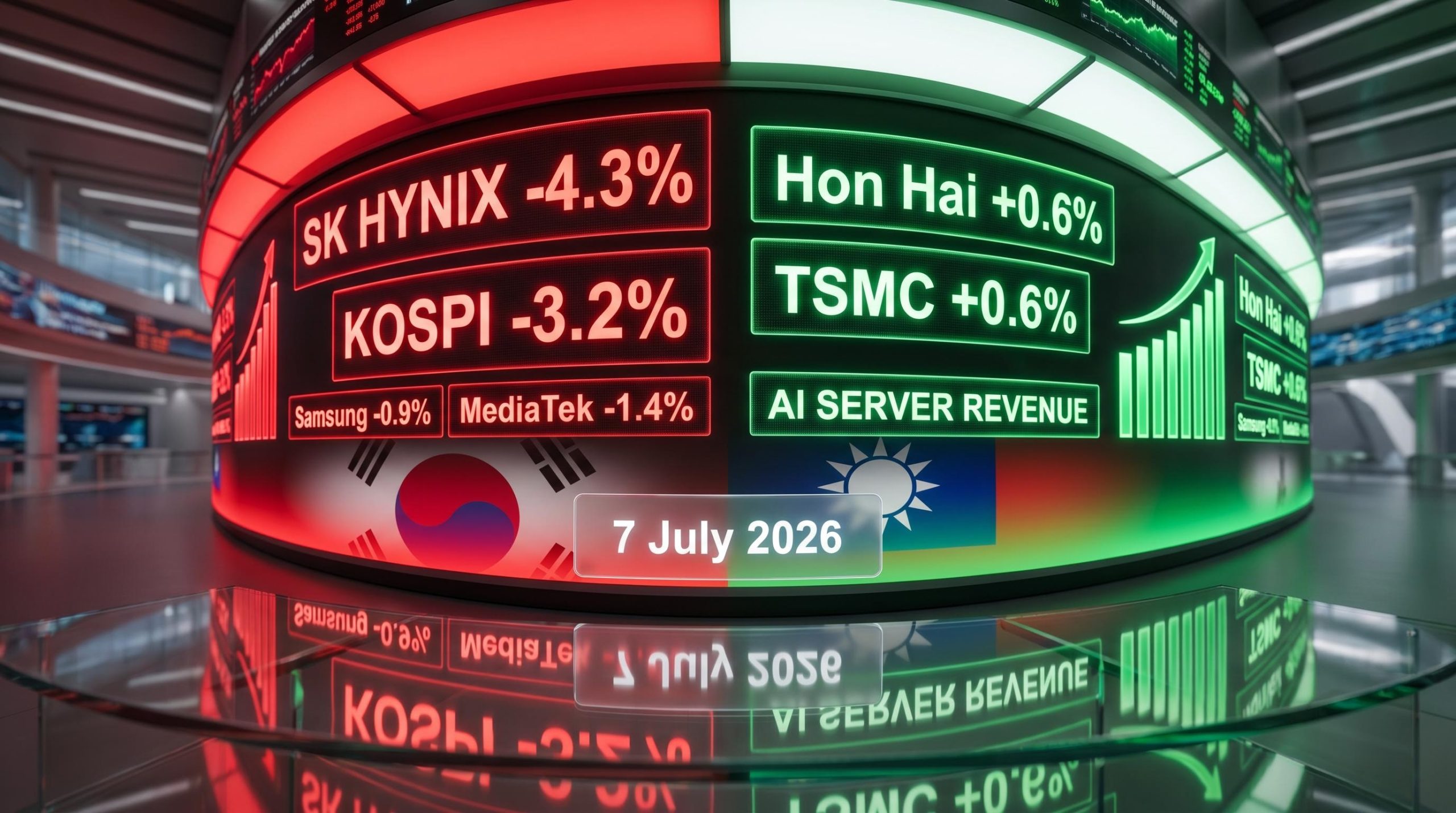
SK Hynix dropped 4.3% on Monday. On the same day, Hon Hai Precision Industry published figures showing both June and second-quarter revenue had reached record levels, with AI server demand cited as the primary driver. The company’s shares finished the session up 0.6%.
That single session captured the contradiction sitting at the centre of the Asian semiconductor trade right now. The selloff on 7 July 2026 was not a uniform retreat. It was the third act in a rapid cycle: an AI-driven multi-day selloff, a sharp Friday recovery as bargain hunters returned, and then a fresh wave of profit-taking that sent South Korea’s KOSPI down 3.2% and Japan’s Nikkei 225 lower by 1.3%.
Here is what the pattern of sell, rebound, and sell again actually tells you about where AI investor positioning stands, and what the upcoming earnings season will need to deliver to break the cycle.
The two days that explain why Asian chip stocks are so hard to read right now
The sequence matters. Last week’s multi-day selloff in AI-linked semiconductor names triggered an aggressive Friday rebound as bargain hunters moved in. By Monday morning in Asia, that relief had already faded. Sellers returned across the region in force: the KOSPI shed 3.2%, the Nikkei 225 gave back 1.3%, and both China’s CSI 300 and the Shanghai Composite pulled back by roughly 0.6%.
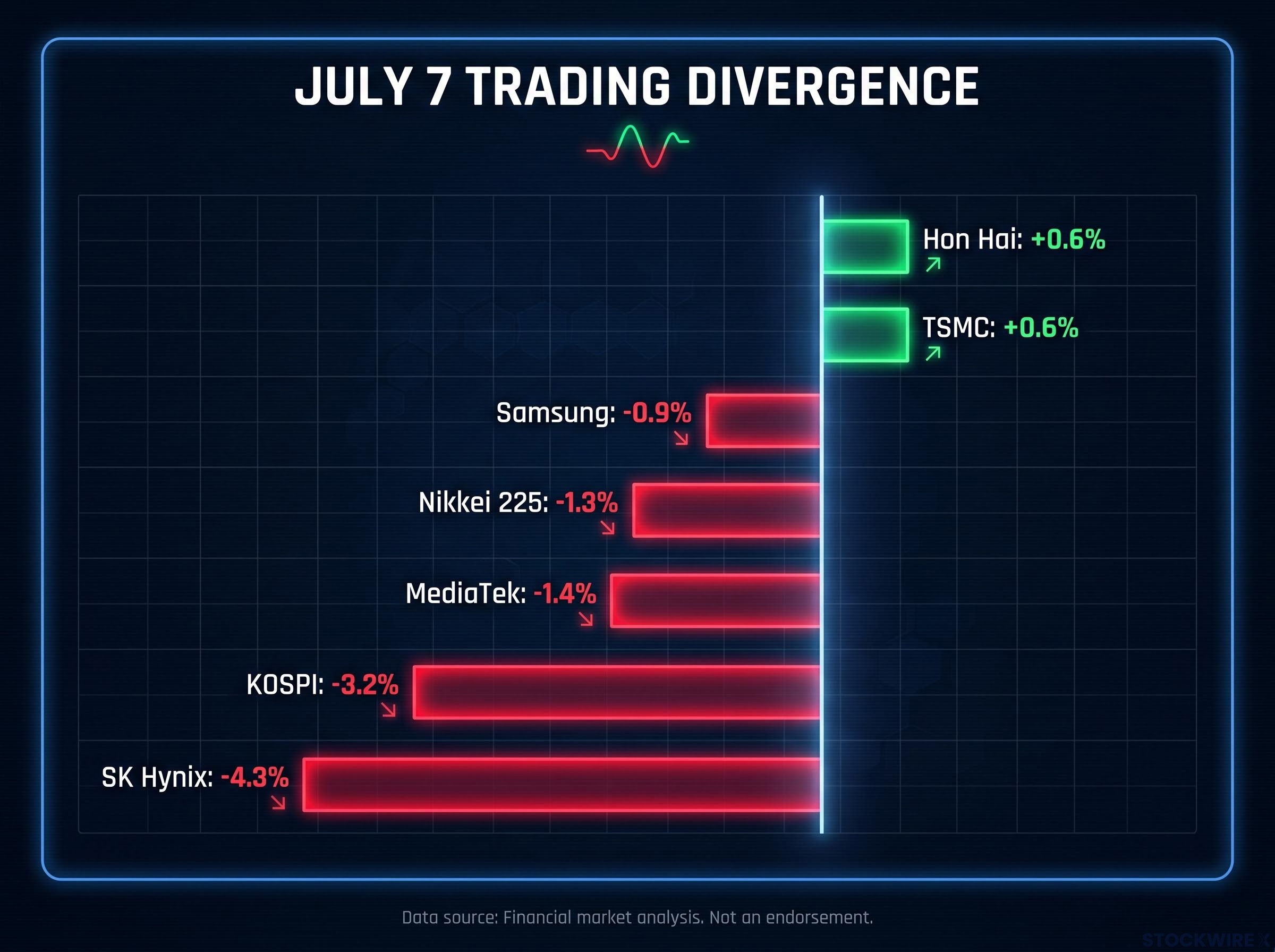
What made 7 July distinctive was the divergence within the same trading session. Memory and overcapacity concerns pushed SK Hynix down 4.3%, while Samsung Electronics eased 0.9% and MediaTek lost 1.4%. Contrast that with Hon Hai, which added 0.6% after disclosing record AI server revenues, and TSMC, which also gained 0.6% on the strength of its advanced-node foundry position in AI chip production.
The market is already sorting the chip sector into tiers, and which tier a stock sits in matters more right now than whether AI demand is broadly positive.
| Name | Market | Move (%) | Role in AI supply chain |
|---|---|---|---|
| KOSPI | South Korea | -3.2% | Broad index, semiconductor-heavy |
| Nikkei 225 | Japan | -1.3% | Broad index, tech exposure |
| SK Hynix | South Korea | -4.3% | Memory and HBM supplier |
| Samsung | South Korea | -0.9% | Diversified chips, memory, foundry |
| MediaTek | Taiwan | -1.4% | Mobile and consumer chip design |
| Hon Hai | Taiwan | +0.6% | AI server assembly for hyperscalers |
| TSMC | Taiwan | +0.6% | Advanced-node AI chip foundry |
When big ASX news breaks, our subscribers know first
What repositioning looks like when an entire sector has been crowded
The selloff was sharp, but the institutional read is consistent: this is a positioning adjustment, not a collapse in AI demand.
Bank of America noted that the recent pullback in AI-linked equities looked more like a portfolio reset than evidence of eroding business fundamentals, and maintained that AI infrastructure spending continues to be well-supported even as investors have grown more discerning.
Wells Fargo strategist Ohsung Kwon framed the broader June-July moves as “positioning adjustments” in an overbought sector driven by crowded trades and risk management, rather than any fundamental collapse in AI demand.
When a sector has delivered gains on the order of 91% year-to-date (the MSCI EM Semiconductors index, per some estimates) and individual names like SK Hynix and Samsung have recorded returns in the range of 150-300% year-to-date, the concentration of positioning itself becomes a risk factor. Everyone is in the same trade, and when a few start to take profits, the exit gets crowded.
When flat guidance hits like bad news
The Broadcom episode on 5 June 2026 made this dynamic visible. Broadcom reported results that met expectations and maintained its AI-chip revenue guidance without raising it. That was enough to trigger a roughly 10% single-day drop in the Philadelphia Semiconductor Index (SOX), the index’s worst session since March 2020. When valuations are priced for acceleration, reaffirmation without an upward revision is read as disappointment. That tells you the bar for the upcoming earnings season is substantially higher than a simple beat.
Not all chips are the same, and the market is starting to price that in
The “Asian chip stocks fell” headline obscures a more useful reality: different parts of the semiconductor supply chain carry materially different risk profiles, and the market is now pricing that distinction in real time.
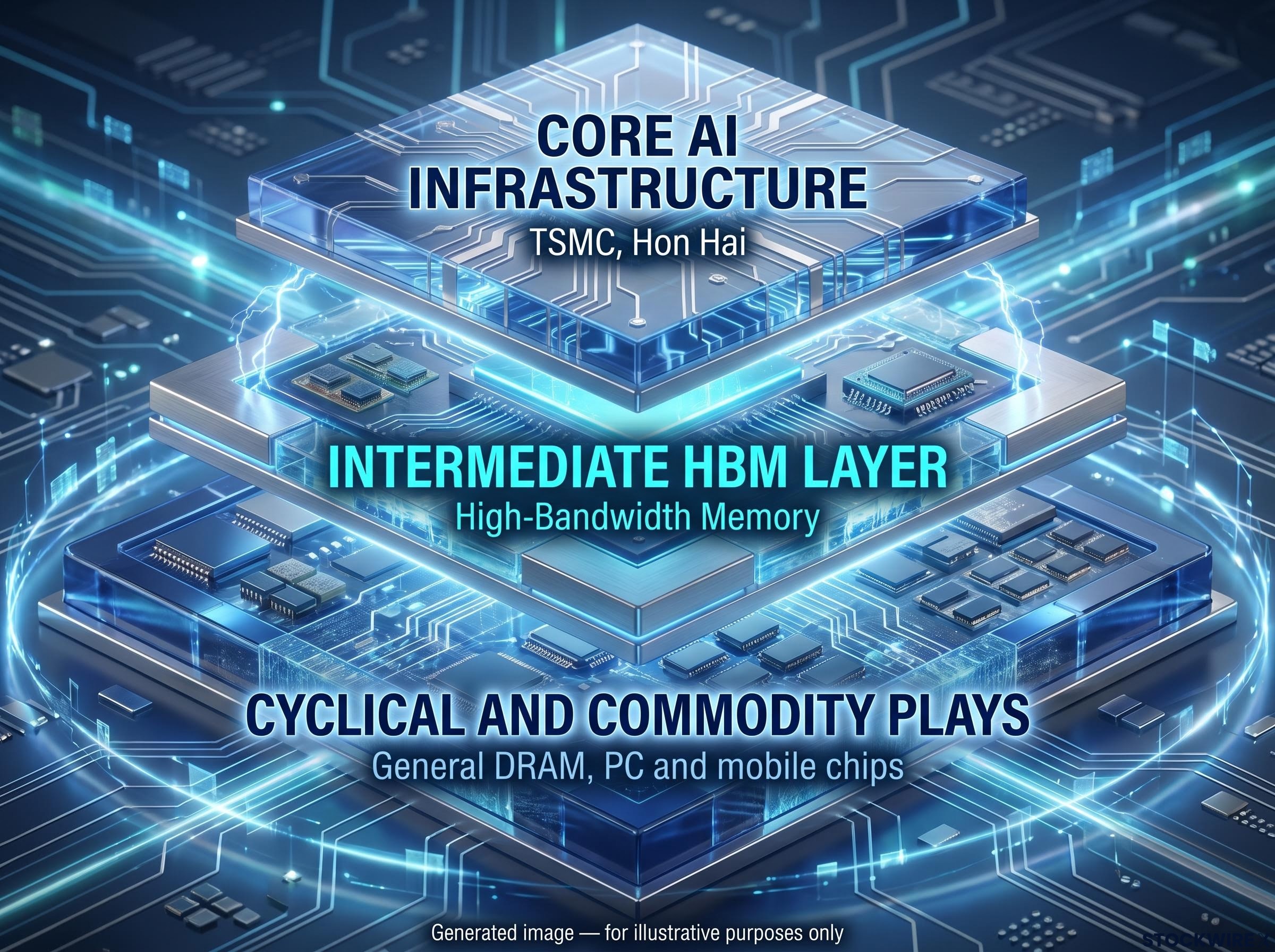
Three tiers are emerging:
The tiering dynamic now visible in daily price action reflects a structural reality embedded in the AI chip supply chain itself: Nvidia, TSMC, ASML, and Broadcom occupy distinct and non-interchangeable layers, meaning capital flowing into ‘semiconductors’ as a category is not flowing into the same risk profile at each node.
- Core AI infrastructure: Leading accelerator designers, top-tier advanced-node foundries like TSMC, and critical AI-server assemblers like Hon Hai. These have direct hyperscaler contracts, strong pricing power, and order books tied to the multi-year AI capex cycle.
- Intermediate HBM layer: High-Bandwidth Memory (HBM), a specialised form of DRAM optimised for AI accelerators, sits closer to core AI infrastructure than commodity memory. But it remains subject to pricing-cycle swings and capacity-addition risks as competitors ramp production.
- Cyclical and commodity plays: General DRAM, PC and mobile chips, and lower-value components. AI is one demand driver among many, and overcapacity concerns, including growing Chinese competition in memory segments, weigh more heavily on these names.
How July 7 trading illustrated the divergence in real time
The session delivered a live case study. Hon Hai and TSMC, both with direct AI infrastructure exposure, held up or gained. SK Hynix, facing memory cycle and overcapacity concerns, dropped 4.3%. Samsung’s more modest 0.9% decline reflected its diversification across product lines, which provided a partial cushion. Choosing “AI chip exposure” is no longer sufficient as a portfolio decision; what matters is which layer of the supply chain you are buying.
Why the earnings season coming up is not routine for AI chip investors
The June-July volatility cycle has turned the upcoming earnings season into a genuine inflection point. Investors are no longer satisfied with strong revenue alone. They want evidence that AI capex is accelerating and translating into margin expansion and durable earnings growth across the supply chain.
Four metrics and themes will determine whether the bull case holds or cracks:
- AI-related revenue growth and backlog extension: How fast are AI server and accelerator-driven revenues growing, and are order books extending further into 2027?
- Foundry utilisation for advanced-node and AI-specific wafers: This is the data that validates the AI supercycle narrative at the production level.
- HBM pricing and capacity additions: Memory makers’ commentary will shape earnings trajectories for the next 12-18 months.
- Hyperscaler capex language on ROI and early monetisation: If major cloud providers continue to raise or reaffirm AI infrastructure budgets and begin emphasising early revenue from AI services, equity markets will have more confidence that current chip valuations are not purely speculative.
HBM pricing mechanics add a further layer of complexity to reading memory stocks: Bernstein projects 2 to 2.5 times contract price increases for 2027, but those increases amplify approximately fourfold at the hyperscaler purchase level once GPU vendors apply margin preservation, meaning SK Hynix commentary on HBM pricing carries implications well beyond the memory segment alone.
Hon Hai’s record Q2 revenue is an early positive signal, but it is specific to AI server assembly. It does not resolve questions about memory pricing, foundry utilisation rates, or hyperscaler spending sustainability.
Institutional consensus holds that underlying AI infrastructure spending remains supported by hyperscaler capex, but the market has become more selective after this year’s strong run. Simply maintaining guidance is no longer enough for highly valued AI names.
What distinguishes an AI chip investment thesis from a crowded trade
The sell-rebound-sell pattern has now recurred multiple times across June and July. It should be treated as a structural feature of AI chip investing at current valuations, not an anomaly to wait out.
The productive question is not “AI chips: in or out?” It is which part of the stack, at what valuation, and with what risk profile.
Attributes that favour resilience:
- Direct contracts with hyperscalers for AI servers or accelerators
- Proven pricing power at advanced nodes or in scarce components
- Disciplined capacity expansion and strong balance sheets
- AI revenue as a primary, not ancillary, growth driver
Attributes signalling elevated risk:
- Highly cyclical segments where AI is one demand driver among many
- Valuations priced for perfection, where any guidance wobble triggers outsized corrections
- Overcapacity exposure, particularly in commodity memory
- Bull case that remains primarily narrative rather than visible in earnings
Using earnings as a portfolio quality filter
Treat this earnings season as a filter for portfolio quality. Names that deliver convincing AI-driven earnings and strong forward guidance on AI-specific metrics warrant retention or addition. Where guidance wobbles on AI revenue share, HBM pricing, or data-centre growth rates, reassess your position size relative to your conviction. The filter is specific, not general: pay attention to AI-specific commentary, not just headline beats.
For investors who want a systematic framework for acting on the earnings filter approach, our comprehensive walkthrough of semiconductor cycle positioning maps the five-indicator framework for capturing peak-cycle gains across memory, foundries, and logic players without holding premium multiples past their expiry date.
What confirms the bull case, and what breaks it
The core AI investment thesis, that a multi-year capex cycle in AI compute will drive durable earnings growth across leading parts of the chip supply chain, remains intact in institutional research. Bank of America, Wells Fargo, and J.P. Morgan all maintain that underlying AI infrastructure demand is supported by hyperscaler capex. J.P. Morgan has flagged the concern that many semiconductor stocks trade at P/E multiples implying the data-centre investment cycle may have already peaked, though this assessment has not been independently confirmed.
The thesis is intact but not yet confirmed by broad-based earnings data. That is precisely why markets react so violently to incremental news, whether a single company’s guidance decision or a single day’s profit-taking.
The capex-to-revenue lag is the structural mechanism connecting current hyperscaler spending to the earnings confirmation the market is demanding: Morningstar analyst Dennis Li has identified an 18-24 month gap between capital deployment and revenue recognition, meaning that even with $725 billion committed for 2026, the earnings proof the market needs may not fully arrive until late 2027.
If upcoming earnings broadly confirm AI-driven revenue acceleration and hyperscaler capex growth, recent volatility will be read as a healthy positioning reset in an overbought sector.
If earnings disappoint
A disappointing earnings season looks specific: guidance cuts on AI-related revenue, weak HBM pricing commentary, hyperscaler capex reductions or deferrals, and management language that hedges on the durability of AI infrastructure spending. In that scenario, the market will likely re-rate AI chip names lower, with the most extended valuations and cyclically exposed models at greatest risk.
The most useful thing you can do right now is suspend the binary “bull or bear” judgement. Treat the next four to six weeks of earnings reports as the evidence base that will actually resolve the question. The sell-rebound-sell cycle tests positioning and valuation discipline, not the underlying AI infrastructure wave itself. Let earnings determine which parts of the supply chain truly deserve their current valuations.
This article is for informational purposes only and should not be considered financial advice. Investors should conduct their own research and consult with financial professionals before making investment decisions. Past performance does not guarantee future results. Financial projections are subject to market conditions and various risk factors.