Ask most people which AI lab is winning corporate America and they will name OpenAI. The spending data says otherwise. In August 2026, 43.8% of US businesses in Ramp’s transaction sample paid for Anthropic, against roughly 39.8% for OpenAI, and it is Anthropic that is reportedly chasing a valuation of around $2 trillion.
That lead comes at an awkward moment for anyone pricing these companies. As of October 2026, Anthropic is reportedly aiming for a listing as soon as November 2026, with OpenAI’s mooted for 2027. Neither timeline is confirmed.
Meanwhile, the price businesses pay for each unit of AI output has been falling fast. The risk for you is simple: paying IPO-level multiples for market share that may not hold.
Here is how to separate the adoption signals that matter for valuation from the ones that are noise, and what indirect exposure to this contest gives you and costs you.
What the Ramp data actually shows about Anthropic vs OpenAI
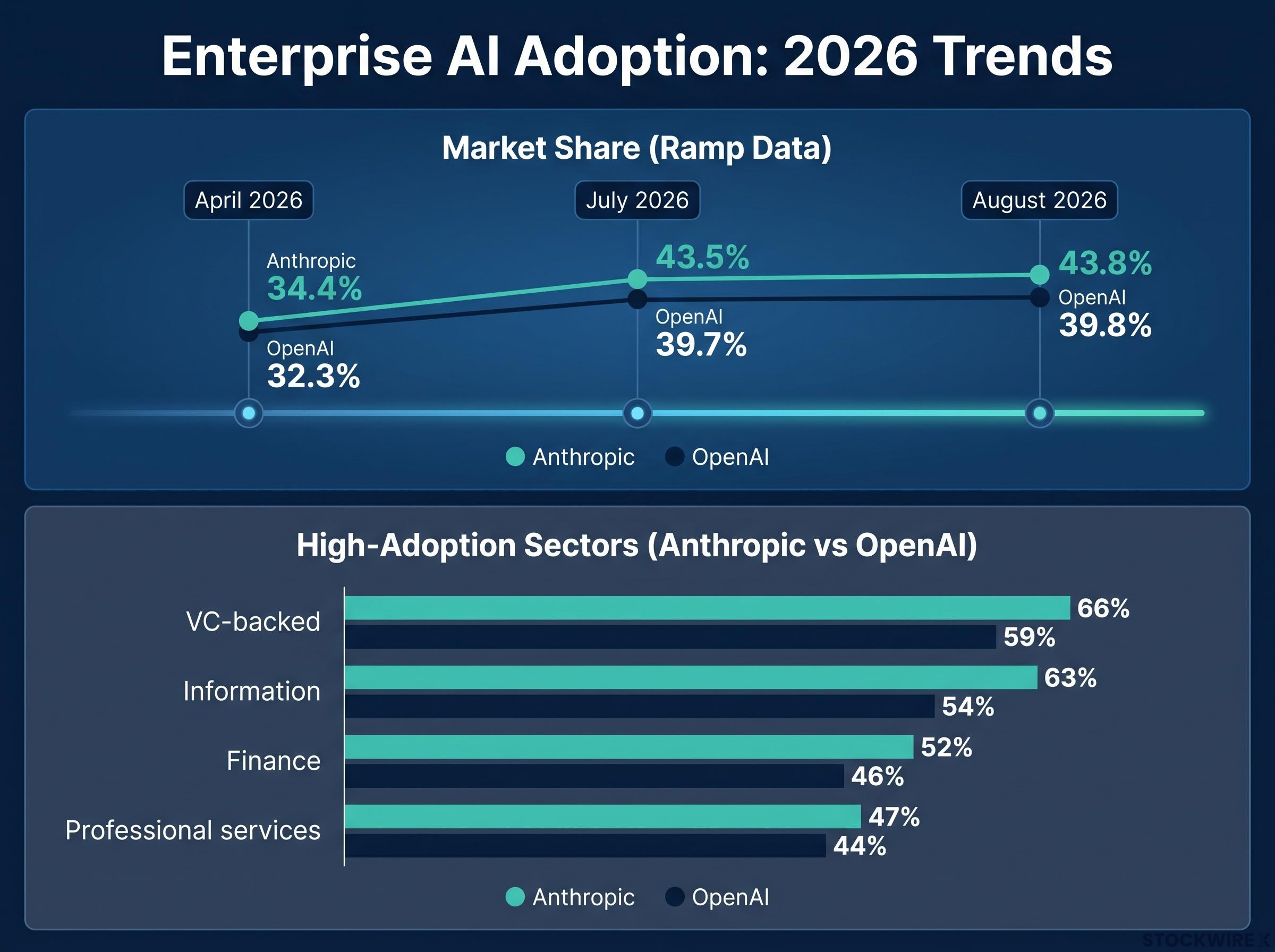
The gap did not open overnight. In April 2026 data, Anthropic edged ahead at 34.4% to OpenAI’s 32.3%, a lead of about two points. By July it was 43.5% to 39.7%, and August held at 43.8% to 39.8%.
| Month (2026 data) | Anthropic | OpenAI | Gap |
|---|---|---|---|
| April | 34.4% | 32.3% | 2.1 points |
| July | 43.5% | 39.7% | 3.8 points |
| August | 43.8% | 39.8% | 4.0 points |
The pace is the striking part. Ramp’s 13 May 2026 note reported that Anthropic’s business adoption had quadrupled over the prior year, while OpenAI’s grew just 0.3 percentage points. Some strategist commentary dates the crossover to May; the difference reflects the month the data covers (April) versus the month it was released and discussed.
The lead is sharpest among the most AI-hungry customers. Ramp economist Ara Kharazian found Anthropic used by 66% of VC-backed firms against 59% for OpenAI, and ahead in the three highest-adoption sectors:
- Information: 63% vs 54%
- Finance: 52% vs 46%
- Professional services: 47% vs 44%
The rest of the field remains small. xAI sits near 4%, Google roughly 4-5%, and Chinese open-source models have grown to 6.4% of AI spend from about 4.8%.
Markets are already reading the shift. Moomoo chief market strategist Tapas Strickland interpreted a recent tech selloff, triggered by a report that OpenAI’s revenue fell short of earlier guidance, as share moving from OpenAI to Anthropic rather than a reason for alarm.
How representative is Ramp’s sample?
Ramp tracks anonymised card, bill-pay and ACH (automated bank transfer) payments from more than 70,000 US businesses. In that group, paid AI adoption reached about 56% in August, with growth slowing. The US Census Bureau, surveying firms more broadly, puts the share spending on AI models at just 22.1%.
The difference comes down to who is sampled, which sectors dominate, and how “usage” is defined. Ramp’s customers lean digitally mature and well capitalised.
What this tells you is that Anthropic is winning the most valuable segment, paying and technically sophisticated firms. It does not tell you the whole economy has moved.
Paid usage is not the same as real enterprise adoption, since an estimated 70-80% of AI pilots stall on poor data integration, and only a minority of firms embed AI deeply enough to build lasting operational dependence.
When big ASX news breaks, our subscribers know first
Why switching costs matter more than market share
If Anthropic leads in customers, the next question is whether those customers stay. That is what investors mean by “stickiness”.
Switching costs are the time, money and effort a business faces when changing suppliers. Multi-homing means using more than one supplier at once. A standard API (application programming interface) is a common connection that lets software talk to a service, so swapping one AI model for another can be close to a configuration change.
Think of a company that can move its phone plan or a cloud workload by changing a setting. Loyalty in that market is cheap. Ramp’s figures suggest AI models are behaving the same way:
- About 8% of firms switched AI providers each month, averaged over three months (Ramp Economics Lab)
- Roughly 43% of Anthropic customers had come from another generative AI vendor
- 52% of Anthropic or OpenAI users pay for both
Monthly churn signal Around 8% of businesses changed AI provider every month, according to Ramp Economics Lab.
At that rate, a share lead looks more like a rental than a moat. OpenAI has not collapsed either: more than a third of businesses still pay for it, and Ramp’s later letters describe a duopoly rather than a runaway.
Some strategists argue standalone model providers face airline-like economics, with heavy capital intensity and interchangeable output, and a roughly 8% monthly switching rate is the kind of evidence that supports that thesis.
The same ease that brought customers to Anthropic can carry them away. For you, that makes today’s share a weaker foundation for a 2036 revenue forecast than the headline gap implies.
How a 41% drop in token prices changes the revenue math
Low switching costs feed straight into pricing. When customers can leave cheaply, suppliers compete on price, and the numbers show it.
Ramp’s AI price index, introduced on 26 June 2026, tracks the effective cost businesses pay per million tokens (a token is a small chunk of text an AI model reads or writes). The index fell from a 2026 peak of 1.15 in March to 0.68 by early September.
Price compression Effective cost per million tokens dropped 41% in about six months, according to Ramp.
Cheaper models, better negotiated rates and competition all drove the decline. Both OpenAI and Anthropic announced several price cuts over the past month.
That alone is not fatal. Price cuts are manageable if volume grows faster, and Ramp shows adoption still climbing. Yet its “Cracks in the AI thesis” letters also show spend growth slowing and per-employee costs falling among top spenders.
Falling unit prices do not always shrink customer bills, because agentic workloads can consume 10-100x more tokens than simple chat, which is why revenue growth for labs depends on volume and product mix.
There is a case that adoption is still early, with free models widely used and physical AI and robotics yet to arrive. But falling unit prices mean revenue growth must come from volume, agents and workflow products. When a prospectus lands, IPO investors are likely to scrutinise three things:
- Revenue mix: commodity token sales versus higher-margin products
- Customer concentration and retention: who pays, and how long they stay
- Compute costs and commitments: what the infrastructure bill locks in
For your diligence, the split between commodity tokens and premium products is the number that tells you whether revenue quality is improving or eroding.
Can $2 trillion and $1.4 trillion valuations survive these pressures?
All of this feeds into valuations that are reported, not confirmed. Reuters reporting says Anthropic has prepared a confidential S-1 (the registration document filed before a US listing) targeting about $2 trillion, up from a private valuation of as much as $965 billion in May 2026. Exact filing dates are not verified.
Bloomberg reports OpenAI is in early talks to raise at least $30 billion at about $1.4 trillion pre-money, framed as bridge funding toward a listing. Its last private mark was $852 billion in March 2026.
| Item | Anthropic | OpenAI |
|---|---|---|
| Reported IPO timing | November 2026 (reported) | Early 2027 (mooted, delayed once) |
| Prior private valuation | Up to $965B (May 2026) | $852B (March 2026) |
| Reported target valuation | About $2T | About $1.4T pre-money |
| Status | Confidential S-1, not public | Early private funding talks |
Neither lab consistently discloses its latest annualised revenue, so outsiders are working without the most important input. The skeptics have done the arithmetic anyway.
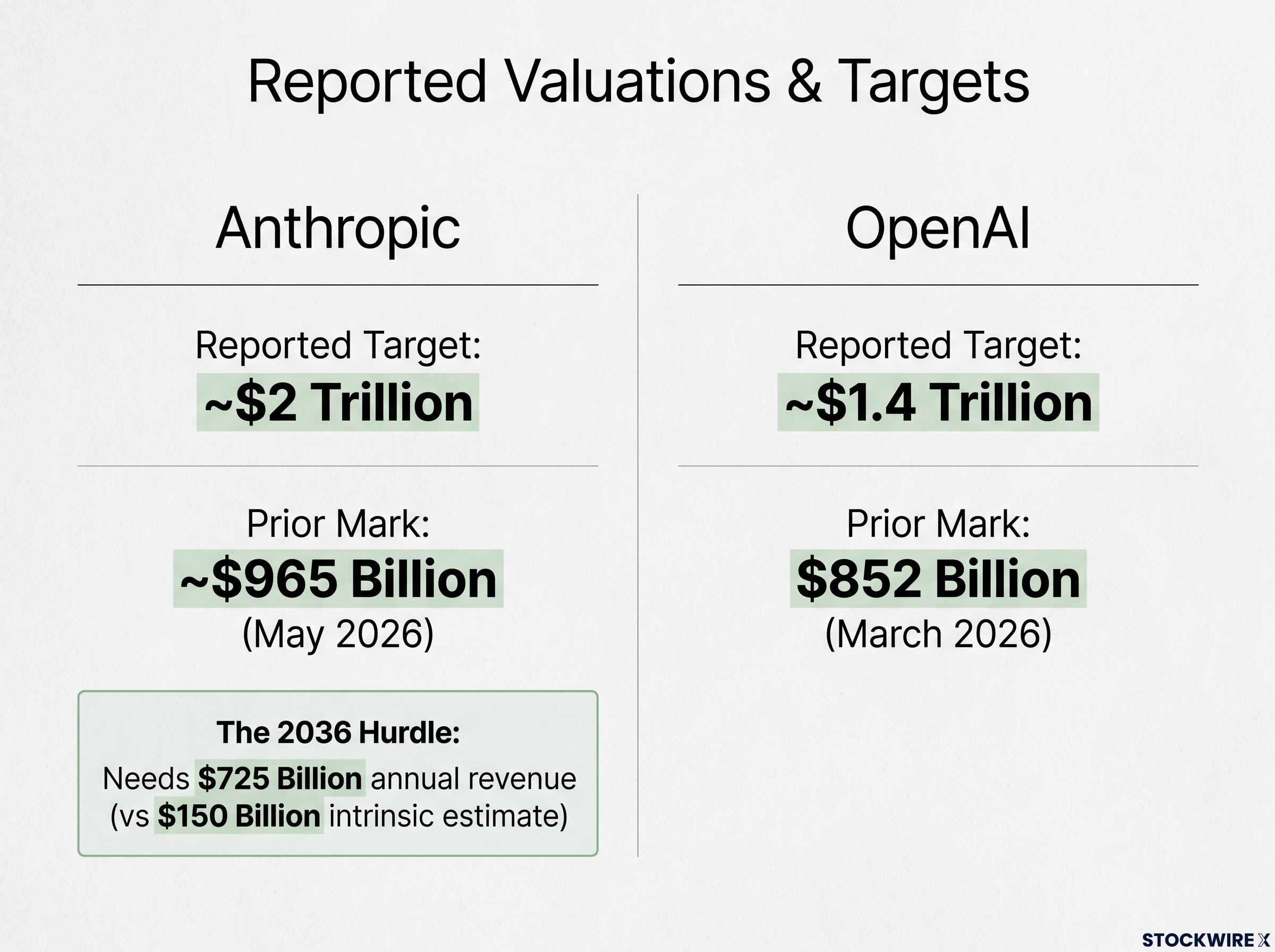
The 2036 hurdle One analyst cited by CNBC estimates Anthropic would need about $725 billion in annual revenue by 2036 to justify $2 trillion, assuming a 10% cost of equity, 25% free-cash-flow margin and 25x terminal multiple.
Another firm puts intrinsic value nearer $150 billion. Weak stickiness and falling prices raise the odds that dates slip or terms are reworked. Wedbush’s Dan Ives takes the other side, arguing demand for both IPOs will be strong despite negative headlines.
Third-party estimates put Anthropic’s implied forward multiples near 22x sales on a roughly $44 billion run-rate, and only 39% of AI-deploying organisations report a positive EBIT impact, which tests the revenue assumptions behind both valuations.
History adds caution: large tech IPOs have suffered post-listing drawdowns when expectations ran too hot. You should read these valuations as bets on 2036 outcomes, so a shift in adoption share or price trend today moves the implied odds even if no IPO date changes. Past performance does not guarantee future results, and these projections are speculative and subject to change.
How can investors get indirect exposure, and what headline risk comes with it?
With no listing yet, some US investors are reaching for proxies. The most direct is the Tema Photonics Optical ETF (LAZR).
What LAZR holds
LAZR mainly owns photonics and optical infrastructure companies, the chips and connectivity behind data centres. It also holds a special purpose vehicle (SPV), a separate entity that owns a stake in a private company, giving it pre-IPO access to Anthropic.
- Lumentum Holdings at about 18.3% in one recent snapshot, plus AXT Inc
- Anthropic SPV weight of roughly 11%, most recently 10.76% per Morningstar on 8 October 2026
- Assets under management above $100 million within three months of launch (24 September 2026 release)
Figures on the Anthropic weight vary: Tema cited 11.8% on 23 September, and Morningstar showed 11.12% on 1 October. Tema claims the largest Anthropic weighting of any US-listed ETF.
Why infrastructure names swing on headlines
A double-digit Anthropic stake plus a single holding above 18% means a handful of names drive returns. Rapid inflows also point to a crowded theme, vulnerable to news on AI demand, regulation or safety incidents.
Australian-listed Weebit Nano offers an illustration, not a US holding. It fell 25.9% last week to a 52-week low of $2.80 (Australian dollars) on a report about bankruptcy risk, which the company rejected, citing $168 million in cash.
Moves like that cut both ways: sharp selloffs can damage a position or create an entry point. If you hold or consider these names, you carry Anthropic’s IPO re-rating and broad AI sentiment at once, so size positions for headline-driven swings. This is general information, not personalised advice.
What the share shift changes, and what it leaves open
Anthropic’s lead in Ramp’s data is real. But an 8% monthly switching rate and a 41% fall in token prices mean it is not yet a moat, and both valuations hinge on volume and product mix. Three variables deserve your attention:
- The next Ramp readings on adoption and switching
- The price index trend against spend growth
- Public S-1 disclosures on revenue mix and compute commitments
If you are weighing direct IPO participation against indirect routes like LAZR, the choice is between concentrated exposure at a disclosed price and diluted exposure carrying extra infrastructure and sentiment risk.
This article is for informational purposes only and should not be considered financial advice. Investors should conduct their own research and consult with financial professionals before making investment decisions.