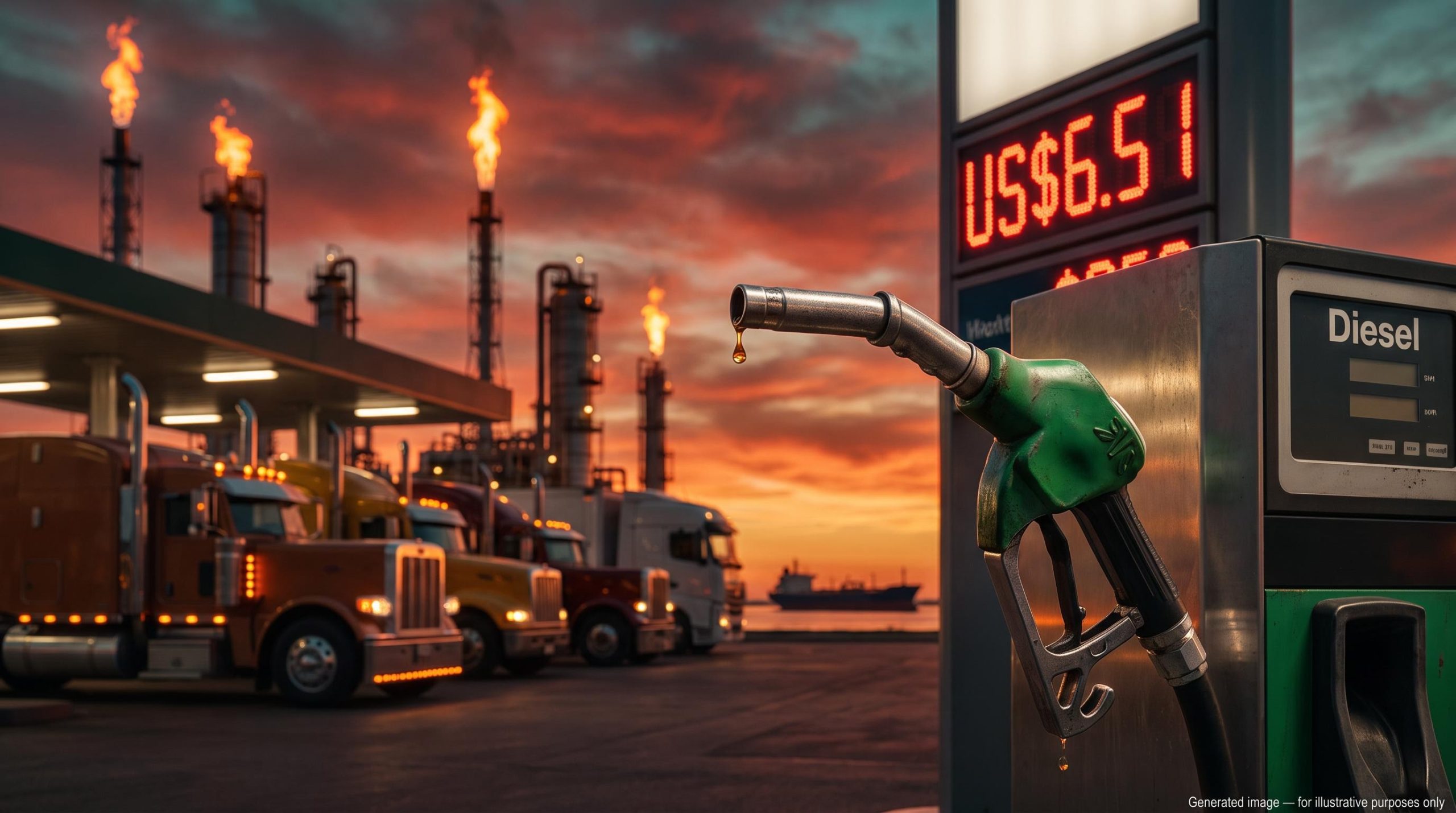
If US$110 oil means the world is running short of crude, the demand numbers should be climbing. They are falling. The International Energy Agency (IEA) expects global oil demand to drop by 2.6 million barrels per day (b/d) in 2026, yet the Brent crude price settled at US$109.86 on 16 October, its highest close since 19 May.
The real squeeze sits further down the supply chain, in refined products and above all in diesel.
Three forces hit in the same week: tanker incidents in the Strait of Hormuz, Ukrainian drone strikes on Russian refineries, and a US executive order waiving Russian energy sanctions weeks before the 3 November midterms. Each pushes prices for a different reason, and each has a different shelf life.
If you hold energy shares, track inflation or simply pay for fuel, the useful question is which of these forces will last. Here is how to separate the risk premium from the genuine shortage, and which numbers to check before ExxonMobil reports on 30 October.
Why is the Brent crude price at US$110 when oil demand is falling?
Start with the contradiction. In its 14 October report, the IEA noted that Brent had climbed about 13% since the start of September to around US$107, even as it forecast demand falling 2.5 million b/d year-on-year in Q4 2026.
Then Friday added another leg. Brent rose US$3.94, or 3.7%, and briefly touched US$110 intraday for the first time since May. WTI, the US benchmark, settled at US$101.41.
So where is the shortage? Not in the oilfields. It is in the refineries that turn crude into fuel, and in the shipping lanes that move both.
The IEA expects global refinery runs to bottom at a seasonal low of 81.3 million b/d in October before recovering to 84.6 million b/d by year-end. Fewer working refineries means less diesel, regardless of how much crude is available.
Even when crude flows recover, refined-product shortages can keep pump prices elevated, because Gulf product exports run far below pre-conflict levels and distillate stocks remain thin.
Refining capacity under strain The Federal Reserve Bank of Dallas estimates that as much as 6-8 million b/d of Middle Eastern, Russian and other refining capacity has been disrupted, up to roughly 10% of the global total. It stresses these losses span several disruptions and should not be treated as permanent.
The diesel pump price shows where the pressure lands.
| Benchmark | Latest | Change or comparison | Note |
|---|---|---|---|
| Brent crude | US$109.86/barrel | Up US$3.94 (3.7%) on 16 October | Highest settlement since 19 May |
| WTI crude | US$101.41/barrel | Up US$3.44 (3.5%) | Highest close since 17 September |
| US diesel | US$6.51/gallon (September 2026) | Above the 2022 record of US$5.81 | Gasoline stayed below its 2022 peak |
What this means for you: the crude headline is the loudest number, but diesel and refining capacity tell you whether the price is backed by a lasting physical problem or mostly by fear of one.
When big ASX news breaks, our subscribers know first
How do Hormuz tensions and Russian refinery strikes feed into diesel prices?
To follow the chain, you need one term. A diesel crack spread is the difference between the price of diesel and the price of the crude oil used to make it. When it widens, refiners earn more on every barrel they process.
When you track the diesel crack spread over time, you can see that readings far above the normal $15-$40 per barrel range signal a structural squeeze in refining rather than a seasonal blip, which is why refiners can earn outsized margins.
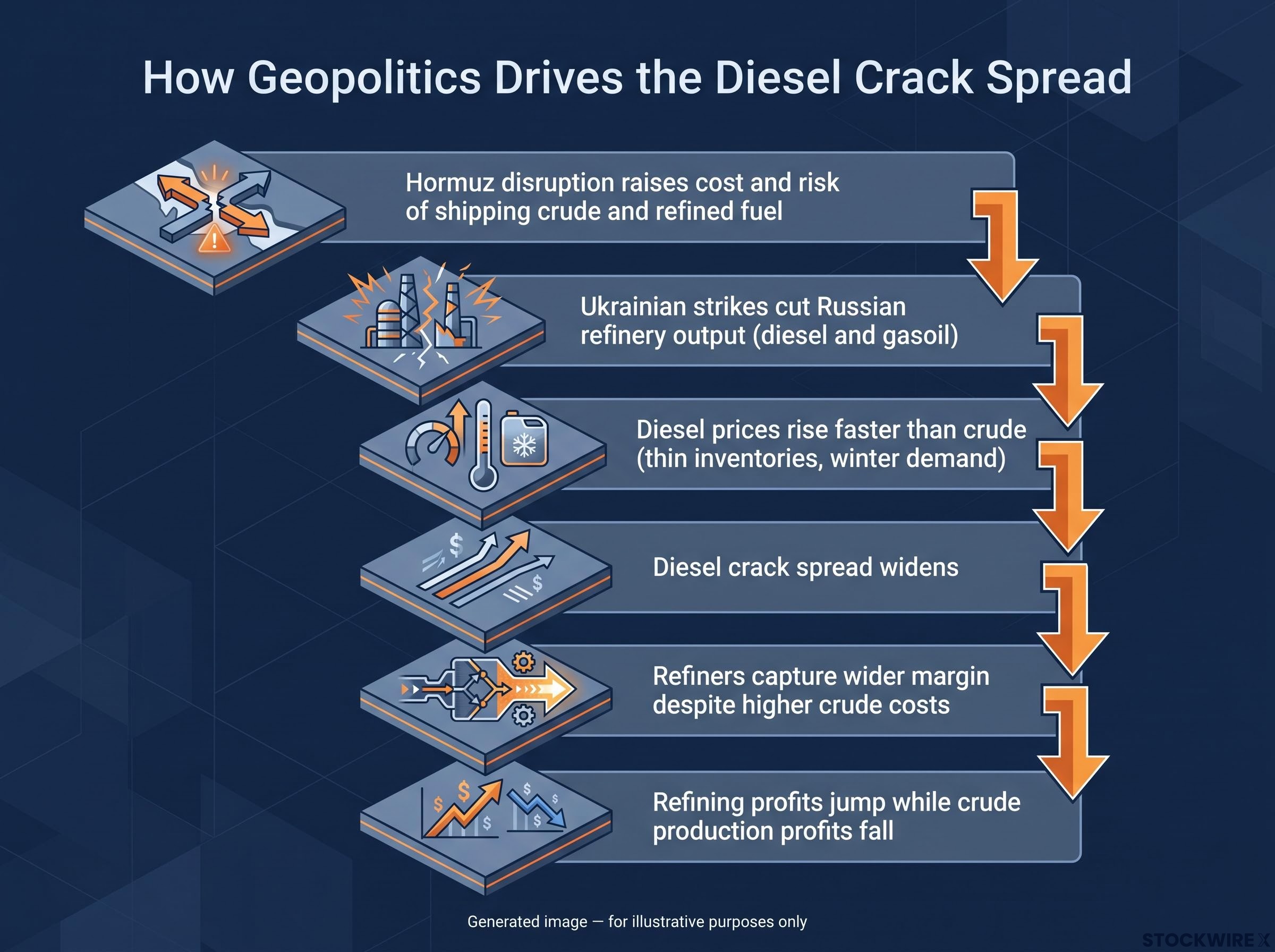
Here is how the pressure travels:
- A Hormuz disruption raises the cost and risk of shipping both crude and refined fuel.
- Ukrainian strikes cut Russian refinery output, particularly diesel and gasoil.
- Diesel prices rise faster than crude because inventories are thin and winter demand is approaching.
- The diesel crack spread widens.
- Refiners still running capture that wider margin, even if their crude costs more.
- Refining profits can jump while profits from producing crude fall.
What the Hormuz escalation ladder looks like
The strait normally carries roughly one-fifth of the world’s crude flows, and markets do not react to it in a straight line. An isolated incident adds a risk premium. Repeated attacks lift insurance and freight costs, a partial closure diverts ships and delays cargoes, and a sustained closure could create simultaneous shortages of crude, diesel and liquefied natural gas.
The recent incidents sit on the lower rungs. On 6 October, India’s foreign ministry said 12 crew were injured on the tanker On Peace after an unidentified projectile struck it. On 17 October, Iran claimed a supertanker carrying more than 2 million barrels hit a mine, a claim not independently established.
That second report matters for you precisely because it was unverified. Treat sudden spikes as sentiment until confirmed supply losses show up.
Why estimates of Russian refinery damage differ
The Dallas Fed says attacks cut Russian refining capacity by as much as 60% during summer 2026. The Oxford Institute for Energy Studies put roughly one-third offline by mid-June.
Both can be right. They measure different dates, define “offline” differently, and track refineries that go down and come back. The strikes continue: a drone attack shut a primary processing unit at the Ryazan refinery, reported on 18 October.
What does the US Russian sanctions waiver change for oil supply and politics?
On 16 October, President Trump signed an executive order waiving key provisions of the Lindsey O. Graham Sanctioning Russia and Iran Act of 2026. Signed into law in September, the act would have imposed tariffs of up to 500% on Russian goods and up to 100% on major buyers of Russian oil and gas.
The order followed a temporary waiver allowing Russian diesel exports through April 2027. Its legal basis is the act’s own national-interest provision, which lets the president exempt sanctions after certifying to Congress that doing so serves US interests.
The White House executive order rests on the act’s national-interest certification, and the Treasury license allowing Russian diesel transactions runs only to 7 April 2027, so any relief you see at the pump has a fixed end date.
The administration said the move was needed to lower fuel prices. With diesel above its 2022 record and midterms on 3 November, the timing is hard to separate from the politics.
| Argument | Supporting evidence | Main risk |
|---|---|---|
| Practical fuel-market fix: Russian diesel adds supply quickly to a tight market | Administration’s stated aim of lowering fuel costs; waiver could ease shipping, insurance and settlement of Russian energy trades | Temporary relief that expires in April 2027 |
| Diplomatic concession: weakens economic pressure on Moscow during the war | Criticism from Ukrainian President Volodymyr Zelenskyy; Reuters reported the order substantially diluted the sanctions Congress enacted | Reduced credibility of US sanctions and less leverage over Russia |
Washington’s reaction remains unsettled. Lawmakers introduced a bill to block the diesel arrangement, briefly lifting oil intraday, and criticism has come from both parties. There is no indication the bill has passed or is moving forward.
For you, the waiver cuts both ways. It may ease diesel supply in the near term, but it also shows US energy policy bending to domestic price pressure, which makes the policy outlook itself a source of uncertainty.
How are refining margins lifting ExxonMobil, and what could undo the gain?
The headline figure is striking. ExxonMobil’s 16 October filing said stronger refining and fuels margins could lift Energy Products segment earnings by about US$4.5 billion in Q3 versus Q2.
Now the qualifier. That estimate is calculated at Q2 volumes, and it is not a forecast of Exxon’s total profit or even the segment’s full result. For scale, Energy Products earned US$4.1 billion adjusted in Q2.
The filing’s other line items show where the money is coming from:
| Item | Estimated change vs Q2 (US$ billion) |
|---|---|
| Product margins (net) | +4.4 (approx.) |
| Upstream oil and liquids prices | -1.3 |
| Natural gas prices | +0.3 |
| Chemicals | -0.6 |
| Specialty products | +0.5 |
Upstream price effects were negative. Refining is doing the work, exactly as the crack spread mechanism predicts, and Exxon attributes that strength to the Iran conflict and Ukrainian strikes on Russian refineries.
That dependence is the vulnerability. The gain could shrink if:
- Diesel crack spreads narrow as supply returns
- Refinery utilisation falls
- Crude prices rise faster than product prices
History offers a caution on reading oil spikes as broad market signals. In 2022, Brent rose 35% while the State Street Consumer Discretionary Select Sector SPDR ETF fell 36%.
When full results land on 30 October, compare the margin line against these estimates. Treat the windfall as a snapshot of a diesel shortage, not a new earnings baseline.
Will the oil price spike last? China’s gas buffer, yields and central banks
The case for higher prices rests on the IEA’s view of severe near-term product tightness and a fragile supply recovery. Not everyone expects it to persist.
Where the forecasters split Goldman Sachs raised its December 2026 Brent forecast to US$90 from US$85 and still expects an average of about US$80 in 2027, flagging a possible Q4 surplus if disruptions ease. The IEA’s emphasis on product shortages supports a higher near-term risk premium. The disagreement is about how long the shock lasts.
China adds weight to the softer view. Rystad Energy analyst Xiong Wei said China’s underground gas storage was 80% full at the end of September, reducing the chance it bids aggressively for spot cargoes of liquefied natural gas if Middle East disruption continues.
The macro backdrop pulls the other way on energy shares. The US 10-year Treasury yield sat near 5.1% on 16 October after peaking at 5.34% on 1 October, its highest since 2002; a Reuters poll expects about 5.00% by end-2026. Higher yields reduce the present value of future earnings, and fuel-driven inflation delays rate cuts.
Central banks are still tightening. The European Central Bank sits at 2.50%, with a hike to 2.75% widely expected in December, and President Christine Lagarde said the bond selloff has tightened financing conditions. The Bank of Japan holds 1.25%, with a pause expected at its 29-30 October meeting and a possible rise to 1.50% in December or January.
There is also less of a safety net: US Strategic Petroleum Reserve inventories are near their lowest since 1992, limiting further releases.
Emergency reserve releases totalling roughly 280 million barrels earlier this year failed to halt the inventory drawdown, which explains why the thin buffer now matters so much for winter.
What would shrink the premium:
- De-escalation or normal traffic through Hormuz
- Restored Russian refinery units
- Russian diesel flowing under the waiver
- Demand destruction from high prices
What would extend it:
- Confirmed, repeated Hormuz attacks or a partial closure
- Further strikes on Russian refining
- Winter stock draws with limited reserve releases
Energy stocks are caught between strong near-term earnings and a macro environment that can turn sentiment quickly. Past performance does not guarantee future results, and forecasts here are subject to market conditions and various risk factors.
| Date | Event |
|---|---|
| 29-30 October | Bank of Japan meeting |
| 30 October | ExxonMobil full Q3 results |
| 3 November | US midterm elections |
| December | ECB decision, hike to 2.75% widely expected |
| April 2027 | Russian diesel export allowance ends |
What to watch between now and the midterms, and what stays uncertain
Brent near US$110 reflects a refined-products squeeze layered on geopolitical risk, not a shortage of crude itself. That distinction tells you which signals deserve your attention.
Work through the calendar in order: the BoJ on 29-30 October, Exxon’s margin line on 30 October, the midterms on 3 November, the ECB in December, and the diesel waiver’s expiry in April 2027.
Three questions remain open. Will Hormuz incidents be confirmed, will Russian refining recover, and will the congressional bill go anywhere? Your read on the price should shift with the answers, not the headlines.
This article is for informational purposes only and should not be considered financial advice. Investors should conduct their own research and consult with financial professionals before making investment decisions. Forward-looking statements are speculative and subject to change based on market developments and company performance.