How Fidelity Makes $37.7B: the Three-Pillar Revenue Model

Key Takeaways
- Fidelity Investments generated $37.7 billion in revenue in 2025, a 15% year-over-year increase, driven by three core pillars: fund management fees, advisory services, and workplace retirement platforms.
- Fidelity's 2019 pivot away from trading commissions toward asset-based fee structures fundamentally aligned the company's revenue growth with client portfolio performance.
- Unlike publicly traded rivals such as BlackRock and Schwab, Fidelity's private, family-controlled ownership allows long-term strategic investment without pressure from quarterly earnings expectations.
- Fidelity differentiates itself from Vanguard through active management and sector rotation strategies, with 2026 priorities including AI monetisation in communication services and diversification into non-US equities.
- Investors holding Fidelity 401(k) plans or brokerage accounts should understand that the firm's active management emphasis creates both opportunities and risks relative to passive indexing alternatives.
Fidelity Investments generated $37.7 billion in revenue during 2025, a 15% increase from the prior year. The Boston-based financial services giant now oversees approximately $15-18 trillion in assets and serves roughly one in five American adults. Yet despite this massive scale, many investors remain unclear about how the privately held firm actually makes money.
Understanding the Fidelity business model matters because the company manages retirement accounts, brokerage platforms, and mutual funds for millions of Americans. This analysis breaks down Fidelity’s three primary revenue engines, explains how its approach differs from competitors like Vanguard and Schwab, and examines the strategic priorities driving growth in 2026.
What Is Fidelity Investments? A Quick Primer for New Investors
Fidelity Investments is a privately held financial services company headquartered in Boston, founded by the Johnson family over 80 years ago. Unlike competitors such as BlackRock or Charles Schwab that trade publicly, Fidelity remains family-controlled across three generations. Abigail Johnson currently serves as chairman and CEO. This private ownership structure limits transparency compared to publicly traded rivals but allows the firm to pursue long-term strategic decisions without quarterly earnings pressure.
Fidelity provides a comprehensive range of services to retail and institutional clients:
- Brokerage accounts for self-directed investing
- Mutual funds and exchange-traded funds (ETFs)
- Workplace retirement plan administration (401(k) programmes)
- Wealth management and financial advisory services
- Institutional asset management
The company’s scale and service breadth position it as one of the largest retail investment platforms in the United States.
When big ASX news breaks, our subscribers know first
The Three Pillars of Fidelity’s Revenue Model
Fidelity’s revenue model has evolved significantly since 2019, when the firm eliminated trading commissions to match competitors. Before this shift, transaction fees represented a major income source. After going commission-free, Fidelity successfully pivoted toward asset-based revenue models that align the company’s interests with client portfolio growth.
Asset management firms like State Street have similarly demonstrated how fee revenue models at State Street scale with market performance, reinforcing the asset-based approach that has become standard across the financial services industry.
The SEC guidance on broker-dealer revenue models explains how firms transitioned from commission-based income to alternative structures including payment for order flow, cash sweep interest, and asset-based advisory fees following industry-wide commission elimination.
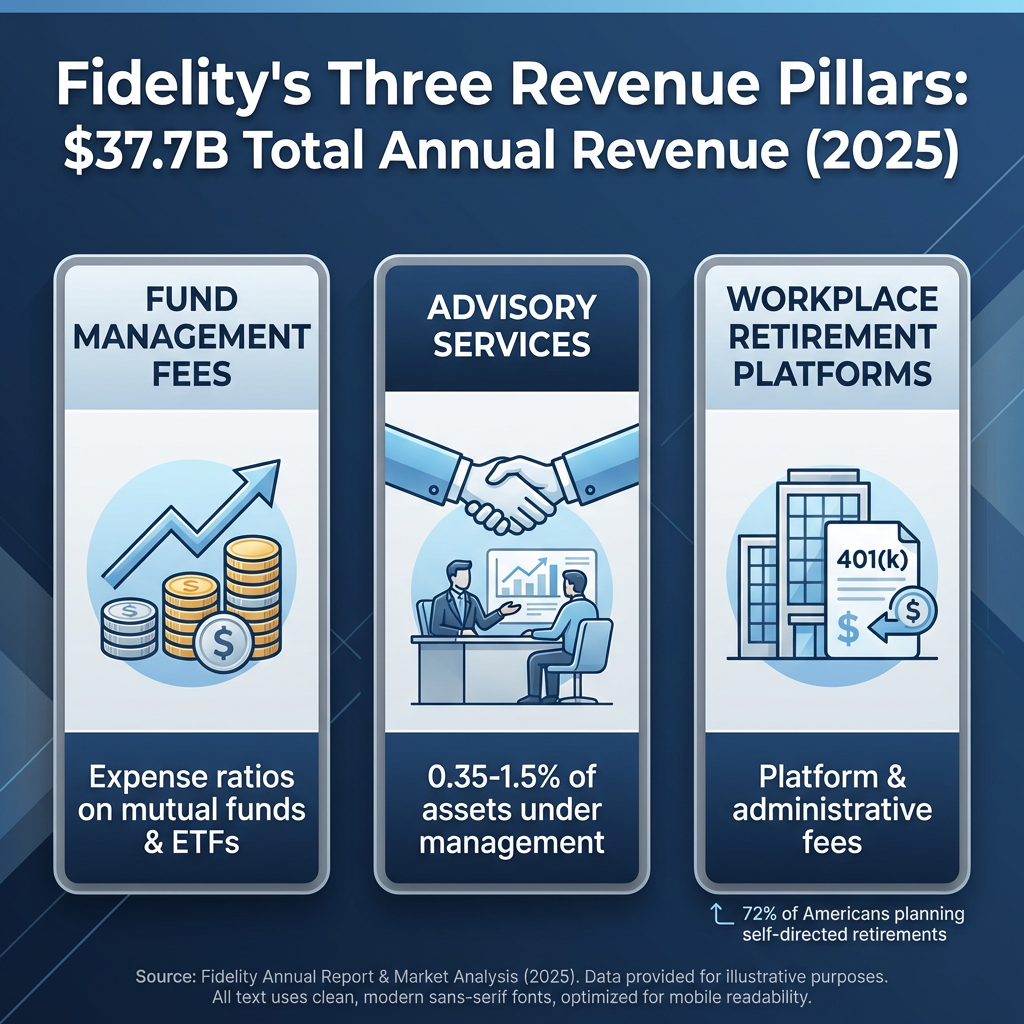
The three primary revenue streams now driving Fidelity’s $37.7 billion annual income are fund management fees, advisory services, and workplace retirement platforms.
| Revenue Pillar | How It Works | Why It Matters |
|---|---|---|
| Fund Management Fees | Fidelity charges expense ratios on mutual funds and ETFs, earning a percentage of assets under management | Higher market values directly increase fee income, creating alignment with investor returns |
| Advisory Services | Discretionary management and financial planning generate fees based on portfolio size, typically 0.35-1.5% of assets | Recurring revenue from clients seeking professional management rather than self-directed investing |
| Workplace Retirement Platforms | Employer-sponsored 401(k) plans generate platform fees and administrative service revenue | Creates sticky, long-term relationships as employees consolidate retirement assets over decades |
Workplace retirement services represent a particularly strategic component. Research from Fidelity shows 72% of Americans are planning self-directed retirements, which directly benefits the company’s platform fees and account inflows. Account holders tend to consolidate assets over time, increasing fee generation per customer as portfolios grow.
How Fidelity’s Business Model Differs From Vanguard, Schwab, and BlackRock
Retail investors often choose between Fidelity, Vanguard, and Schwab for brokerage and retirement accounts. Each firm generates revenue differently, which influences product offerings, fee structures, and investment philosophy. Understanding these distinctions helps investors evaluate which platform best aligns with their needs.
Fidelity and Vanguard represent contrasting approaches to investment management. Fidelity emphasises active management in sectors like artificial intelligence and communication services, offering retail-friendly tools for self-directed active investing. The firm positions heavily in sector rotation strategies, seeking to capitalise on market shifts before they occur. Vanguard, by contrast, was founded on a low-cost passive indexing philosophy that prioritises expense ratio minimisation over active stock selection. This fundamental difference shapes everything from fund offerings to advisory services.
The Morningstar analysis of fund fee structures benchmarks expense ratios and asset flows across major providers, documenting the active versus passive management fee dynamics that differentiate Fidelity’s approach from index-focused competitors.
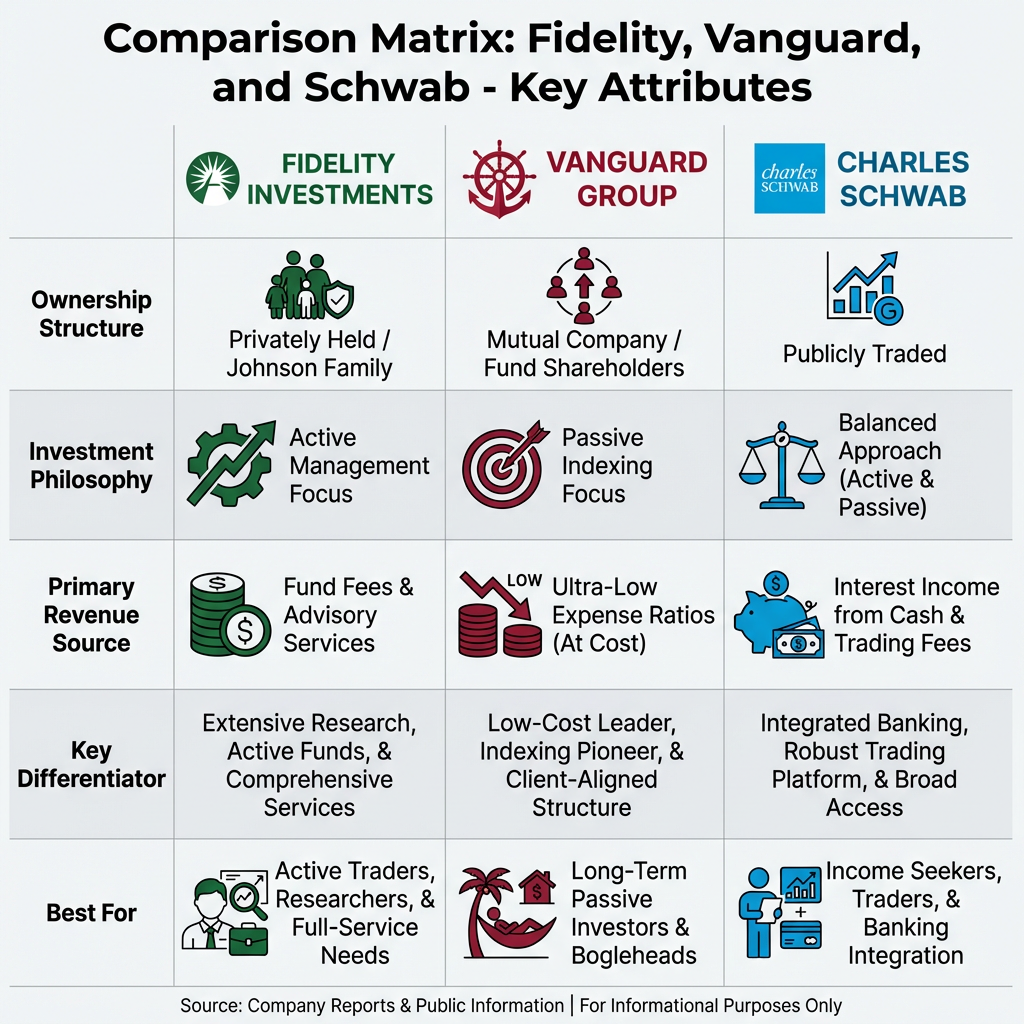
Charles Schwab and BlackRock occupy different competitive spaces. Schwab leverages an integrated banking-brokerage model that generates significant interest income from client cash balances. Fidelity focuses on pure investment management and retirement platform depth rather than banking services. BlackRock dominates the institutional ETF market with passive index products. Fidelity balances retail accessibility with institutional-grade active management, showing more opportunistic positioning in sector rotation compared to BlackRock’s traditionally tech-concentrated portfolios.
Fidelity’s Strategic Priorities for 2026 and Beyond
Fidelity’s business model depends on generating returns for clients, which drives asset inflows and fee revenue. The firm’s 2026 strategy reflects proactive risk management, rotating away from concentrated technology positions toward diversified opportunities that management believes will outperform in the coming years.
This strategic rotation away from concentrated technology positions aligns with broader market dynamics where equal-weighted indices have begun outperforming cap-weighted benchmarks dominated by large-cap tech stocks.
Five strategic priorities are shaping Fidelity’s positioning for 2026:
- Positioning in economically sensitive value stocks, anticipating rotation from growth stocks that dominated recent years
- Capitalising on artificial intelligence monetisation in communication services as tech companies transition from infrastructure investment to revenue generation
- Diversifying into non-U.S. equities to reduce concentration risk in American technology stocks
- Expanding private credit exposure to provide alternative income sources beyond traditional fixed income
- Maintaining quality growth focus on companies with sustainable competitive advantages and strong profitability
The artificial intelligence positioning deserves particular attention. Fidelity has maintained heavy AI-related holdings across Strategic Advisers portfolios throughout 2025. The firm believes communication services companies will benefit significantly from monetising three years of AI infrastructure investment made by technology companies. This positions Fidelity to capture returns as artificial intelligence moves from capital expenditure phase to revenue generation phase, potentially creating new profit streams for companies in the communication services sector.
While Fidelity positions heavily in artificial intelligence monetisation opportunities, investors should consider AI investment risks as the sector transitions from infrastructure spending to revenue generation phases.
The next major ASX story will hit our subscribers first
Why Fidelity Remains Privately Held and What It Means for Customers
Unlike BlackRock, Schwab, or Vanguard (structured as a mutual company owned by fund shareholders), Fidelity remains family-controlled through three generations of Johnson leadership. This private ownership structure allows patient capital allocation and strategic pivots without satisfying public shareholders’ short-term quarterly expectations. The firm can make decade-long strategic investments in technology, platforms, and market positioning without immediate return requirements.
> Private ownership enables Fidelity to pursue long-term strategic priorities and weather short-term market volatility without quarterly earnings pressure. However, customers and analysts receive less visibility into financial details, executive compensation structures, and internal performance metrics compared to publicly traded competitors.
Abigail Johnson succeeded her father as chairman after navigating a complex internal succession process. She currently serves as CEO, representing the third generation of Johnson family leadership. Each generational transition has brought distinct management approaches and strategic emphases, though the core commitment to private ownership has remained consistent across eight decades.
What Fidelity’s Business Model Means for Your Money
Fidelity’s $37.7 billion business rests on three pillars: fund management fees from mutual funds and ETFs, advisory services for clients seeking professional management, and workplace retirement platform fees. The firm’s 2019 pivot from commission-based revenue to asset-based fees fundamentally aligned Fidelity’s interests with client portfolio growth. When your account value increases, the company’s fee revenue increases proportionally.
Whether you hold a Fidelity 401(k) through your employer, maintain a self-directed brokerage account, or invest in Fidelity mutual funds, understanding this business model helps you evaluate fee transparency and investment philosophy alignment. Fidelity’s emphasis on active management and sector rotation distinguishes it from passive indexing competitors, creating both opportunities and risks depending on how those active strategies perform. Investors should assess whether Fidelity’s approach matches their own investment objectives and risk tolerance.
This article is for informational purposes only and should not be considered financial advice. Investors should conduct their own research and consult with financial professionals before making investment decisions.
Frequently Asked Questions
What is Fidelity's business model?
Fidelity's business model relies on three primary revenue streams: fund management fees from mutual funds and ETFs, advisory services fees based on portfolio size, and workplace retirement platform fees from employer-sponsored 401(k) programmes.
How does Fidelity make money after eliminating trading commissions?
After eliminating trading commissions in 2019, Fidelity pivoted to asset-based revenue models, earning fees as a percentage of assets under management, advisory fees typically ranging from 0.35% to 1.5%, and administrative fees from workplace retirement platforms.
How is Fidelity different from Vanguard and Schwab?
Fidelity emphasises active management and sector rotation strategies, while Vanguard focuses on low-cost passive indexing and Schwab integrates banking services to generate interest income from client cash balances.
Is Fidelity Investments publicly traded?
No, Fidelity remains a privately held, family-controlled company through three generations of Johnson family leadership, which allows long-term strategic decision-making without quarterly earnings pressure from public shareholders.
What is Fidelity's strategy for 2026?
Fidelity's 2026 strategy includes rotating toward value stocks and non-US equities, expanding private credit exposure, and positioning in AI monetisation opportunities within communication services as technology companies transition from infrastructure investment to revenue generation.