Memory stocks have fallen roughly 19% from their September peak. Samsung Electronics dropped about 22% and SK Hynix about 26% over the five sessions to 15 October 2026, yet TrendForce still expects DRAM contract prices to rise again in Q4 2026. Falling share prices alongside rising product prices is a signal many investors may be misreading.
One announcement started the slide. Chinese DRAM maker CXMT said it plans to introduce a denser 4F2 DRAM architecture and a DDR5 RDIMM server product by the end of 2026. That revived the oldest fear in memory: that every boom builds the capacity for its own glut.
UBS disagrees with the market. It calls the pullback excessive, keeps Buy ratings on every memory stock it covers, and names Samsung as its preferred pick. The UBS figures here come from secondary coverage dated 15-17 October 2026, because the original note was not publicly available.
This piece gives you a three-part test covering valuation, demand and supply risk, so you can judge whether the drop is an opportunity or a cyclical warning.
Why did memory stocks fall 19%, and what is UBS arguing?
The drop came fast. In five trading sessions, the two Korean leaders lost roughly a quarter of their value, and Micron Technology fell about 11%, according to CNBC. By 16 October, the Roundhill Memory ETF sat about 22% below its September rebound high.
| Company | Five-session move to 15 Oct | Stated trigger |
|---|---|---|
| Samsung Electronics | About -22% | CXMT 4F2 fears, AI-spending doubts, oversupply concerns |
| SK Hynix | About -26% | CXMT announcement, HBM valuation concerns |
| Micron Technology | About -11% | AI-capex worries, Chinese competition, oversupply fears |
Look closely at the trigger. CXMT president Cao Kanyu described a plan, not a shipped product. Investors read it as a threat to server DRAM, the profitable segment the incumbents depend on, rather than an incremental consumer-memory upgrade. Doubts about AI-capex durability and stretched post-rally valuations added to the pressure.
That matters for you. A sell-off driven by a stated roadmap prices in a possibility, and the real question is whether that possibility justifies a 19% reset.
What UBS actually said
UBS calls the CXMT concerns premature. It expects CXMT’s near-term work to stay at the research or sample stage rather than adding meaningful supply, and it retains Buy ratings across its coverage.
The bank also argues the correction should push memory makers toward higher shareholder returns. Those programmes are already large. SK Hynix plans to return more than 50% of cumulative free cash flow for 2025-2027 and cancel about 40 trillion won of shares. Samsung is expected to return 90-110 trillion won for 2026, with details due at a January 2027 board meeting.
When big ASX news breaks, our subscribers know first
Why memory has always been cyclical, and what AI changes
To judge UBS’s case, you need to know why memory investors are so jumpy. The industry runs on a repeating loop:
- Demand rises and inventories fall.
- Prices and margins surge.
- Suppliers commit to new fabs.
- Capacity arrives with a delay, often all at once.
- Supply overshoots demand and prices collapse.
- Producers cut output and spending, seeding the next shortage.
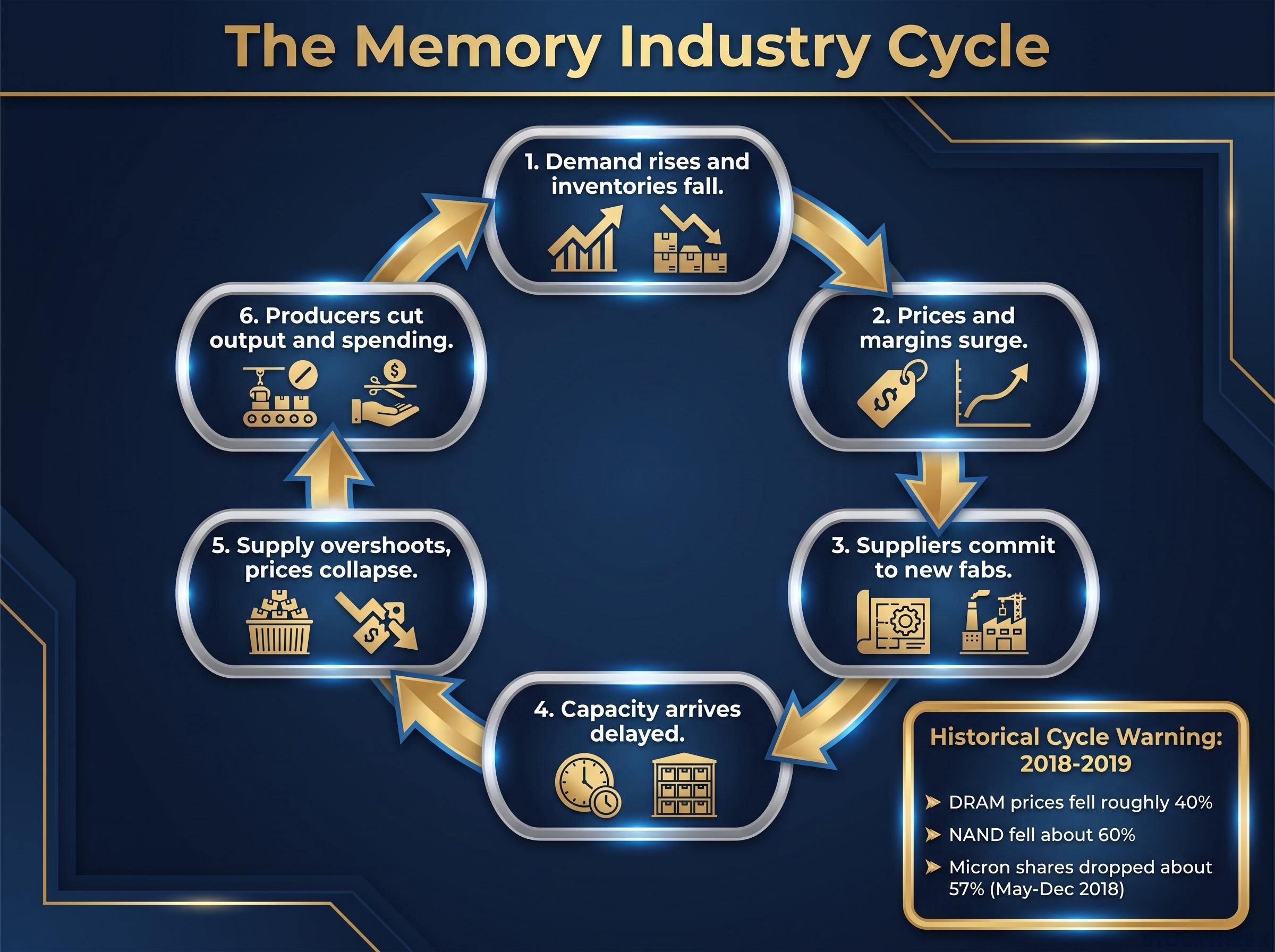
The cycle in one line: “demand outruns supply, manufacturers add capacity, capacity arrives all at once, and prices collapse.”
History backs this up. In 2018-2019, DRAM prices fell roughly 40% and NAND about 60%, and Micron shares dropped about 57% between May and December 2018. The 2022-2023 post-pandemic slump repeated the pattern as consumer demand faded.
For you, the lesson is uncomfortable. A low forward multiple on memory has historically been a late-cycle warning, not a bargain signal, because earnings peak just before prices turn.
Where AI bends the cycle
A few terms first. HBM (high-bandwidth memory) is stacked DRAM placed beside AI processors. DDR5 RDIMM is registered server memory. 4F2 is a denser DRAM cell design. SOCAMM is Nvidia’s memory module format.
AI changes the arithmetic. One estimate puts an AI training server at about 4.6 TB of memory (around 1.6 TB HBM and 3 TB DDR5), six to eight times a traditional cloud server. HBM also consumes roughly three to four times the wafer capacity per gigabyte of standard DRAM, and it needs specialised packaging and testing.
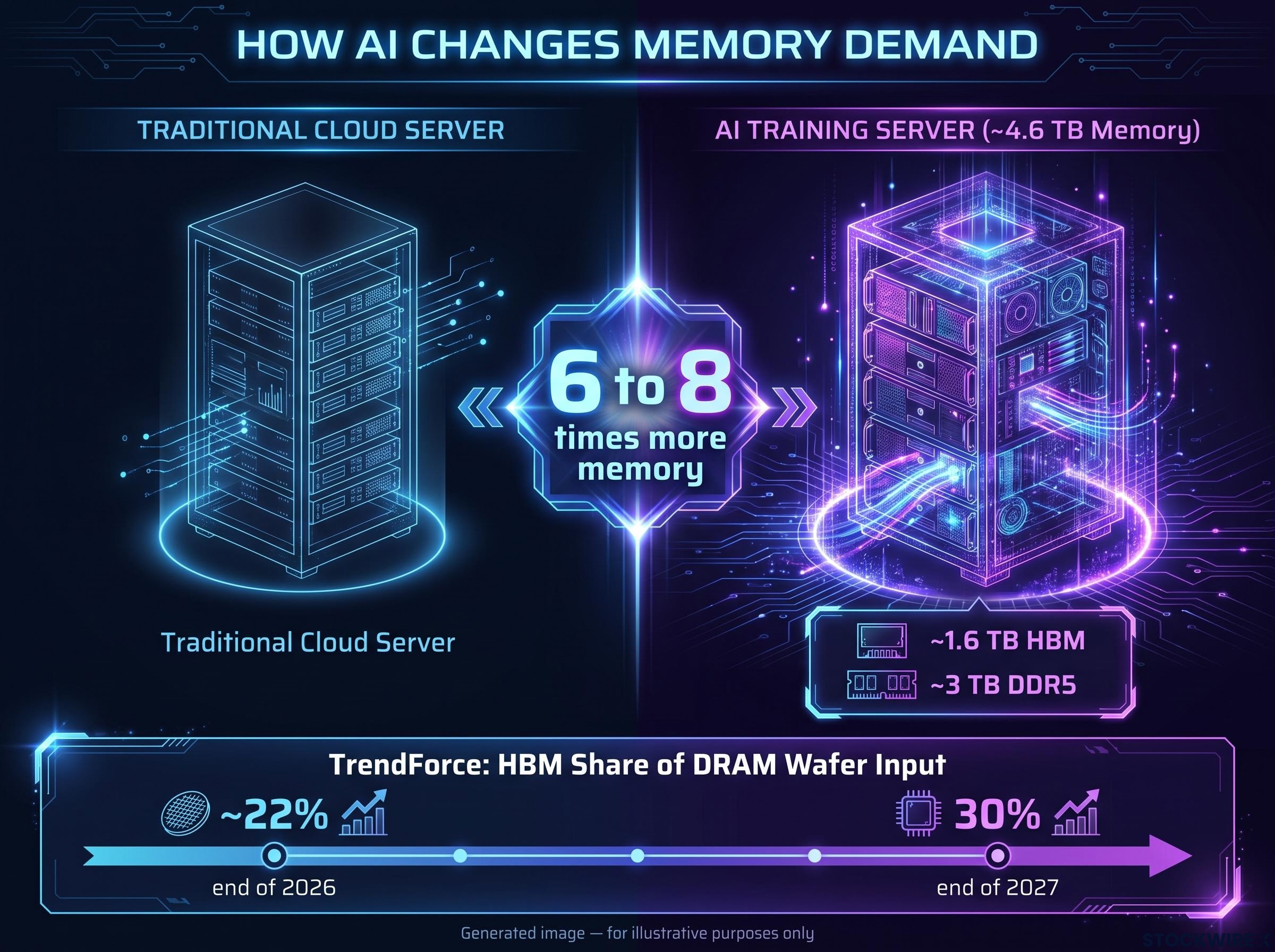
TrendForce expects HBM to take about 22% of DRAM wafer input by the end of 2026 and 30% by the end of 2027. Every wafer diverted to HBM tightens ordinary DRAM supply. The catch is concentration: this only works while a handful of hyperscalers keep raising capex. AI changes the cycle only if demand outlasts the supply response.
Is the demand and pricing evidence strong enough to support the bull case?
On near-term numbers, the bulls hold the stronger hand. TrendForce’s Q4 2026 forecasts show price increases across every major segment.
| Market segment | Q4 2026 expected change (QoQ) | Source |
|---|---|---|
| Conventional DRAM | +10-15% | TrendForce, 30 Sep 2026 |
| DRAM including HBM | +15-20% | TrendForce, 30 Sep 2026 |
| NAND Flash | +15-20% | TrendForce, 30 Sep 2026 |
| Enterprise SSD | +23-28% | TrendForce, 24 Sep 2026 |
UBS points to several demand drivers:
- Server DDR5 orders rising into 2027, backed by AI inference deployments
- Strengthening demand for Nvidia’s SOCAMM modules
- HBM shipments forecast to grow 49% in 2027
- Conventional server memory and SSD demand offsetting HBM uncertainty
Independent voices broadly agree. UOB Kay Hian expects HBM demand to grow at about 50% a year from 2026 to 2029, and SemiAnalysis sees the industry supply-constrained through 2027 and probably 2028. One TrendForce summary even suggested 2027 HBM contract prices could rise 70-140%, though that is a single-source estimate.
The demand is uneven, however. Consumer memory is weaker than AI-server memory, and the strength sits with a small group of buyers. Near-term earnings visibility is strong, but that is exactly when forecasts built on 2027-2030 prices deserve the hardest scrutiny.
Are CXMT and Samsung capacity fears overdone, and is a 29% free cash flow yield believable?
Supply: the timing and cost argument
The supply threat looks weaker under examination. SemiAnalysis estimates CXMT’s DDR5 cost per bit remains more than 30% above the three leading suppliers, and its prospectus disclosed no dedicated HBM funding. Yield, customer qualification and packaging remain hurdles.
Scale still matters. CXMT raised about US$8.5 billion in its IPO and runs roughly 320,000 wafers per month, according to the Korea Herald (ChosunBiz cites about 290,000). Morningstar warns that credible competition can compress incumbents’ multiples well before CXMT wins market share.
Samsung’s possible 150,000+ wafer starts per month in 2028 is the other worry. UBS expects little effect before late 2028, and SemiAnalysis estimates Samsung adds only about 15,000 wafers a month in 2026, versus 60,000 for SK Hynix and 30,000 for Micron.
| Institution | Stance | Key difference from UBS |
|---|---|---|
| Goldman Sachs | CXMT fears overblown | Stresses CXMT’s technology and yield gap, not FCF yield |
| Rosenblatt (Kevin Cassidy) | Sell-off overblown; Buy on Micron, SK Hynix | Focuses on structural server DRAM demand |
| Morningstar | More cautious | Sees 4F2 as a credible source of future pricing pressure |
Valuation: the 29% yield problem
UBS’s headline figure is an average free cash flow yield of 29% for 2027-2030, excluding CXMT. That is the thesis’s most fragile piece.
Why the yield is fragile: The 29% figure depends on 2027-2030 pricing that may sit near a cyclical peak. If DRAM or NAND prices normalise, the yield could fall sharply.
The technology argument buys the incumbents time. The yield, though, assumes peak prices hold for four years, something the memory cycle has rarely allowed. The question to ask is how much of that 29% survives normal pricing. Other risks compound it: an AI-capex slowdown, customer concentration, export controls and HBM execution.
Past performance does not guarantee future results. Forecasts cited are subject to market conditions and may change.
A three-test framework for weighing memory stocks after a sharp pullback
Before acting on the 19% drawdown, run each holding through three tests:
- Valuation: Is the yield built on peak prices? Discount the 29% claim accordingly.
- Demand: Are DDR5, SOCAMM and HBM orders still rising toward UBS’s 49% HBM growth forecast?
- Supply risk: Is CXMT closing its cost, yield and qualification gaps, and does Samsung’s capacity stay beyond late 2028?
Signals worth monitoring:
- Contract-price direction in each quarterly TrendForce update
- Hyperscaler capex commentary
- CXMT yield and customer announcements
- Samsung’s shareholder-return details from its January 2027 board meeting
On balance, UBS’s case looks credible on timing and less certain on valuation.
This article is for informational purposes only and should not be considered financial advice. Investors should conduct their own research and consult with financial professionals before making investment decisions.