You cannot simply click “buy” on an IPO and expect to own shares at the price in the headlines. If you plan to trade a US IPO from Australia, the number that matters is not the offer price. It is the price of the first public trade on Nasdaq, and that trade happens while you are most likely asleep.
Anthropic’s proposed Nasdaq debut under the ticker ANT shows why. Reuters and CNBC have reported that the listing is expected on 19 November 2026. They have also reported indicative terms of 825 million shares at US$70-US$78.
None of that is final as of today, 13 November 2026. The date, the price range and the share count could all change before pricing. The mechanics, though, stay the same whatever Anthropic’s final terms turn out to be.
This covers what happens between the ticker appearing on your broker’s screen and the first trade going through. It explains which order you can actually place, and what you need to sort out before the night arrives.
Why does the opening price differ from the offer price?
Most people assume an IPO has one price. It actually has two, and each comes from a different process run by different people.
The offer price is set the evening before listing. Underwriters run a process called book-building, which means collecting indications of interest from large institutional investors and using that demand to set the final price and decide who receives shares. The opening price comes later. It is discovered on listing day from the buy and sell orders the public sends to the exchange.
According to a Selfwealth article published on 13 November 2026, most retail investors, including its own clients, cannot get shares until open-market trading begins. The gap between the two prices is how the system is designed. It is not an exchange error.
| Item | Reported position | Status |
|---|---|---|
| Filing | S-1 filed 26 October 2026, updated 9 November 2026 | Reported |
| Exchange and ticker | Nasdaq, ANT | Proposed |
| Listing date | 19 November 2026, pricing expected 18 November | Reported by Reuters and CNBC, not final |
| Price range | US$70-US$78 | Indicative, not final |
| Shares offered | 825 million | Indicative, not final |
| Demand | About six times oversubscribed | Reuters citing Bloomberg, 12 November 2026 |
| Final offer price | Not set | Unconfirmed |
You may have seen an earlier figure of about 866.7 million shares at US$70-US$80. Reuters reported those numbers on 10 November, but Anthropic said those details were inaccurate, so set them aside.
The offer price is a reference point, not your entry price. Any plan built on “buying at US$70-US$78” starts from the wrong number.
Who gets the offer price, and who does not
Institutions and brokers that receive an allocation pay the offer price. Everyone else buys in the secondary market, which means trading with other investors on the exchange once Nasdaq allows public trading to begin.
The IPO allocation process is largely finished before retail investors hear about a deal, and each broker then divides its own small slice by lottery, pro-rata scaling or client ranking, which is why two people can make the same request and get different outcomes.
Six-times oversubscription signals strong demand. It does not guarantee a gain on day one. Heavy demand can sit alongside a high final price, changed allocations, selling by investors who did receive shares, or a sudden turn in the broader market. If the stock opens well above or below the offer price, the system is working as designed.
When big ASX news breaks, our subscribers know first
What happens on listing day, step by step?
Knowing that the opening price is discovered rather than set, the next question is how that discovery unfolds. Selfwealth’s timeline was built on a 16 November listing date. If Anthropic lists on 19 November, the same clock applies, starting on Thursday night US time and running into early Friday morning in AEDT.
- Ticker created. Selfwealth expected the ticker to appear around 5:00am New York time, or about 9:00pm AEDT.
- Orders queue. You can submit whole-share limit orders, but they cannot execute yet.
- Market opens, stock does not. The US market opens at 9:30am New York time, but the new listing is not trading.
- Price discovery. The exchange and market makers collect buy and sell orders to locate the price at which the greatest number of them can be matched. This can take minutes or hours.
- The opening cross. Limit orders waiting in the queue can fill if their price is equal to or better than the opening price. The first trade commonly lands between 10:00am and 12:00pm New York time, roughly 2:00am-4:00am AEDT.
- Market orders accepted. Normal trading begins.
- Fractional orders follow. Fractional and dollar-amount orders arrive several minutes later, once there is a market price to work from.
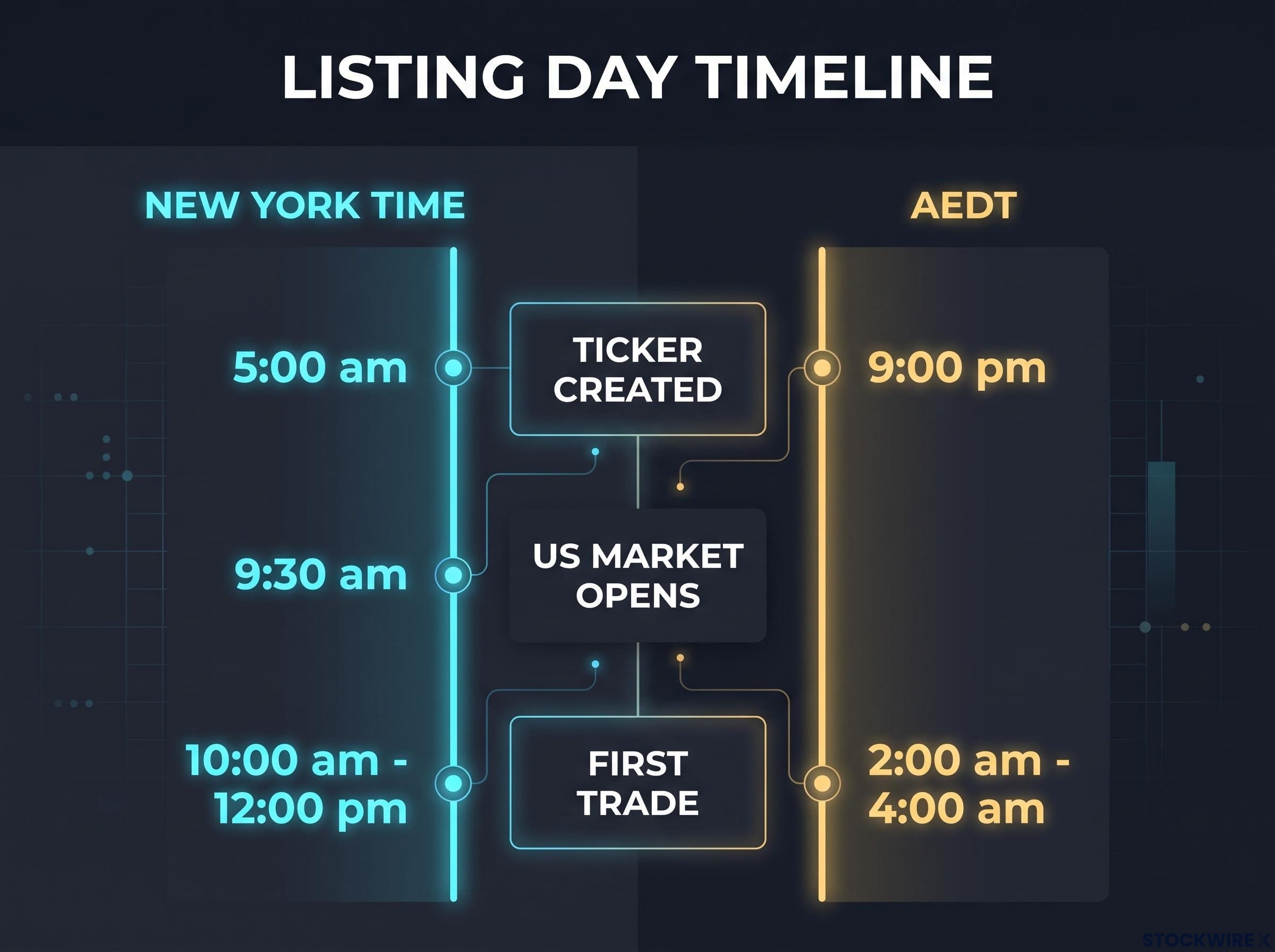
The first trade commonly occurs between 10:00am-12:00pm NY, which translates to roughly 2:00am-4:00am AEDT.
Before the first trade, only whole-share limit orders can queue. A limit order sets the highest price you will pay, so you stay protected while the price is still unknown.
Market orders and fractional orders would be risky or simply impossible before a price exists. Your broker may also reject a limit price set far outside a reasonable range.
At the centre of this is Nasdaq’s IPO Cross, an auction that settles on a single price for all matched orders. According to the research behind this explainer, the process runs a quote-only period of about 15 minutes, which the lead underwriter and Nasdaq can extend if orders are badly unbalanced or prices swing too much. Nasdaq’s IPO Cross FAQ reportedly sets the trigger for a five-minute extension at a move of 10% or US$0.50, whichever is greater, though this has not been independently confirmed.
A queued order is a bid waiting in line, not a purchase. If you sit at 1:30am wondering why nothing has filled since “the open”, the answer is that the auction has not finished yet.
The Nasdaq IPO Cross FAQ is the primary document for how the opening auction works, so you can check the quote-only period and extension triggers against the exchange’s own wording rather than relying on broker summaries.
What are halts and the overnight session, and how do they affect your order?
The auction is the plan. On a hot debut, the plan often gets interrupted.
Nasdaq’s IPO Cross documentation reportedly allows the pre-launch period to run indefinitely, until the underwriter and Nasdaq decide the stock is ready to open. Even after the first trade, US exchanges apply Limit Up-Limit Down (LULD) rules. LULD sets price bands around a reference price and temporarily stops trading when the price swings outside those bands too sharply and quickly. A volatile new listing can be paused several times on its first day, and each restart runs through another auction.
A halt does not cancel your open order. Once trading resumes, it can still fill at your limit or better. A queued order is not a guarantee, though. It may sit outside the price range where trades can execute, fill only partly, or expire under its time-in-force setting, which is the instruction that controls how long the order stays live.
The problems most likely to catch out a first-time IPO trader are:
- Delayed opening: Nasdaq holds the stock in pre-launch while demand is unbalanced or prices are too volatile.
- Rejected orders: your broker may refuse the wrong order type or a limit price far from reality.
- Partial fills: only part of your order executes at the auction price.
- Gap-up: unmet demand pushes the open well above the offer price.
- Halt after opening: a sharp move triggers an LULD pause and a reopening auction.
- Broker-specific delay: Stake warns that allocated shares may not trade on day one, and CommSec’s terms flag that time differences can delay when orders are received and executed.
A reliable, verified comparison of recent debuts such as Arm, Reddit, Circle or CoreWeave against their offer prices is not available, so treat any confident claim about “how hot IPOs open” with care. A halt or delay is a pause in the process, not an emergency.
| Session | US time (ET) | AEDT (approx.) |
|---|---|---|
| Pre-market | 4:00am-9:30am | 7:00pm-12:30am |
| Regular | 9:30am-4:00pm | 12:30am-7:00am |
| After-hours | 4:00pm-8:00pm | 7:00am-11:00am |
| Selfwealth overnight session (order window) | Outside standard exchange hours | 12:00pm-8:00pm |
These conversions are approximate. Selfwealth’s listing-day timeline uses a slightly different offset, so check times on your broker’s platform before you set alarms.
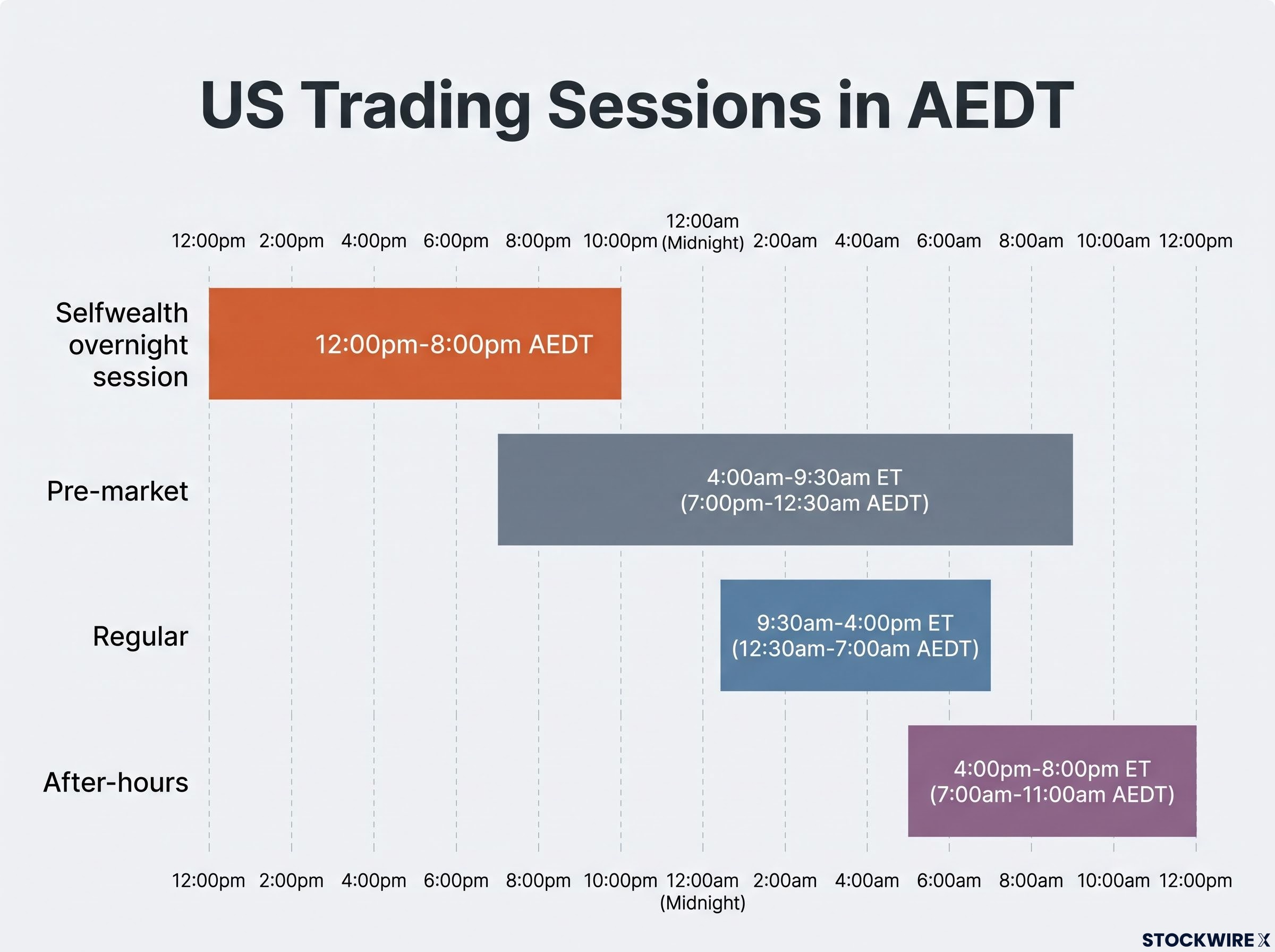
The regular trading session runs from 9:30am-4:00pm ET (12:30am-7:00am AEDT), while the Selfwealth overnight session provides a 12:00pm-8:00pm AEDT window.
Using the overnight session on day two
There is a less stressful option. Selfwealth runs an overnight session that, if ANT is offered in it, lets you place limit orders from the day after listing during an order window of 12:00pm-8:00pm AEDT. You trade during your own afternoon and avoid the 2:00am auction altogether.
Before you rely on this, confirm with your broker that ANT is actually available in the session.
How should an Australian investor prepare before listing day?
Understanding the mechanics only helps if your account is ready to act on them. Start with the distinction that trips up most investors: an IPO allocation means receiving shares at the offer price, while secondary-market trading means buying from other investors once trading opens.
A queued order or a displayed ticker is not an IPO allocation.
| Broker | IPO allocation | Order handling | Access hours |
|---|---|---|---|
| Selfwealth | Retail trades after open-market trading begins | Queued whole-share limit orders; stop-limit supported (unverified) | Pre-market from 7:00am ET (unverified); overnight session |
| Stake | Warns allocated shares may not trade on day one (unverified) | Only limit orders in extended hours (unverified) | Pre-market, regular and after-hours (unverified) |
| CommSec | IPO Centre is an application facility, not proof of access (unverified) | Out-of-hours orders may queue; time differences can delay execution (unverified) | Per international service terms |
| Interactive Brokers Australia | No published ANT policy | No published ANT policy | No published ANT policy |
| Moomoo Australia | No published ANT policy | No published ANT policy | No published ANT policy |
Then work through this checklist:
- Set up your account and US trading access well before listing day.
- Decide your maximum price and use a limit order, never an unbounded market order.
- Drop the offer price as your expected entry point.
- Size in whole shares you can still afford if the price gaps higher.
- Expect a wait after the US open, and avoid repeatedly cancelling and re-entering orders.
- Ask your broker whether it joins the IPO Cross or simply queues an order for after the open.
- Assume a halt, partial fill or no fill is possible.
- Remember you need not buy on day one.
- Judge the company separately from the excitement around the ticker.
Waiting reduces auction noise and lets you see a two-sided market, but you may pay more. Buying on day one gives you immediate exposure along with the most uncertainty on price, spreads and execution. Lock-up expiry, the date when insiders and early investors become free to sell, is a separate question, and so is valuation.
Judging the business is one task and separating the company from the deal is another, since valuation, investor base and lock-up structure shape aftermarket returns largely independently of how good the product is.
Records, tax and currency
Check that your W-8BEN is current. This is the US tax form that confirms you are not a US taxpayer and lets you claim any applicable treaty rate on withholding. Moneysmart warns that international investments can carry currency risk, trading delays, different regulatory protections and different tax treatment.
Your real return is measured in Australian dollars, after movements in AUD/USD and your broker’s FX spread (the margin it charges to convert currency). A US-dollar gain on screen can shrink, or even disappear, once you convert back. According to Moneysmart, holding for more than 12 months may reduce a taxable capital gain by 50% under the CGT discount, subject to the rules.
Keep records of AUD values at purchase and sale, brokerage, FX costs, dividends and withholding, and all dates and share numbers.
Making a calm call on a debut that opens while you sleep
Three ideas carry you through the night. There are two prices, and only one of them is available to you. Buying is a queue-and-auction process, not click-and-buy. And your protection is a limit price you set before the stock opens.
Before listing night, watch for Anthropic’s final pricing announcement, reportedly expected on 18 November. Also look for confirmation of the listing date and ticker, and for the final prospectus, including its lock-up terms.
Then make your decisions in daylight. Confirm how your broker handles ANT and which order types it accepts. Set your maximum price and decide now whether you will trade overnight or wait for day two.
This article is for informational purposes only and should not be considered financial advice. Investors should conduct their own research and consult with financial professionals before making investment decisions. Reported IPO terms and dates are subject to change based on market developments and company announcements.