
A 5% yield on a US Treasury sounds like the easy answer to “are treasuries worth buying?” The 10-year note closed at 5.10% on 12 November 2026, its highest level in a long stretch. Yet two of the market’s best-known bond strategists, both of whom now see value, will not call government bonds cheap.
That gap between “worth owning” and “a bargain” matters more than usual this week. October’s consumer price index (CPI), the government’s main inflation gauge, rose 0.4% for the month against a 0.3% forecast. Core CPI, which strips out food and energy, rose 0.3% for a third straight month.
Economists now treat a December rate hike from the Federal Reserve as close to certain. Anyone living off portfolio income has to decide whether to lock in today’s yields or wait for higher ones.
The useful answer comes from three checks you can run yourself: the real yield after inflation, the yield on offer from stocks, and the likely path of Fed policy. Together they show whether bonds belong in your portfolio and how much you should expect from them.
What does a 5% Treasury actually pay once inflation and stocks are in the picture?
Start with the headline. The 10-year Treasury yielded 5.10% on 12 November, up from 4.98% two days earlier, according to the US Treasury’s daily yield curve. The 30-year bond sat at 5.44%.
Now take inflation out. Treasury Inflation-Protected Securities (TIPS) are government bonds whose principal adjusts with inflation, so their yield shows the return you earn above rising prices. The 10-year TIPS yield was 2.78%, the closest market measure of what a 10-year bond really pays you in purchasing power.
TIPS inflation protection is also unusually cheap relative to realised inflation, partly because the main bond benchmark leaves TIPS out, which keeps institutional demand thin and breakeven rates low.
| Measure | Latest figure | Source and date |
|---|---|---|
| 10-year Treasury yield | 5.10% | US Treasury, 12 November 2026 |
| 30-year Treasury yield | 5.44% | US Treasury, 12 November 2026 |
| 10-year TIPS real yield | 2.78% | US Treasury real yield curve, 10 November 2026 |
| Shiller CAPE earnings yield | About 2.5% | CAPE near 40.7, November 2026 |
The final step is the stock comparison. The Shiller CAPE ratio measures share prices against 10 years of inflation-adjusted earnings. At about 40.7, it implies an earnings yield of roughly 2.5%, which is the real return stocks would deliver if earnings simply held steady.
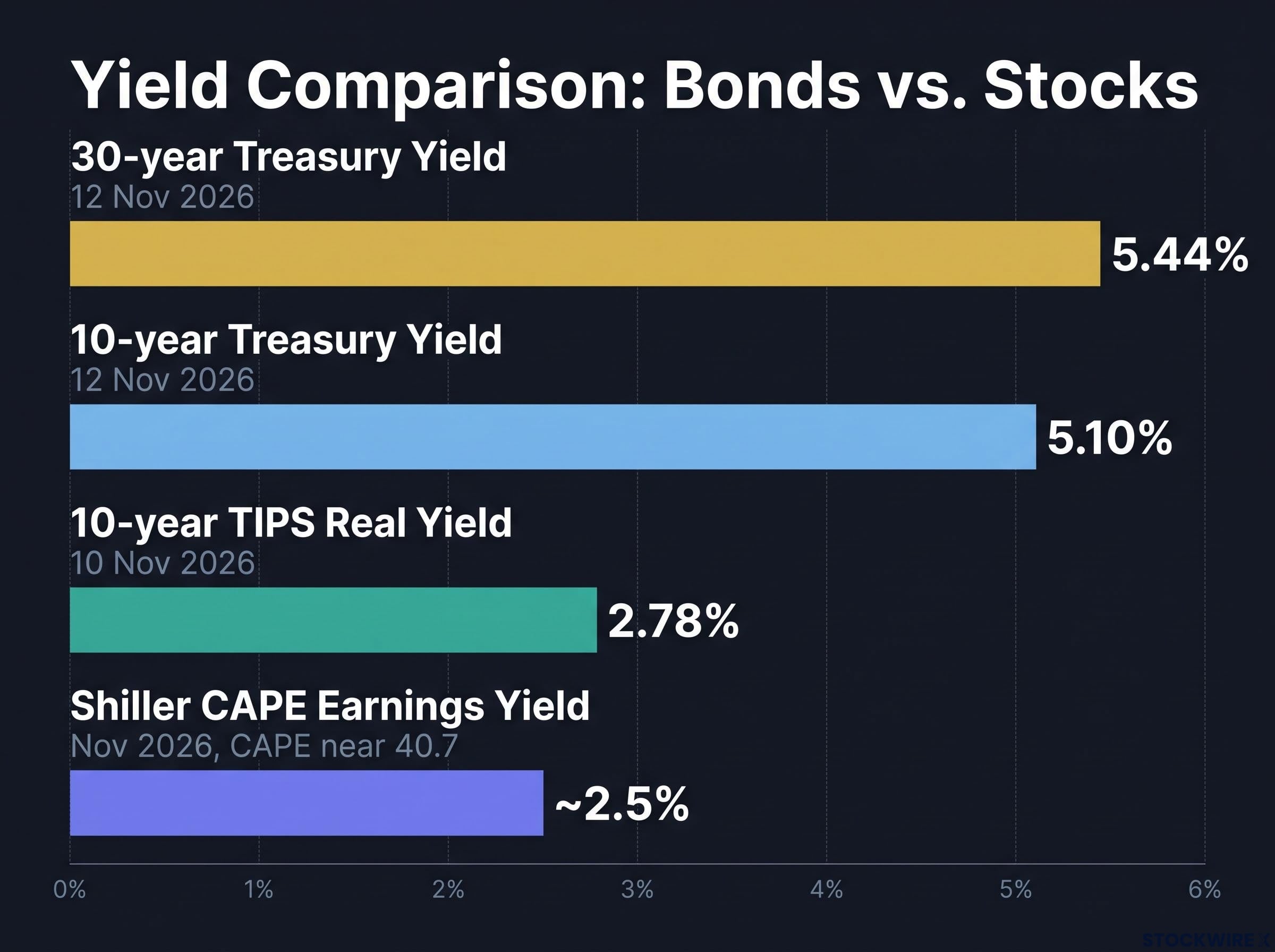
Government bonds are now competing directly with equities, with the 10-year TIPS real yield of 2.78% beating the Shiller CAPE earnings yield of ~2.5%.
Bonds versus stocks, yield for yield 10-year TIPS real yield: 2.78%. CAPE earnings yield: about 2.5%. A November 4 analysis put the gap at 2.66% against 2.5%, and it has widened since.
That comparison sits at the core of David Rosenberg’s case. The Rosenberg Research founder points out that the 10-year yielded about 30 basis points in 2020, when a tiny rate rise could wipe out holders, and argues the trade-off is far better now. Jim Bianco of Bianco Research adds that 5% roughly matches a US economy growing about 5% in nominal terms.
The comparison is imperfect. Company earnings can grow, while a Treasury’s price falls if yields rise. Still, a real yield above the equity earnings yield tells you bonds are now competing for the core of your portfolio, not just sitting in it as a hedge.
When big ASX news breaks, our subscribers know first
Fairly valued or cheap: where Bianco and Rosenberg part ways
Both strategists reach the same broad verdict: Treasuries near 5% offer reasonable value. The disagreement is narrower, and it is the part that should shape how you buy. Each measures value against a different set of yardsticks:
- Versus cash: bonds lock in a rate for longer but may lag cash if the Fed keeps hiking
- Versus equities: a real yield near 2.8% beats a CAPE earnings yield near 2.5%
- Versus history: 5% is high for the post-2008 era but not unusual across the long US record
- Versus nominal GDP: yields near nominal growth look fair; yields above it would look cheap
Bianco’s case: no longer expensive
Bianco turned more positive on bonds in late September after holding a negative view since 2020. His logic rests on the GDP yardstick: roughly 3% inflation plus 2% real growth makes 5% fair compensation, not a discount. In his view, a move toward 6% would make bonds genuinely cheap.
A third yardstick for the fairly-valued question is Gundlach’s fair value model, which blends seven-year nominal GDP growth with the German bund yield and put 10-year Treasury fair value near 4.53% earlier this year.
He also sees little risk of capital loss at these levels. The one scenario he can picture driving yields much higher is $200 oil, and oil prices are currently falling.
Bianco Advisors’ one-year scenarios (Q4 outlook) If the 10-year yield stays unchanged, a ~5% bond returns about 5.3% over a year. If yields fall 100 basis points, the return is about 12.7%.
These scenarios are illustrative projections and depend on market conditions; past performance does not guarantee future results.
Rosenberg’s case: cheap against stocks
Rosenberg goes a step further and calls bonds cheap, but only against equities on a yield-for-yield basis. His own positioning is measured rather than all-in: he holds two-year and 10-year bonds and has recently added some long-end exposure. A couple of hot CPI reports, he says, will not change his core view.
Institutional voices sit between the two. Corient describes current yields as the most attractive high-quality bond returns in years, while Capital Group favours managing duration over betting on a rally.
The distinction tells you that 5% justifies buying for income, but you should not expect a bargain-driven price gain. If you are buying yield, you can size for the long haul; if you are buying a rally, the experts are not promising one.
Is another Fed hike the cure or the problem?
That brings in the third lens, and it is where the October CPI landed hard. Headline prices rose 0.4% against a 0.3% consensus, and core rose 0.3% against an expected 0.2%. The federal funds rate sits at 3.75%-4.00% after the Fed held in October on a 10-2 vote.
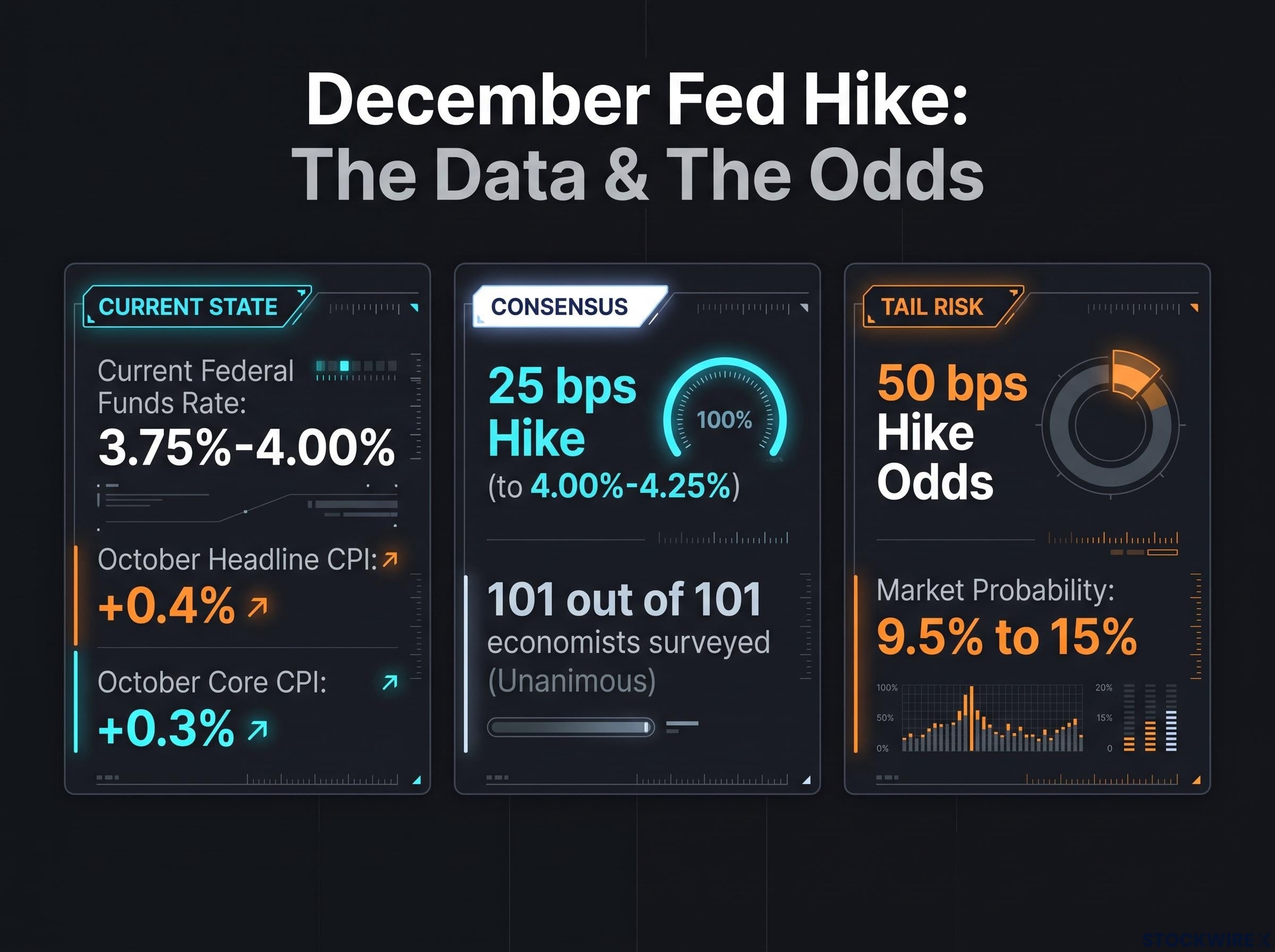
Despite unanimous consensus for a 25 bps hike to 4.00%-4.25%, markets still price in 9.5% to 15% odds of a 50 bps move after hot October CPI prints.
The case for hiking harder
Fed Governor Christopher Waller, speaking in London on 10 November, said he was “leaning toward” a 25 basis point hike. He added that if core CPI rose 0.3% or more, “a 50 basis point hike in the policy rate should be considered at the December meeting.” The print delivered exactly that.
Bianco backs the tougher line on credibility grounds. He reads last week’s election as voters signalling that inflation is out of control, and argues the Fed must hike in December and again afterwards.
A Reuters survey of 101 economists was unanimous on a 25 basis point December hike to 4.00%-4.25%, with 45 expecting at least two more. Market odds of a 50 basis point move ranged from about 9.5% to 15%.
The case for patience
Rosenberg sees the fork differently. He estimates financial conditions have tightened about 150 basis points since February, the equivalent of roughly six hikes, with effects still working through the economy.
His core argument is that much of today’s inflation comes from supply. Rate hikes cannot produce more oil or remove tariffs. He notes real wages have trailed inflation for seven straight months and that diesel, gasoline and farm commodity indices are down more than 20% from their peaks, signs that demand is already being squeezed.
| Case for more tightening | Case against |
|---|---|
| Core CPI at 0.3% for a third month | Financial conditions tighter by about 150 bp since February |
| Waller says 50 bp should be considered | Energy and tariff inflation are largely supply-driven |
| Bianco: credibility at risk with only 25 bp | Real wages lagging for seven straight months |
| Voters see inflation as unresolved | Commodity prices down over 20% from peaks |
| Risk that expectations come loose | Over-tightening could tip the economy into recession |
Richmond Fed President Tom Barkin reportedly said policy should move “with care”, a sign the debate runs inside the Fed too.
Both camps expect a December hike, so you should focus less on whether it happens and more on the dot plot and guidance. Those projections of future rates are what move long-dated yields, and Rosenberg himself expects the dot-plot shift to matter more than the hike.
What could go wrong at 5%, and how to size a position
A 5% coupon is fixed, but the bond’s price is not. Understanding how a purchase can disappoint is the step that turns a view into a plan.
The risks that matter most
Duration is the sensitivity of a bond’s price to changes in interest rates. The longer the bond, the bigger the price swing. A rise in the 10-year from 5% to 6% can wipe out much of a year’s coupon.
Bond duration is printed on every fund fact sheet, and each year of it translates to roughly 1% of price loss for a 1 percentage-point rate rise, which makes it the first figure to check before buying a bond fund.
- Higher-for-longer policy: the funds rate could reach 4.25% or beyond
- Supply and term premium: the term premium is the extra yield investors demand for holding long bonds. The Congressional Budget Office (CBO) projects a FY2026 deficit of about $1.9 trillion, or 5.8% of GDP, and estimates a five-point rise in duration supply lifts the 10-year term premium by about 2.8 basis points
- Oil shocks: Bianco’s $200 oil scenario remains the main path to much higher yields
- Tariff pass-through: another round of price increases from trade costs
- Refinancing pressure: cheap old debt rolling into higher rates adds to issuance
- Opportunity cost: a fixed 5% could lag stocks if recession is avoided
The supply worry has a counterweight. The Treasury Borrowing Advisory Committee notes long-duration supply has not increased since 2024. Volatility is also elevated: the MOVE index, which tracks expected bond price swings, read 92.44 on 11 November, though readings vary by source, and Bianco ties it mainly to curve flattening ahead of the hike.
History offers two lessons. In 2023 the 10-year approached 5% and then fell, rewarding buyers. In the early 1980s, bond buyers earned exceptional gains, but only once Fed credibility was restored and only after heavy volatility.
A staged way to buy
- Split your intended allocation into tranches. Buy a portion now and set dates or yield levels for the rest.
- Match maturity to your timeline. If you hold to maturity, interim price swings do not change the income you collect.
- Add on weakness toward 6%. Bianco’s marker for “genuinely cheap” gives you a clear trigger to step up purchases.
- Reassess after the December meeting and next CPI print. Let the dot plot inform the size of later tranches.
The risks tell you that a fixed 5% is dependable income but not protection against price swings, so size the position to how long you can hold it.
A framework for the call: real yield, relative value and the Fed’s path
Put the three lenses together and the decision rule is straightforward. A real yield near 2.8% clears the bar against stocks, and a 5% nominal yield matches the economy’s growth rate. That makes Treasuries worth buying for income and diversification, particularly if you hold to maturity.
What they are not, on the current evidence, is a risk-free capital gain or an unambiguous generational bargain. Expect fair value and plan your entry accordingly.
Three signposts will sharpen the picture: the December FOMC statement and dot plot, the next CPI release, and whether the 10-year drifts toward the 5.5%-6% range. Each could shift the balance between buying now and buying more later.
Credit spreads offer a cross-check on whether higher yields signal stress, and with investment-grade spreads near 0.80 percentage points, corporate bond investors are not currently pricing in systemic trouble.
This article is for informational purposes only and should not be considered financial advice. Investors should conduct their own research and consult with financial professionals before making investment decisions.