Two advisers looked at the same cyber security ETF, agreed the theme will last for years, and still came to opposite verdicts. Meanwhile, the defence theme has record government budgets behind it, yet the VanEck Global Defence ETF (ASX: DFND) returned -14.47% over the year to 31 October 2026.
Both cases point to the same lesson: a theme can be right while the investment still disappoints.
The two funds in question are the Amplify Cybersecurity ETF (HACK) and DFND. For both, the real question is how much you are paying compared with how much demand is actually secured. One complication is that “DFND” is used by two different funds: the VanEck version on the ASX and the iShares Global Aerospace & Defence UCITS ETF. This analysis focuses on the VanEck fund and compares the two where they differ.
Here is the framework for judging when a good theme is already priced in, and how each fund holds up against it.
Why do advisers split on a cyber security ETF when the demand is not in doubt?
Advisers Adam Doors and Michael Wayne agree on the basics. Cyber attacks are not going away, and companies cannot easily cut their security budgets. Their disagreement starts once the price tag enters the conversation.
The structural demand case
Doors is a buyer, and he has held HACK in client portfolios for years. He points to high-profile breaches such as Medibank and Optus, to hackers now using AI, and to growing rules that force companies to report incidents. That combination turns security into a non-discretionary cost, which means businesses keep paying for it even when other budgets are cut.
Australian investors also have local regulatory demand floors to weigh, since domestic rules such as the SOCI Act and the Notifiable Data Breaches scheme support security spending independently of global conditions.
The forecasts support him. Gartner expects global information-security spending to reach $247.5 billion in 2026, up 12.7% in constant currency, and $372.8 billion by 2030. Gartner also raised its 2026 estimate from an earlier $239.8 billion. IDC uses a wider definition and puts 2026 spending at about $308 billion, so the two figures should not be compared directly.
The valuation and AI-sentiment case
Wayne is a seller. In his view, the theme is already widely known, and some of the AI-driven enthusiasm has recently drained out of the sector.
Wayne’s drawdown warning The ETF could fall 10-20% quickly if sentiment around AI wobbles.
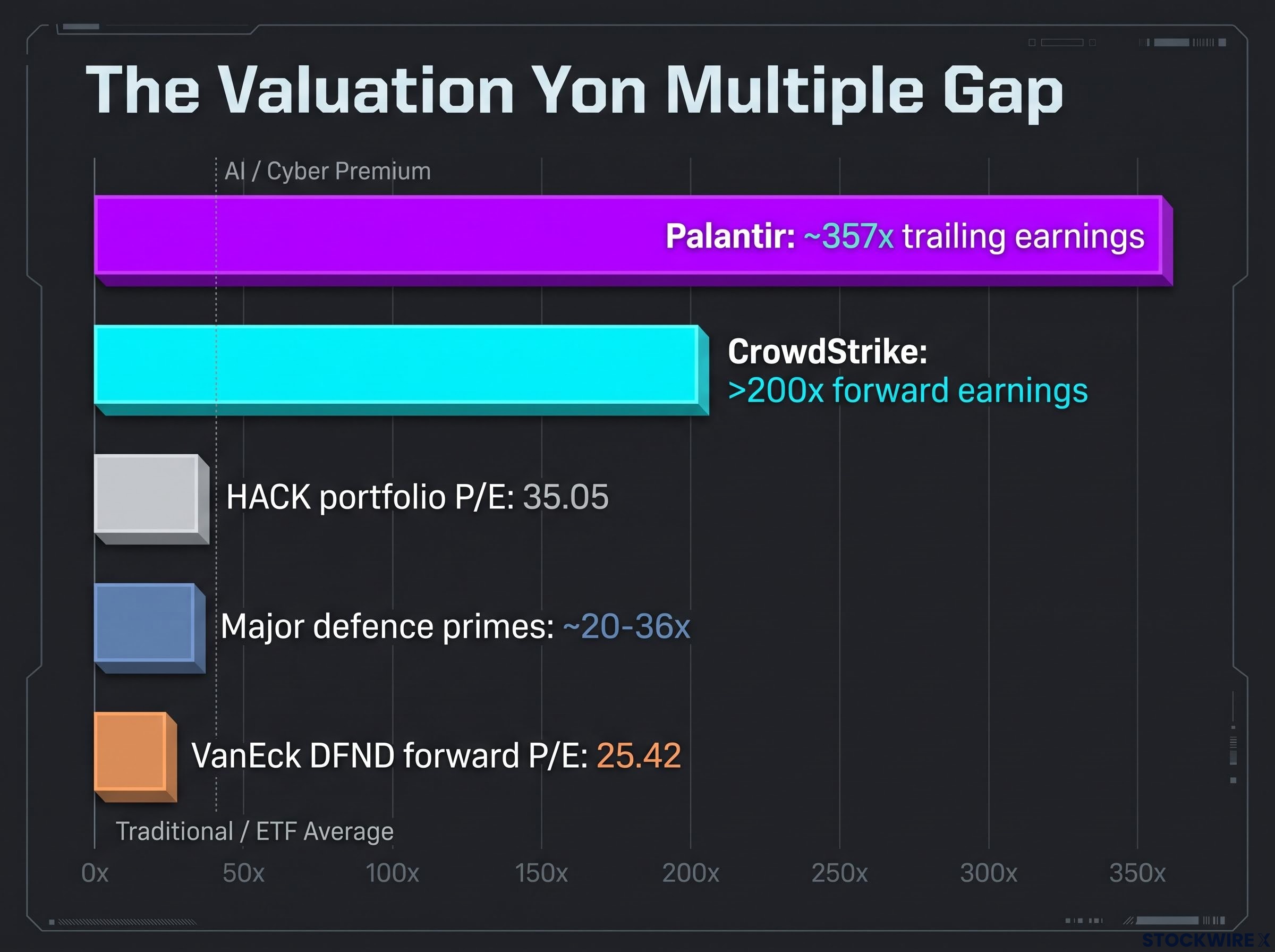
The numbers explain his caution. HACK’s portfolio price-to-earnings (P/E) ratio, which is the share price divided by earnings per share, stood at 35.05 on 12 November 2026. The top 10 holdings make up about 52% of assets. Reuters reported in August 2025 that CrowdStrike traded above 200x forward earnings.
Bull case
- Persistent attacks keep security spending non-discretionary
- Mandatory incident reporting adds regulatory demand
- Cloud, software supply chains and AI expand the attack surface
Bear case
- The theme is widely known and largely priced in
- AI-related sentiment has already wobbled
- Multiple compression can overwhelm earnings growth
Performance has rewarded the bulls so far. Recent data puts HACK’s 12-month return at roughly 35-42%, depending on the source and the period measured. The podcast where the advisers debated the fund cited a lower figure from an earlier period. The expense ratio is 0.60%.
Strong demand growth tells you the business case is intact. The valuation tells you how much of that growth you are already paying for. Your decision depends on how big you judge that gap to be.
When big ASX news breaks, our subscribers know first
Why has defence lagged despite record spending, and where does fair value end?
Defence looks like a contradiction. SIPRI recorded global military spending of $2.887 trillion in 2025, up 2.9% in real terms and the 11th consecutive annual increase. Over the same period, the VanEck fund lost money.
The explanation is that budgets are not earnings. Money approved by governments still has to pass through procurement approvals, and manufacturers face capacity limits, export controls and long delivery cycles. Revenue arrives years after the headline announcement.
Backlogs and book-to-bill ratios offer a more direct read on how quickly approved budgets are converting into contracted work than headline spending totals do.
The long-term support is real. NATO’s framework targets 5% of GDP by 2035, made up of at least 3.5% core defence spending plus up to 1.5% in related spending. European and Canadian core spending rose more than 19% in 2025, so the money is already flowing rather than simply being promised.
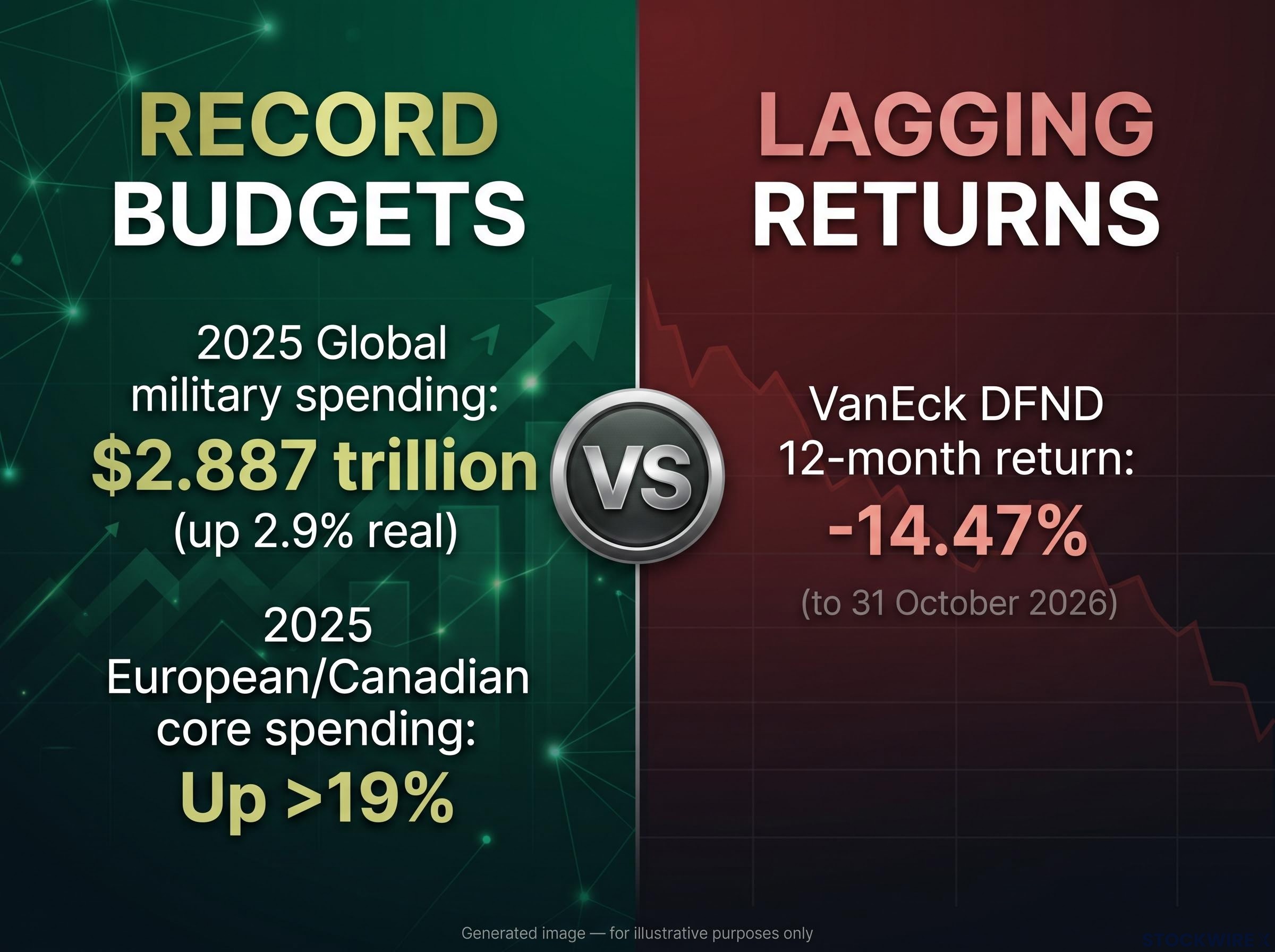
Despite record 2025 global military spending of $2.887 trillion, the VanEck DFND 12-month return fell to -14.47% to 31 October 2026.
Both advisers rated DFND a buy on financial grounds. Its makeup deserves a closer look, though, because Palantir has changed the character of the basket.
| Item | Figure | Source/Date |
|---|---|---|
| Global military expenditure | $2.887 trillion in 2025, up 2.9% real | SIPRI, 27 April 2026 |
| NATO target | 3.5% core plus up to 1.5% related, by 2035 | NATO, 29 June 2026 |
| European and Canadian core spending | Up more than 19% in 2025 | NATO, 5 November 2026 |
| VanEck DFND valuation | Trailing P/E 30.92; forward P/E 25.42 | Fact sheet, 9 November 2026 |
| VanEck DFND 12-month return | -14.47% total return | To 31 October 2026 |
Ethical screens and Palantir
Palantir makes up 8.38% of the fund and RTX 8.34%. According to June 2026 commentary, Palantir traded at about 357x trailing earnings, compared with roughly 20-36x for the major defence primes. That makes part of DFND an AI-growth trade.
Ethics add another filter. Doors flagged concerns about Palantir, and holdings such as Palantir and Elbit Systems can be excluded under ethical, ESG or Sharia mandates. Reports, which have not been independently confirmed, say Palantir has drawn human-rights scrutiny from some investors and appears on at least one manager’s exclusion list. If your own values or mandate rule these companies out, the financial case does not matter.
Record spending supports the multi-year thesis. The weak returns, however, show that your entry timing and the pace at which budgets turn into contracts matter as much as the headline figure.
What actually separates HACK from the two DFND funds?
The ticker confusion is a practical trap. If you search for “DFND”, you may land on either fund. The two have different fees, different holdings and very different returns, so their numbers should never be blended into a single comparison.
The VanEck fund charges a 0.65% management expense ratio (MER), which is the annual fee taken from the fund’s assets. It holds 44 stocks according to its fact sheet, and Palantir and RTX together account for about 16.7%. The iShares UCITS fund charges 0.35%, holds 96 stocks led by names such as GE Aerospace, Rolls-Royce and Airbus, and has returned roughly 3-6% over one year, depending on the source.
HACK sits apart. Its largest positions are Broadcom at 6.73%, CrowdStrike at 5.59%, Cisco at 5.54%, Palo Alto Networks at 5.10% and Okta at 4.49%.
| Metric | HACK | VanEck DFND | iShares DFND |
|---|---|---|---|
| Fee | 0.60% | 0.65% | 0.35% |
| Holdings | Top 10 about 52% of assets | 44 | 96 |
| Top concentration | Broadcom 6.73% | Palantir plus RTX about 16.7% | Spread across aerospace and defence majors |
| 12-month return | About 35-42% | -14.47% | About 3-6% |
Four risks shape how these funds behave:
- AI sentiment reversal: high for HACK; moderate to high for VanEck DFND through Palantir
- Valuation: richer multiples leave less room for disappointment
- Budget execution: central to DFND, since procurement delays slow revenue
- De-escalation: a potentially material risk for DFND only, as calmer geopolitics could shrink its premium
Knowing which fund you are looking at tells you which fee, holdings mix and risk profile you would actually own. That shifts the answer more than the theme label does.
How can you tell when a good theme is already priced in?
The evidence from both sectors follows a pattern. CrowdStrike above 200x forward earnings showed that growth can be priced in long before valuations look reasonable. Palantir near 357x turned a defence basket into an AI bet. And VanEck DFND’s negative return arrived despite record spending.
The multiple gap CrowdStrike traded above 200x forward earnings, while major defence primes sat at roughly 20-36x.