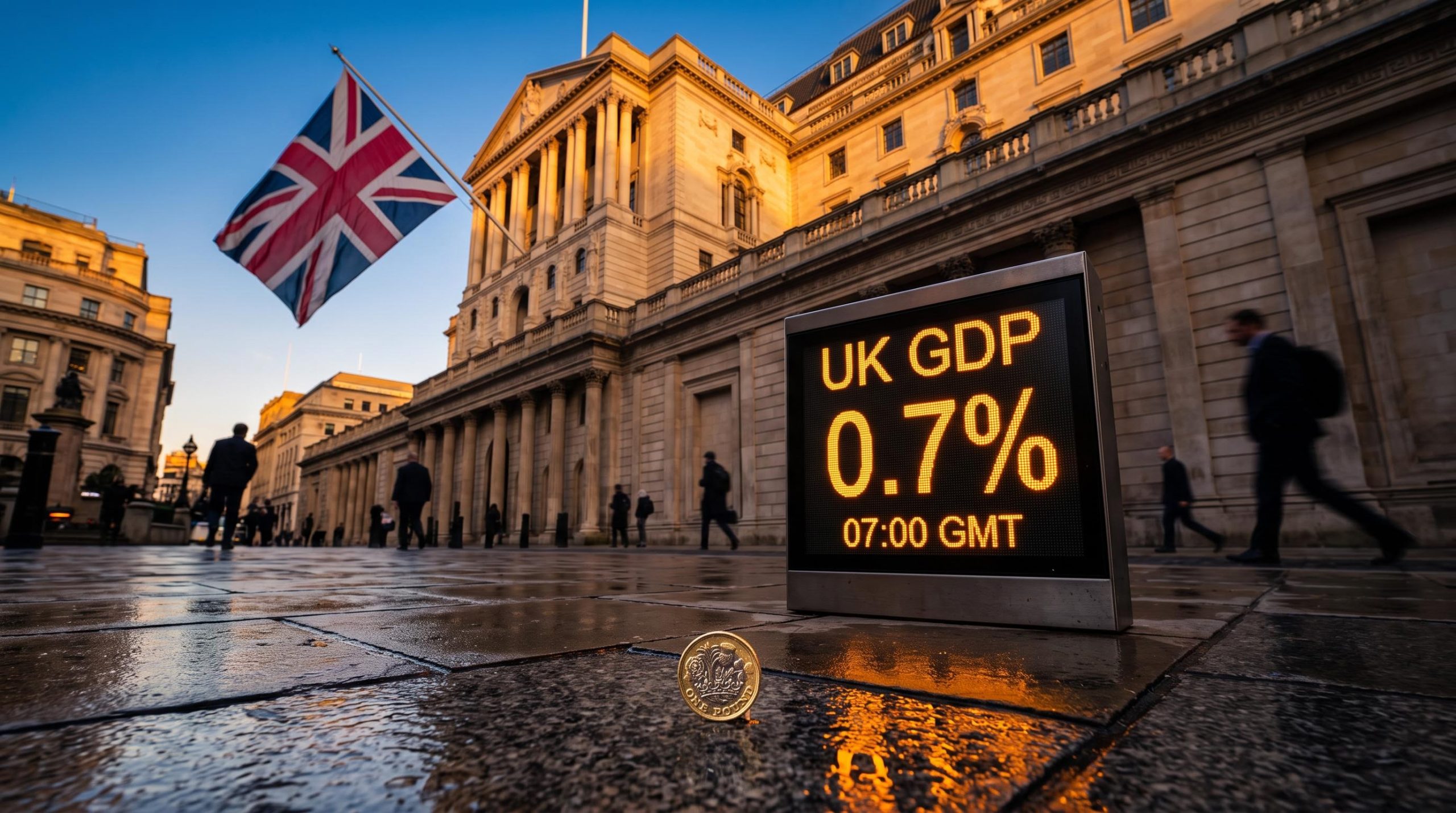
The Office for National Statistics (ONS) releases its first estimate of Q3 2026 GDP at 07:00 GMT today. Economists expect quarterly growth of 0.7%, up from 0.5% in Q2, which would cap a run of UK data that has repeatedly beaten expectations.
The timing gives this UK GDP preview more weight than a routine release. It is the first major data point since the Bank of England raised Bank Rate from 3.75% to 4.00% on 5 November, its first hike since August 2023.
Sterling has not benefited from that hike. GBP/USD has slipped to around $1.33 after hot US inflation data lifted the dollar.
Two questions follow from the release. The first is whether a solid print makes a December rate rise more likely. The second is whether a strong number can lift the pound while the dollar holds the upper hand.
What the market expects from today’s GDP print, and why September is the wrinkle
The headline forecast is confident. Consensus points to 0.7% quarter-on-quarter growth and 1.9% year-on-year, compared with 1.4% previously. That matches the Bank of England’s own November projection exactly.
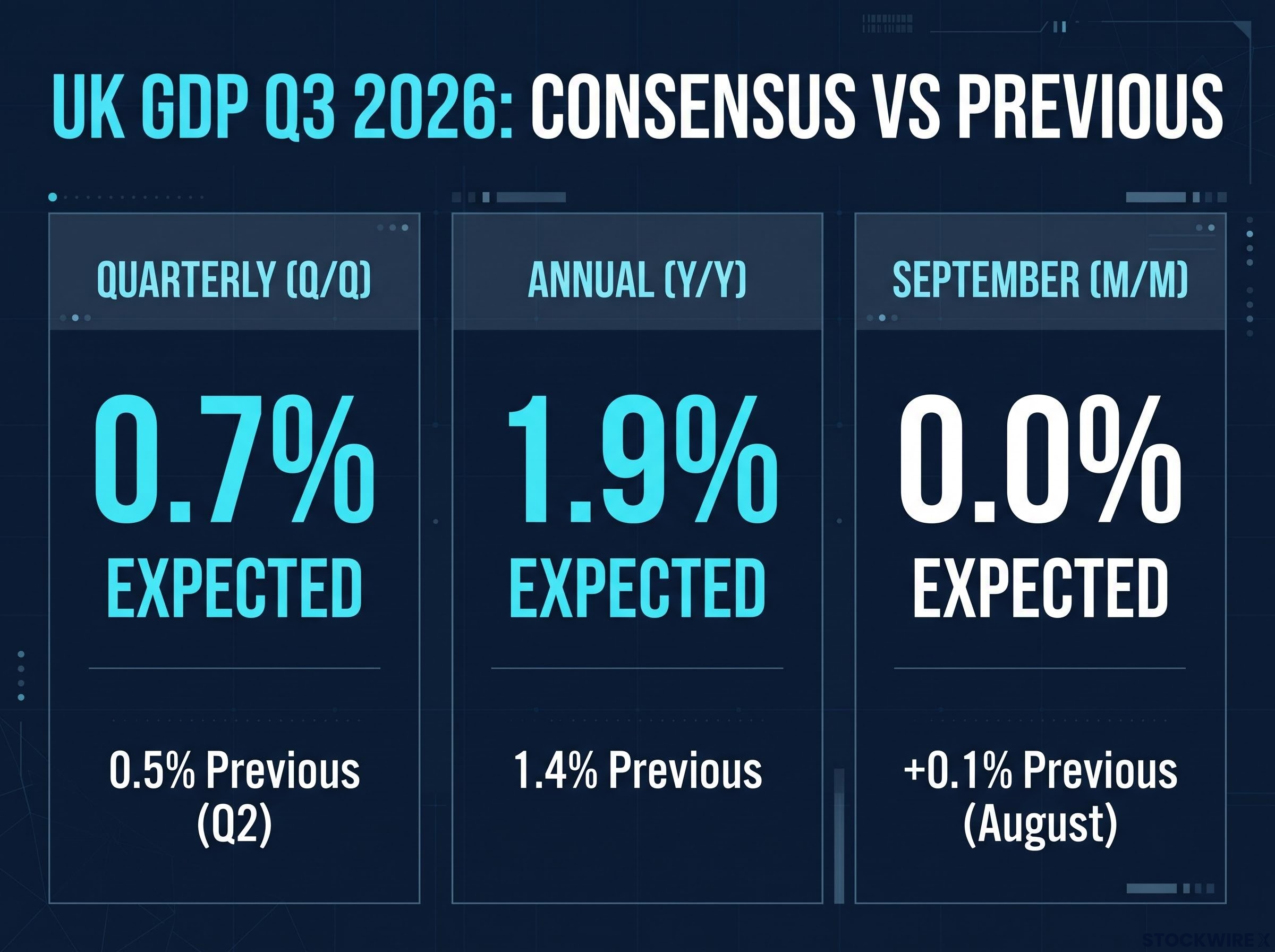
Markets expect Q3 q/q growth to hit 0.7%, up from 0.5%, though September m/m is seen flat at 0.0% compared to +0.1% previously.
| Indicator | Consensus | Previous |
|---|---|---|
| Q3 GDP, q/q | 0.7% | 0.5% (Q2) |
| Q3 GDP, y/y | 1.9% | 1.4% |
| September GDP, m/m | 0.0% (some expect 0.1%) | +0.1% (August) |
| September industrial production, m/m | About -0.2% to -0.4% | +0.8% (August) |
Several data points support the forecast. August GDP rose 0.1% when economists had expected a fall. Manufacturing PMI, a monthly survey where readings above 50 signal expansion, reached 52.8 in October, and the composite measure hit 52.9. The National Institute of Economic and Social Research (NIESR) credited public spending and business investment, and lifted its 2026 forecast to 1.6% from 1.1%. The IMF raised its own forecast to 1.3% from 1%.
The July GDP beat was broad, with services, manufacturing, production and construction all expanding together, which is part of why economists have been revising their quarterly forecasts higher.
The detail for September looks weaker than the quarter as a whole.
Monthly GDP for September is expected to be flat. Industrial production is forecast to fall, even though it is still about 3.0% higher than a year earlier. Services are seen flat and construction weak. The Bank itself warned that recent strength was likely to fall back somewhat. The quarterly number may therefore flatter the pace at which the economy left the quarter.
The policy backdrop is not changing the picture much. The Budget is viewed as neutral, with relief on food and energy costs funded by higher taxes on banks and gambling firms, and bond markets have not reacted strongly against it.
A 0.7% print would confirm the Bank’s forecast rather than surprise it. The more useful details for you are the composition and the September figure, and first estimates are often revised later.
Could a strong print push the Bank of England towards another hike?
The November vote was 8-1, with Catherine Mann voting for a larger 50bp rise. The Bank projects inflation will climb to around 5% in the first half of 2027 because of energy prices. CPI was 3.5% in September.
Reading MPC votes matters as much as the rate itself, since a lopsided 8-1 split with the lone dissent favouring a bigger move says more about direction than the headline.
Officials have signalled a willingness to raise rates again:
- Andrew Bailey, Governor: rejects a fixed course, but sees the argument for another rise if nothing softens the inflation outlook.
- Clare Lombardelli, Deputy Governor: said a further near-term increase is likely to be needed, and on 10 November would not rule out December.
- Catherine Mann: wanted 50bp in November, the most hawkish view on the committee.
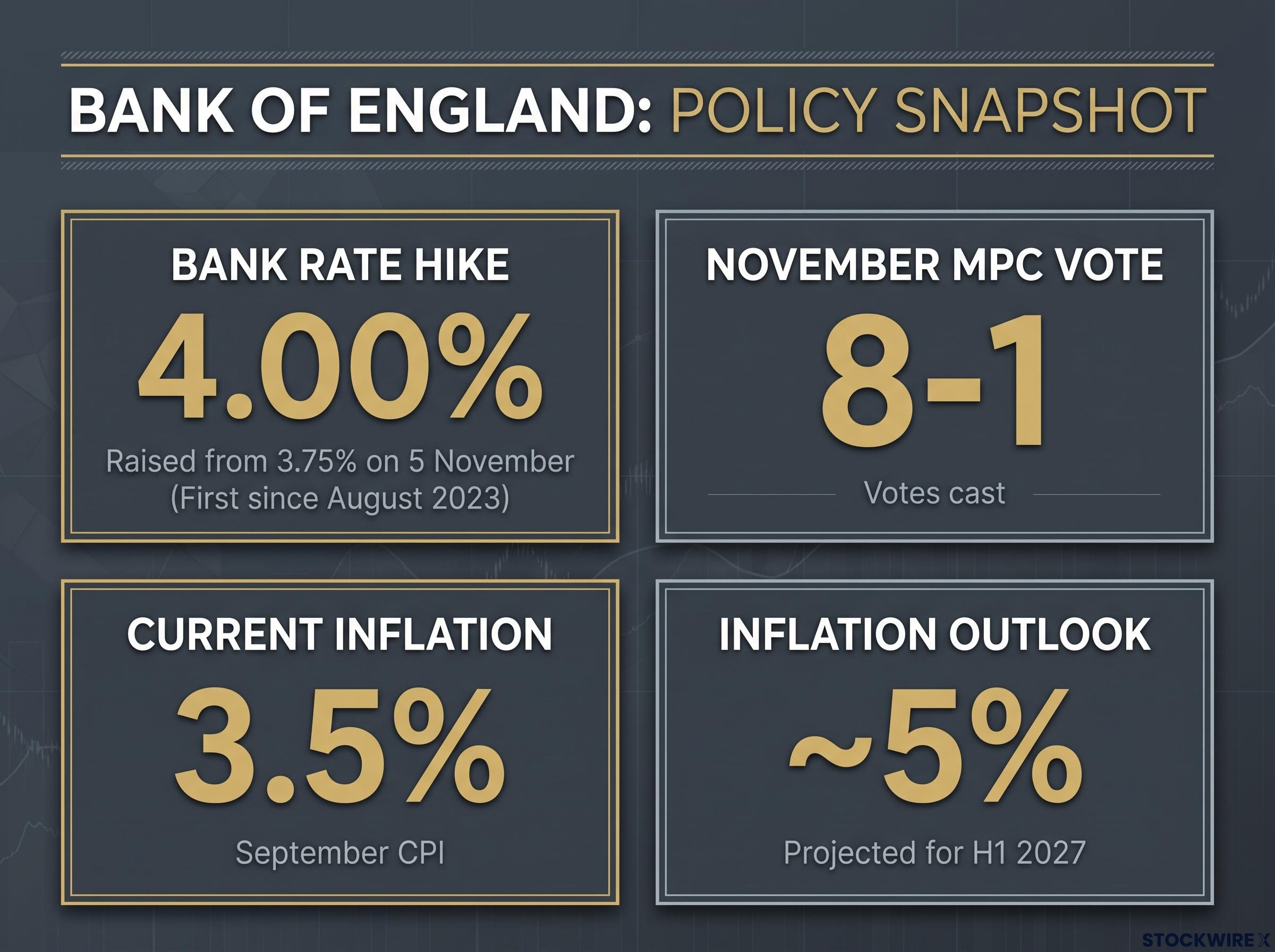
The Bank of England raised rates from 3.75% to 4.00% on 5 November with an 8-1 vote, as projected inflation nears ~5% for H1 2027.
Bailey on the outlook The Monetary Policy Committee is “not on a pre-set path.”
That phrase sets the limit on the hawkish signals. Growth is not part of the Bank’s mandate, which targets inflation, so a strong GDP figure matters mainly as evidence that demand is holding up while prices rise. Unemployment of 4.7% in the three months to July, with the Bank projecting 4.8% in Q4, points to some slack in the labour market.
Reuters reported on 3 November that some analysts saw market pricing of several more hikes as excessive. FXStreet’s analyst sees February as the most likely timing for a further rise after a strong print.
For mortgage holders and savers, a solid number makes another rise more plausible but not certain. December and February are both live possibilities, and neither is confirmed.
Sterling after the print: GBP/USD levels and how BoE tools move the pound
The pound fell after the Bank raised rates. GBP/USD reversed on 10 November after hotter-than-expected US October CPI and supportive comments from Fed Governor Christopher Waller on a December move lifted the dollar. The US data outweighed the effect of the UK hike.
The pair traded near 1.3320 on 12 November, below 1.34. FXStreet’s Guillermo Alcalá says the price has broken below its October ascending channel. He also notes the 4-hour RSI, a momentum gauge, is nearing oversold, with trendline resistance near 1.3380 and the 10 November high near 1.3460.
| Source | Support | Resistance |
|---|---|---|
| TMGM | 1.3260 | 1.3370, 1.3400, then 1.3475 |
| BCR | 1.3266, then 1.3226 | 1.3397-1.3400 |
| Forex.com | Not specified | 1.3475-1.3500 |
| Continuum Economics | 1.3273-1.3300 | Not specified |
A strong GDP figure would tilt the risks for the pound upward, but US yields could still decide the direction.
Sterling has a record of shrugging off growth surprises, with a broad July data beat producing only a marginal move as inflation and energy risk dominated pricing.
How BoE tools move Sterling
The Bank targets 2% inflation, mainly by setting interest rates:
- Higher rates: tend to support Sterling by raising returns on UK assets.
- Quantitative easing (QE): the Bank creating money to buy bonds. It usually weakens the pound by pushing gilt yields lower.
- Quantitative tightening (QT): the Bank shrinking its bond holdings. It is usually supportive, because it pushes yields higher.
Each effect depends on how markets read the move. November’s hike gave the pound only limited support because traders saw it as conditional rather than the start of a sustained series of rises.
If you hold dollar-priced assets or plan UK travel or transfers, the dollar’s direction may matter more today than the GDP number.
What to watch after the 07:00 release
The headline figure is the least informative part of the release. The composition, the September exit rate and the strength of the dollar will show more about what comes next.
The next decision points are the December and February MPC meetings, the Fed’s December decision and the next UK inflation print. Each will show whether November’s hike was a single step or the first of several.
Your decision does not depend on whether the economy grew. It depends on whether that growth is strong enough to keep inflation high, and whether the dollar allows Sterling to reflect it.
This article is for informational purposes only and should not be considered financial advice. Investors should conduct their own research and consult with financial professionals before making investment decisions.