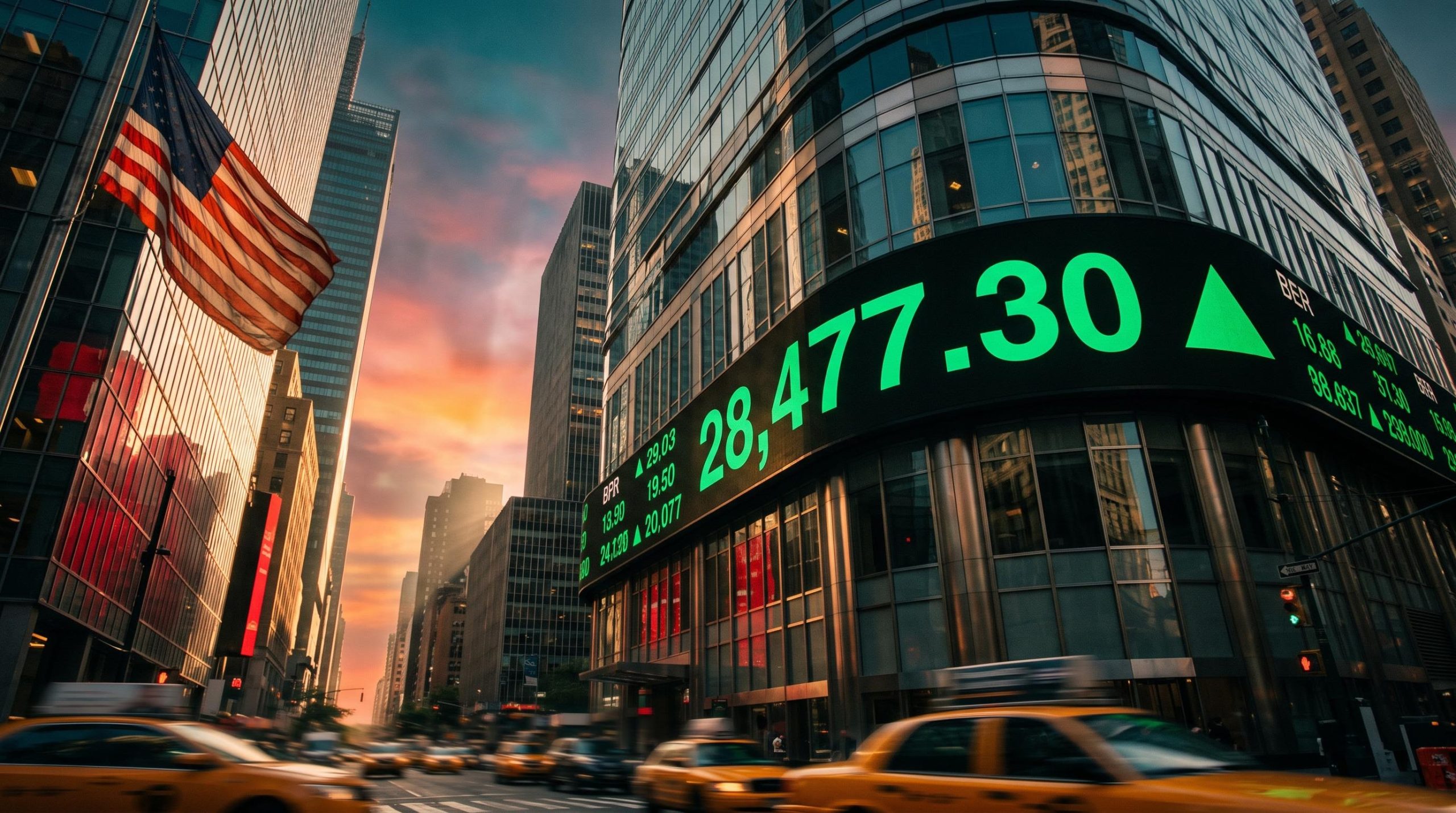
The Nasdaq 100 rebound arrived on Veterans Day. The index climbed back above its 5 November opening level on Wednesday, recovering from a slide that had pushed it into correction territory. The latest intraday report put it near 28,477.
The bounce was not evenly shared. AI-heavy benchmarks recovered more ground than the S&P 500 and the Dow Jones Industrial Average, and that gap shows where market conviction currently sits.
Here is what drove the move, why the Nasdaq 100 outran its peers, and which Fed speeches and data releases could test it before December.
How much of the November 5 damage did the Nasdaq 100 actually recover?
The numbers came in fast. Market reports put the Nasdaq 100 up 2.38% on 11 November. That followed a loss of about 6.5% on 5 November, which was reported as the index’s worst session since April 2025. Neither figure has been independently confirmed.
The 5 November drop took the index more than 10% below its 6 October peak. A fall of that size counts as a correction, which is the market term for a decline of at least 10% from a recent high.
Historical dip-buying odds differ sharply by cause: pullbacks outside crises have been positive after three months far more often than those inside crises, which is why the origin of a sell-off matters as much as its size.
On Wednesday, the index reached an intraday high slightly under 28,600 before trading around 28,400, according to FXStreet analyst Joshua Gibson. No verified closing level was available, so these remain intraday readings. The three reference points look like this:
- 6 October peak: about 31,350
- 5 November low: about 26,600
- Latest level: roughly 28,400-28,477 (intraday)
Recovery check The Nasdaq 100 has recouped over a third of its slide from the 6 October peak to the 5 November trough, according to FXStreet.
That is real progress, but it is only part of the way back. Getting back above the 5 November open suggests the selling was at least partly forced rather than a final verdict on AI demand. With the index still about 3,000 points below its peak, you should treat this as repair, not a new high.
When big ASX news breaks, our subscribers know first
Why did AI-heavy indices outrun the S&P 500 and Dow?
The same headlines moved each index by a different amount, and the gap is clearest when the figures sit side by side. All of these figures are reported and have not been independently confirmed.
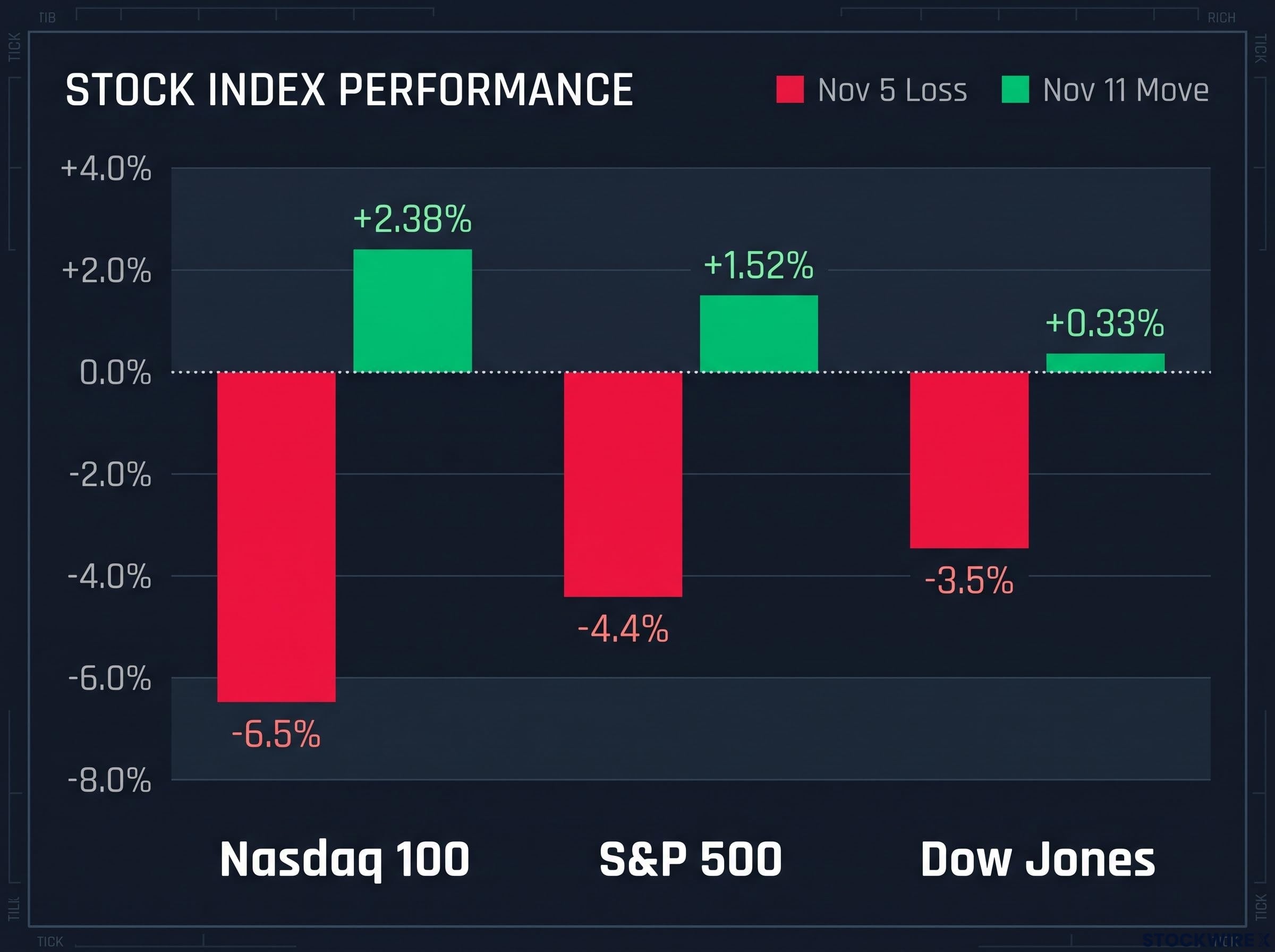
The Nasdaq 100 showed the strongest rebound with a +2.38% move on November 11 after a -6.5% loss on November 5.
| Index | Nov 11 move | Nov 5 loss | Level | Share of loss recovered |
|---|---|---|---|---|
| Nasdaq 100 | +2.38% | -6.5% | 28,477.30 (intraday) | Over a third of peak-to-trough slide |
| S&P 500 | +1.52% | -4.4% | 7,635.40 | Roughly four fifths of decline |
| Dow Jones | +0.33% | -3.5% | 52,405.96 | Roughly three fifths of decline |
| Nasdaq Composite | +2.14% | Not reported | 25,602.51 | Not reported |
The Dow tells a different story. It did not fall in October. It rose from about 50,500 on 1 October to just under 53,800 on 5 November, so its pullback started from a fresh high. It now sits about 1,300 points below that level. The S&P 500, which peaked just under 7,850, has recovered more than half of its drop from that peak.
How the Nasdaq 100 is built, and why that matters here
The Nasdaq 100 is a modified market-cap-weighted index of 100 large non-financial companies listed on Nasdaq. Bigger companies carry more weight, subject to caps on concentration. It leans heavily towards technology and includes some non-US firms. Reported rules include quarterly rebalances and an annual December reconstitution, though these details are unverified.
The S&P 500 has a broader base. The Dow tracks just 30 stocks, weights them by share price, and holds fewer direct AI beneficiaries. A mega-cap AI surprise therefore moves the Nasdaq 100 most, the S&P 500 less and the Dow least.
If your portfolio leans towards a broad index fund or Dow-style holdings, you captured less of this bounce. You also absorbed less of the drop.
What lifted AI stocks: CoreWeave, Anthropic and Nvidia
That structure explains the size of the move. The cause came from three catalysts, and the evidence gets more concrete with each one.
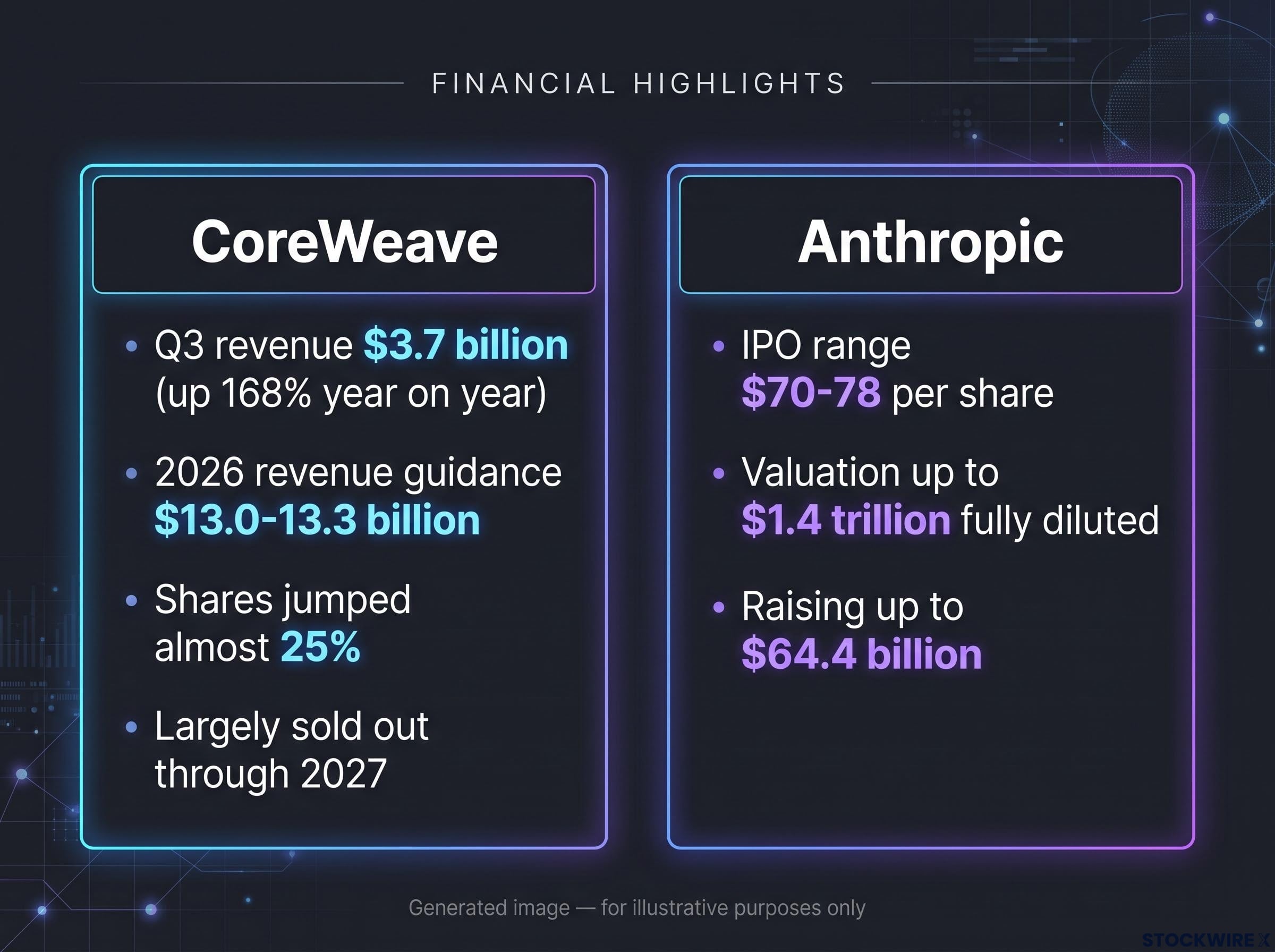
CoreWeave posted Q3 revenue of $3.7 billion (up 168% year on year), while Anthropic targets an IPO range of $70-78 per share.
CoreWeave’s results answered the delay fear
CoreWeave reported Q3 revenue of $3.7 billion, up 168% year on year and ahead of analyst expectations. It also raised its outlook. These guidance figures are reported and unverified:
- 2026 revenue guidance: $13.0-13.3 billion, up from $12.4-13.2 billion
- 2026 adjusted operating income guidance: $1.275-1.375 billion
The shares jumped almost 25%. The bigger reassurance came from Chief Executive Officer Michael Intrator. He told CNBC that data centre construction is not being delayed, which was the exact fear behind the 5 November selling.
“Largely sold out” Intrator said CoreWeave was “largely sold out” of AI infrastructure through 2027.
Anthropic’s IPO and Nvidia’s resilience
Anthropic‘s initial public offering (IPO) was reported as oversubscribed several times over. Oversubscribed means investors asked for more shares than were on offer. Reports put the range at $70-78 per share and the valuation at about $1.0 trillion non-diluted, rising to as much as $1.4 trillion fully diluted. The company is reported to be raising up to $64.4 billion. Pricing is expected on 18 November, with Nasdaq trading under the ticker ANT from 19 November. None of these details has been independently confirmed.
Anthropic’s debut lands at a moment when AI lab revenue has become the variable the market watches most closely, because run-rate disclosures now decide whether the infrastructure build-out thesis holds.
Nvidia gained despite a difficult run of headlines. It had lost nearly 10%, or roughly $430 billion in market value, over Monday and Tuesday. On Wednesday, Morgan Stanley removed it from its top-pick list, and a House China panel set CEO Jensen Huang a same-day deadline to respond. Reports of the day’s gain range from about 2.9% to more than 4%.
Short covering, where traders who bet against stocks buy them back to close their positions, likely added fuel after the oversold slide. Treasury markets were closed for the holiday, so bond yields did not react.
Delivered revenue, a sold-out backlog and heavy IPO demand together suggest the market read the sell-off as a positioning reset rather than a collapse in AI demand. Weigh that against any claim that the bounce was only short covering.
What could test the rally before the December Fed decision?
The rally now has to hold up against the calendar. Traders price roughly 90% odds of a quarter-point rate hike on 9 December. CME FedWatch was cited at about 88.8% for a 25 basis point rise and 11.2% for 50 basis points, figures that are unverified. A basis point is one hundredth of a percentage point.
The build-up in December hike odds followed a payrolls report that beat consensus by a wide margin, while the Fed’s October hold carried two dissents in favour of raising rates.
Thursday brings six Fed speakers. They include Cleveland Fed President Beth Hammack, who voted for a hike in October, San Francisco Fed President Mary Daly and New York Fed President John Williams. Williams’ timing has been reported inconsistently.
| Event | Time (ET) | Forecast | Prior |
|---|---|---|---|
| Initial jobless claims (Thu 12 Nov) | 8:30 a.m. | 195K | 189K |
| Continuing claims (Thu 12 Nov) | 8:30 a.m. | About 1.72M | Not reported |
| Hammack speech (Thu) | About 9:00 a.m. | Signal on hike size | Voted to hike in October |
| Daly speech (Thu) | About 12:10 p.m. | Signal on hike size | n/a |
| Williams speech (Thu) | Evening (approx.) | Signal on hike size | n/a |
| October PPI (Fri 13 Nov) | 8:30 a.m. | +0.4% m/m; +6.6% y/y | +1.3% m/m; +6.3% y/y |
| October core PPI (Fri 13 Nov) | 8:30 a.m. | +0.3% m/m | +0.7% m/m |
The Producer Price Index (PPI) tracks the prices businesses receive, and it often signals where consumer inflation is heading. A bigger hike raises the discount rate applied to future profits, and that hits growth stocks whose earnings sit furthest out. If the speeches hint at a 50 basis point move or PPI runs hot, expect the high-multiple AI names that led the rebound to give back gains first.
What the rebound confirms, and what the next 48 hours will settle
The Nasdaq 100 is back above its 5 November open because delivered AI revenue and IPO demand outweighed fears about infrastructure delays. It remains well short of its 6 October peak.
Two readings now compete. One says the sell-off was a positioning reset, with demand intact. The other says the bounce only postponed a repricing of AI infrastructure economics. Rates, inflation data and Anthropic’s pricing will help decide between them.
Your checklist is short: Thursday’s Fed speakers, Friday’s PPI, the 18 November Anthropic pricing and its debut the next day, and the 9 December rate decision.
This article is for informational purposes only and should not be considered financial advice. Investors should conduct their own research and consult with financial professionals before making investment decisions. Rate expectations and forecasts cited here are speculative and subject to change based on market developments.