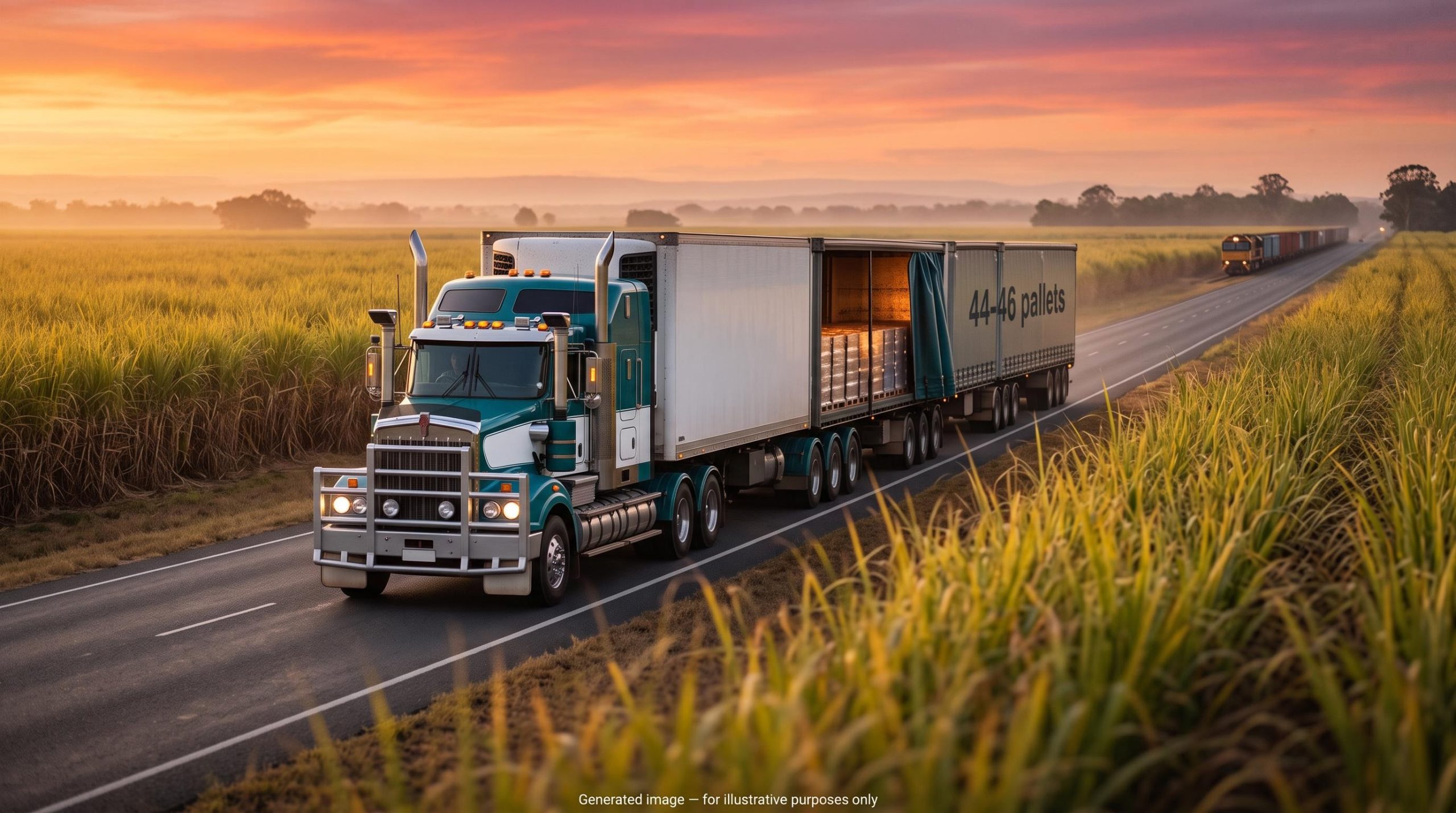
Lindsay Australia (ASX: LAU) passed $1 billion in group revenue for the first time in FY26, reporting $1,072m, up 26.2%. Most people assume a transport company grows by adding trucks. This one grew earnings faster than revenue by getting more out of the trucks, depots and rail assets it already had.
The supporting numbers are just as strong. Underlying EBIT (earnings before interest and tax, adjusted for one-off items) rose 37.7%. Shareholders received 3.8c in fully franked dividends, and net leverage, which measures debt against earnings, came back inside the company’s target range at 1.92x.
All figures come from the company’s AGM address and presentation on 6 November 2026. The question this piece answers is simple: what is driving the growth, and how does it keep going?
You will see how a freight business earns more from assets it already owns. You will also get four questions you can reuse on any ASX transport company.
How does Lindsay Australia (ASX: LAU) move more freight from every truck?
Start with a pallet count. A standard B-Double, the familiar two-trailer truck on Australian highways, carries 34 pallets. A Lindsay High Productivity Vehicle (HPV), a longer combination approved to carry more freight on suitable roads, carries 44 to 46.
| Vehicle | Pallets per trip | Truck | Driver | Uplift |
|---|---|---|---|---|
| Standard B-Double | 34 | One | One | Baseline |
| High Productivity Vehicle | 44-46 | One | One | More than 30% |
Same truck, same driver The company describes the HPV uplift as more than 30% in freight carried per trip.
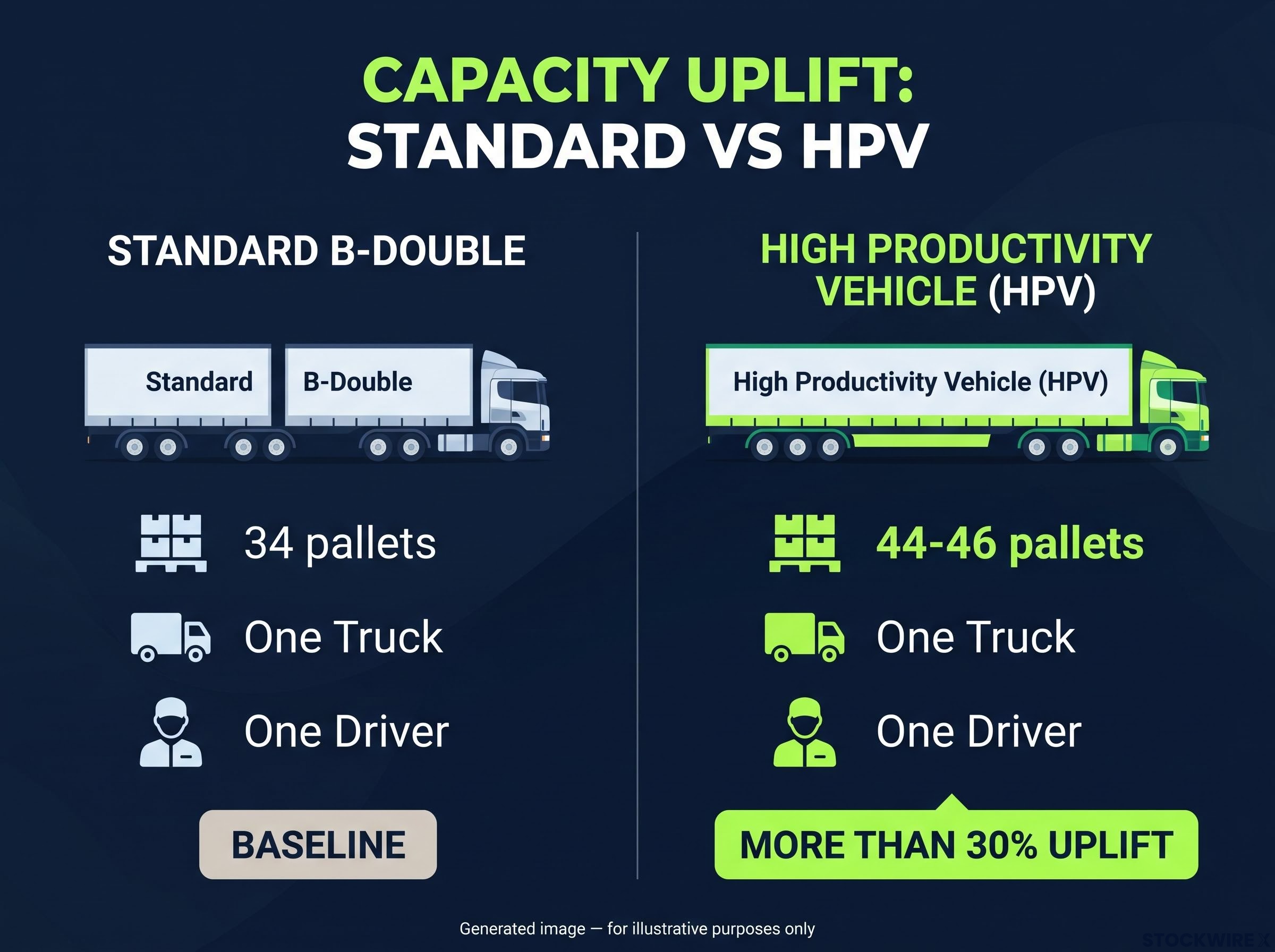
By using High Productivity Vehicles, Lindsay achieves a more than 30% uplift, moving 44-46 pallets instead of the baseline 34 pallets per trip.
Ten or twelve extra pallets sounds modest. Repeat it on every run, every week, and the same fuel, driver hours and truck now earn more per trip.
Lindsay added 25 HPV combinations in FY26, and HPVs now cover more than 13% of its road kilometres. The National Heavy Vehicle Regulator (NHVR) reports that Performance Based Standards (PBS) combinations, the national scheme behind vehicles like these, improve productivity by 15-30%.
The fleet got safer as it grew. The Lost Time Injury Frequency Rate (LTIFR), which counts injuries causing time off work per million hours worked, fell 34% to 10.9.
For you, rising freight per truck is the first thing to look for in a transport earnings story. It means revenue can grow faster than the cost of the fleet and drivers behind it.
When big ASX news breaks, our subscribers know first
What does a finished network mean for earnings?
Bigger trucks need somewhere to load and unload. That is where five years of spending comes in.
The five-year build
Over five years, Lindsay invested more than $250 million in its network:
- Fleet upgrades, including HPV combinations
- Property and depots across its operating regions
- More than $90 million in long-life rail assets
That spending phase has eased. FY26 capex (capital expenditure, money spent on long-term assets) came in at $40.5m, the low end of guidance.
Perth and Adelaide ready for HPVs
The Perth upgrade is finished, adding East-West capacity and access to Southwest WA. The Adelaide site has been expanded. Both can now receive and dispatch HPVs, which also gives the network a road option when East-West rail is disrupted.
Management describes the investment cycle as complete for the medium term. According to the AGM material, the focus is moving from building the network to “extracting value from it”, with growth coming from incremental volume over capacity already paid for.
Here is why that matters to you. When the depots and rail assets are already funded, each extra load fills space that costs little more to use. Future growth leans less on big new spending, so more of each extra dollar of revenue can reach earnings.
Your read on the growth story is stronger when you see how management framed the pivot from network construction to returns, and Lindsay’s FY26 full year results show how the company positioned itself as smaller operators face rising cost pressure.
How did SRT Logistics, Tasmania and Rural widen the base?
A finished network is only as useful as the freight flowing through it. Lindsay widened that flow through an acquisition, a new region and a stronger Rural business.
SRT and Tasmania
Management describes the SRT Logistics integration as “fundamentally complete”. EPS (earnings per share) accretion targets were delivered, $1.5m of cost synergies were realised and $5m of capital was redeployed.
SRT also brought Tasmania, now 19% of transport revenue. The company says this improves geographic balance and reduces seasonality, meaning produce freight is spread more evenly through the year rather than peaking with one region’s harvest.
The transport division posted revenue of $763m, up 32.9%, and EBIT of $77.4m, up 25.9%.
Paddock to Port
Lindsay’s Paddock to Port offer links transport, Rural supplies and packaging. A grower can source inputs, pack produce and ship it through one provider.
| Division | FY26 revenue | Revenue change | FY26 EBIT | EBIT change |
|---|---|---|---|---|
| Transport | $763M | +32.9% | $77.4M | +25.9% |
| Rural | $190.8M | +15.3% | $12.2M | +22.8% |
| W.B. Hunter | $118.9M | +7.9% | $3.2M | +11.3% |
Rural lifted its margin from 6.0% to 6.4% and expanded into Southwest WA. W.B. Hunter’s new ERP (enterprise resource planning, the software running its core operations) went live in Q1 FY27.
Management says the organic growth pipeline remains very active as manufacturers and growers streamline and consolidate their supply chains.
For you, spread-out regions and linked services mean steadier freight demand across the year. That steadiness is what supports reliable earnings growth.
Four questions to ask of any ASX transport company
You can run the same test on any transport company’s results. Here is how Lindsay answers each question:
- Is freight per truck rising? Yes, HPVs carry 44 to 46 pallets against 34, and cover more than 13% of road kilometres.
- Can the network handle larger vehicles? Yes, Perth and Adelaide can both receive and dispatch HPVs.
- Is the major investment cycle finished? Yes, management describes it as complete for the medium term.
- Is growth coming from filling capacity already owned? Yes, management points to incremental volume over capacity already paid for.
When you read the next set of transport results, these four questions show you whether growth is coming from productivity or from spending.
Primary Connect: how contracted growth extends the model into Far North Queensland
The next stage of growth is already signed.
What the contract covers
- A 5-year Primary Connect contract to service 40 Woolworths stores from Mackay to Cairns
- New Townsville and Cairns sites being built at returns above the 15% ROIC (return on invested capital) hurdle
- Mackay, Bowen and Townsville deliveries underway
- Cairns secondary freight starting February 2027
- FY27 capex of about $57m, including $20m of contracted Primary Connect growth capital
The contract is signed and rolling out. Each new store route adds committed volume to a network built to carry it.
For you, that changes the character of the growth story. Contracted volume means the next stage rests on signed work rather than hoped-for demand.
Milestones to watch as Lindsay Australia enters FY27
Lindsay Australia heads into FY27 with record earnings, a network built and growth already contracted. The company has set out a clear sequence of milestones:
- February 2027: Cairns secondary freight begins
- July 2027: final Big W volumes arrive, completing implementation
- New Townsville and Cairns sites under construction, expected by the company to return above the 15% ROIC hurdle
- About $57m of FY27 capex, including $20m of contracted Primary Connect growth capital
- 30 June 2027: net leverage targeted at about 1.8x
Each milestone builds on the model you have just read about: more freight per truck, through a network already paid for, with signed volume filling it.
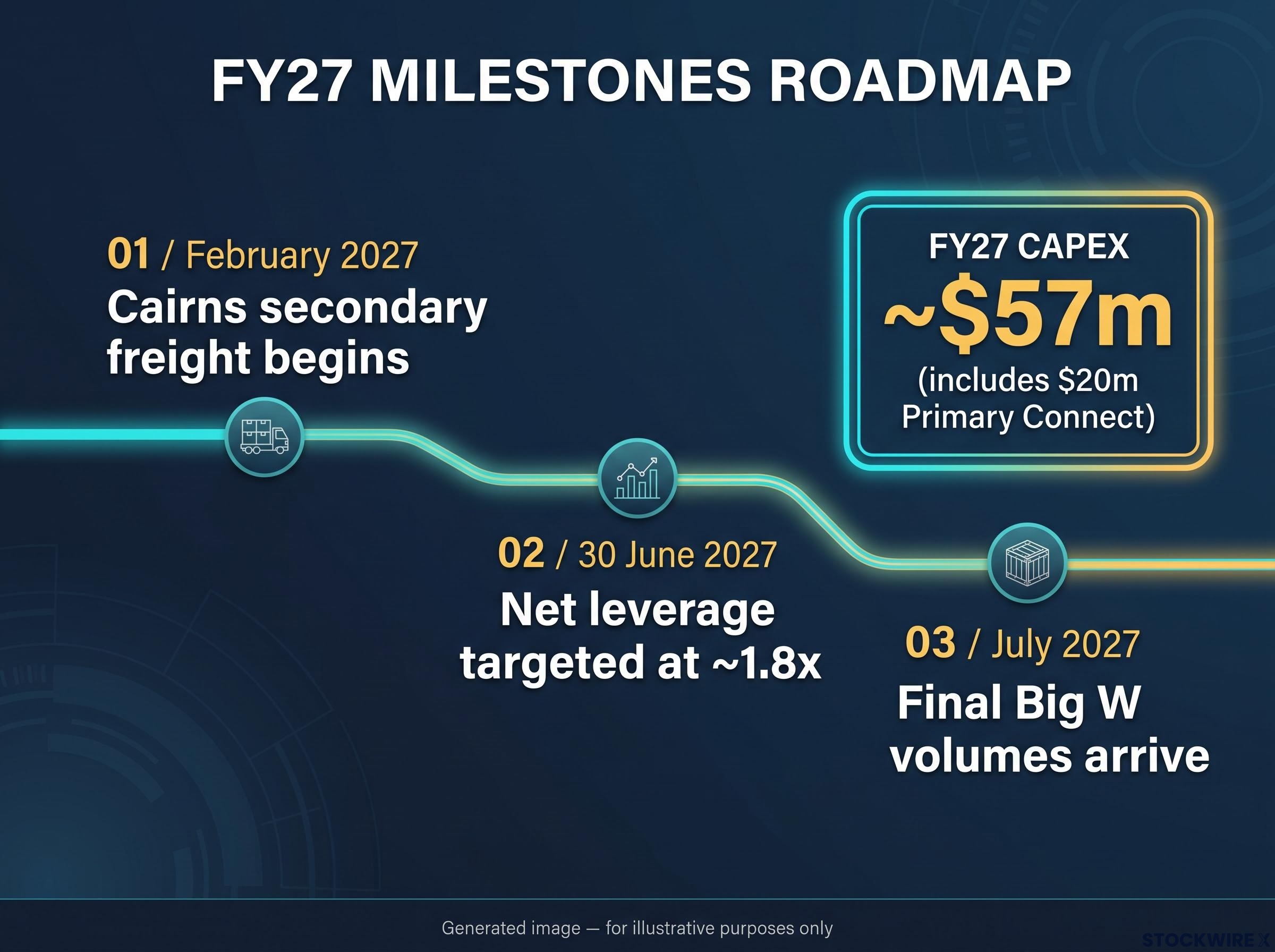
Key upcoming targets include starting Cairns secondary freight in February 2027 and achieving net leverage of ~1.8x by 30 June 2027.
Lindsay Australia (ASX: LAU) enters its next phase with the network built and growth already contracted.
This article is for informational purposes only and should not be considered financial advice. Investors should conduct their own research and consult with financial professionals before making investment decisions.
Disclosure: Lindsay Australia (ASX: LAU) is a commercial client of StockWire X. It did not commission this article.