
Lindsay Australia delivers record revenue as FY26 network build nears completion
In its FY26 full-year results presentation, Lindsay Australia (ASX: LAU) detailed a record revenue result for the financial year ended 30 June 2026, with the diversified transport and rural services group reporting $1,072.7m in revenue, up 26.2% on the prior corresponding period.
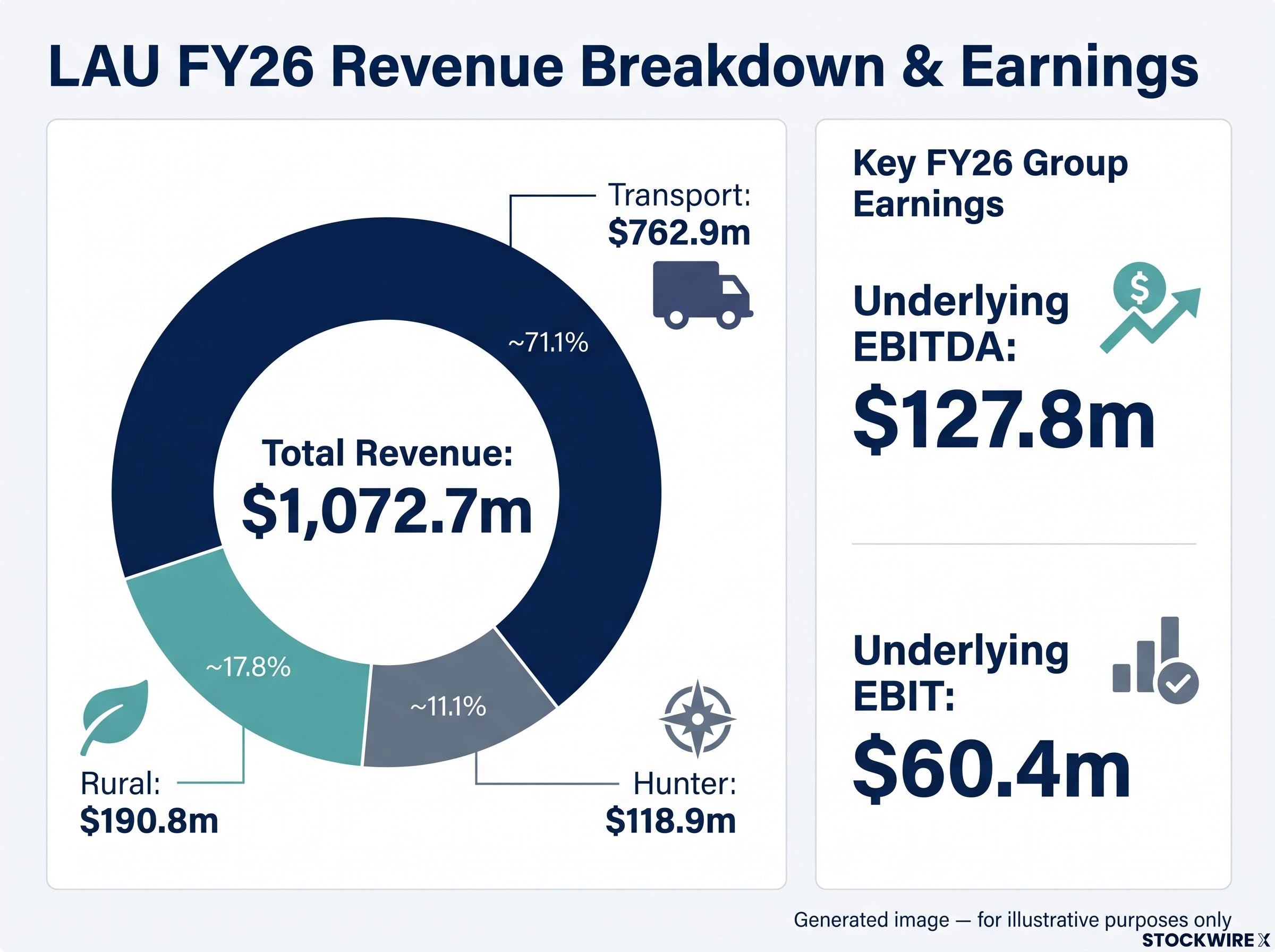
Management outlined a business at an inflection point. Underlying EBITDA reached $127.8m (+25.6%) and underlying EBIT climbed to $60.4m (+37.7%), as the company’s multi-year national network investment phase nears completion.
The strategic message from the presentation was clear: with the network largely built, the focus now shifts from construction to extracting yield and lifting returns across a national logistics footprint spanning road, rail and sea.
When big ASX news breaks, our subscribers know first
FY26 financial highlights: earnings growth as the national network expands
The result set reflected both the full-year contribution of the SRT acquisition and organic gains across the group’s operations. The following table summarises the key group metrics presented.
| Metric | FY26 | Change on PCP |
|---|---|---|
| Revenue | $1,072.7m | +26.2% |
| Underlying EBITDA | $127.8m | +25.6% |
| Underlying EBIT | $60.4m | +37.7% |
| Underlying NPAT | $27.6m | +27.1% |
| Reported NPAT | $22.9m | +31.5% |
| Underlying EPS | 7.6c | +10.0% |
Supporting metrics from the presentation included:
- Full-year dividend of 3.8c fully franked, in line with FY25
- 13.9% ROIC, compared with 14.3% in the prior year
- 1.92x net leverage, within the group’s target range of 1.0x to 2.0x
- LTIFR of 10.9, a 34.0% safety improvement on the prior period
The presentation noted that earnings growth was driven by the first full-year contribution from the SRT acquisition alongside organic gains across the divisions.
Divisional performance: transport leads a broad-based result
Management detailed a broad-based result across the group’s three operating divisions, with transport delivering the largest contribution.
| Division | Revenue | Underlying EBIT | Change | Key driver |
|---|---|---|---|---|
| Transport | $762.9m (+32.9%) | $77.4m | +25.9% | Full 12 months of SRT; Tasmania now 19% of transport revenue |
| Rural | $190.8m (+15.3%) | $12.2m | +22.8% | Cartons, fertilisers, nutrients; margin 6.0% to 6.4% |
| Hunter | $118.9m (+7.9%) | $3.2m | +11.3% | Turnaround gaining traction; earnings growing faster than revenue |
Within transport, the presentation highlighted the continued High Productivity Vehicle (HPV) transition, with 25 additional HPV combinations added during the year. HPVs now account for over 13% of road kilometres travelled, lifting utilisation across the fleet.
Management also detailed a new five-year rail services contract signed with Pacific National, securing long-term linehaul capacity on core corridors. The company noted that diversification across services and geography is reducing seasonal reliance on horticulture, with less-seasonal dairy and protein categories continuing to grow.
Understanding the “invest through the cycle” strategy
A central theme of the presentation was Lindsay Australia’s counter-cyclical approach to capital deployment. In plain terms, the company has directed investment toward its network and fleet ahead of an anticipated industry shakeout, positioning to capture share as smaller operators exit.
The presentation framed the industry backdrop as one where road freight oversupply is meeting a rising cost floor, described by management as the same setup that preceded the last industry consolidation. Supporting data points included:
- Road transport insolvencies reached 521 in 2026, 5.3x the 2022 level, representing a 51% compound annual growth rate
- New heavy-duty truck sales fell 12.4% in 2026, the softest reading since 2022
- Invested capital has grown to approximately $400m, up from $199m in FY20
Why does this matter to investors? As smaller operators exit under cost pressure, scale operators with capital already deployed are positioned to capture share. Management reaffirmed a medium-term ROIC target of 15% to 20%, noting the company enters the downturn with its network built, three transport modes, a young fleet and capital already deployed.
Secondary freight: a new position in a ~$3bn market
The presentation framed secondary freight as growth optionality unlocked through the SRT integration. Management detailed the group’s first scale position in a market it estimates at approximately $3bn, currently serving under 1% today.
Contract highlights outlined in the presentation included:
- Revenue of $30m to $36m per annum
- ROIC of 15%+, above the internal hurdle
- $20m of dedicated capital expenditure
- A five-year contract term across 4 sites, including two greenfield locations
- A staggered rollout beginning October 2026
On the SRT integration, the presentation noted $5m of capital redeployed, $1.5m of cost synergies realised, and EPS accretion delivered. The company estimates its total addressable market across the group at approximately $19bn, with secondary freight adding a new pool alongside the markets it already leads.
Cash, capital and dividends
The presentation detailed strengthening cash generation as elevated tax payments unwind and capital intensity eases. Key points included:
- Operating cash flow of $75.2m, a 61% conversion of reported EBITDA (74% normalised for prior-period tax timing, above the five-year average of 70%)
- FY26 free cash flow of $11.8m after a $16.4m prior-period tax unwind, with approximately $16.9m still to unwind
- FY26 capital expenditure of approximately $40m, at the lower end of guidance, with major network and rail investment now complete for the medium term
- A final dividend of 1.7c fully franked, taking the full year to 3.8c, at a payout ratio of 60.7%, with a franking balance of $44.2m
Management noted that dividends remain the primary form of capital return under the group’s capital allocation framework.
Strategic positioning
“Scale, diversification and modal flexibility across road, rail and sea position Lindsay to remain resilient through the cycle and capture share, as rising industry costs accelerate consolidation toward scale operators.”
FY27 outlook: extracting yield, driving returns
Looking to the year ahead, management outlined a set of priorities focused on transitioning from the build phase to a returns-focused phase. Stated FY27 priorities include:
- Extract yield by lifting EPS and moving ROIC toward the medium-term target range of 15% to 20%
- Grow the primary market through share gains on existing lanes, with continued focus on less-seasonal dairy, protein and grocery categories
- Begin contributing from secondary freight, capturing a partial year in FY27 with the full run-rate targeted from FY28
- Maintain capital discipline, with net leverage targeted at approximately 1.8x by 30 June 2027, which may temporarily exceed the top of the range in the first half due to the timing of PC+ growth capital
On near-term conditions, the presentation noted that refrigerated transport remains competitive with subdued volumes as capacity continues to exit, while rural conditions are broadly favourable. The investment thesis outlined by management centres on the company’s transition from a build phase to a returns-focused phase within a consolidating market.
Don’t Miss the Next ASX Transport and Logistics Winner
Big News Blast delivers FREE breaking ASX news to your inbox within minutes of release, complete with in-depth analysis already done. Join 20,000+ investors staying ahead of the market across transport, logistics, and beyond. Click the “Free Alerts” button at Big News Blast to start receiving alerts the moment market-moving announcements hit the ASX.