
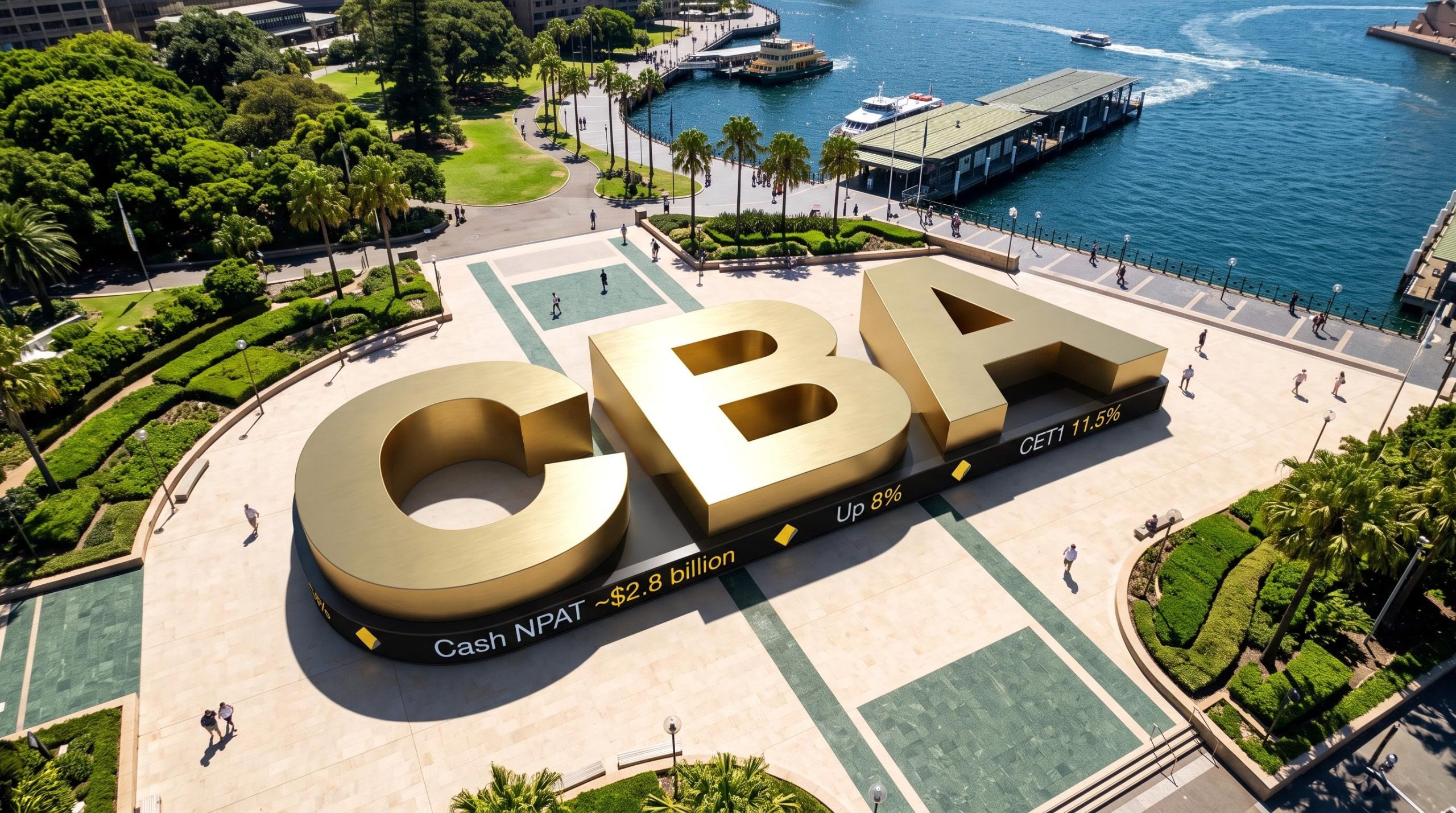
Q1 FY27 results: cash NPAT of ~$2.8 billion, up 8% on the prior comparative quarter
In its 1Q27 trading update for the quarter ended 30 September 2026 (Q1 FY27), Commonwealth Bank of Australia recorded unaudited cash NPAT of ~$2.8 billion, flat on the 2H26 quarterly average and up 8% on the prior comparative quarter. Unaudited statutory NPAT was also ~$2.8 billion.
The quarter follows a record FY26 full year result in August, where management also flagged softer home loan application volumes and a roughly $2.4 billion technology and AI investment commitment for FY27.
Key metrics from the quarter:
- Operating performance up 2% on the 2H26 quarterly average and up 8% on 1Q26
- CET1 (Level 2) ratio of 11.5%
- Deposit funding at 79% of total funding
- The #1 NPS position among major banks across Consumer, Business and Institutional
Chief Executive Officer Matt Comyn said the bank’s focus remained on its customers while delivering sustainable outcomes for shareholders.
Matt Comyn, Chief Executive Officer
“We have continued to execute our strategy with discipline, with a focus on supporting our customers and communities while delivering sustainable outcomes for our shareholders.”
When big ASX news breaks, our subscribers know first
Operating performance: lending and deposit growth drive income
Income and expenses
Operating income rose 3% in the quarter. Net interest income increased 4%, reflecting lending and deposit volume growth and 1.5 additional days, while other operating income fell 5%.
The decline in other operating income was driven by weaker Markets trading income, primarily in Fixed Income and Rates, mainly reflecting the impact of higher yields on bond inventories. Excluding movements in liquid assets, underlying net interest margin was broadly stable.
Operating expenses also rose 3%. The company pointed to wage and IT vendor inflation, 1.5 additional days, and higher cloud computing volumes and software licensing, partly offset by timing of marketing and vendor spend.
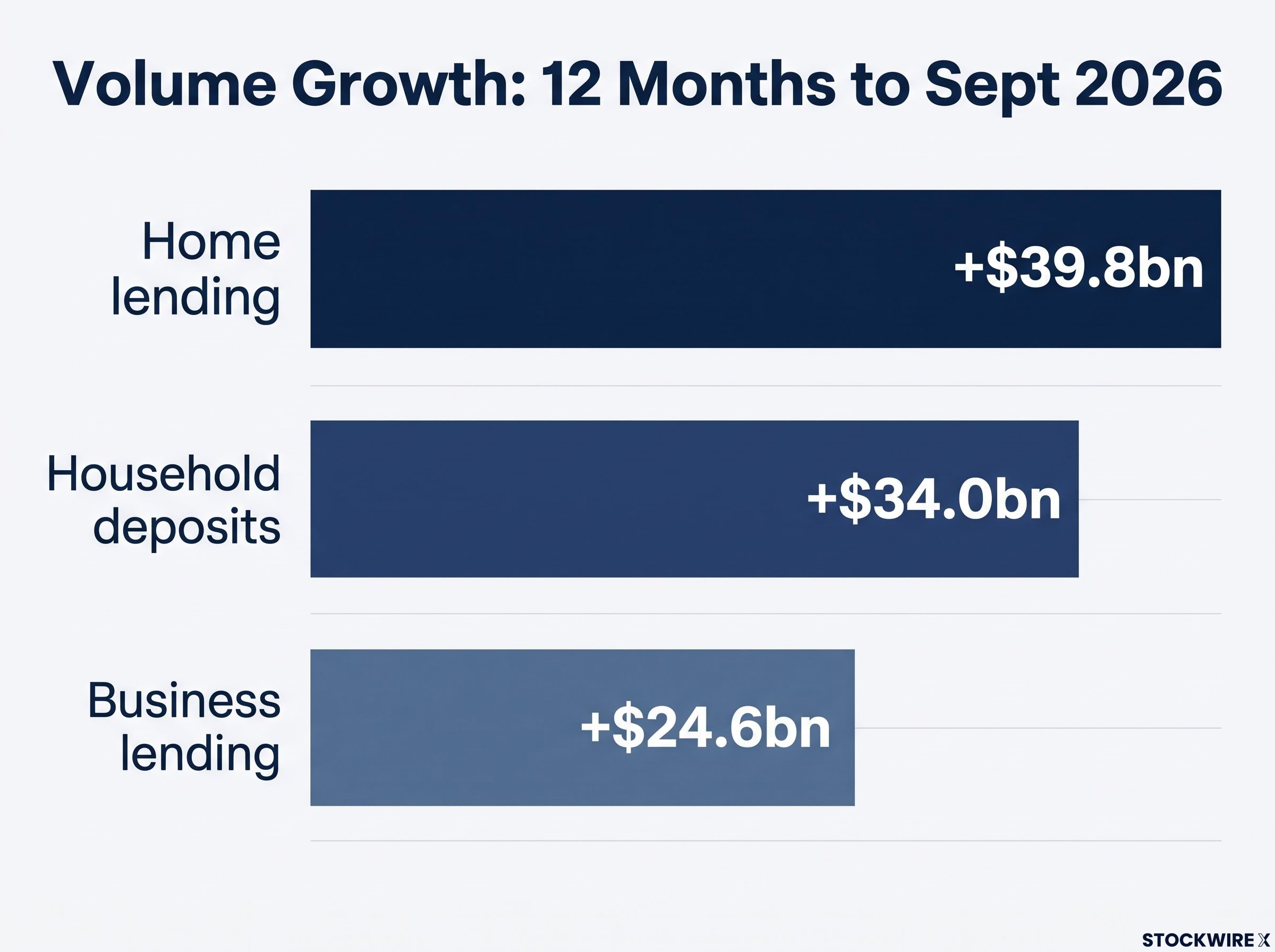
Volume growth, 12 months to September 2026
Business lending, household deposits and home lending all grew over the 12 months to September 2026, with business lending running at 1.3x system.
| Category | Growth | System multiple | Balance growth |
|---|---|---|---|
| Business lending | +$24.6bn | 1.3x | 13.6% |
| Household deposits | +$34.0bn | 1.0x | 7.7% |
| Home lending | +$39.8bn | ~1.1x | 6.6% |
Other volume highlights from the quarter:
- New home loan funding of $44 billion
- Proprietary mix of 62% of new business flows for CBA home loans
- Retail transaction accounts up by more than 135,000
- Business transaction accounts up 6% on the prior comparative period
Credit quality and balance sheet strength
Provisions and credit quality
Credit quality remained sound. Loan impairment expense was $300 million, or 11bpts of average Gross Loans and Acceptances (GLAA), and collective provisions increased by $105 million in the quarter.
Total provisions were flat at $6.5 billion, with collective provision coverage at 1.35% of Credit Risk Weighted Assets.
Home loan arrears rose 7bpts, reflecting cost-of-living pressures from higher inflation and interest rates, with the reported rate also affected by slower resolution following earlier pauses in late-stage collections activity. Personal loan arrears improved by 6bpts, while credit card arrears were flat.
Corporate troublesome and non-performing exposures were slightly higher at $6.9 billion, or 1.00% of Total Committed Exposures.
Funding, liquidity and capital
Funding and liquidity metrics at the end of the quarter:
- Liquidity Coverage Ratio (LCR) of 132% and Net Stable Funding Ratio (NSFR) of 115%, both above the 100% regulatory minimum
- Customer deposits up $59.4 billion since September 2025
- A$14 billion of long-term wholesale funding issued this financial year to date
- Long-term wholesale funding at 67% of total wholesale funding, with a weighted average portfolio tenor of 5.2 years
The CET1 (Level 2) ratio was 11.5% as at 30 September 2026, above APRA’s 10.25% minimum requirement. It rose 36bpts in the quarter after the payment of the $4.5 billion 2H26 dividend (-85bpts) to over 780,000 shareholders.
Cash NPAT added 52bpts and other items 6bpts, while underlying risk weighted assets (RWA) growth subtracted 22bpts.
The bank also completed the purchase of approximately $560 million of shares on market to neutralise the impact of the 2H26 Dividend Reinvestment Plan, reflecting a participation rate of 12.4%.
What CBA’s 1Q27 update means for the investment case
The update combined earnings up 8% on the prior comparative quarter, volume growth across core businesses, and capital, funding and liquidity ratios the company described as well above minimum regulatory requirements.
Management also noted that higher inflation and interest rates continue to place uneven pressure on household incomes and business activity, and that while economic growth is slowing, the Australian economy remains resilient.
Want Alerts Like This on the Financials Stocks You Follow?
StockWire X Market Intelligence scores every announcement in our coverage for how significant it’s likely to be for investors, and which way it points, then alerts you on the stocks you follow. The first 1,000 founding members lock in 50% off for life: A$247 a year instead of the standard A$495. Join the founding waitlist today.