
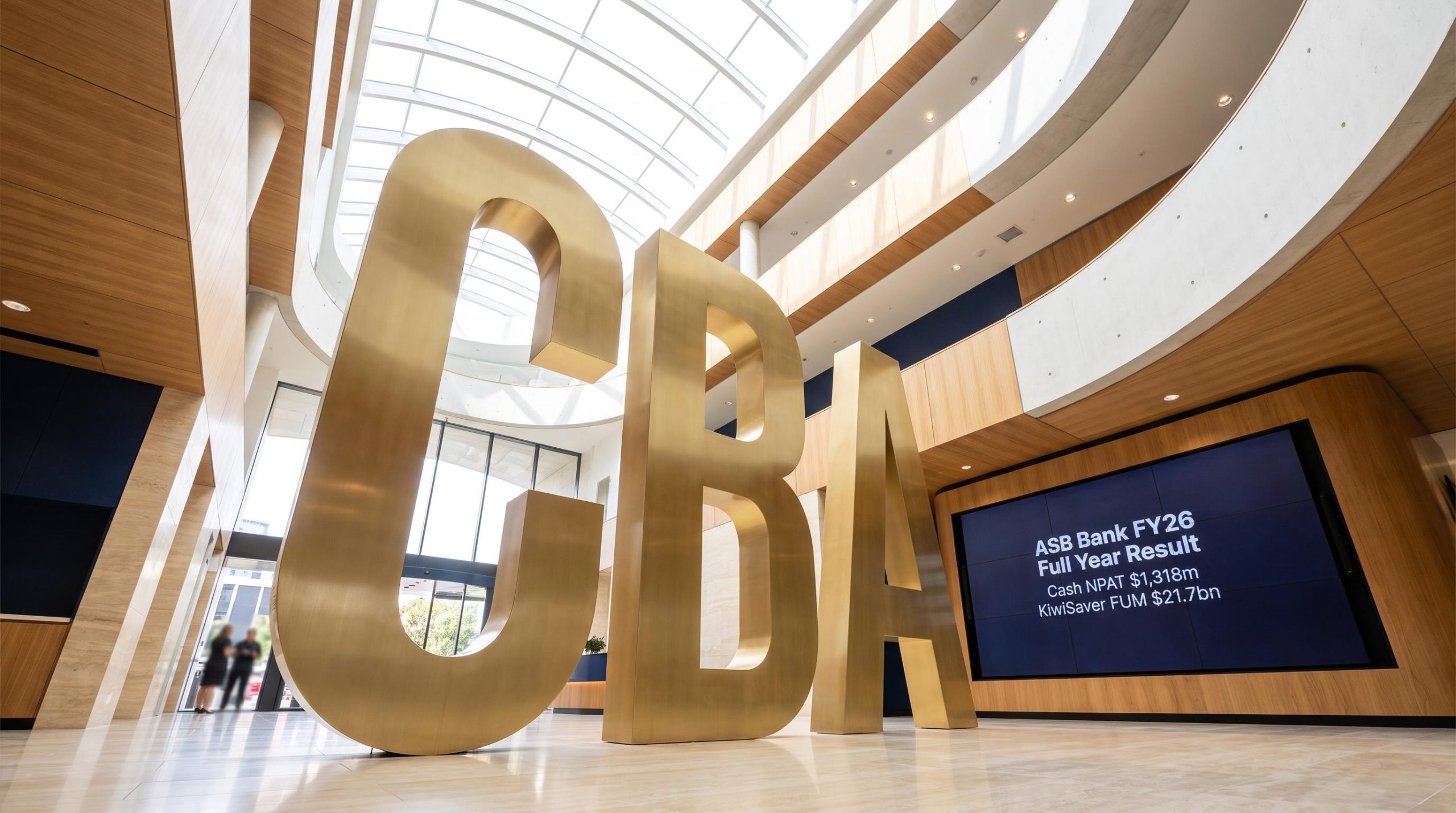
ASB delivers resilient FY26 result as lending momentum holds firm
In its full-year results for the 12 months to 30 June 2026, ASB, the New Zealand banking subsidiary of Commonwealth Bank of Australia, reported a cash net profit after tax (NPAT) of $1,318 million, down 2% year-on-year. Statutory NPAT came in at $1,398 million, down 4%. The result was lodged with the NZX on 12 August 2026.
The modest profit dip sat alongside a broad-based growth story. Home lending, business and rural lending, and customer deposits each grew 6%, while KiwiSaver funds under management (FUM) climbed 15%.
ASB Chief Executive Vittoria Shortt attributed the mixed picture to a stop-start economic recovery. The conflict in the Middle East and a subsequent global oil price shock disrupted the inflation outlook and pushed interest rates up faster than anticipated, changing conditions between the first and second halves of the financial year.
When big ASX news breaks, our subscribers know first
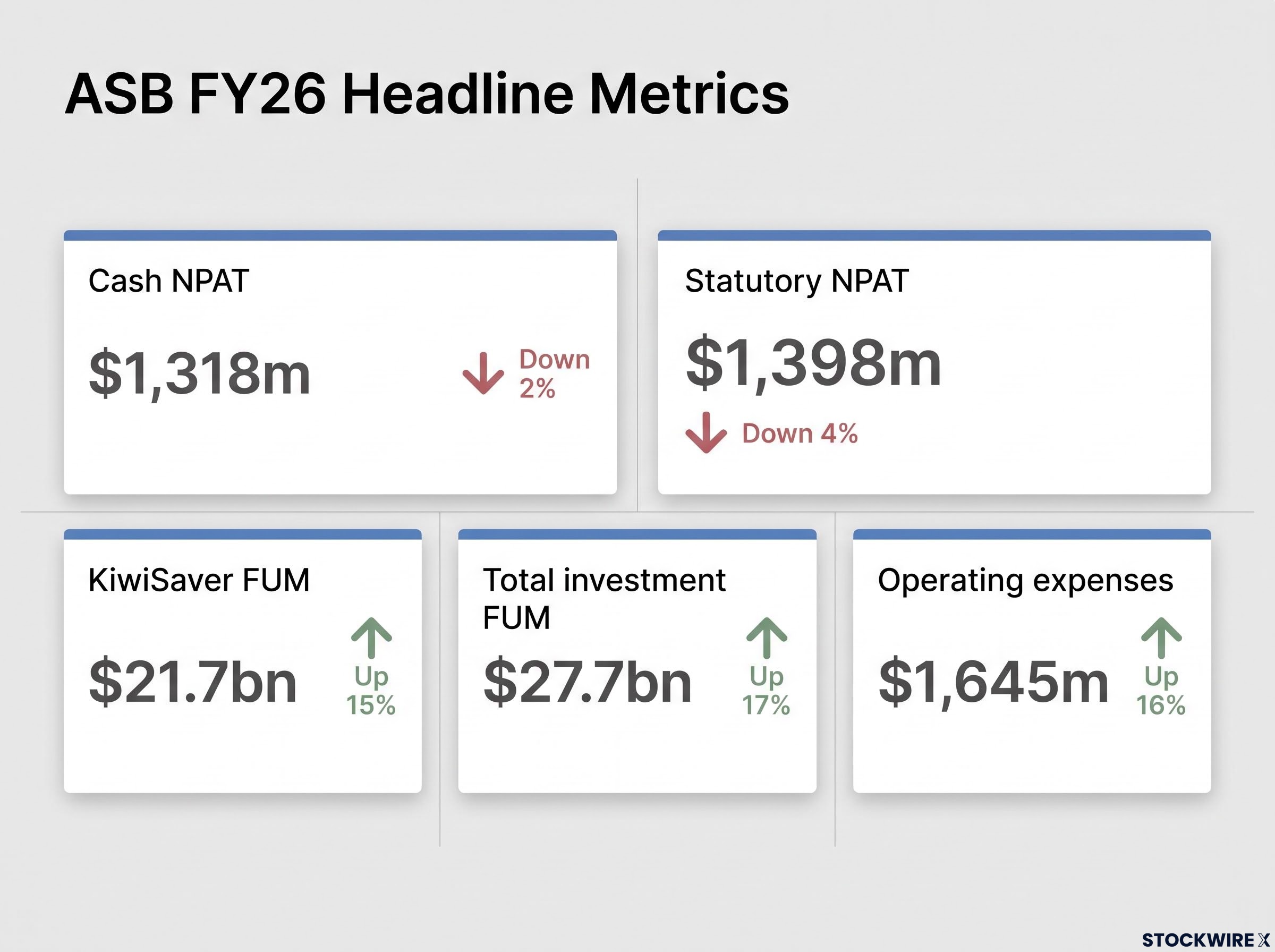
FY26 result at a glance
The table below summarises ASB’s headline metrics for the full-year period.
| Metric | FY26 | Change |
|---|---|---|
| Cash NPAT | $1,318m | Down 2% |
| Statutory NPAT | $1,398m | Down 4% |
| Home lending | — | Up 6% |
| Business & rural lending | — | Up 6% |
| Customer deposits | — | Up 6% |
| KiwiSaver FUM | $21.7bn | Up 15% |
| Total investment FUM | $27.7bn | Up 17% |
| Operating expenses | $1,645m | Up 16% |
Operating expenses rose 16% to $1,645 million. According to ASB, the increase was driven predominantly by three factors:
-
Settlement of the Credit Contracts and Consumer Finance Act 2003 class action proceedings
-
Inflation-driven cost increases
-
Increased hiring to support greater levels of technology investment
Business and rural lending drive the growth story
The standout of the period was ASB’s business banking momentum. The bank recorded its strongest year for business lending growth in almost a decade, providing business and farming customers with around three times as much new lending as the prior year.
ASB Rural grew its agriculture lending market share to 17.7%. In large business lending, ASB outperformed the market, growing its book by $436 million (8.6%) against market growth of 3.4%, based on RBNZ data to 31 March 2026 (June data was not yet available).
ASB Business and Corporate Banking and the CBA New Zealand branch collectively became New Zealand’s second-largest business bank. Farmer-focused initiatives including ASB SMART Solar and Every Hectare Matters continued to gain traction, positioned as a key enabler of the Government’s Land Use Flexibility programme.
CEO Commentary
“We maintained strong momentum in business banking in a very competitive market, recording our strongest year for business lending growth in almost a decade and providing business and farming customers with around three times as much new lending than last year,” said Vittoria Shortt, ASB Chief Executive.
Investing in digital, KiwiSaver and housing
Operational progress in FY26 spanned three main areas: digital customer experience, wealth and KiwiSaver, and housing support.
Faster, simpler customer experiences
More than 350,000 transactions were completed digitally in FY26 that would once have involved a phone call or visit to an advice centre. ASB reported it became the first bank to offer joint home loan applications digitally, removing the need for eligible applicants to meet in person.
The workforce grew by more than 360 FTE (5%) over the year. AI tools such as conversational IVR (Interactive Voice Response) in the Contact Centre helped reduce average call wait times by around 40% compared with FY25.
CBA’s technology leadership restructure, which split the group’s top tech role into dedicated CIO and CTO positions in mid-2026, reflects the same strategic direction ASB is pursuing: separating customer-facing digital delivery from enterprise infrastructure to accelerate AI adoption across the broader group.
KiwiSaver and wealth
ASB was named KiwiSaver Fund Manager of the Year at the 2026 Morningstar Awards for Investing Excellence. Total KiwiSaver FUM reached $21.7 billion, supporting nearly half a million scheme members, while total investment FUM grew 17% to $27.7 billion.
The latest data ranked ASB’s Conservative and Moderate KiwiSaver funds number one in their respective categories for the three years ended 30 June 2026, according to the Morningstar KiwiSaver Survey (June 2026 quarter). Past performance is not an indicator of future performance.
ASB Share Central, a trading platform developed in partnership with CMC Markets, is expected to launch by the end of this year. It will offer access to more than 15 international markets for registered customers.
Supporting housing
ASB committed $430 million to social and affordable housing this year, placing it $200 million ahead of its FY26 target. Key figures included:
-
Support for the construction of close to 1,200 homes
-
$108 million committed to Māori housing providers, helping deliver around 350 homes
-
Expansion of the accelerated housing initiative to $1 billion
Outlook: positioned for FY27 recovery
Shortt expects economic momentum to return in the coming months, while cautioning that uncertainty remains the new norm and that many New Zealanders will continue to face cost pressures.
Looking ahead, ASB is embarking on a programme of work to streamline its practices. This complements work already underway to modernise technology, simplify products and processes, and invest further in financial crime capability, described as building a simpler, more modern bank.
CEO Outlook
“While we expect economic momentum to return in the coming months, uncertainty remains the new norm and we’re cognisant that many New Zealanders will continue to face cost pressures. We’re working closely with customers and are ready to support New Zealand as it puts its foot back on the pedal in FY27,” said Shortt.
Stay Ahead on ASX Finance and Banking News
Get breaking ASX financial sector announcements delivered to your inbox within minutes, complete with in-depth analysis already done for you. Over 20,000+ subscribers rely on Big News Blast for FREE real-time alerts the moment market-moving news hits. Click the “Free Alerts” button to start receiving coverage before the market has a chance to react.