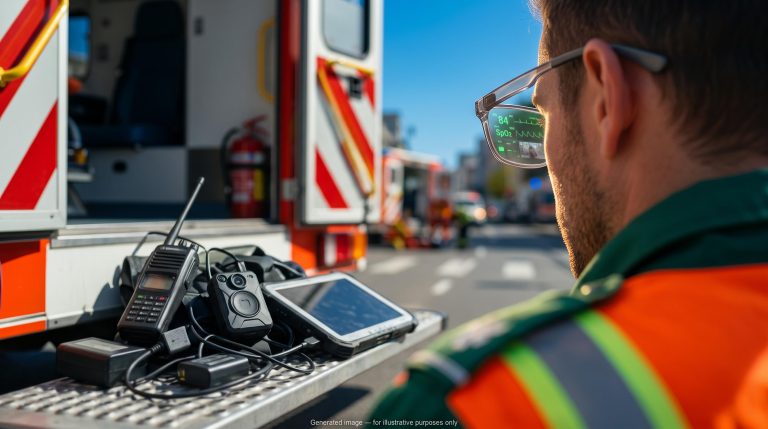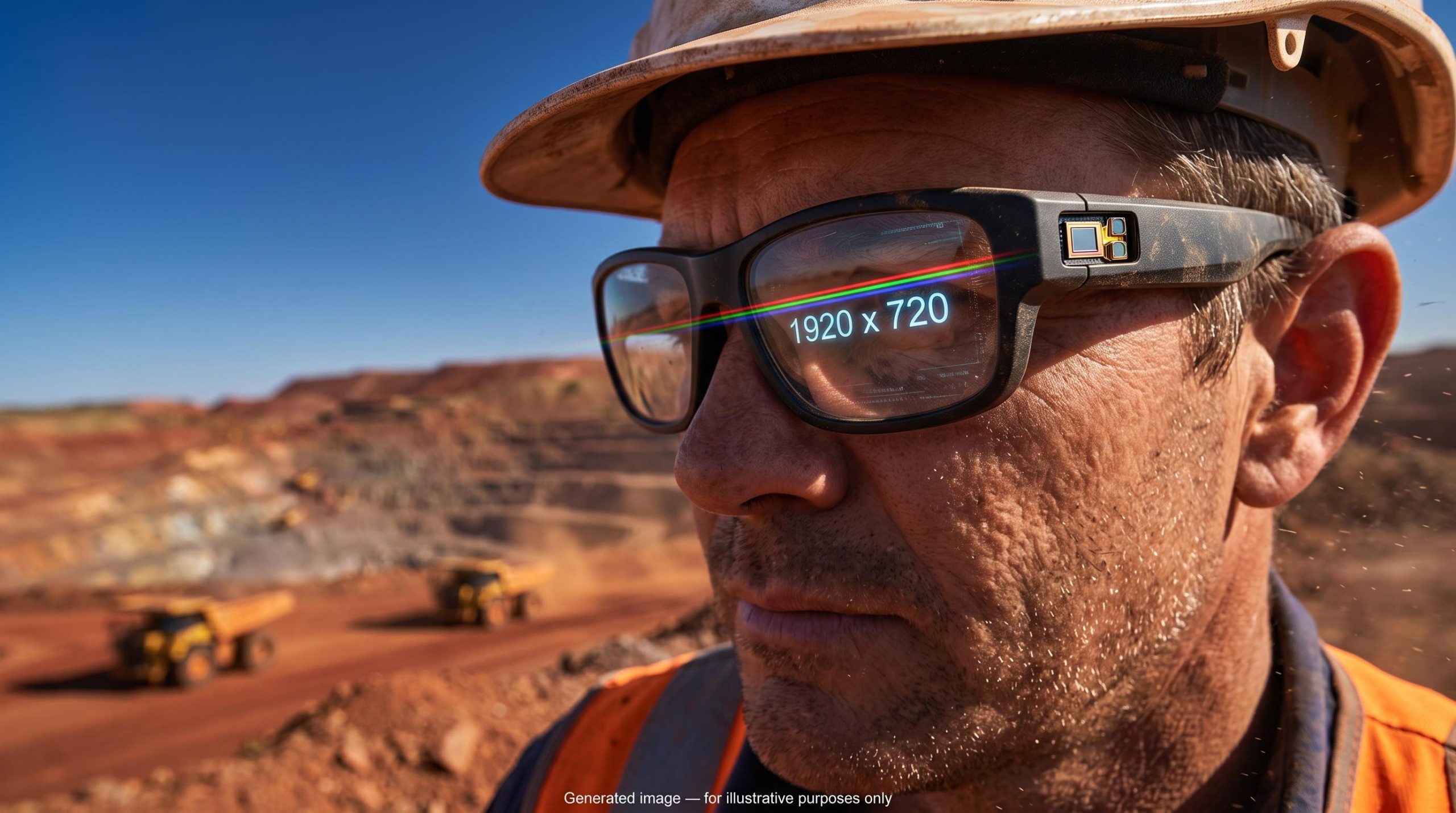
Squinting at a phone screen on a bright beach is a small annoyance. You tilt it, shade it with your hand and get on with your day. Smart glasses face a harder version of the same problem, because their image sits over the real world and has to compete with daylight directly.
Most smart glasses are designed for indoor use, and their displays wash out in bright sun. Frontline work, however, mostly happens outdoors. For a field worker, a display that fades in daylight lets them down at exactly the moment they need it. That is why laser beam scanning smart glasses are drawing attention as one route to sunlight-readable displays.
Here you will learn how a laser draws an image, why that approach suits bright conditions, and four questions you can bring to any ASX smart glasses announcement.
How do smart glasses make an image in the first place?
Most smart glasses use a microdisplay. A microdisplay is a very small screen that lights up an image, which optics then relay to your eye. There are four common types, and each handles light differently.
| Technology | How it works and the outdoor challenge |
|---|---|
| OLED | Each pixel makes its own light and resolution can be high, but it does not reach the brightness needed to compete with direct sunlight. |
| MicroLED | Makes light only where it is needed, but higher resolution needs smaller pixels, which lowers efficiency and brightness. |
| LCoS | A constant backlight shines through a liquid-crystal layer that removes the light it does not need, and the removed light becomes heat. |
| DLP | Also removes unwanted light from a constant source, so it shares the same wasted light and heat as LCoS. |
The table comes from a technical review published by Electronic Design on 29 November 2023. That review sets out the challenge every one of these approaches has to meet.
The outdoor test According to Electronic Design, AR displays need “very bright, high-contrast images” to stay visible against direct sunlight.
So when an announcement mentions an “AR display” without saying how it is built, you now know the first thing to ask. Is it bright enough for daylight?
When big ASX news breaks, our subscribers know first
How does a laser draw an image instead of lighting a screen?
You probably picture a display as a screen that switches on. Laser beam scanning (LBS) works differently. There is no fixed screen to light up at all.
Instead, the image is drawn. It works much like an old cathode-ray television, where a single point traced the picture row by row so quickly that your eye saw a complete frame. The process runs in three steps:
- Combine the colours. Red, green and blue lasers merge into a single beam.
- Sweep the mirror. A MEMS mirror, which is a microscopic mirror built on a chip, moves rapidly to steer the beam. It sweeps horizontally to draw each line, then moves vertically to start the next row.
- Build the image line by line. The beam traces the full picture progressively across your field of view.
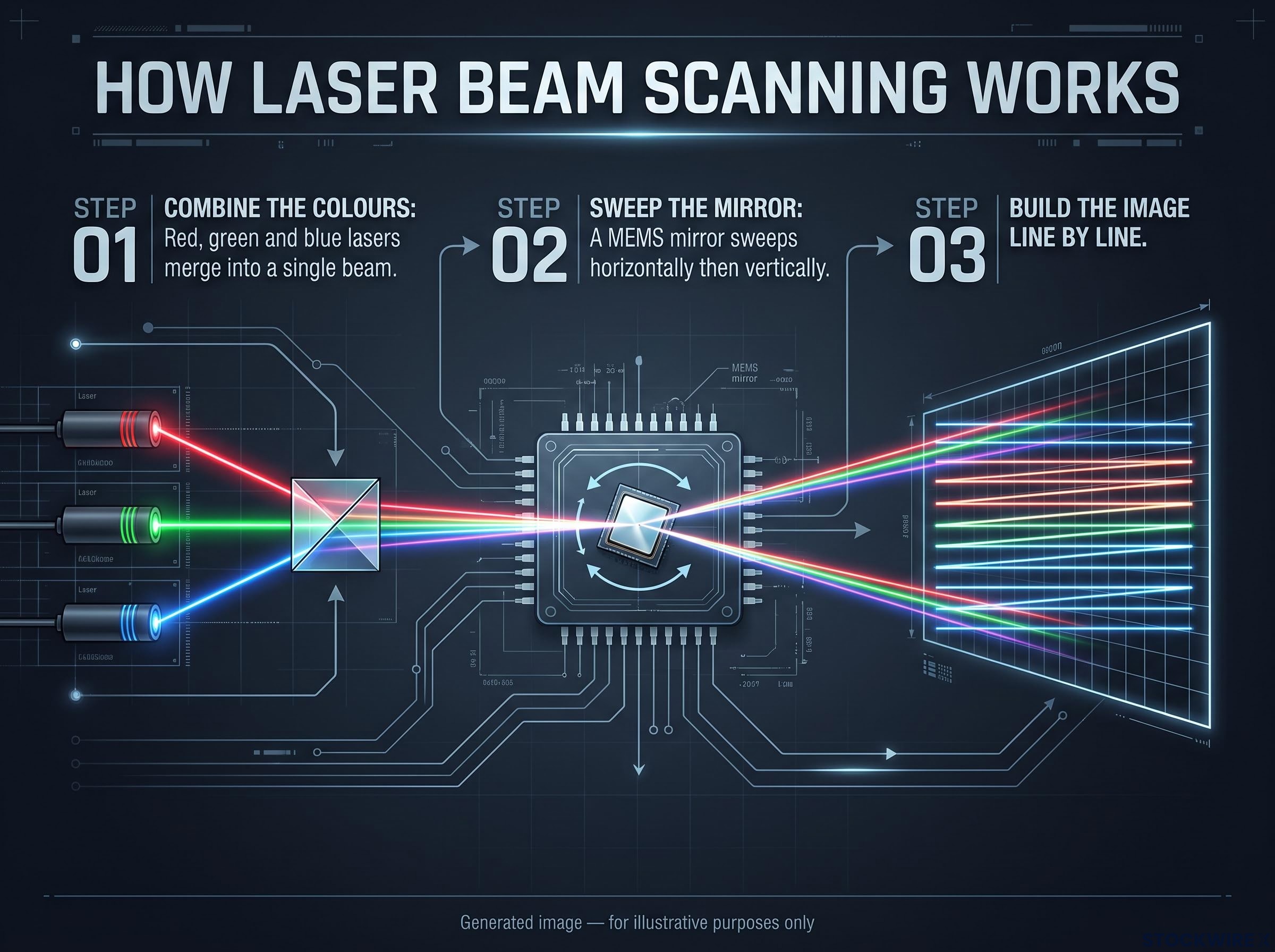
The laser beam scanning process uses three sequential steps to combine red, green and blue lasers and steer the beam with a MEMS mirror.
Electronic Design reports that LBS generates enough brightness for outdoor use with very low power consumption. The reason follows from the mechanism. Laser light is concentrated where the image is being drawn, rather than spent on a backlight that is then partly thrown away.
For a device worn through a full shift, that matters. You can think of it as “drawn light” rather than a “lit screen”, and when a company describes its display this way, you can now recognise why it suits sunlight and battery life.
Four questions to ask of any smart glasses announcement
With the mechanism clear, you can turn it into a simple screening tool. Here are four questions that travel to any company, answered using company-reported information from Energy Technologies (ASX: EGY).
- Is the display built for outdoor conditions? The company states its MEMS laser engine is readable in direct sunlight.
- Does the company own the core display technology? The company reports that its subsidiary Cogenic holds the Maradin portfolio of 14 global patents and designs a proprietary custom MEMS chip.
- Has the technology been licensed for demanding programmes? The company reports that Amalgamated Vision is using it under a five-year licence for heads-up display solutions in AFWERX and NASA projects.
- Is it heading into field use? The company reports a ten-unit field-operational proof of concept is under way with Synch.
Keep this list handy. The next time an ASX release mentions smart glasses, you can see quickly how it measures up against the same standard.
Ownership matters because the Maradin patent portfolio came with the development team attached, so Cogenic took on working laser scanning knowledge rather than a bare set of filings, and funded the purchase without an equity raise.
Energy Technologies and Cogenic: the technology line from acquisition to field program
Energy Technologies is a Brookvale, New South Wales company established in 1983. Its wholly owned subsidiary, Cogenic Pty Ltd, develops laser optical engineering technology.
Cogenic runs a fabless model, meaning it keeps design and intellectual property in-house but uses external partners for mass production. According to the company, its technology includes a proprietary custom MEMS chip. The company has also built its progress in a clear, dated sequence:
| Date | Step | What it covers |
|---|---|---|
| March 2026 | Maradin IP acquired | 14 global patents in laser beam scanning, with the development team retained |
| July 2026 | Amalgamated Vision licence | Five-year Master Licence Agreement with a 5% royalty |
| 21 October 2026 | Synch Heads of Agreement | Binding agreement for a ten-unit field-operational proof of concept |
StockWire X covered the Maradin acquisition on 22 March 2026. Under the licence covered on 23 July 2026, the AFWERX and NASA projects are Amalgamated Vision’s development projects using Cogenic’s technology. The Synch agreement, covered on 21 October 2026, includes a framework for purchase orders of up to US$10 million after acceptance, a ceiling with no minimum beyond the proof-of-concept payments.
In its 22 October 2026 investor presentation, the company reported these display specifications:
- 1920 x 720 resolution
- 50 x 30 degree field of view
- 70Hz refresh rate
The company describes the engine as light, low power and readable in direct sunlight. It is also positioning the display within a broader multi-function wearable story.
The Amalgamated Vision licence also shows how the technology can reach defence buyers: Cogenic earns a royalty on gross sales, and the first stated target is military-grade heads-up displays.
Read against the four questions, the order is plain: owned technology, then a licensed pathway, then a field programme.
Milestones to watch as Cogenic’s display moves into field use
In seven months, Cogenic has taken a laser display patent portfolio into a licensed defence and aerospace pathway and a field-operational smart glasses programme.
The company has announced these next steps under the Synch agreement:
- Master Agreement: execution targeted within 60 days of the 20 October 2026 Effective Date.
- Unit delivery: ten field-operational units targeted within six months of the Effective Date.
- Acceptance: proof-of-concept acceptance under the agreed testing criteria.
- Purchase orders: orders placed under the framework.
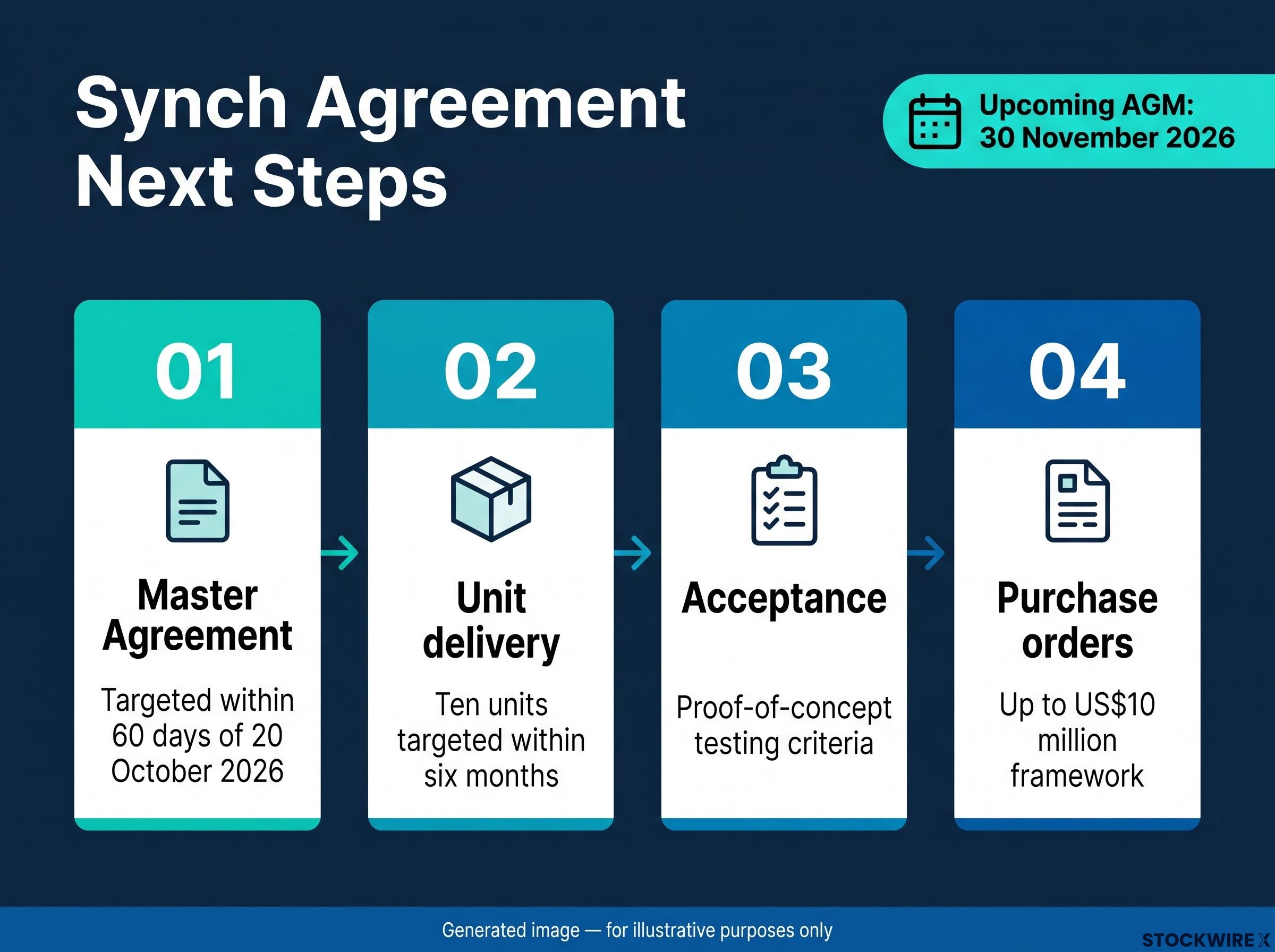
The agreement includes a Master Agreement within 60 days of 20 October 2026, Ten units within six months, and a framework of Up to US$10 million.
Energy Technologies will also hold its Annual General Meeting on 30 November 2026, with the notice released on 30 October 2026. Each step gives you a dated marker to match against company releases as they arrive, as Energy Technologies moves its display technology into field use.
Where the display story goes next
Outdoor readability is the test any smart glasses display has to pass, and laser scanning is one answer to it. The four questions apply to any company making the same claim.
This article is for informational purposes only and should not be considered financial advice. Investors should conduct their own research and consult with financial professionals before making investment decisions.
Disclosure: Energy Technologies (ASX: EGY) is a commercial client of StockWire X. It did not commission this article.