The US dollar has stopped falling just as the October CPI report arrives at 8:30 a.m. ET today, 10 November 2026. Futures markets already price roughly 84-85% odds that the Federal Reserve hikes rates in December. That pricing could make a 0.2% core inflation print far less market-moving than it looks on paper.
The USD Index fell more than 0.5% on Monday and is now consolidating beneath 102.00, while gold holds above $4,100. The actual CPI figures had not been published at the time of writing, so every level below reflects pre-release pricing.
Here is the consensus forecast, the scenarios banks are flagging for a soft or hot core reading, and a simple way to read the release yourself.
Why a 0.2% core print may not be the easy dollar trade
Forecasters expect a calmer month than September:
- Headline CPI: consensus +0.3% month-on-month, MUFG forecast +0.29%, September +0.6%
- Core CPI: consensus +0.2%, MUFG forecast +0.23%, September +0.3%
Monthly changes carry the whole story this time. According to Reuters, the 2025 government shutdown stopped the collection of October 2025 price data, so no official year-on-year October figures will be published.
The bigger tension sits in what the market has already priced. CME FedWatch shows 84.4% odds of a December hike to 4.00%-4.25%, against 15.6% for a hold. MUFG puts that at roughly 20 basis points of tightening, where one basis point is one-hundredth of a percentage point.
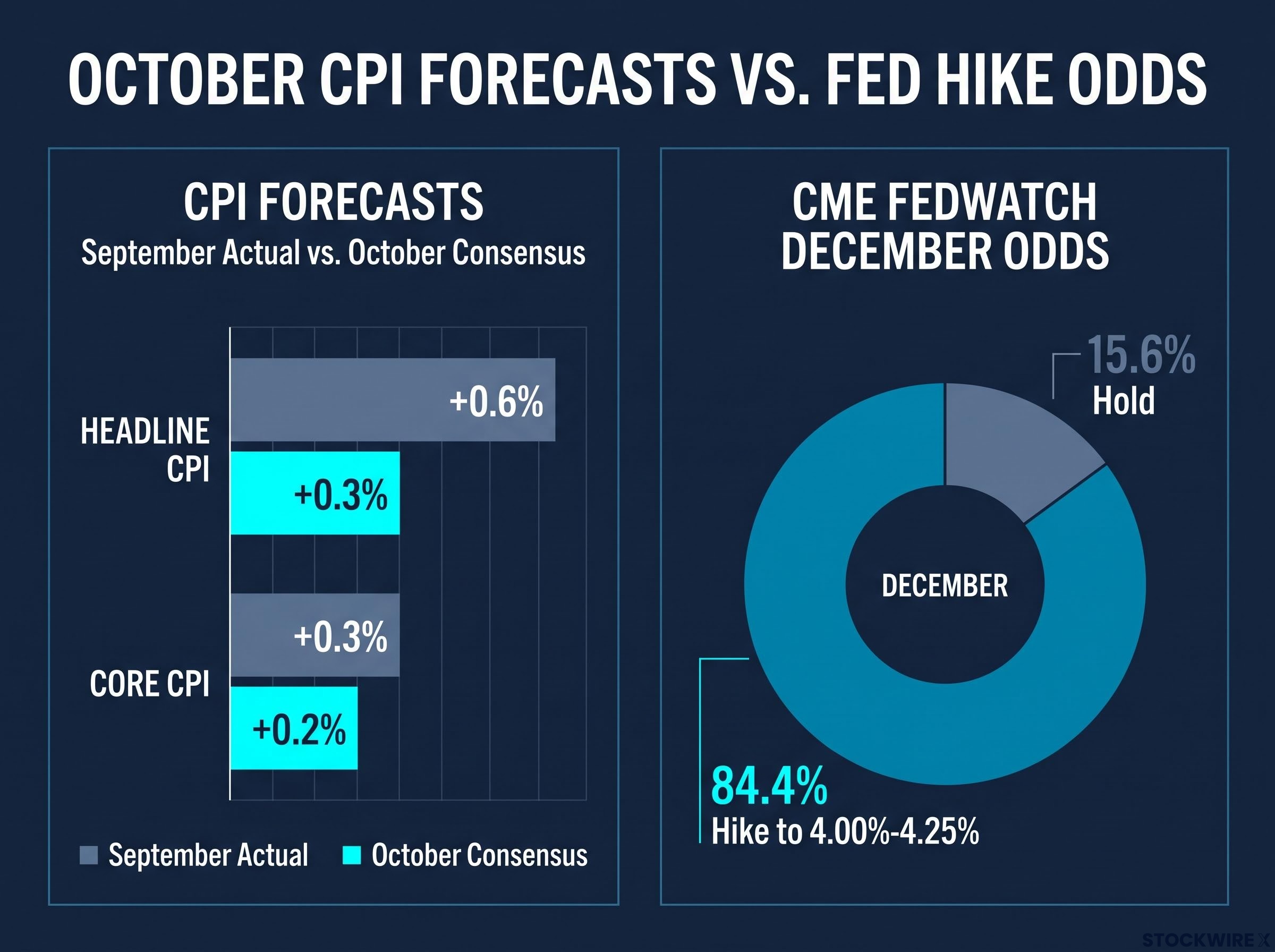
The October consensus for Headline CPI is +0.3%, compared to September’s +0.6%, alongside an 84.4% probability for a December rate hike.
Meanwhile, the dollar has been losing ground across the board this week.
| USD versus | Week-to-date change |
|---|---|
| EUR | -0.80% |
| GBP | -0.76% |
| JPY | -0.27% |
| AUD | -0.78% |
| NZD | -1.30% (weakest) |
| CAD | -0.06% |
| CHF | -0.14% |
The speaker calendar adds further risk. Fed Governor Christopher Waller is scheduled to speak, MarketWatch also lists Chicago Fed President Austan Goolsbee, and Bank of England Governor Andrew Bailey is on the calendar. The original source said ECB officials were also due to speak, although the ECB’s own calendar appears to show only an Economic Bulletin pre-release.
What the banks say a hot or soft core means
MUFG argues that a 0.2% core reading would restrain the dollar’s upside. In its view, only a materially hotter number would push expectations towards further tightening in 2027. The bank also says the Fed will watch for energy costs spilling into other prices.
The Federal Reserve FOMC statements remain the primary channel for policy signalling, and the committee’s wording on inflation and activity will shape how officials interpret any soft or hot core reading ahead of the December meeting.
Westpac’s Imre Speizer says a hot print could add little to December pricing but could lift expectations for later meetings. At Macquarie, Thierry Wizman and Gareth Berry warn that a Democratic congressional sweep and weaker 2027 growth could eventually cap the dollar.
The broad read is this: a core reading near 0.2% eases pressure on yields and the dollar, while 0.3% or higher reinforces the December hike and supports the greenback. For you, the number that matters is the size of the surprise, not the print itself.
How EUR/USD, GBP/USD, USD/JPY, AUD/USD and gold are positioned going in
| Asset | Level | Recent move | Key driver |
|---|---|---|---|
| EUR/USD | ~1.1220 | +0.7% Monday, sideways Tuesday | Broad dollar weakness |
| GBP/USD | ~1.3441-1.3450 | +0.7% Monday | The Bank of England’s recent hike |
| USD/JPY | ~158.00 | About -0.3% Monday | Intervention risk |
| AUD/USD | ~0.6918-0.6920 | Nearly +1% through Monday | China’s exports +35.2%, imports +41.6%, surplus $105.28B (from $133.53B) |
| Gold | $4,140 Monday close | Up nearly 1.75% | Lower oil, lower yields, softer dollar |
Two of these markets have the clearest tripwires.
Yen: the 158 line
Traders treat 158.00-158.50 as Japan’s intervention corridor, the range where Tokyo has stepped in to buy yen. According to Reuters, Japan sold about $97 billion of reserves through late July and August, and MUFG judges that 160 will be hard to break. Bank of Japan Chief Economist Seisaku Kameda has signalled that a December hike is plausible.
The counter-view is that while US yields stay above Japan’s, intervention only slows the yen’s weakness rather than reversing it. A hot core reading would test that line first.
Gold: $4,150 and $4,000
Bloomberg links gold’s strength to oil falling on hopes of diplomatic progress in the Middle East. OANDA notes that the 10-year Treasury yield has slipped below 5%. FXStreet flags $4,150 as resistance and sees a hot core reading sending gold back towards $4,000.
FXStreet’s framing: the CPI result is the deciding catalyst for whether gold’s recovery can hold.
Veterans Day on 11 November thins liquidity, and FXStreet warns this may exaggerate the first move, so expect early noise.
Why inflation data moves currencies and gold: a quick guide to reading the print
Every CPI release comes down to one question: does it raise or lower the expected path of US interest rates?
Headline CPI tracks price changes across a basket of goods and services. Core CPI strips out volatile food and fuel. Central banks target about 2% inflation and watch core most closely, because it tends to persist.
The chain for the dollar runs in five steps:
- Hotter CPI raises the odds of a Fed hold or hike.
- Expected short-term rates and Treasury yields rise.
- The US rate advantage over the euro, pound, yen and Australian dollar widens.
- Capital flows towards higher US yields.
- The dollar tends to strengthen, and a soft print reverses the chain.
Gold reacts through two channels:
- Opportunity cost: gold pays no interest, so higher real yields (yields after inflation) make holding it more expensive.
- Dollar translation: a stronger dollar raises gold’s price for non-US buyers.
Gold’s safe-haven appeal is the exception, because it can still attract buying during severe market turmoil.
| Scenario | Core CPI | Expected USD | Expected gold |
|---|---|---|---|
| Soft | Below 0.2% | Weaker | Supported |
| In line | 0.2% | Muted | Muted |
| Hot | 0.3%+ | Stronger | Pressured |
FXStreet and StoneX describe exactly this setup, while MUFG notes that softer core data could weigh on a dollar already pricing more than 80% hike odds. The rule is not mechanical, though. This week’s dollar slide despite high hike odds shows that risk appetite, oil, equities and positioning can briefly outweigh rate differentials.
For readers wanting the full mechanics, our dedicated guide to why hot inflation strengthens the dollar explains the yield transmission chain and why gold struggles when real yields stay positive.
What to check in the first minutes after the release
Once the figures arrive, three checks will tell you most of what you need:
- Core month-on-month against 0.2%: the size of the miss or beat matters more than the number itself.
- Pricing beyond December: whether the print shifts expectations for 2027 meetings, not just the December decision.
- Treasury yields first: see how yields react before reading too much into moves in the dollar or gold.
With US markets thinner ahead of Veterans Day, the first reaction may overshoot. The second hour often gives you a more reliable read.
This article is for informational purposes only and should not be considered financial advice. Investors should conduct their own research and consult with financial professionals before making investment decisions.