ECB chief economist Philip Lane said on 10 November 2026 that another interest rate increase in December would be sensible if incoming data hold steady. He added that euro-area inflation has not yet reached its peak, which hardens the case for an ECB rate hike before the year ends.
Headline inflation across the euro area already sits at 4.0%. Lane expects it to finish 2026 “a little bit” above that level.
That puts real weight on the Governing Council meeting on 17 December 2026. Borrowers, bond holders and currency traders all have exposure to its outcome.
Here is what markets have already priced in, what could still knock the decision off course, and the dates that will settle it.
What Lane’s signal means for the 17 December decision
The headline is clear. The ECB’s most senior economist sees a December hike as the prudent next step and believes inflation has further to climb.
The key word is conditional.
Lane tied the call to incoming data not shifting materially. That makes it data-dependent guidance, not a commitment. It echoes Christine Lagarde, ECB President, who said on 29 October that if later data confirmed the picture, “the sense of direction is quite clear.”
Lane on the inflation outlook “More to come in terms of peak inflation.”
The deposit facility rate stands at 2.50%. This is the rate the ECB pays banks on overnight deposits, and it anchors borrowing costs across the euro area. It rose from 2.25% with the hike effective 16 September, and the Council held unanimously on 29 October. December would be the next move.
The October decision was widely read as a hawkish pause, since a hike was discussed even though the vote to hold was unanimous, and bond yields were already tightening conditions ahead of the Council.
Markets moved well ahead of Lane. On 4 November, Morningstar reported derivatives implying roughly an 85% probability of a quarter-point hike. Reuters reported between 4 and 7 November that the heads of the German and Italian central banks had signalled another December move was increasingly likely.
| Voice | Date | Position | Qualification |
|---|---|---|---|
| Philip Lane (ECB) | 10 Nov | December hike prudent if data unchanged | Conditional on data |
| Christine Lagarde (ECB) | 29 Oct | Situation “could have warranted a hike” | October hold was unanimous |
| Carsten Brzeski (ING) | 4 Nov | Case for a December hike strengthened | December could be the last hike |
| Capital Economics | 29 Oct | One more hike in December | Less aggressive than some market pricing |
| Goldman Sachs | 6 Nov | One December hike, peak rate 2.75% | Flags fiscal risk in Spain, France and Italy |
| Robeco | 5 Nov | Hikes in December and March | Could skip if French spreads widen materially |
With a December move largely priced, the hike itself is unlikely to surprise you. The real risk to euro rates and the currency lies in any signal that tightening continues beyond it.
When big ASX news breaks, our subscribers know first
Why inflation is rising: energy first, food and core next
Energy is doing most of the work. Eurostat’s flash estimate, published 4 November and updated 8 November, showed energy inflation jumping to 20.8% from 18.9%. That lifted headline inflation to 4.0% from 3.8% in September.
Core inflation tells a calmer story at 2.5%. Core strips out energy, food, alcohol and tobacco to show underlying price pressure. The OECD puts it at 2.6%, but Eurostat is the primary source.
Because energy carries a basket weight of only about 9%, the current energy shock can lift headline readings sharply while leaving underlying price pressure comparatively contained, which is why the gap between the two measures matters.
Food is where the shock starts to spread. Food, alcohol and tobacco inflation rose to 1.6% from 1.3%, while unprocessed food reached 4.6%.
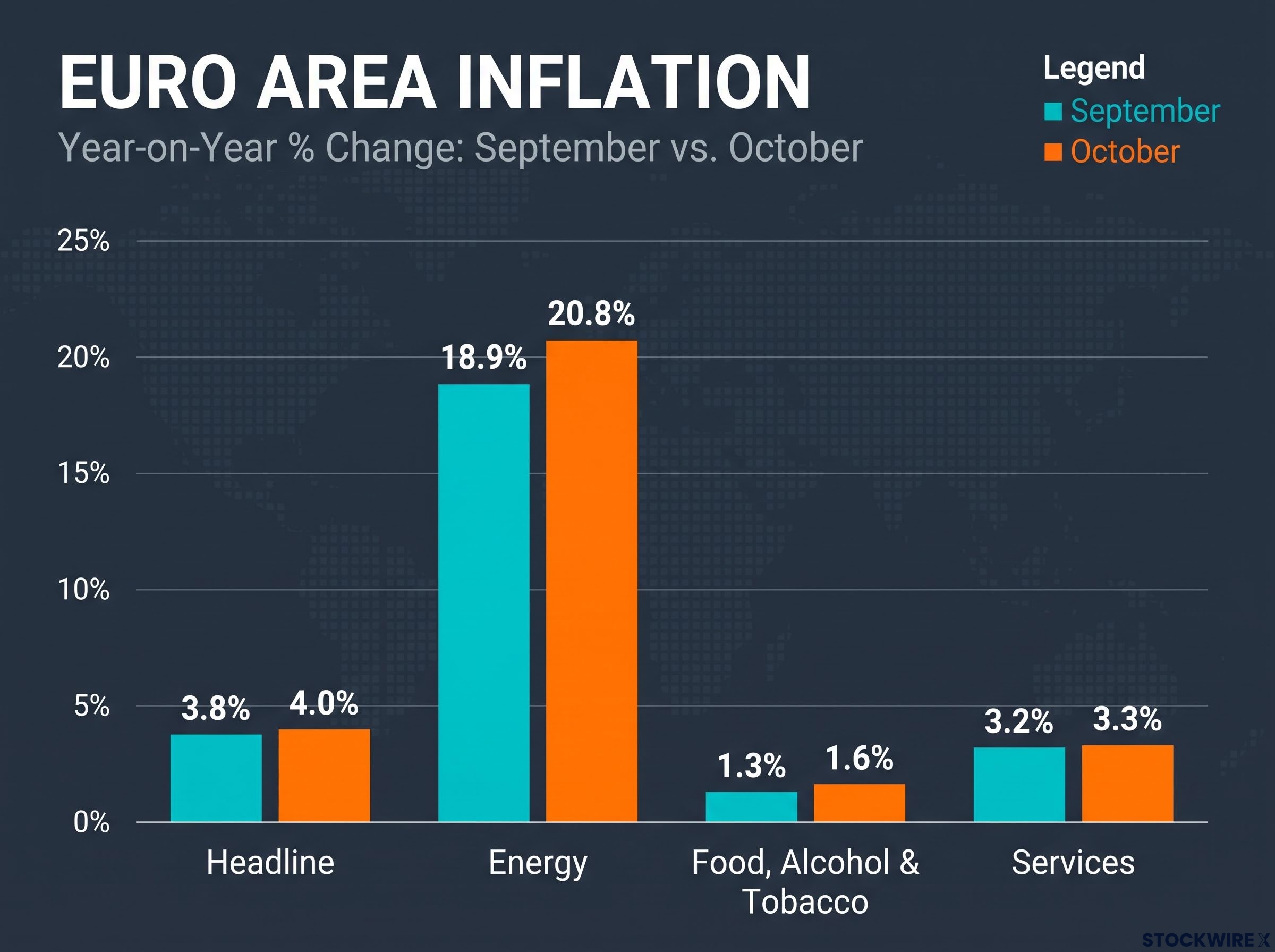
Energy inflation jumped from 18.9% in Sept to 20.8% in Oct, vastly outpacing headline inflation at 4.0%.
| Measure | September | October | Change |
|---|---|---|---|
| Headline HICP | 3.8% | 4.0% | +0.2 points |
| Core HICP | Not provided | 2.5% | Not provided |
| Energy | 18.9% | 20.8% | +1.9 points |
| Food, alcohol and tobacco | 1.3% | 1.6% | +0.3 points |
| Services | 3.2% | 3.3% | +0.1 points |
ING’s Carsten Brzeski reads the muted underlying figures as a sign that energy costs are passing through only in a limited way. On that view, December could be the last hike.
Where Lane sees pressure building
Lane expects food and core prices to quicken, particularly in Q1 2027. Lagarde said in October that the ECB was not yet seeing second-round effects beyond those built into its projections. Second-round effects are when an initial price shock feeds into wages and other prices.
The ECB is acting on where food, core and wage pressure may be heading, not on today’s core reading. For you, that means the early 2027 data will matter more than October’s print.
France’s fiscal strain and the limits of ECB tightening
Lane drew a firm line on France. Its fiscal difficulties, he said, must be addressed by authorities in Paris.
That reflects the ECB’s division of labour. National governments restore fiscal credibility, while the ECB sets one interest rate for the whole euro area.
The line blurs in bond markets. A rate hike raises borrowing costs for heavily indebted governments, and reports describe sharply elevated spreads between French government bonds (OATs) and German Bunds. A spread is the extra yield investors demand to hold one country’s debt over another’s, and a wider one signals more perceived risk.
Robeco said on 5 November that it expects hikes in December and March on elevated energy prices. It also warned that a material widening in French spreads, especially with spillovers elsewhere, could lead the ECB to skip hikes. Goldman Sachs flagged fiscal risks from elections and fragmented parliaments in Spain, France and Italy.
What gives the Council room to tighten is growth. Lane called the resilience of Europe’s economy fairly comforting.
Three variables could still change December:
- Energy prices: Reuters reported that ECB hike pricing has frequently moved with energy markets.
- French spreads: Material widening with spillovers could prompt a pause.
- Food and core data: Faster acceleration would support hikes beyond December.
If you hold euro sovereign bonds, watch French spreads alongside energy prices. Those two are the likeliest triggers for a change of plan.
The global backdrop: Fed hike bets ahead of US CPI
The view from Frankfurt is only half the picture. Reuters reported on 6 November that markets priced about an 80% chance of a 25 basis point Federal Reserve hike at the 8-9 December Federal Open Market Committee (FOMC) meeting, up from about 67%.
US October consumer price index (CPI) data are due today at 8:30 a.m. ET. Consensus sits at about 0.3% month-on-month for headline. StoneX expects 3.9% year-on-year headline and 2.8% core. The Bureau of Labor Statistics was expected to leave out its standard year-on-year October comparisons because the 2025 government shutdown disrupted data collection.
The two decisions connect through the currency. Stronger Fed hike expectations tend to support the dollar and weaken the euro, and a weaker euro raises the cost of imported goods in the euro area.
History shows how fast energy shocks can reprice rates. The ECB raised rates by 350 basis points over six meetings from July 2022 to March 2023, its first hiking cycle since 2011.
A hot US print would likely lift Fed pricing and test the euro. Treat today’s release as an input to ECB pricing, not just a US story.
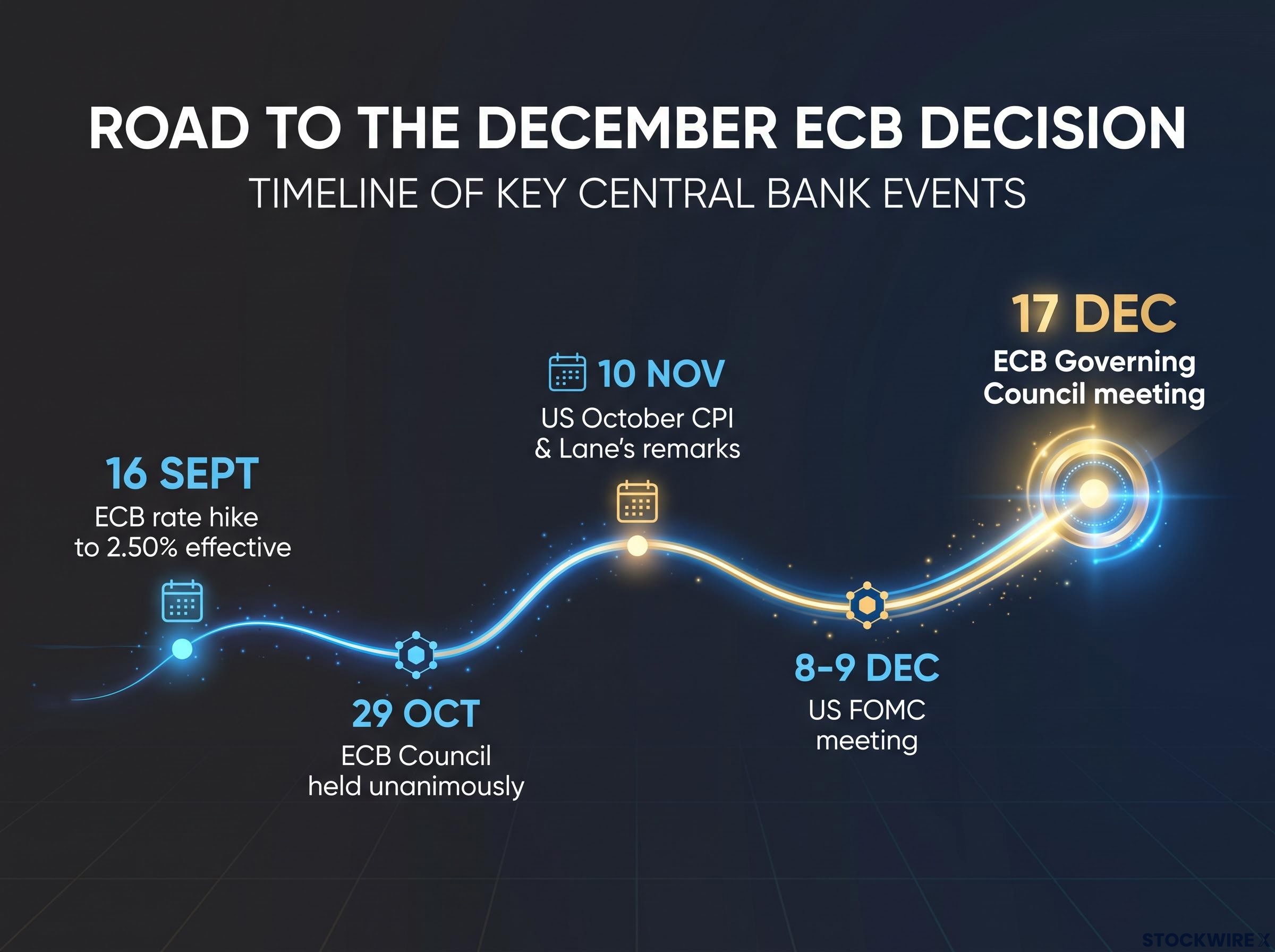
Key dates to the 17 Dec ECB decision include the 16 Sept rate hike to 2.50% and the 8-9 Dec US FOMC meeting.
- 10 November: US October CPI and Lane’s remarks
- 8-9 December: FOMC meeting
- 17 December: ECB Governing Council decision
What to watch before the ECB decides in December
A December hike is the base case, and markets have largely priced it. The open question is persistence: whether an energy-led shock spreads into food, core prices and wages enough to justify more.
The decision points are clear. Upcoming Eurostat releases will show whether food and core are accelerating as Lane expects. Energy prices and the euro will shape imported inflation. French spreads will test how far the Council can push.
The December round of staff projection revisions is the next formal checkpoint, because a second consecutive upward revision to 2027 and 2028 inflation would put the temporary-shock thesis under material strain.
The Fed’s meeting on 8-9 December lands just over a week before the ECB’s updated outlook on 17 December. The move itself may be settled. Food prices, core inflation and French bond stress will decide whether the ECB’s language after the hike points to a pause or to more.
This article is for informational purposes only and should not be considered financial advice. Investors should conduct their own research and consult with financial professionals before making investment decisions.