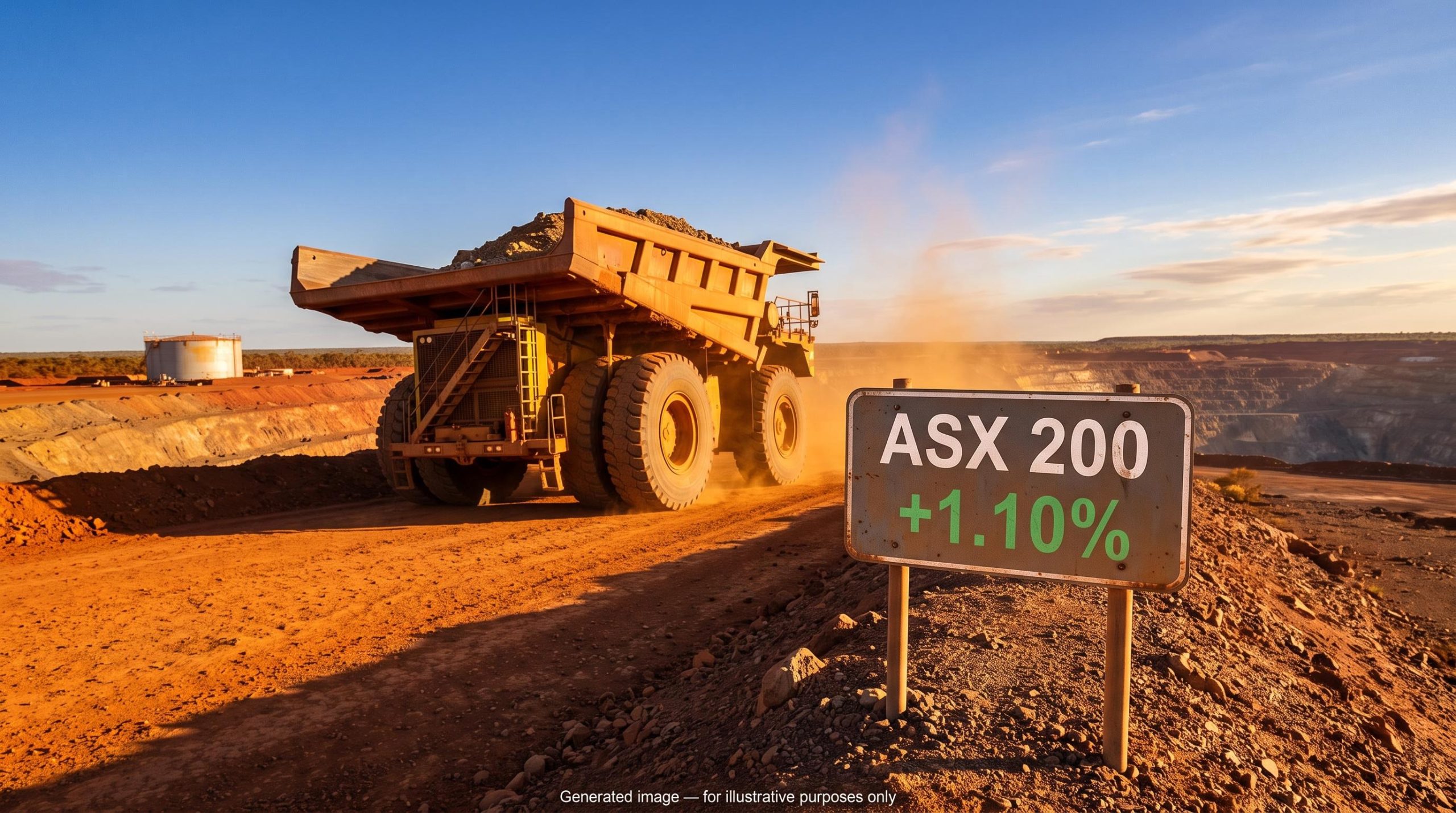
The S&P/ASX 200 closed 1.10% higher at 9,129.0 on Tuesday 10 November 2026, adding 99.3 points and finishing within reach of record territory. Oil’s slide drew money out of defensive stocks and into gold miners, property trusts and banks.
Cheaper oil reaches portfolios in several ways at once. It cuts fuel bills for miners, eases pressure on bond yields and lifts the appeal of rate-sensitive holdings such as real estate investment trusts. The buying was spread widely across the market.
Across the ASX 300, 253 stocks advanced and only 36 declined. That is about seven risers for every faller, so the gains were not carried by a few heavyweights.
Below is what drove the move, who benefited, and the price zone that will decide what happens next.
Which sectors led the ASX 200 higher, and which fell behind?
Industrials, property and gold led the day. Two defensive sectors closed lower.
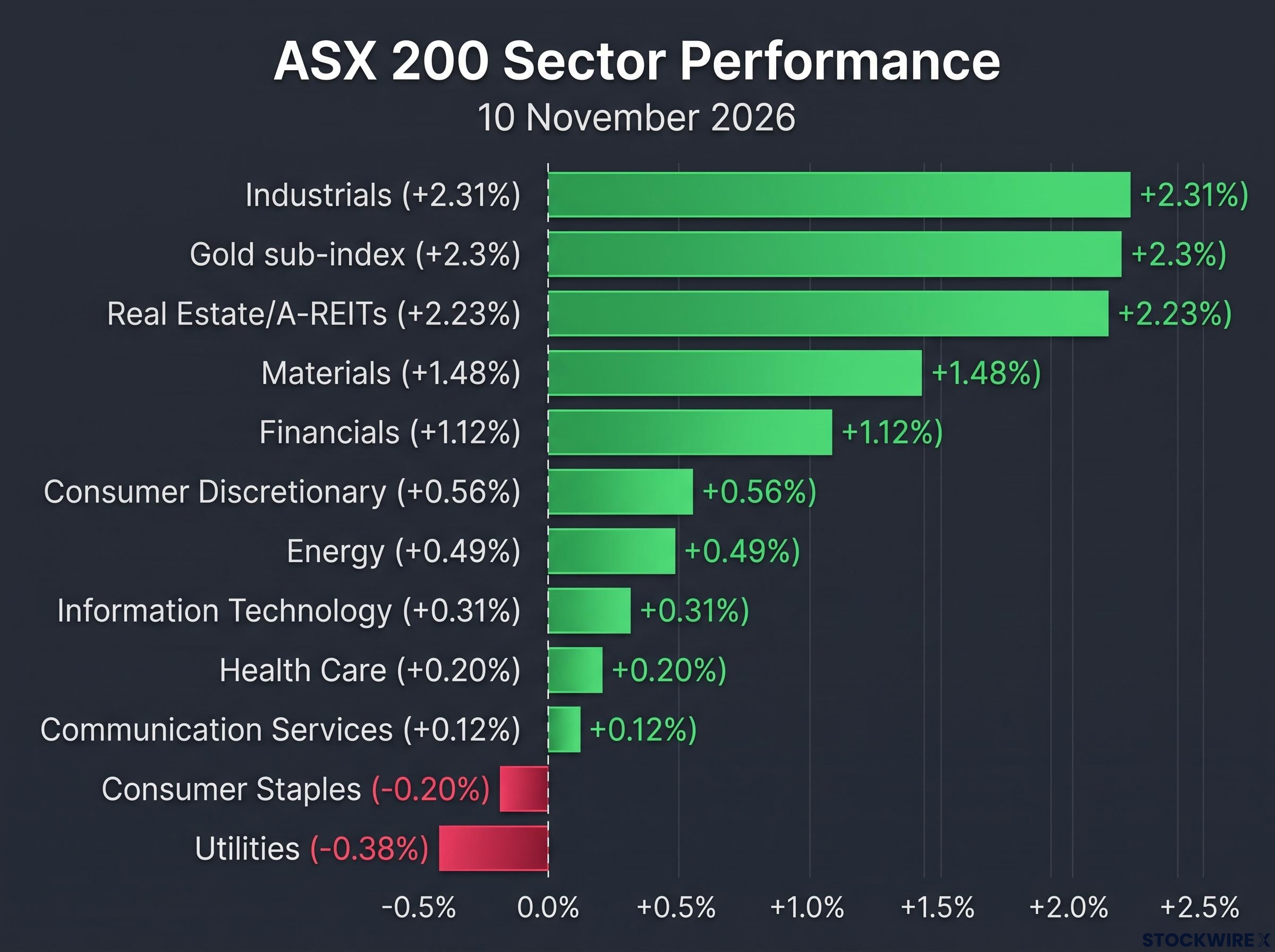
Industrials and the Gold sub-index led the ASX 200 with gains of 2.31% and 2.3% respectively, while Utilities fell 0.38%.
| Sector | Move | Standout stock |
|---|---|---|
| Industrials | +2.31% | Monadelphous (ASX: MND) +15.3% |
| Gold sub-index | +2.3% | Ora Banda +7.2% |
| Real Estate (A-REITs) | +2.23% | Goodman +3.4% |
| Materials | +1.48% | Arafura +6.7% |
| Financials | +1.12% | AMP +3.2% |
| Consumer Discretionary | +0.56% | Modest gains |
| Energy | +0.49% | Paladin +5.0% |
| Information Technology | +0.31% | Modest gains |
| Health Care | +0.20% | Telix -0.9% |
| Communication Services | +0.12% | TPG -1.2% |
| Consumer Staples | -0.20% | Woolworths -0.9% |
| Utilities | -0.38% | Origin -0.4% |
Only Utilities and Consumer Staples finished in the red. Health Care and Communication Services barely moved.
The All Ordinaries gained 1.14% to 9,267.8, and the All Tech index added 0.56%. The Small Ordinaries rose 2.29%, more than double the large-cap gain, which shows investors were willing to take on more risk. If your portfolio leans towards defensive stocks, it probably lagged the index on Tuesday.
Gold, materials and rare earths
Gold miners led the resources sector, with gold trading at about US$4,122-4,132/oz and the Australian dollar near US$0.69. Ora Banda jumped 7.2% and Northern Star gained 3.0%.
Gains spread well beyond gold. Champion Iron rose 5.2% and Nickel Industries climbed 4.9%. In rare earths, Arafura added 6.7% and Lynas rose 4.2%. BHP gained 1.1%, recovering after last week’s concern that a slowdown in AI spending could weaken copper demand.
A-REITs and banks
Property trusts rose on expectations of lower interest rates. Goodman gained 3.4% and Stockland rose 2.5%. CBA climbed 1.8% and was one of three big four banks to finish more than 1% higher.
Why did falling oil lift so much of the market?
The rally started with a single comment from Washington.
On Iran Donald Trump said further US attacks on Iran were “highly unlikely” provided negotiations keep progressing.
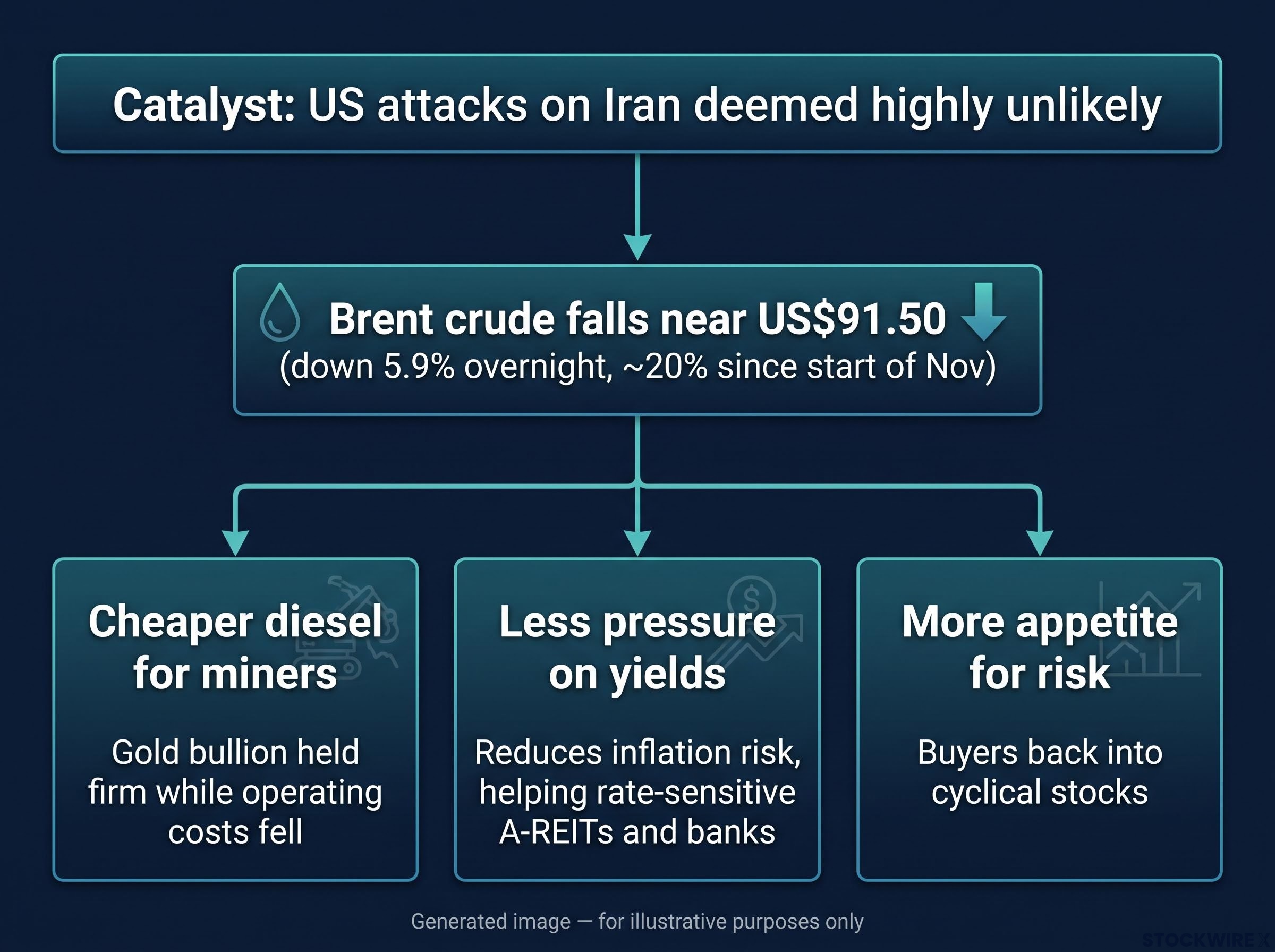
Brent crude fell near US$91.50, dropping 5.9% overnight, which led to cheaper diesel for miners, less pressure on yields and more appetite for risk.
That lowered the perceived risk of a wider conflict and extended oil’s fall. Brent crude traded near US$91.50 during the Australian session after dropping 5.9% overnight. It is now down roughly 20% since the start of November. Newcastle coal fell 3.0% to US$137.70/t.
Earlier in the year, the way oil shocks reprice sectors showed that energy producers gained while transport, staples and rate-sensitive groups absorbed cost and discount-rate pressure through separate channels.
The fall in oil lifted the market through three main channels:
- Cheaper diesel for miners. Haul trucks and remote mine sites burn large amounts of fuel. For gold miners, this was a double benefit: bullion held firm while operating costs fell.
- Less pressure on yields. Cheaper oil reduces inflation risk, which helps rate-sensitive A-REITs and banks.
- More appetite for risk. Lower odds of escalation sent buyers back into cyclical stocks, whose earnings rise and fall with the economy.
The energy sector still rose 0.49%. Refiners benefit when crude gets cheaper, so Viva Energy gained 2.7% and Ampol added 2.2%. Paladin rose 5.0% on uranium strength, while Woodside (+0.1%) and Santos (-0.2%) were flat.
The relief came with a condition attached. Attacks around the Strait of Hormuz have continued, and AMP chief economist Shane Oliver has warned that geopolitical risk remains high. If you own gold, materials or property stocks, Tuesday’s gains rested on a headline rather than any change in earnings, so expect them to react to the next Iran development.
The domestic data check
Beneath the rally, the local economic data was weak. The Westpac-Melbourne Institute consumer sentiment index for November fell to 78.2, a four-year low. Sentiment among mortgage holders dropped to a record low of 68.1.
NAB’s October business confidence reading slipped to -15, well below its long-run average of +4. If households keep cutting back, a rally led by cyclical stocks will have a harder time holding its gains.
Which stocks made the biggest moves, and where does the ASX 200 face its next test?
Company news produced some of the day’s biggest moves in both directions.
| Company | Move | Catalyst |
|---|---|---|
| Monadelphous | +15.3% | About $1.7B half-year revenue, NPAT guidance $80-85M |
| Qantas (ASX: QAN) | +6.3% | 850 jobs outsourced to Accenture |
| Ingenia (ASX: INA) | +1.5% | AVID matches Warburg Pincus at $5.55 cash |
| Life360 (ASX: 360) | -15.3% | Revenue US$174.1M, up 40% |
| Superloop (ASX: SLC) | -10.2% | Capex guidance $58-62M |
| Service Stream (ASX: SSM) | -5.9% | About $404M capital raising |
Monadelphous has won about $830 million in new contracts and extensions since 1 July, but management warned that activity may ease in the second half. IperionX gained 14.9%.
In the Ingenia contest, AVID’s offer is worth $5.60 including a permitted distribution. Warburg Pincus keeps due-diligence access until 13 November, and AVID’s exclusivity runs to 14 December.
Strong results did not protect Life360. The company reported more than 107 million monthly active users and FY26 revenue guidance of US$665-681 million, yet its shares still fell sharply. Superloop guided to FY27 EBITDA (earnings before interest, tax, depreciation and amortisation) of $148-156 million, and Channel Infrastructure slipped 3.9%.
The technical zone traders are watching
Chart analysts have marked out the levels below:
- Supply zone (9,221-9,297): According to ChartWatch’s Carl Capolingua, this is where selling has previously built up.
- Short-term demand (8,870-8,899): Capolingua’s nearest area of buying support.
- 9,226.5: StoneX identifies this as the former February record, with 9,100 as immediate support.
Capolingua says he is 67% invested and wants to see how the index behaves near the supply zone before committing fully. Watch how prices react in that range rather than assuming a breakout.
What to watch after a record-high test
Tuesday’s rally had two kinds of drivers. Cheaper diesel and lower yields are lasting influences on miners, property trusts and banks. The Iran headline, Monadelphous’s update, the Ingenia contest and the Qantas report were one-off catalysts.
Three variables will decide whether the momentum continues: progress in US-Iran talks, how the index trades in the 9,221-9,297 supply zone, and US Core CPI on Wednesday. US markets close on Thursday, and the US 30-year bond auction follows on Friday.
The reason oil is falling matters most. Easing tension supports cyclical stocks, but oil falling because of weak global demand would work against them. Check which of the two is driving prices before adding to your exposure.
This article is for informational purposes only and should not be considered financial advice. Investors should conduct their own research and consult with financial professionals before making investment decisions.