Key Takeaways
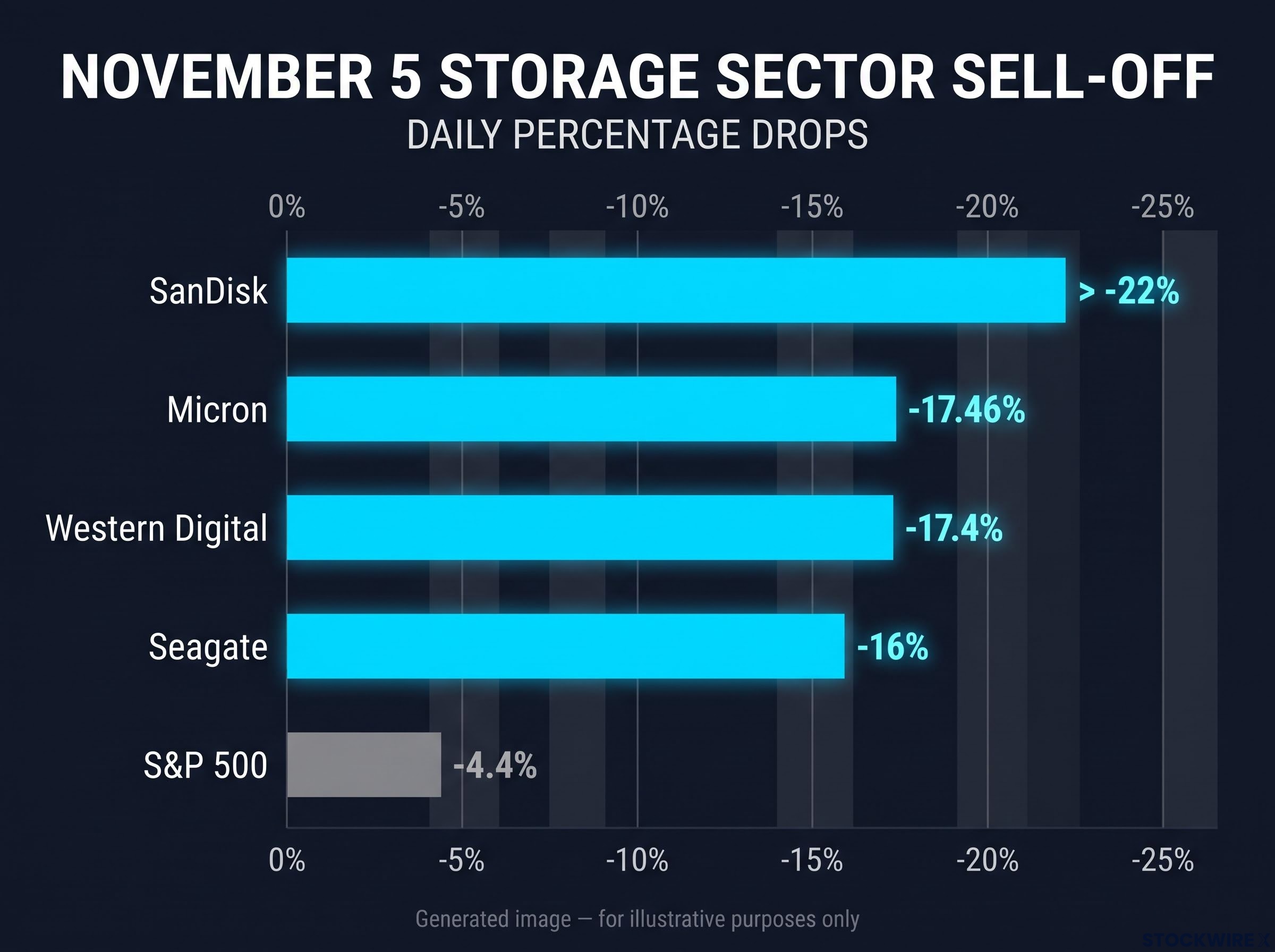
- Micron closed at $656.39 on 5 November, down 17.46%, but SanDisk, Western Digital and Seagate fell 16% to more than 22% too, which points to a broad unwind of crowded AI positions rather than a company-specific failure.
- The paused $4.5 billion Taiwan Fab 11E, not expected to produce chips until about 2028, is too distant to explain a one-day loss of nearly a fifth of Micron's value.
- Put premium surged from $1.16 million to nearly $15 million before the crash, but without fills and hedge details, that flow proves little about trader foresight.
- The $770 January calls carry a break-even near $821.68, so they pay off only if Micron erases the entire crash and climbs further.
- The stock sits about 45.9% below its $1,213.56 record close while the average analyst target is near $1,562, and the $361 to $3,000 target range shows how deeply experts disagree on the memory cycle.
Traders spent nearly $15 million on Micron puts on Wednesday, the day before the stock lost 17.46%. Then, with the shares sitting at $656.39 after Thursday’s crash from $795.23, other traders bought $770 calls that only pay off if the stock recovers everything it lost and more. On the surface, the options market called the drop and then the bounce, but that reading is probably wrong.
The wider picture is even stranger. Micron closed Friday about 46% below its record close of $1,213.56 on 25 June 2026, yet the average analyst price target sits near $1,562. The share price, the options positioning and the forecasts are each telling a different story.
This piece separates those three stories. It shows how to treat options headlines with healthy scepticism, and how to weigh the bull and bear cases on their evidence rather than their volume.
What actually drove the one-day plunge?
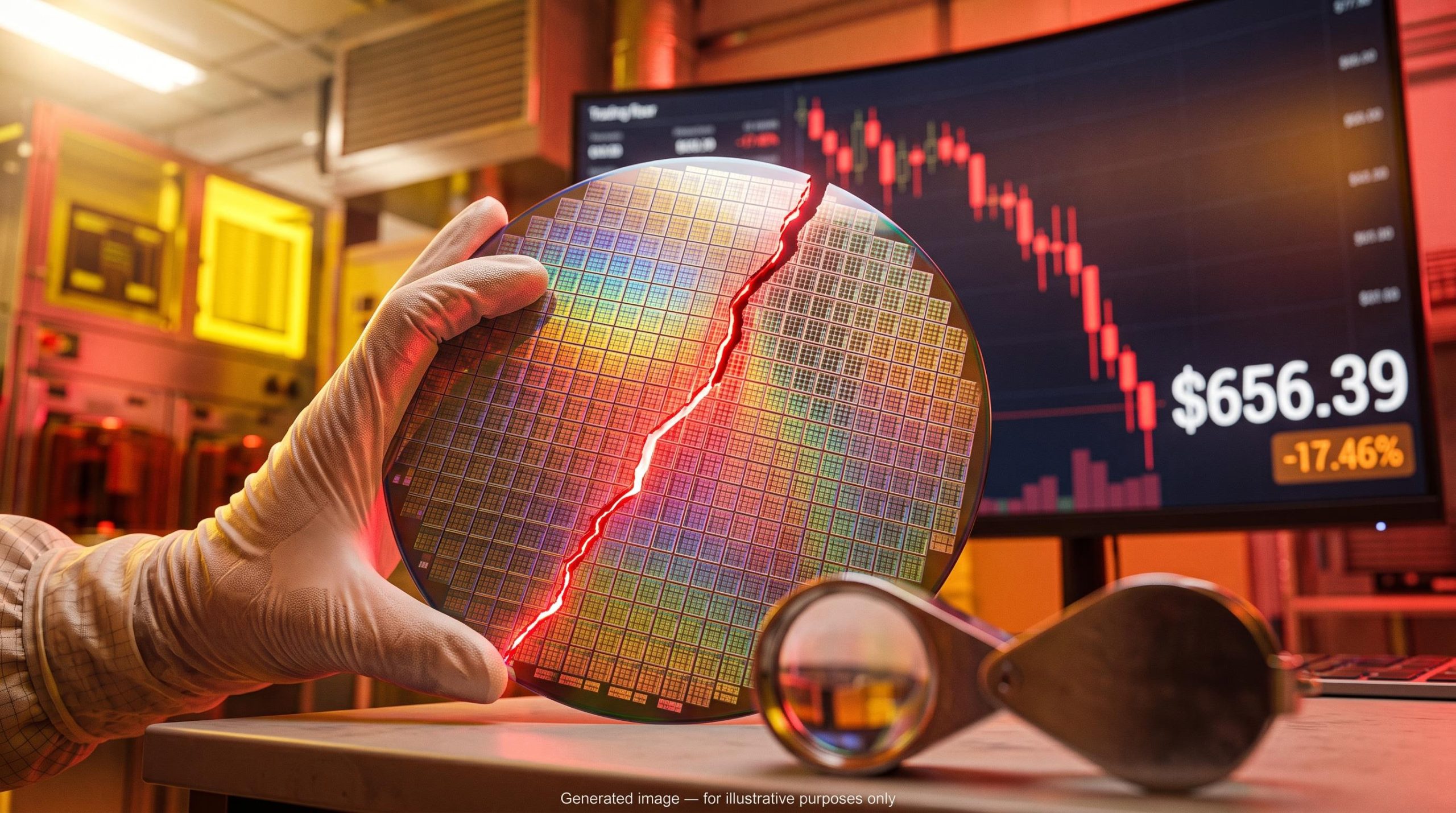
The numbers alone look like a company-specific disaster. Micron closed at $656.39 on Thursday 5 November, down 17.46%, and visited the $650 area for the first time in six months.
Friday brought a partial reprieve. The shares rose 5.12% to $690.00, still well short of Wednesday’s close.
Measured from the record close, the drawdown is about 45.9%. The “almost 48%” figure in some early coverage likely compares Thursday’s close with the intraday peak near $1,255. Context matters too: the stock had gained roughly 193% in 2026 through 2 November, which Yahoo Finance framed as a valuation and sustainability reset rather than a collapse in the business.
The real clue sits in the stocks that fell alongside it.
The S&P 500 fell 4.4% the same day. Other named pressures piled on: doubts about whether AI infrastructure spending can keep its pace, a phone-chipmaker’s warning that higher memory costs were hurting margins and handset sales, and fears that Democratic midterm gains could slow data-centre build-out.
When big ASX news breaks, our subscribers know first
How to read the put and call flow around the crash
If the sell-off was a broad unwind, what about the traders who seemed to see it coming? The options data deserves a careful, chronological look before anyone treats it as foresight.
The put build-up before the fall
Put buying climbed sharply through the week. Puts are contracts that gain value when a stock falls. Premium totalled about $1.16 million on Monday 2 November, $4.85 million on Tuesday and nearly $15 million on Wednesday.
That escalation looks prescient. The problem is that nobody outside those trades knows whether the puts were standalone bets, hedges protecting long stock positions, or one leg of a spread.
Alerts on unusual options activity confirm only that abnormal volume printed at a specific strike; they say nothing about whether the buyer was making a directional bet, hedging stock, or holding one leg of a spread.
The same doubt applies to a $700-strike put print that OptionsBell reported at about $177.72 million in premium on 5 November. The size is dramatic, yet the trader’s net position is unknown. OptionsBell also counted about $1.24 billion of put premium against roughly $300 million of calls on 6 November.
What the $770 call buyers need to be right
After the fall came the bullish trades. Break-even for a bought call is the strike price plus the premium paid per share, so it depends on the actual fill.
The January calls had an average fill of about $51.68, above the option’s closing price, which implies some buying happened before the lows. OptionsBell’s figures for the November calls differ modestly from these totals. A separate $12.5 million block of January $600 calls is a different trade entirely and should not be lumped in with the $770 buying.
Aggregate premium cannot produce a break-even; only the actual fill can.
Before you trust any flow headline, run through five checks:
- Is this one order or many? Contract totals can combine repeated prints, spread legs, rolls and closing trades.
- What does the open-interest ratio suggest? High volume against existing contracts hints at new positions, but it is a clue, not a conclusion.
- Could it be a hedge? A call bought at the ask may protect a short position; a put at the bid may be a sale of downside insurance.
- What was the fill? Without it, you cannot calculate a break-even.
- What would copying cost you? Followers enter late, pay wider spreads, and absorb time decay and volatility shifts without the originator’s hedge information.
A headline dollar figure is not a verdict. Until you know the fill, the structure and the hedge, you cannot say what the trader believes, so treat alerts as context, not instructions.
Bull case or bear case: what does the evidence support?
With the flow set aside as ambiguous, the real argument lies in the memory cycle itself. Both sides bring serious evidence.
The case for holding
Micron has reportedly confirmed its 2026 and 2027 capacity as sold out, and Chief Executive Officer Sanjay Mehrotra said tight supply could last into 2028. More than 75% of 2027 output was reportedly committed.
ASML’s 14 October commentary reportedly indicated that planned equipment supply for 2027-2028 would not fully meet demand. Micron’s buyback authorisation stands at $35.16 billion, with repurchases able to begin on 9 December, a week before the 16 December fiscal Q1 report. In the past 30 days, 20 analysts raised next-year estimates against 2 cuts.
The case for caution
Bears point to how memory stocks behave. They often peak before earnings do, because the share price starts discounting the eventual price fall while income statements still show records. A low forward price-to-earnings (P/E) multiple, which compares price with expected profit, can mislead when that profit is near a cyclical high.
Supply is coming. TrendForce expects 2026 DRAM supply to be short by only about 1%-2%, with meaningful new production arriving in the second half of 2027 as Samsung and SK Hynix expand DRAM and high-bandwidth memory (HBM), the stacked chips used in AI servers. NAND and consumer demand may soften first, and AI spending could prove overestimated.
History adds weight. Past Micron drawdowns, generally within 12-18 months of a peak, were:
- About 75% in the 2015 cycle
- About 57% in the 2018 cycle
- About 51% in the 2022 cycle
The HBM cycle may differ in length and product mix. Michael Burry clearly doubts it will, reportedly holding June 2027 puts at about a $500 strike. His thesis rests on future supply, circular AI financing and Chinese competition, not current weakness.
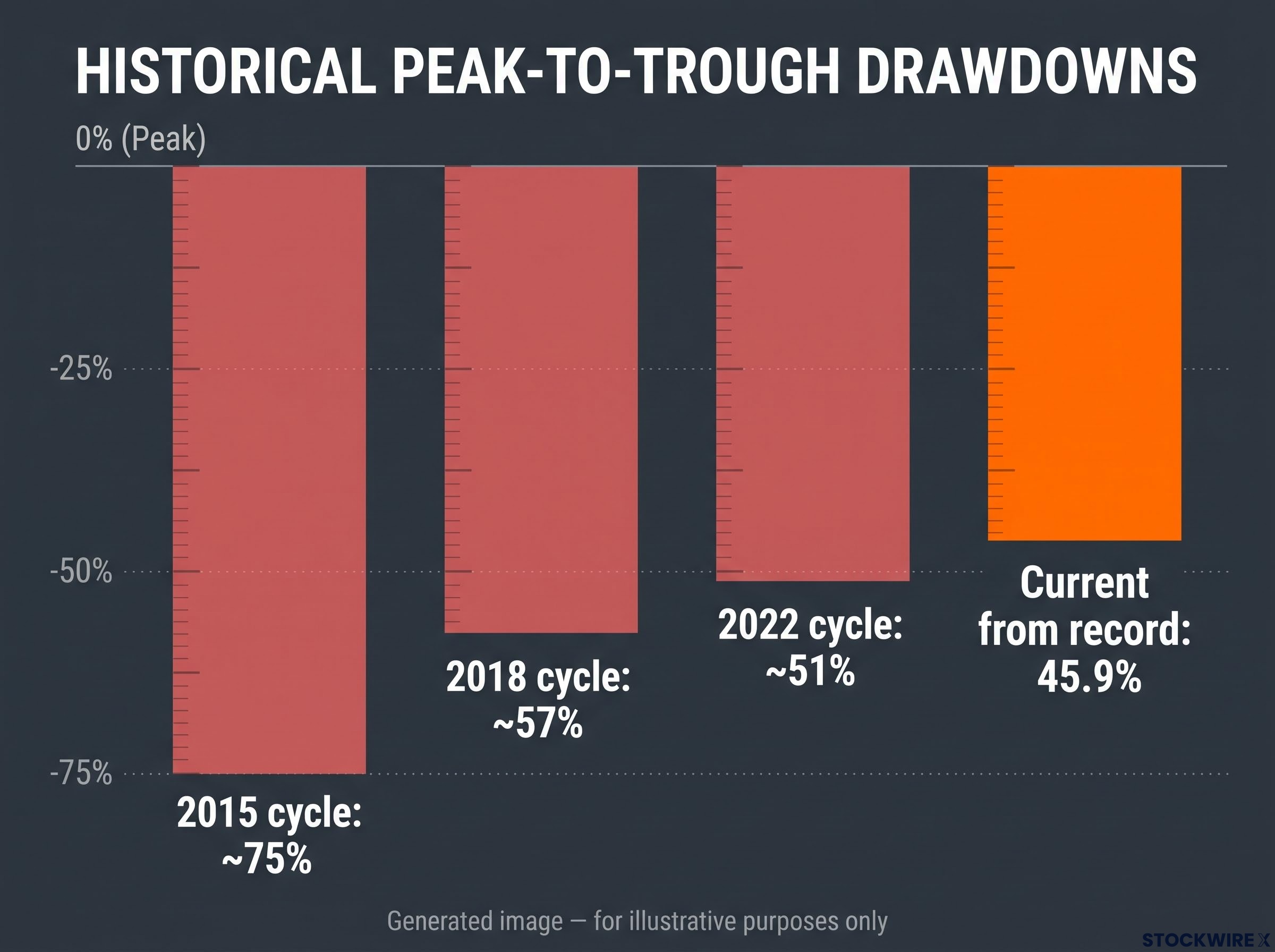
The current 45.9% drawdown from the record close approaches the severity of historical bear cycles, such as the ~51% drop in 2022.
“Sold out” also does not lock in pricing. Customers can renegotiate, delay or substitute orders.
Notice that neither side disputes the current quarter. Record earnings and a falling stock can coexist, so the question for you is where the price cycle sits, not whether 16 December will be strong. A good report may simply extend the debate.
Truist’s research on when chip stocks peak found they have typically topped about a quarter after revenue growth peaks, which complicates the idea that a falling price already signals a fundamental top.
Why does the analyst target sit so far above the share price?
The arithmetic is jarring. Yahoo Finance showed an average target of about $1,562 across 49 analysts on 8 November, while another cut showed $1,538.93 from 42. Against Friday’s $690 close, that implies roughly 126% upside, above even the June record.
Named targets include:
- Rosenblatt: $1,900
- Bank of America (Vivek Arya): $1,550
- Wedbush (Matt Bryson): $1,400
- Bernstein (Mark Li): $1,300
- Citi (Atif Malik): $1,300
Analysts have reason for confidence. Estimates keep rising, with 20 raises against 2 cuts in a month, and Apple’s chief executive has described memory pricing as unprecedented and expected to keep climbing.
But targets can lag. They may rest on stale or optimistic forward assumptions, and nothing obliges a share price to converge on them.
The spread of opinion Targets run from a low of $361 to a high of $3,000.
That spread is the more useful number. It tells you experts disagree sharply about the memory cycle, so consensus is an input to test against your own view, not a destination.
The gap may also explain the $770 call buyers, who could be betting that rising estimates eventually pull the price back up. That is an interpretation, not a confirmed motive.
Past performance does not guarantee future results. These statements are speculative and subject to change based on market developments and company performance. This article is for informational purposes only and should not be considered financial advice. Investors should conduct their own research and consult with financial professionals before making investment decisions.
What the Micron stock crash does and does not settle
Thursday’s fall looks like a broad liquidation of crowded AI positions, sharpened by cycle fears, with Taiwan as a minor headline. The options flow, for all its size, proves little without fills and hedge details. The bull and bear cases both turn on the future rather than the current quarter.
The next tests arrive quickly. Repurchases can begin on 9 December, and the fiscal Q1 report lands on 16 December. Beyond that, capacity news through 2027 and 2028 will show whether supply arrives on the bears’ timetable or the bulls’.
Your decision rests on one judgement: whether you believe the memory price cycle has already turned. If you cannot answer that yet, the next two catalysts are where the evidence will start to accumulate.