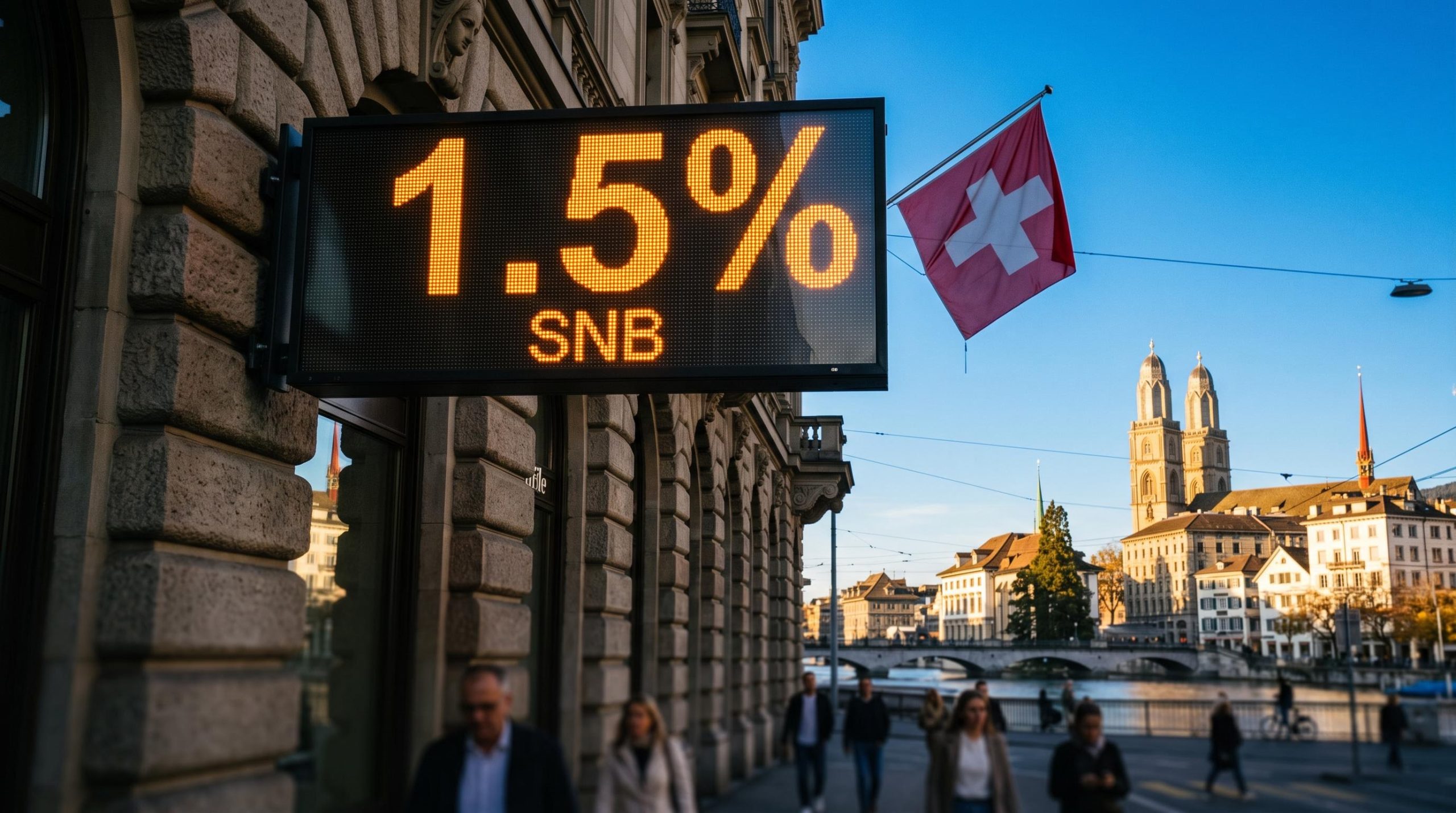
Swiss inflation came in hotter than forecast in October, and Swiss National Bank (SNB) Chairman Martin Schlegel said on Wednesday, 4 November 2026, that inflation pressures have grown. The franc barely moved. That quiet response is the more revealing part of the story, because it shows how traders are reading the SNB’s next step.
The October reading of 1.5% still sits inside the SNB’s 0%-2% price-stability range, and the policy rate remains at 0%. The real question is what would push the bank from watching to acting.
Here is how to read the next SNB signal: which levers the bank pulls, what each one does to the franc, and why it is in no rush to use them.
Why did a hot inflation print barely move the franc?
The surprise was real. On 3 November 2026, the Federal Statistical Office reported that consumer prices rose 1.5% year on year and 0.2% month on month, taking the index to 101.7 points. Economists surveyed by AWP had expected annual inflation of 1.1%-1.4%, and a separate consensus estimate pointed to 1.3%.
| Measure | October actual | September actual | Expectations |
|---|---|---|---|
| Year on year | 1.5% | 1.0% | 1.1%-1.4% (AWP); 1.3% (consensus) |
| Month on month | 0.2% | 0.0% | -0.1% to +0.1% (AWP); 0.0% (consensus) |
A day later, Schlegel acknowledged that the reading beat expectations and that the bank would keep a close eye on developments.
Martin Schlegel, SNB Chairman: The bank stands ready to adjust monetary policy if price stability comes under threat. No significant second-round effects have appeared so far, though they could emerge later.
Markets shrugged. According to FXStreet, USD/CHF was down 0.53% near 0.8165 at press time on 4 November, and TMGM described the franc’s reaction as muted. EUR/CHF fell sharply after the data release.
What drove the October jump
According to Le Temps, much of the rise came from energy, especially heating oil. Trading Economics also pointed to a weaker franc, which pushes up the price of imports in local terms. Core inflation stayed considerably lower.
That mix explains the calm. ING’s Chris Turner said the surprise raised the risk of a stronger franc and questions over whether the SNB can avoid tightening in 2027. UBS expects the first rate hike no earlier than sometime in 2027.
A reading above forecast but inside the target range tells you the market sees an SNB that is watching rather than acting. If you are tracking a shift in policy, 2027 is the window that matters, not this week.
How does the SNB steer policy, and why is it in no hurry to react?
Hot inflation usually suggests a rate hike or currency action. In Switzerland, the mechanics often point the other way.
The tools and the 2% target
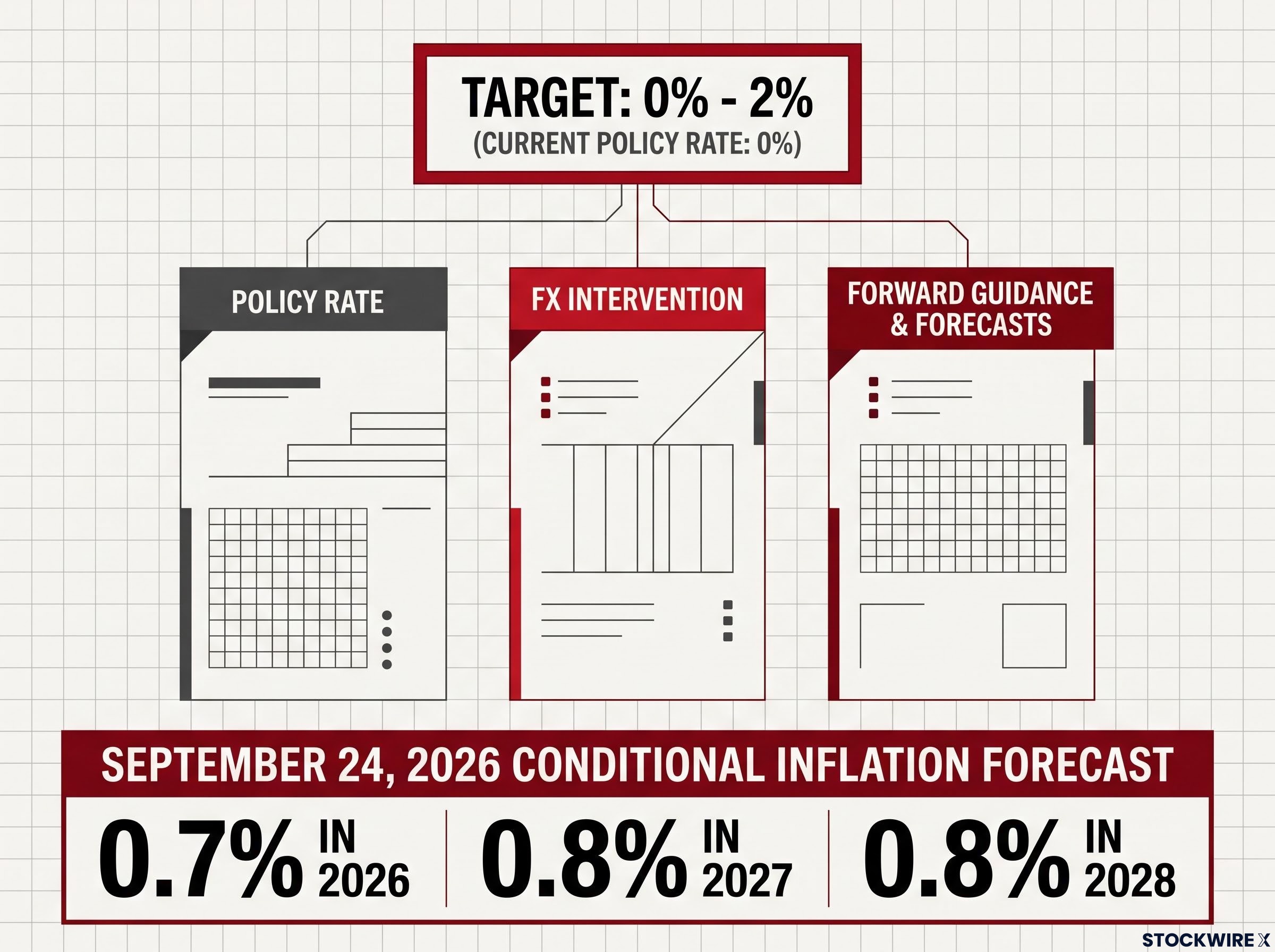
The SNB defines price stability as consumer prices rising by less than 2% a year. It steers conditions with three main levers:
- Policy rate: the SNB’s principal instrument. Higher rates tend to support the franc by lifting yields, while lower rates tend to weaken it.
- Foreign exchange (FX) intervention: the supplementary tool. Buying foreign currency and selling francs weakens the franc; the reverse supports it.
- Forward guidance and forecasts: what the bank says about future policy, which can move the franc without a single transaction.
The SNB builds its foreign-exchange reserves by creating francs to buy foreign assets rather than running domestic quantitative easing, which is why intervention sits alongside the policy rate as a core lever.
The franc matters because it feeds straight into prices. As Reuters has reported, franc appreciation lowers import prices and can threaten the 0%-2% objective. So when inflation is energy-driven, the SNB tends not to fight a strong franc, because buying foreign currency would weaken it and lift import costs further.
The calculation flips when safe-haven demand drives excessive appreciation while inflation is too low. Then intervention can be justified, since a strong franc hurts exporters.
Second-round effects and the quarterly calendar
A second-round effect is a broader, lasting rise in inflation that follows an initial price shock. It usually runs like this:
- An energy price shock lifts living costs.
- Workers ask for higher wages.
- Firms raise prices to cover labour costs.
- Workers push for further wage increases.
That chain is why Schlegel singled the risk out. One energy-led spike can fade; a wage-price loop does not.
The SNB holds four assessments a year, in March, June, September and December, each with a rate decision and a conditional inflation forecast. On 24 September 2026, it held the rate at 0% and projected inflation of 0.7% in 2026, 0.8% in 2027 and 0.8% in 2028, assuming no rate change, with a temporary fourth-quarter rise expected.
The read for you is simple: a rising franc is not automatically a sign of tighter policy, and wage data, not oil prices, is what could change the SNB’s stance.
What do the 2011-2015 peg and 2026 intervention signals say about the next move?
History shows an SNB that adjusts its signals as conditions change, sometimes abruptly.
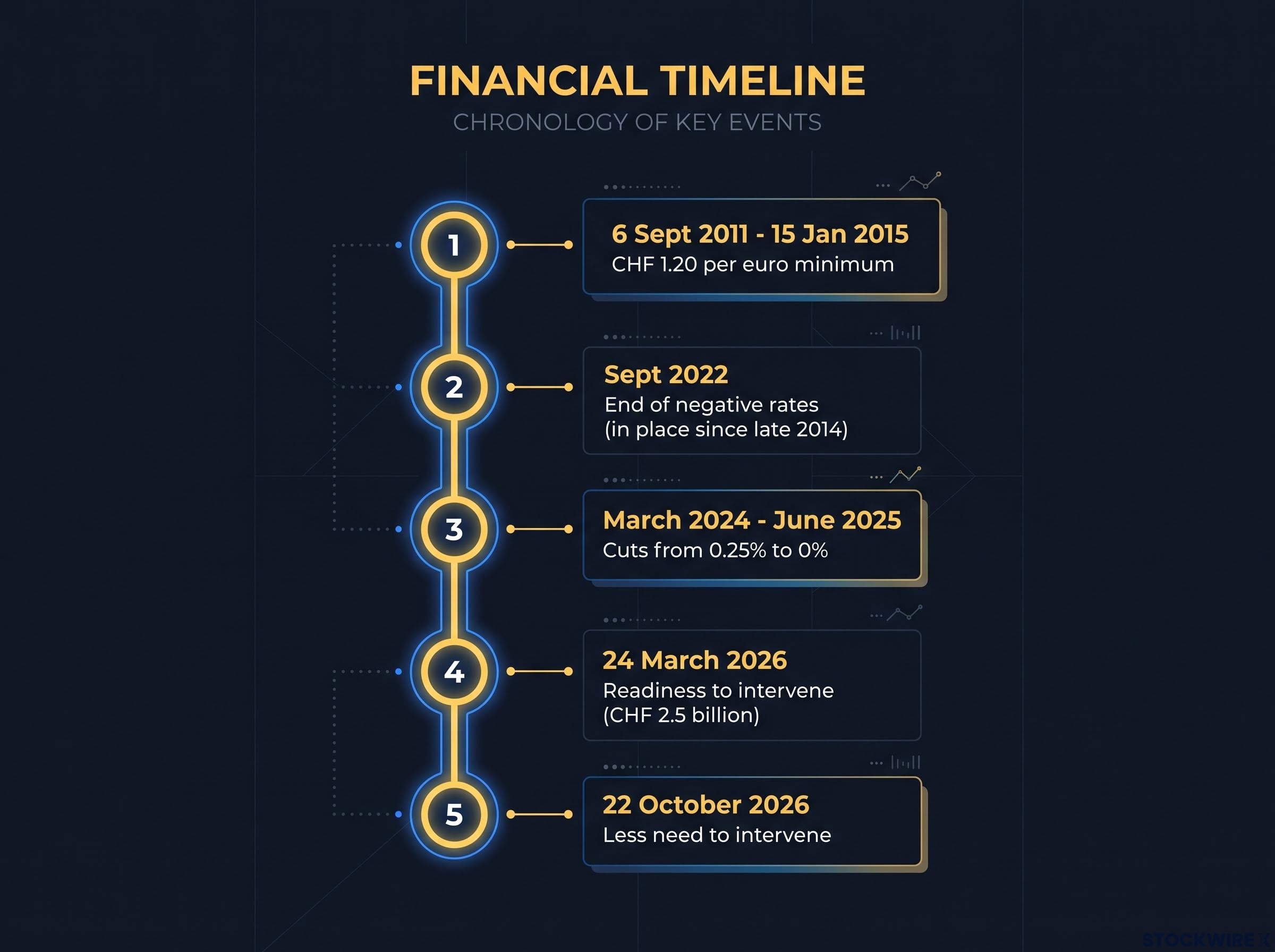
| Episode | Action or signal | Significance |
|---|---|---|
| 2011-15 euro floor | CHF 1.20 per euro minimum set 6 September 2011, abandoned 15 January 2015 | A commitment can become indefensible |
| 2022 end of negative rates | Negative rates, in place since late 2014, ended in September 2022 | Extraordinary easing can be reversed |
| 2024-25 easing | Cuts from March 2024; 0.25% to 0% in June 2025 | High bar for negative rates limited expectations |
| 2026 safe-haven signalling | March readiness to intervene; October minutes showed less need | Words can shape the franc without large trades |
This year’s sequence is the most telling. Reuters reported on 24 March 2026 that Schlegel said the bank had increased its readiness to intervene against safe-haven franc strength. UBS estimated purchases of about CHF 2.5 billion that month, modest compared with 2020. By 22 October 2026, Reuters reported that SNB minutes showed less need to intervene as appreciation pressure eased.
Easing room is also thin. After cutting to 0% in June 2025, Schlegel said in September 2025 that the “bar” for negative rates was higher. Reuters reported the same month that US tariffs had weakened the Swiss outlook. Energy versus core inflation, tariffs and safe-haven flows are the forces that will shape the path.
On balance, October raised the odds of a tightening debate in 2027 without forcing a move now. Signals to watch:
- Swiss wage data
- Core CPI
- Franc strength against the dollar and euro
- The December conditional forecast
- SNB meeting minutes
Because the SNB shifts between words, intervention and rates, the December forecast and the minutes will tell you more than any single speech.
What to watch from the SNB before the next policy decision
October delivered a surprise inside the range. Inflation of 1.5% beat forecasts, the policy rate stays at 0%, and the SNB’s stated priority is spotting second-round effects before they take hold.
The next checkpoint is the December assessment and its fresh conditional forecast. If that projection moves materially above September’s 0.8% path for 2027, the tightening debate ING flagged gets closer. If it holds, the calm in the franc looks justified.
Your decision point is less about oil and more about wages and core prices. Watch those, alongside the minutes, to judge whether the SNB stays in watching mode or starts preparing to act.
These statements are speculative and subject to change based on market developments and central bank decisions.
This article is for informational purposes only and should not be considered financial advice. Investors should conduct their own research and consult with financial professionals before making investment decisions.