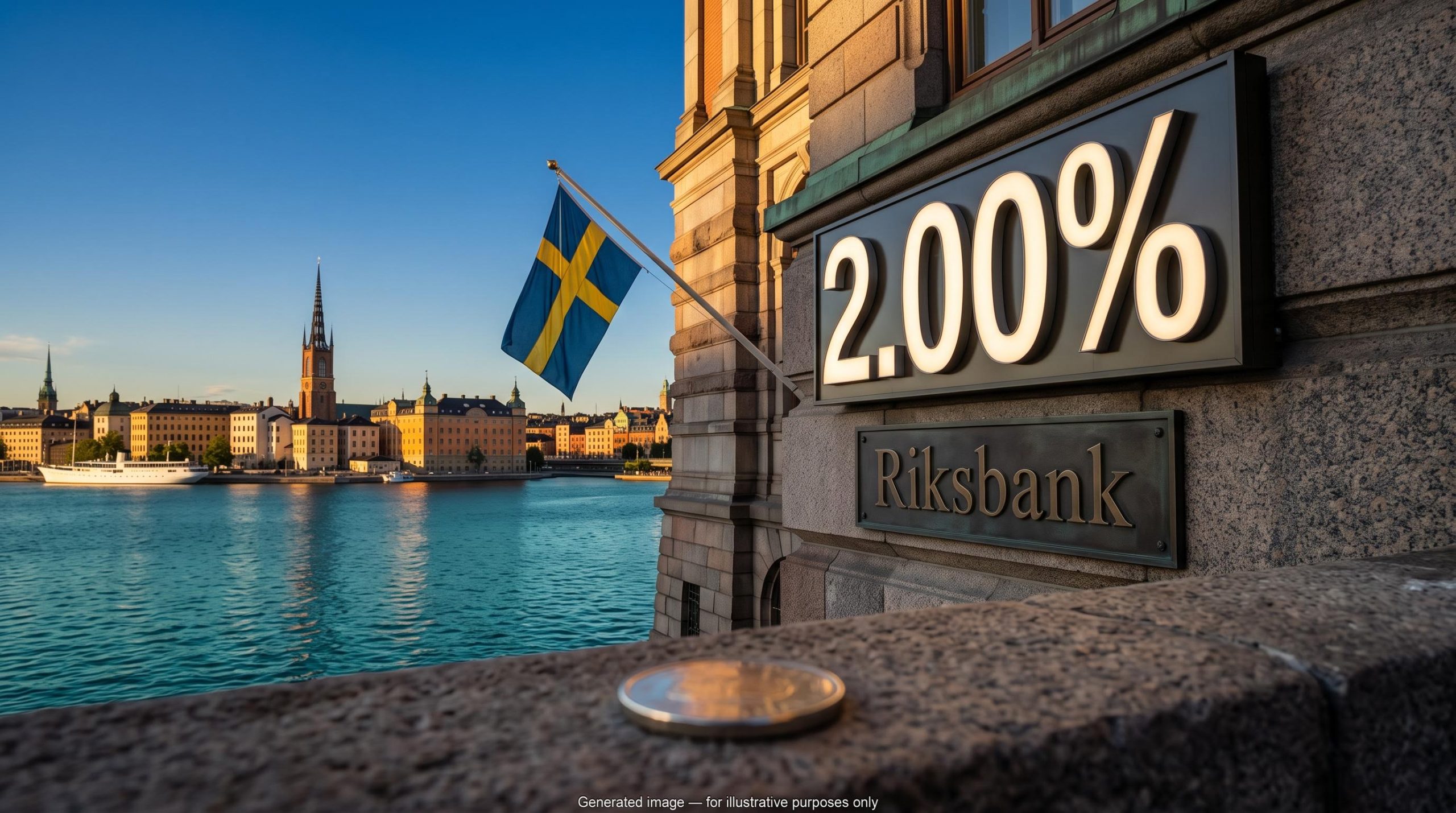
The Riksbank raised its policy rate to 2.00% on 4 November 2026, a 25 basis point move from 1.75%. It is a hawkish shift in Swedish monetary policy, and yet the krona barely moved. According to Swedish reporting, which has not been independently confirmed, the currency actually weakened by roughly one öre against both the euro and the US dollar.
That reaction stands out because this is the Riksbank’s first hike since 2023. The new rate applies from 11 November 2026.
The timing adds weight. Stockholm moved the day after the Reserve Bank of Australia (RBA) and a week after the Bank of Canada, and both of those banks also raised rates by a quarter point.
Here is what the decision means for the Swedish krona (SEK), and what the EUR/SEK chart is saying as it tests one of the most closely watched lines in technical analysis.
Why did a Riksbank rate hike barely move the krona?
A central bank lifts rates for the first time in three years, and the currency it supports slips. That looks like a contradiction until you check what the market already knew.
The decision itself was simple:
- Size: a 25bp increase
- New rate: 2.00%, up from 1.75%
- Effective date: 11 November 2026
The Riksbank had flagged this increase at its September meeting. Traders had about two months to build it into prices, and the numbers suggest they did. Swedish reporting (not independently confirmed) put the 10-year government bond yield just 1bp higher at 3.08%, which is barely a flicker for a policy shift of this kind.
So the muted move was not a failure of the policy signal. It showed the hike had already been priced in.
What the market had not yet seen was the guidance. The Riksbank said a further hike is likely within the coming year, during 2027, and attached a clear condition:
Earlier in 2026, the Riksbank’s September hold produced a stronger krona because of steeper rate-path projections, a reminder that forward guidance often moves currencies more than the decision itself.
The condition attached to the next hike “if the outlook for inflation and economic activity holds”
The bank left its September rate path unchanged. That path implies a policy rate of about 2.3% in 2027 and 2.5% in 2028. Société Générale, in analysis published via FXStreet’s Insights Team, read the statement as a signal that more tightening is probable.
The flat price reaction tells you the krona had already absorbed this hike. What moves SEK from here is the pace of the next one.
When big ASX news breaks, our subscribers know first
Where does 2.00% sit against neutral, and why is the Riksbank still leaning hawkish?
A rate of 2.00% means little on its own. It needs a benchmark, and for the Riksbank that benchmark is the neutral rate.
What “below neutral” means in practice
The neutral rate is the interest rate that neither stimulates nor restrains the economy. The Riksbank’s September 2026 Monetary Policy Report reportedly placed the long-run neutral range at 1.5%-3.0%, a figure that has not been independently confirmed. The midpoint of that range is 2.25%.
At 2.00%, policy still sits below that midpoint. In plain terms, the Riksbank is still supporting the economy rather than restraining it, even after this hike.
The reason for tightening is not that inflation is already far above target. The Riksbank expects stronger activity, cost increases from supply disruption and a weaker krona to push CPIF inflation above 2% in 2027, before it settles back near target. CPIF is Sweden’s main inflation measure: consumer prices calculated with a fixed mortgage interest rate. Underlying inflation is expected to follow the same pattern (these projections are also not independently confirmed).
The concern is persistence. If policy stays loose while demand strengthens and costs rise, above-target inflation could become harder to remove.
For you, “below neutral” means the policy debate is about how far and how fast the Riksbank goes, not whether it has finished.
What forecasters expect next
Sweden’s major banks broadly expect another move early next year. None of the following forecasts have been independently confirmed.
| Bank | Expected next move | Expected timing |
|---|---|---|
| Nordea | +25bp to 2.25% | February 2027 |
| Swedbank | +25bp to 2.25% | February 2027 |
| SEB | Further increase | Q1 2027 most likely |
Nordea pointed to a more hawkish global policy environment and to upside inflation risks from external factors and the weaker krona. SEB’s view comes from Newsquawk’s preview of the decision.
How does the Riksbank rate hike fit with the RBA and Bank of Canada?
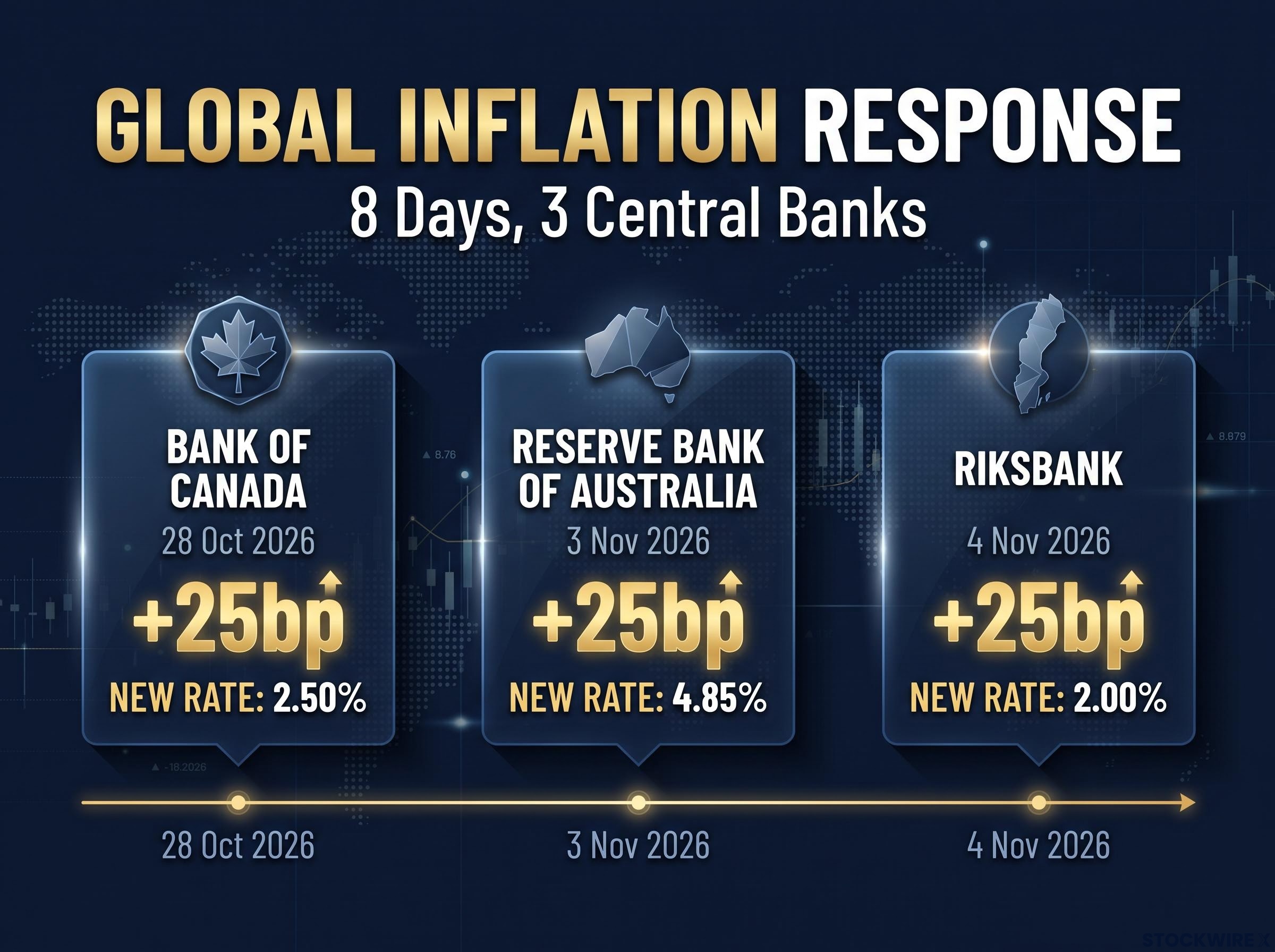
Look beyond Stockholm and the decision forms part of a pattern. Three central banks raised rates by a quarter point within eight days.
| Central bank | Date | Move | New rate | Stated driver |
|---|---|---|---|---|
| Bank of Canada | 28 Oct 2026 | +25bp | 2.50% | Persistent inflation; risk of energy costs broadening price pressure |
| Reserve Bank of Australia | 3 Nov 2026 | +25bp | 4.85% | Inflation still above target |
| Riksbank | 4 Nov 2026 | +25bp | 2.00% | Risk of persistent above-target inflation |
The Bank of Canada and RBA details have not been independently confirmed. Canada’s figures include a reported increase in its 2027 inflation forecast to 3.1% from 2.0%.
The shared driver was persistent inflation, including energy and supply costs. None of these banks raised rates to cool an overheating boom, and none were cutting to support a weak economy. Société Générale highlighted this sequence directly. It noted that the Riksbank’s projections narrow the rate gap with the European Central Bank (ECB), and that SEK has outperformed despite negative carry.
Nomura had argued that the Riksbank and ECB rate gap reflects a structural decline in Sweden’s neutral rate, driven by weak inflation, high unemployment and heavy variable-rate mortgage exposure, rather than a temporary lag.
One detail shows the consensus has limits. The RBA’s vote was reportedly split 6-3, so a third of its board did not see tightening as a risk-free choice.
You should read the Riksbank’s move as part of a global inflation response, not a Swedish one-off.
What is the EUR/SEK chart saying at the 200-day moving average?
The chart tells a story that has built over several months. Policy and technical signals now point the same way.
Reading the chart
EUR/SEK measures how many krona one euro buys, so a falling chart means a stronger krona. The pair peaked in September, then broke below a multi-month ascending trend line. It then failed to hold the neckline of an earlier inverse head-and-shoulders pattern, which is a formation traders often read as a sign of a coming rise. When the pair failed at that line, the bullish setup lost its force.
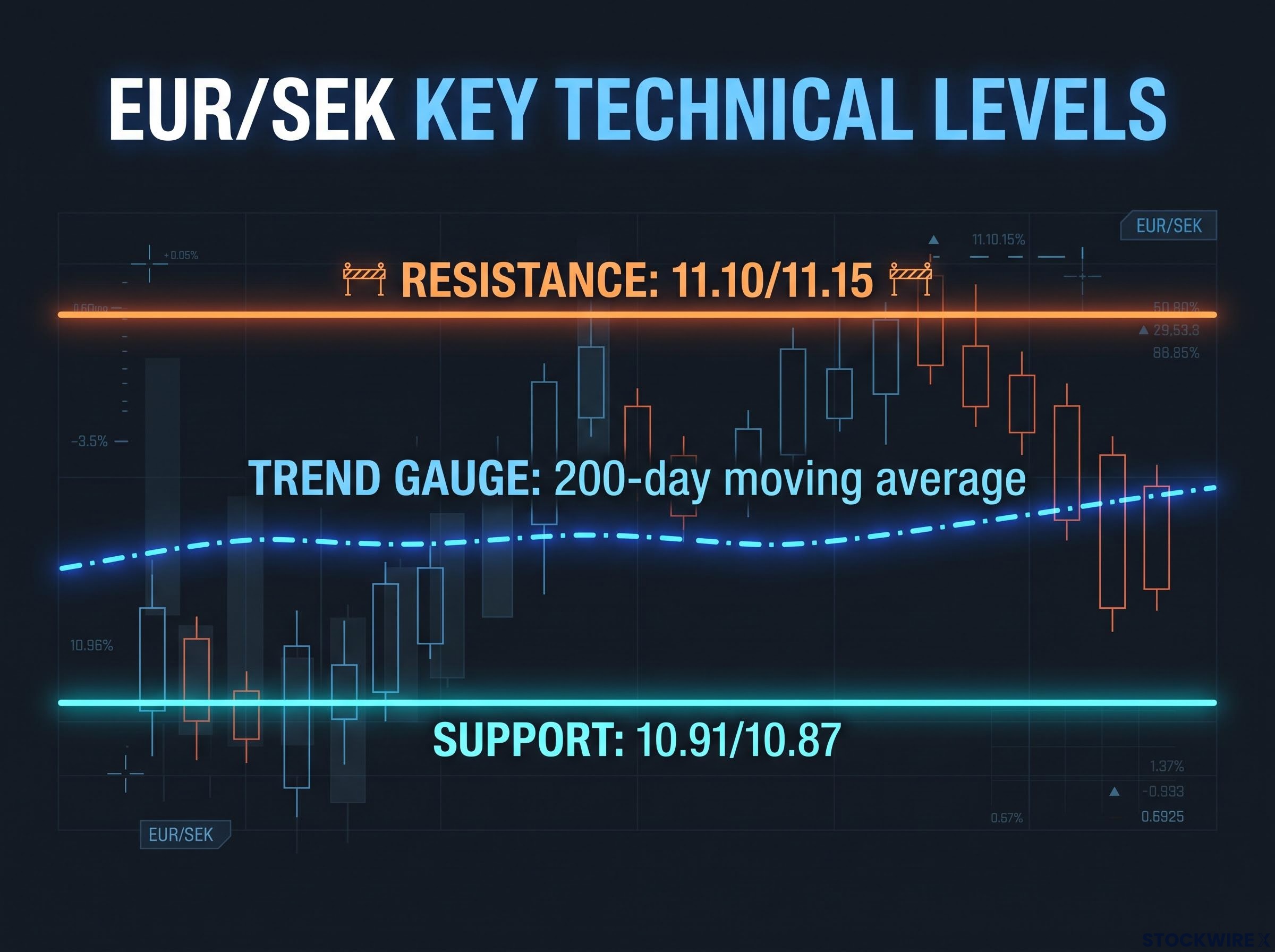
The pair is now testing its 200-day moving average, the average closing price over the past 200 trading days. Traders watch it as a gauge of long-term trend. Support and resistance are price zones where buying or selling has previously stopped a move, so they act as decision levels.
The exact current EUR/SEK price was not available at the time of writing.
| Level | Price zone | Significance | What a break implies |
|---|---|---|---|
| Resistance | 11.10/11.15 | Recent pivot high | A move back through it suggests the policy signal has not overcome the forces supporting EUR/SEK |
| Trend gauge | 200-day moving average | Key near-term test | A rebound here challenges the bearish case |
| Support | 10.91/10.87 | August trough | A sustained break strengthens the bearish case for EUR/SEK |
Société Générale notes that a short-lived bounce from the 200-day average cannot be ruled out. ING, before the decision, kept a one-month EUR/SEK target of 11.15, with risks tilted lower (not independently confirmed).
Nordea had already moved to a neutral stance in its Swedish krona outlook, arguing that oil, global risk appetite and SEK’s role as a funding currency weigh on the krona more than domestic fundamentals do.
If you follow EUR/SEK, these two zones will tell you whether the hike is changing the pair’s direction or simply being absorbed.
Why policy can support SEK despite negative carry
Negative carry means holding krona earns less interest than holding euros. A hike can still support SEK through five steps:
- Yields rise: a Riksbank hike lifts Swedish short-term yields.
- The gap narrows: if the ECB is expected to be less hawkish, the Sweden-euro area rate gap narrows in SEK’s favour.
- Carry costs shrink: holding SEK, or closing a short SEK position, becomes cheaper.
- Expectations lead: the prospect of further hikes can strengthen the krona before the gap actually narrows.
- Inflation eases: a firmer krona lowers imported inflation and supports the Riksbank’s aims.
ING reported that the two-year EUR/SEK swap spread had already narrowed by almost 20bp (not independently confirmed), which is step two in action.
These statements are speculative and subject to change based on market developments. This article is for informational purposes only and should not be considered financial advice. Investors should conduct their own research and consult with financial professionals before making investment decisions.
What to watch after the Riksbank’s first hike since 2023
The next move depends on four variables. The first two are incoming CPIF and activity data. The third is the krona’s direction, because a weaker krona raises the cost of imports and feeds inflation. The fourth is ECB expectations, which set the other side of the rate gap.
The dated markers are clear. The new 2.00% rate takes effect on 11 November 2026. Nordea and Swedbank expect another hike in February 2027, and SEB sees Q1 2027 as most likely. The projected path points to about 2.3% in 2027 and 2.5% in 2028.
Across the Nordic region, the Norges Bank rate path shows a different balance, with a 4.5% policy rate held and gradual cuts pencilled in only from end-2027.
The guidance remains conditional, and today’s muted reaction shows a hike does not guarantee immediate krona strength.
When the next decision arrives, check the guidance first, then check whether EUR/SEK is holding above or breaking below 10.91-10.87.