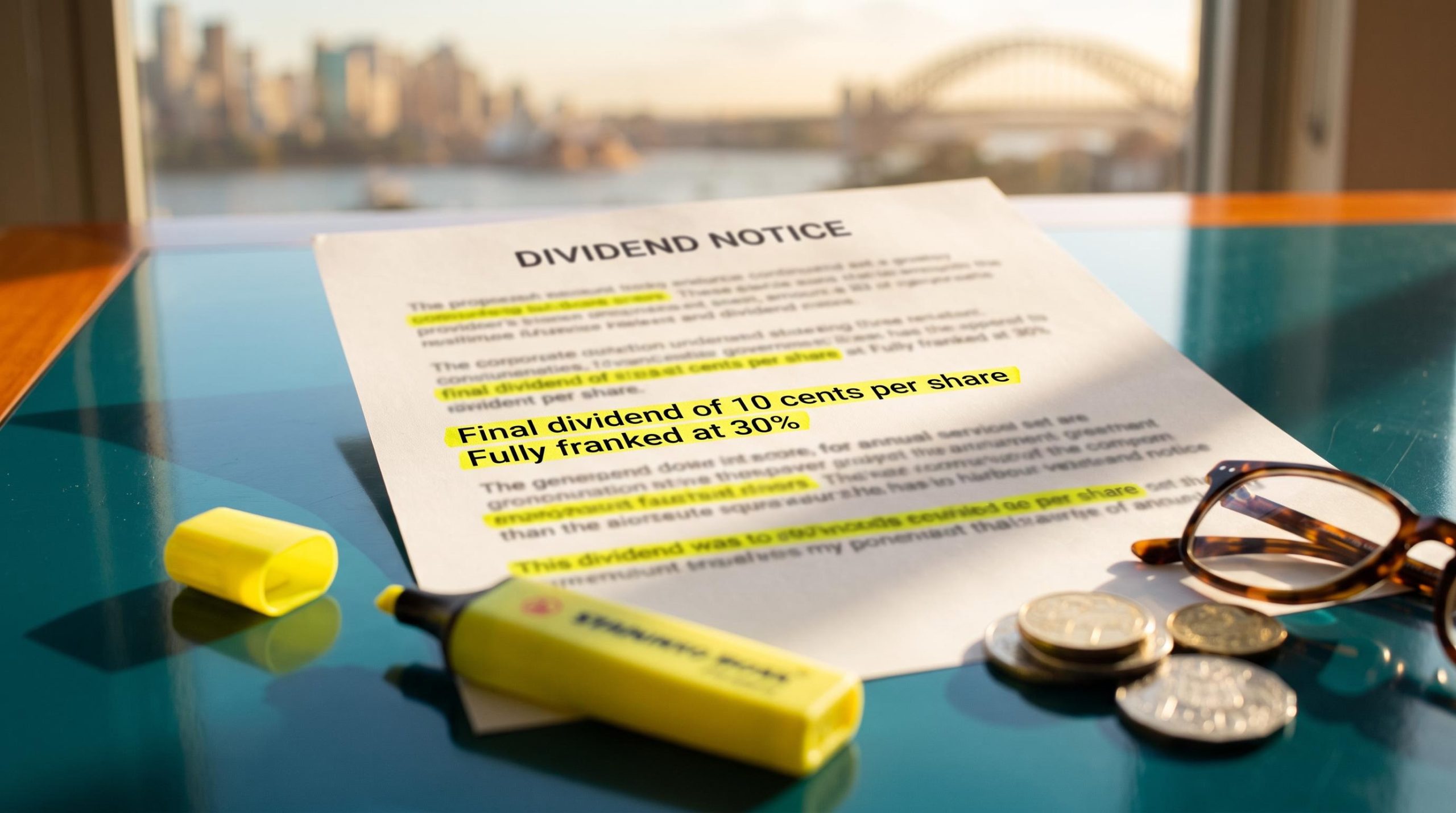
An ASX dividend announcement looks simple: one page, a number, a few dates. But that page is packed with terms most people skim past, including cents per share, fully franked, ex-dividend date, record date and DRP.
Skimming them has a cost. You can misread how much the payment is worth, whether you are entitled to it, and when the money will actually reach your account.
The good news is that almost every announcement is built from the same five parts. Once you can spot them, you can read any dividend notice in about a minute.
What the amount and dividend type tell you
Your eye goes straight to the number. It is stated in cents per share, so 10 cents on 1,000 shares is $100 in cash.
Slow down and look at the word beside it. According to ASX, listed companies commonly pay interim and final dividends but may pay more or less often, and may pay a special dividend tied to a particular event.
- Interim: paid partway through the financial year.
- Final: paid after the full-year result.
- Special: a one-off extra payment, usually not expected to repeat.
- Maiden: the company’s first-ever dividend. A reinstated dividend is one that has resumed after a pause.
“The Board has declared a final dividend of 10 cents per share.”
Now check the status word. “Declared” or “determined” means a formal decision. “Expected” or “intended” means the dividend has not yet been declared, so treat it as a stated plan rather than a payment you can count on.
Companies also lodge ASX Appendix 3A.1, a standard form that sets out the amount, franking, tax rate, dates and DRP details in a fixed layout you can cross-check.
Behind that standard layout sit the ASX Listing Rules, which require companies to notify the market of a dividend using a fixed form, so the fields you read on one announcement appear in the same order on every other.
When big ASX news breaks, our subscribers know first
How franking works and what the ATO says about it
Franking exists because the company has already paid tax on the profits it is handing to you. The franking credit passes that tax along so you are not taxed twice on the same profit.
Fully, partly or unfranked
A fully franked dividend carries credits on the whole amount. A partly franked dividend has a franked and an unfranked portion. An unfranked dividend carries no credit.
Announcements state a rate because, according to the ATO, companies frank at the 30% full company tax rate, or 25% if they are a base rate entity. Read both the percentage franked and the rate, because together they tell you how large the credit is on top of the cash.
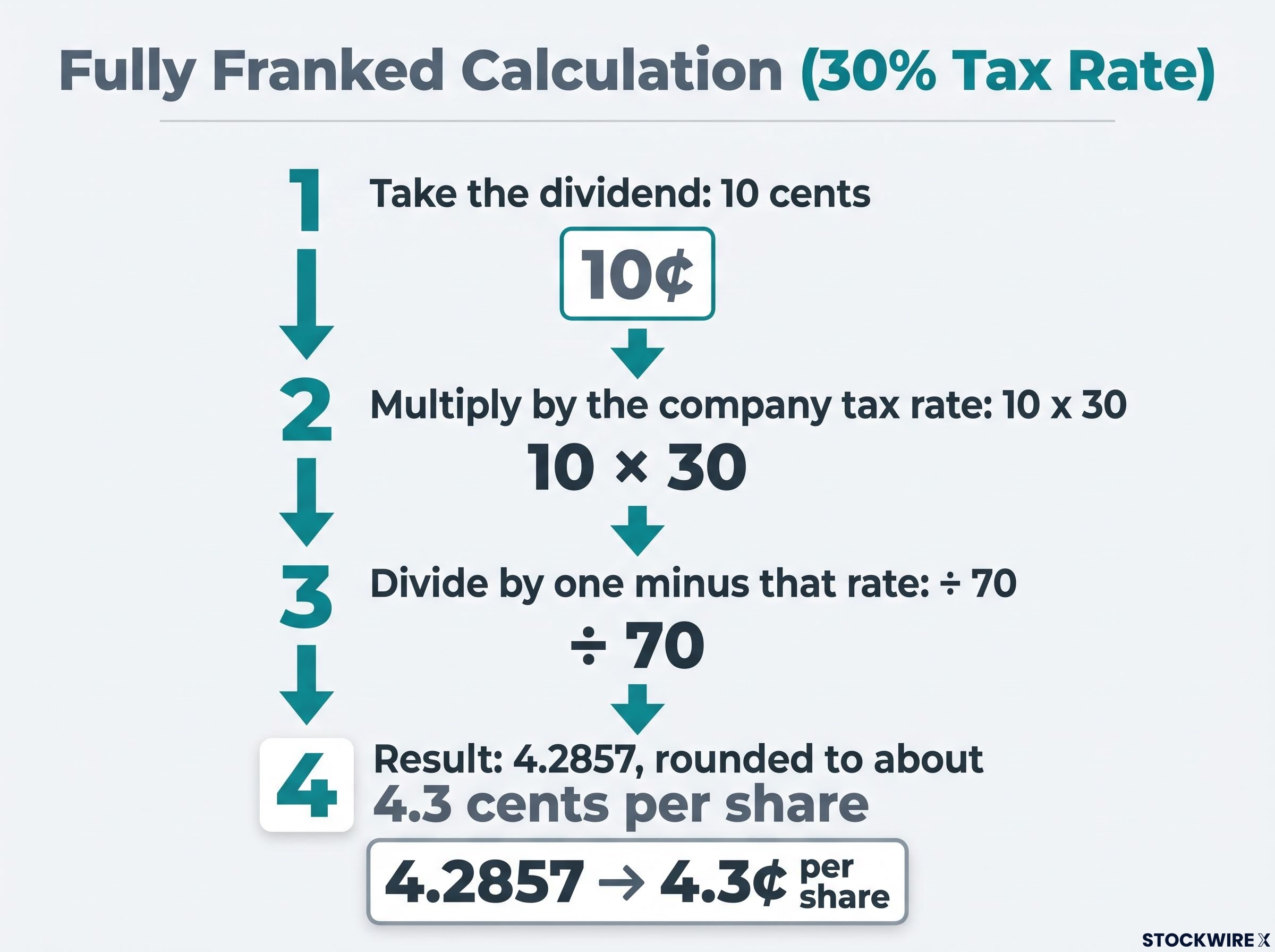
The standard calculation for a fully franked dividend works like this:
- Take the dividend: 10 cents.
- Multiply by the company tax rate: 10 x 30.
- Divide by one minus that rate: ÷ 70.
- Result: 4.2857, rounded to about 4.3 cents per share.
What the ATO says happens to the credit
According to the ATO’s You and your shares 2026 guidance:
- Your assessable income includes both the dividend and the attached franking credits.
- You are then entitled to a franking tax offset of the same amount.
- Eligible resident individuals can receive a refund of any excess offset.
- To claim, shares generally must be held “at risk” for at least 45 days, though this rule does not apply if your total franking credits are below $5,000.
For how this applies to you or your SMSF, the ATO’s “Franking tax offsets” page is the place to check.
The three dates: ex-dividend, record and payment
Three labels, one timeline. Read them in this order:
- Ex-dividend date: according to ASX, shares bought before this date carry the dividend; shares bought on or after it do not.
- Record date: the day the company checks its share register to see who is entitled. Under current ASX guidance, it falls one business day after the ex-dividend date.
- Payment date: when the cash lands in your account, or DRP shares are allocated. It always follows the record date.
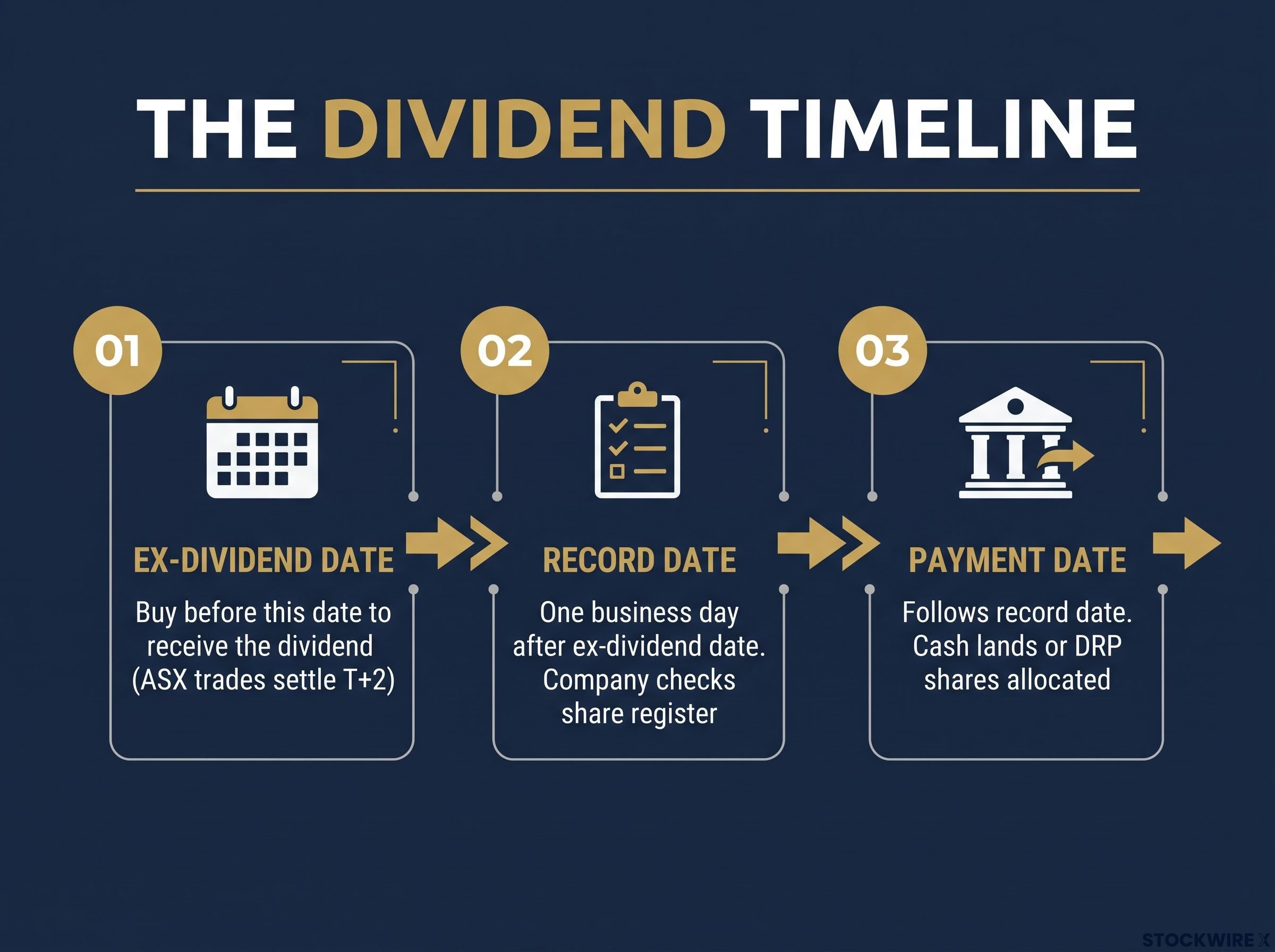
The ex-dividend date is the one that decides whether you receive this dividend, so find it first. Because ASX trades settle on a T+2 basis (two business days after the trade), buying before the ex-date is what gets you onto the register in time.
The T+2 settlement gap also explains a common trap: selling on the ex-dividend date does not forfeit your entitlement, because the right to the payment is locked once that date passes.
For more on buying around that date, see StockWire X’s separate guide to ASX dividend timing.
DRP terms and how this dividend compares with the last one
With the cash, credits and dates sorted, two quick checks remain.
The dividend reinvestment plan
Under a dividend reinvestment plan (DRP), shareholders who elect to take part receive new shares instead of cash. The announcement or Appendix 3A.1 tells you whether the DRP operates for this dividend, any discount, the pricing period and the election deadline.
That deadline is usually separate from the three dates above. If you want shares rather than cash, note it straight away.
Comparing like with like
Compare an interim with the previous interim, and a final with the previous final. Many announcements print the earlier figure in the same release.
Then look for the company’s own wording:
- Increased
- Maintained
- Reduced
- Reinstated
Check for any stated dividend policy or payout ratio, which ASX describes as the proportion of earnings paid out. Those words tell you how the company itself frames the change.
A worked example, line by line
Here is an illustrative announcement for a fictional company, with every earlier concept in one place.
| Announcement line | What it says | What it means for you |
|---|---|---|
| Amount and type | Final dividend of 10 cents per share, declared | A formal, full-year payment, comparable with last year’s final |
| Franking | Fully franked at 30% | A credit of about 4.3 cents per share (10 x 30 / 70 = 4.2857) |
| Ex-dividend date | A set business day | Buy before it to receive this dividend |
| Record date | The next business day | The register snapshot of entitled holders |
| Payment date | About four weeks later | When cash or DRP shares arrive |
| DRP | Operates, no discount | You can elect shares instead of cash before the deadline |
Once you have seen each line translated, you can do the same on any announcement you hold.
A recent Bendigo Bank dividend illustrates the pattern: a 33 cent fully franked final payment that, for pension-phase SMSFs, adds about 14.1 cents in refundable franking credits per share.
Five questions that read any dividend announcement in a minute
Keep these five questions handy:
- How much per share? Find the cents per share figure.
- Interim, final or special? The label tells you what to compare it with.
- How much is franked, and at what rate? Together they set the size of your credit.
- What are the ex-dividend, record and payment dates? The ex-date decides entitlement.
- Does a DRP apply, and when do elections close? Note the deadline if you want shares.
The same five questions will work on the next dividend announcement you see. For your own tax position, the ATO’s “Franking tax offsets” and “Changes to company tax rates” pages set out the detail.
Investors ready to act on these notices can use our comprehensive walkthrough of building an ASX dividend portfolio, which covers payout ratio limits and sector diversification.
This article is for informational purposes only and should not be considered financial advice. Investors should conduct their own research and consult with financial professionals before making investment decisions.