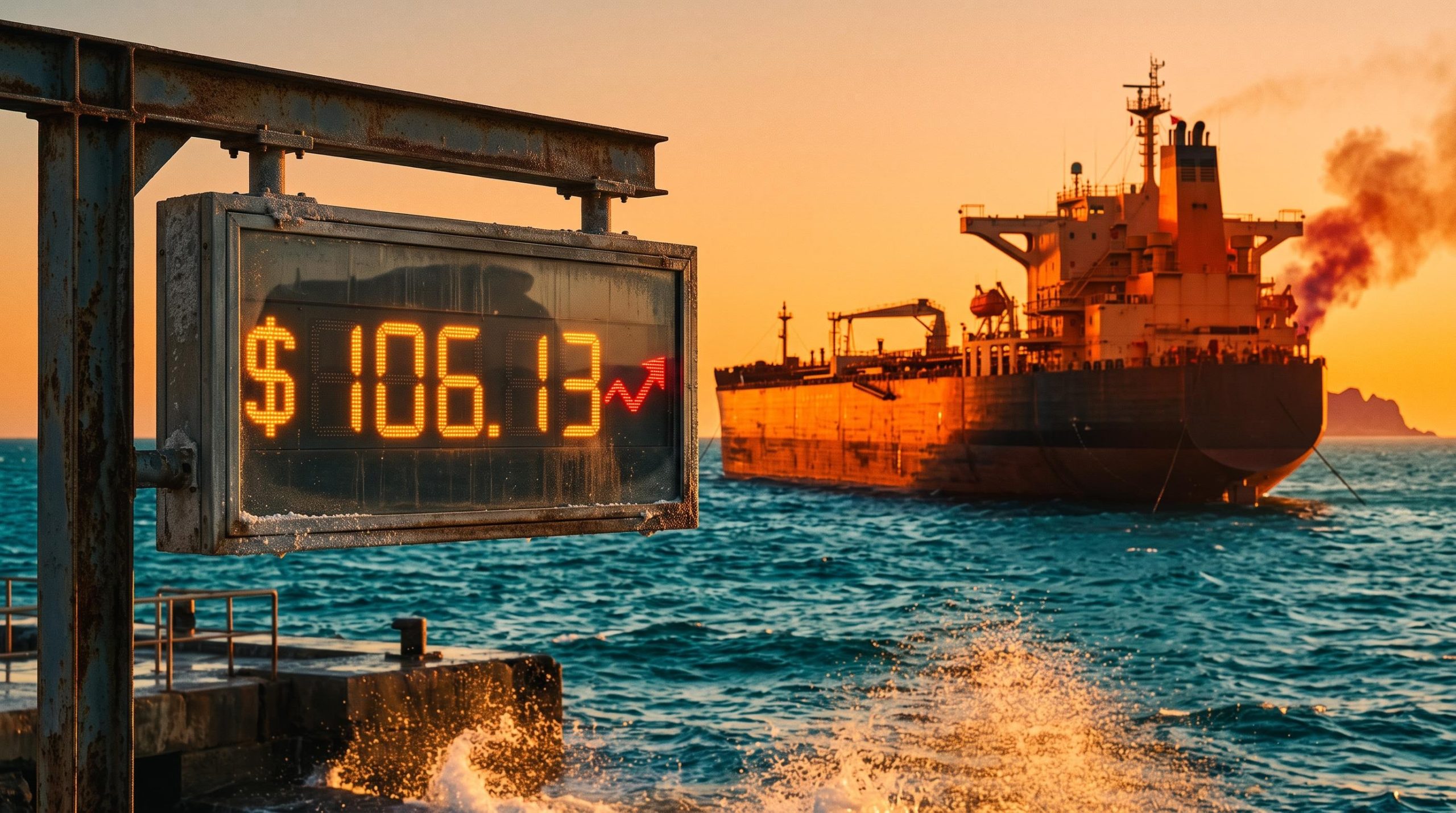
The Brent crude oil price settled at $104.77 a barrel on Monday, 2 November 2026, down 7.6% as hopes of US-Iran talks wiped a large slice of risk out of the market. By 1043 GMT on Tuesday, Brent had climbed back to about $106.13 after news of a US strike on Iran’s Qeshm Island.
One session erased much of the premium. The next session handed part of it back.
The question is whether the war-risk premium in oil is gone or only paused. It is being asked on the day of the US midterm elections, 3 November, which ING has flagged as a political deadline that could shape how much risk traders keep priced in.
Here is how to tell which oil headlines actually move barrels and which only move sentiment. That distinction matters for anyone holding energy stocks, commodity funds or anything sensitive to fuel costs.
Why did Brent fall 7.6% in one session, and why did it bounce back?
The drop was fast. Brent lost more than $8 in a single trading day, and Reuters reported that both Brent and West Texas Intermediate (WTI), the main US benchmark, fell more than 7%.
The trigger was a run of diplomatic signals. President Masoud Pezeshkian said Supreme Leader Mojtaba Khamenei had given the government wider authority to pursue peace negotiations with Washington. President Donald Trump said Iran wanted a deal and suggested progress had been made.
Two readings of the same talks Trump: Iran wants “to make a deal and that could happen.” A senior Iranian official to Reuters: the sides remain far from a deal, and Iran would reject Washington’s “excessive demands.”
Then the other side of the ledger arrived. A US official said the US struck Qeshm Island on Monday, reportedly after Iran fired at a US aircraft. Secondary coverage of Wall Street Journal reporting described it as part of limited US bombardments carried out quietly in recent weeks.
| Benchmark | Time | Price | Move |
|---|---|---|---|
| Brent | 2 Nov settle | $104.77 | -7.6% |
| Brent | 3 Nov, 0355 GMT | $104.80 | +3 cents |
| Brent | 3 Nov, 1043 GMT | $106.13 | +1.3% |
| WTI | 3 Nov, early | $96.66 | +20 cents (0.21%) |
| WTI | 3 Nov, 1043 GMT | $97.91 | +$1.45 (1.5%) |
ING strategists Warren Patterson and Ewa Manthey said energy markets retreated aggressively. They noted that talk hopes have surfaced before without result, but this time the signals came from both Washington and Tehran.
An earlier preliminary framework signal from Trump in August 2026 followed a similar pattern: markets reacted, yet no shipping resumed and a June memorandum of understanding had already collapsed before its window expired.
No detailed agreement was shown. The market repriced the odds of conflict, not the supply of oil, which is why a single day’s close tells you little about the underlying risk.
When big ASX news breaks, our subscribers know first
What is a geopolitical risk premium, and how do headlines move it?
That $8 swing is the premium in action. A geopolitical risk premium is the extra amount traders pay above an estimated fundamentals-only price. It compensates for the chance that conflict removes supply, delays cargoes, raises insurance and freight costs, or blocks producers from using spare capacity.
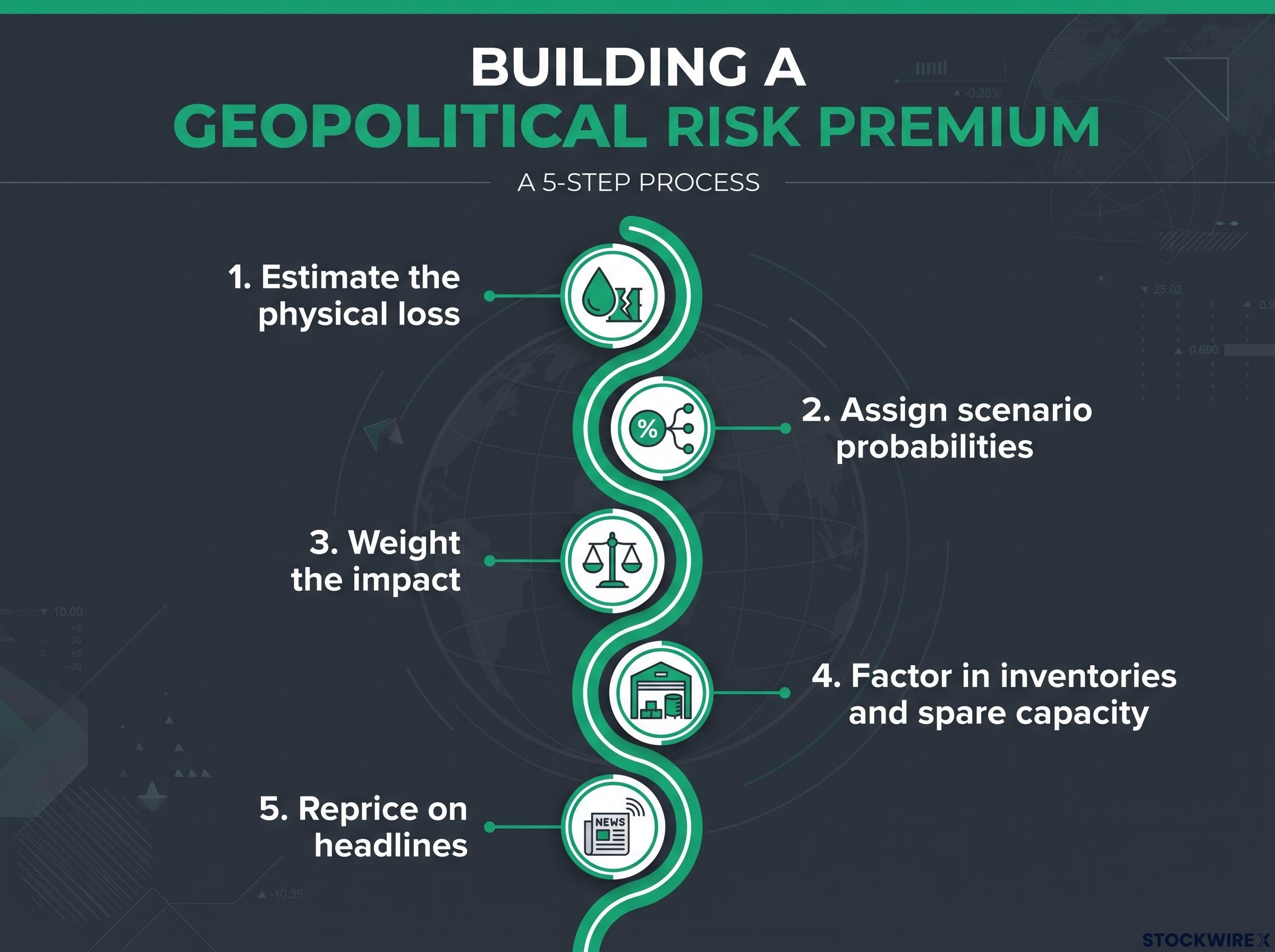
Traders broadly build it in five steps:
- Estimate the physical loss across exports, Gulf output, tanker loadings and Hormuz transit.
- Assign scenario probabilities, since a limited exchange of fire differs from attacks on terminals.
- Weight the impact, because a low-probability Hormuz closure still matters given its scale.
- Factor in inventories and spare capacity, as thin stocks push the premium higher.
- Reprice on headlines, often before any physical flow changes.
Futures react faster than physical flows because they are liquid and forward-looking, while real outcomes take weeks to verify. A presidential comment can shift the perceived odds of war in minutes without moving a single tanker.
In June 2025, Goldman Sachs estimated about $10 a barrel of premium was justified during the Israel-Iran conflict. Argus analyst Bachar El-Halabi has warned that traders can price the premium before any disruption occurs, leaving prices exposed to a sharp fall if mediation succeeds.
What the June 2025 ceasefire showed
Brent rose above $80 during that 12-day conflict, then dropped to about $67. On 24 June 2025 it fell 6.1% to $67.14, and TP ICAP’s Tamas Varga said the premium had “entirely vanished.”
That is a precedent, not a forecast for November 2026. It shows how quickly the premium can go once fears recede, so treat each headline as a change in odds and ask whether it changes any barrels.
Why ING still sees a substantial premium in Brent
The physical numbers explain why Monday’s sell-off did not clear the slate. ING argues a substantial premium remains because Persian Gulf flows are strong but still vulnerable, and says firm evidence of peace progress would imply further falls.
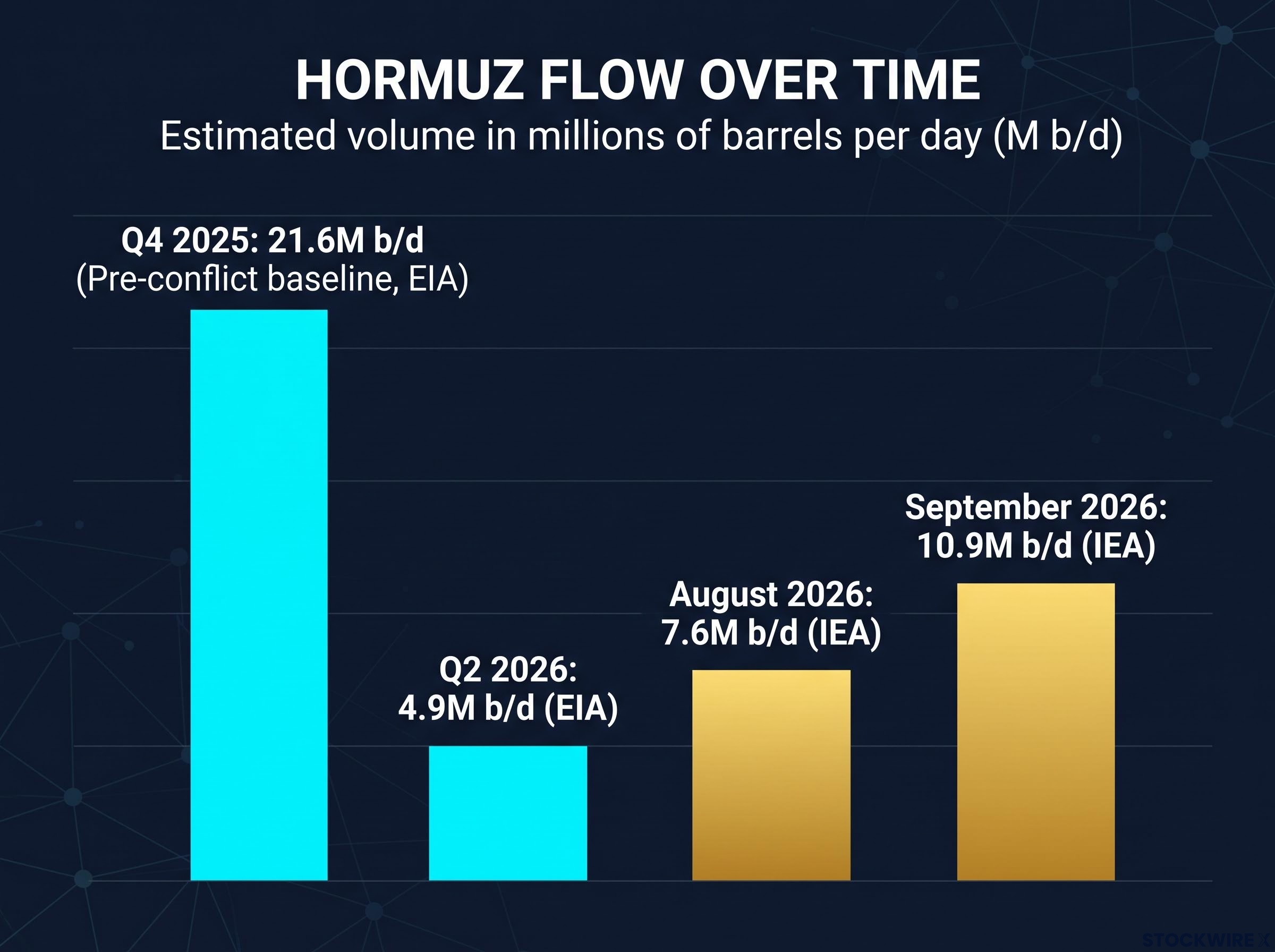
| Period | Source | Hormuz flow | Context |
|---|---|---|---|
| Q4 2025 | EIA | 21.6M b/d | Pre-conflict baseline |
| Q2 2026 | EIA | 4.9M b/d | Average, reported 6 Aug |
| August 2026 | IEA | 7.6M b/d | September report |
| September 2026 | IEA | 10.9M b/d | Up 3.7M b/d as protected transits rose |
The International Energy Agency’s (IEA) report on 29 October put Gulf crude exports at 13.9 million barrels a day (b/d) in September, up 4.4 million b/d and above 75% of pre-war levels. More oil is moving, but Hormuz traffic remains roughly half its pre-conflict level.
Even the starting point is disputed. Sources give different pre-escalation Brent references:
- ING: about $114 in late October and early November
- IEA: about $107 for October
- EIA: about $105 average in June and July 2026
These may reflect different dates or averaging periods, and the reporting does not allow the premium to be measured precisely. The US Energy Information Administration (EIA) projects Brent below $90 in Q4 2026 and averaging $76 in 2027 if conditions improve. ING adds that erosion could begin without a formal deal if the midterms pass without renewed strikes.
For you, the takeaway is that recovering but abnormal flows point to a premium that shrinks gradually, so the sell-off is not the end of it.
For readers wanting the wider picture, our deep-dive into the Hormuz oil squeeze covers physical premiums at Cushing and refining spreads that now drive fuel costs.
Which signals should you watch to read the next oil headline?
The next move depends on which direction events break. Real progress looks like a ceasefire, continued tanker passage, no new strikes after the midterm date and rising Gulf exports. Escalation looks like attacks on tankers, terminals, pipelines or Hormuz traffic.
Daily Hormuz transit counts offer a cleaner read than official declarations, and insurance conditions matter as much as legal status in deciding whether tankers actually sail.
In 2025, RBC’s Helima Croft and S&P Global’s Richard Joswick both pointed to the same threshold: the shift from political conflict to physical disruption.
| Scenario | Trigger | Likely price direction | Source |
|---|---|---|---|
| Diplomacy progress | Ceasefire, rising exports | Lower; EIA sees below $90 in Q4 2026 | ING, EIA |
| Status quo | Recovering but constrained flows | Gradual premium erosion | ING, IEA |
| Escalation (2025 scenarios) | Hormuz closure or blockage | $120-$130 (JPMorgan); about $124 for two months (Deutsche Bank) | JPMorgan, Deutsche Bank |
The JPMorgan and Deutsche Bank figures were 2025 scenarios, not base cases. Past performance does not guarantee future results, and projections are subject to market conditions and various risk factors.
Use this five-step test on any headline:
- Separate rhetoric from barrels. Did exports, loadings or infrastructure change?
- Track the chokepoint. Goldman has noted OPEC+ spare capacity cannot offset a closed shipping route.
- Think in scenario bands, not one forecast.
- Watch unwinding catalysts such as tanker passage and quiet political deadlines.
- Offset with macro downside. In March 2022 the IEA cut Q2-Q4 2022 demand growth by 1.3 million b/d as high prices bit.
ING’s caution Patterson and Manthey say it is likely premature to conclude that escalation risks are over.
The single question that cuts through the noise: does this headline change barrels, tankers or infrastructure? If not, it changes odds, and odds can reverse overnight.
What the sell-off settles, and what the next few sessions will test
Monday’s move repriced the odds of immediate US-Iran escalation. It did not prove Gulf supply risk had disappeared, and Brent’s climb back toward $106 after the Qeshm strike confirms a sizeable, unstable premium is still in the price.
The near-term tests are clear: the midterm outcome, whether strikes resume, further Iranian statements on talks, and the next round of Hormuz and Gulf export data.
When the next headline hits, run it through the five-step test before reacting to its tone. Your read on oil will be steadier for it.
This article is for informational purposes only and should not be considered financial advice. Investors should conduct their own research and consult with financial professionals before making investment decisions.