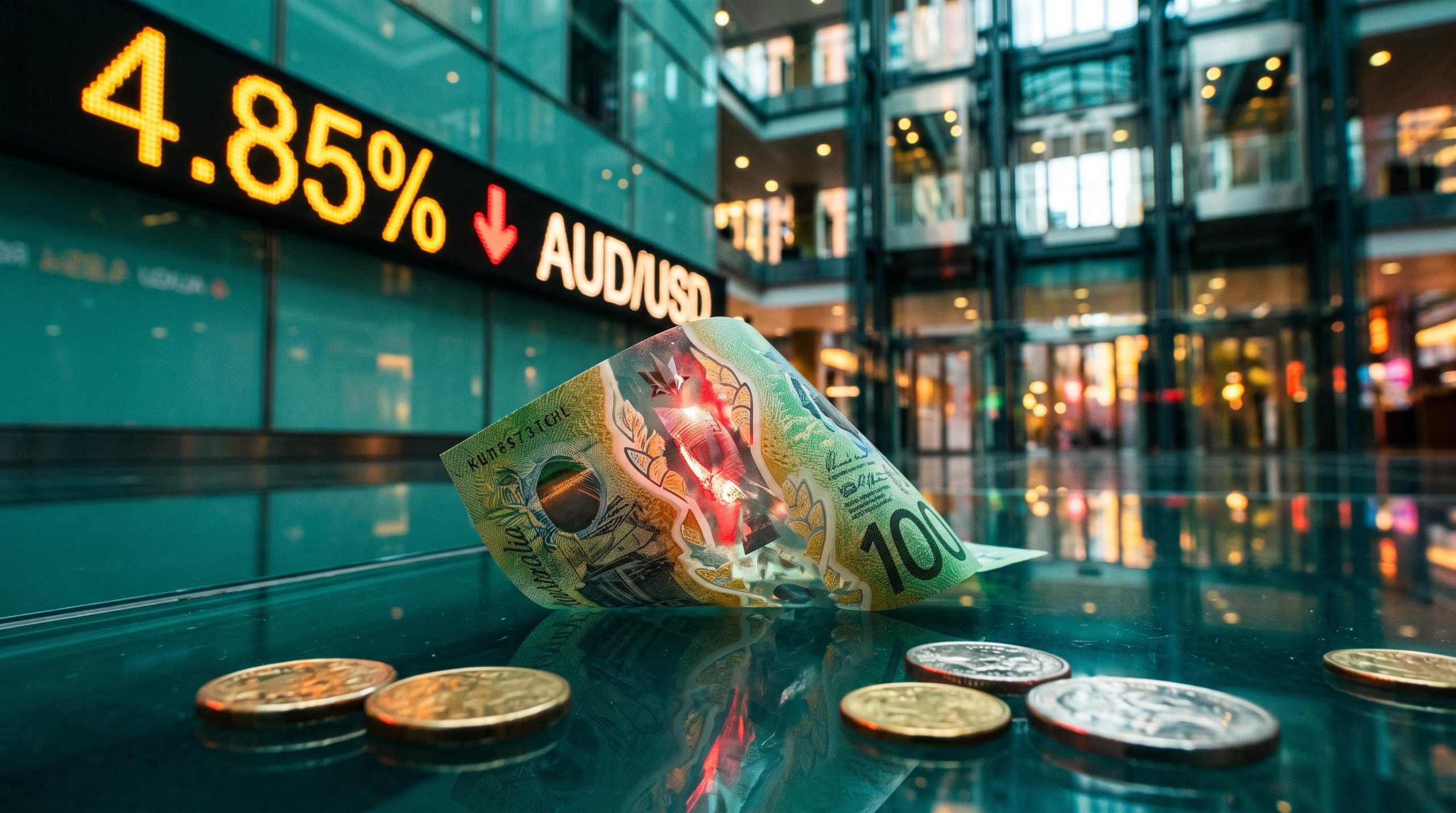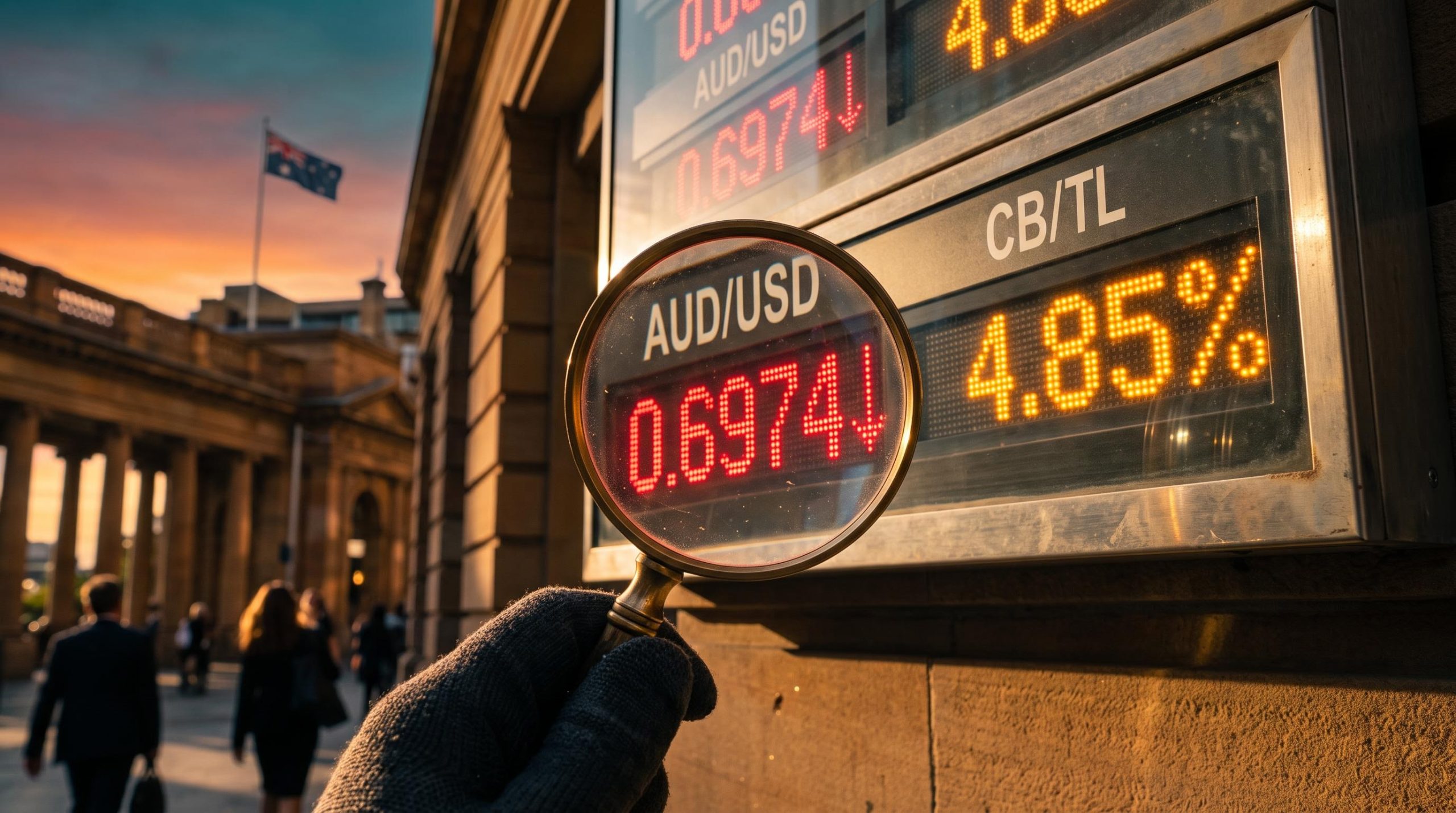
The Reserve Bank of Australia lifted the cash rate to 4.85% on 3 November 2026. Within hours, the Australian dollar had slipped below US$0.7000. If you assumed a rate rise automatically props up a currency, the screen showed otherwise.
The same session delivered a second hawkish story. Gold was sliding back toward US$3,900 an ounce after strong US manufacturing data lifted bets on a December Federal Reserve hike. Two moves in two different markets point to one driver, and it is not the headline RBA rate hike.
Here is why expectations, rather than the rate number itself, move currencies and gold, and what that means for your mortgage, your savings and any overseas or gold holdings.
All market levels below are snapshots from 2-3 November 2026.
Why did the AUD fall after the RBA hiked to 4.85%?
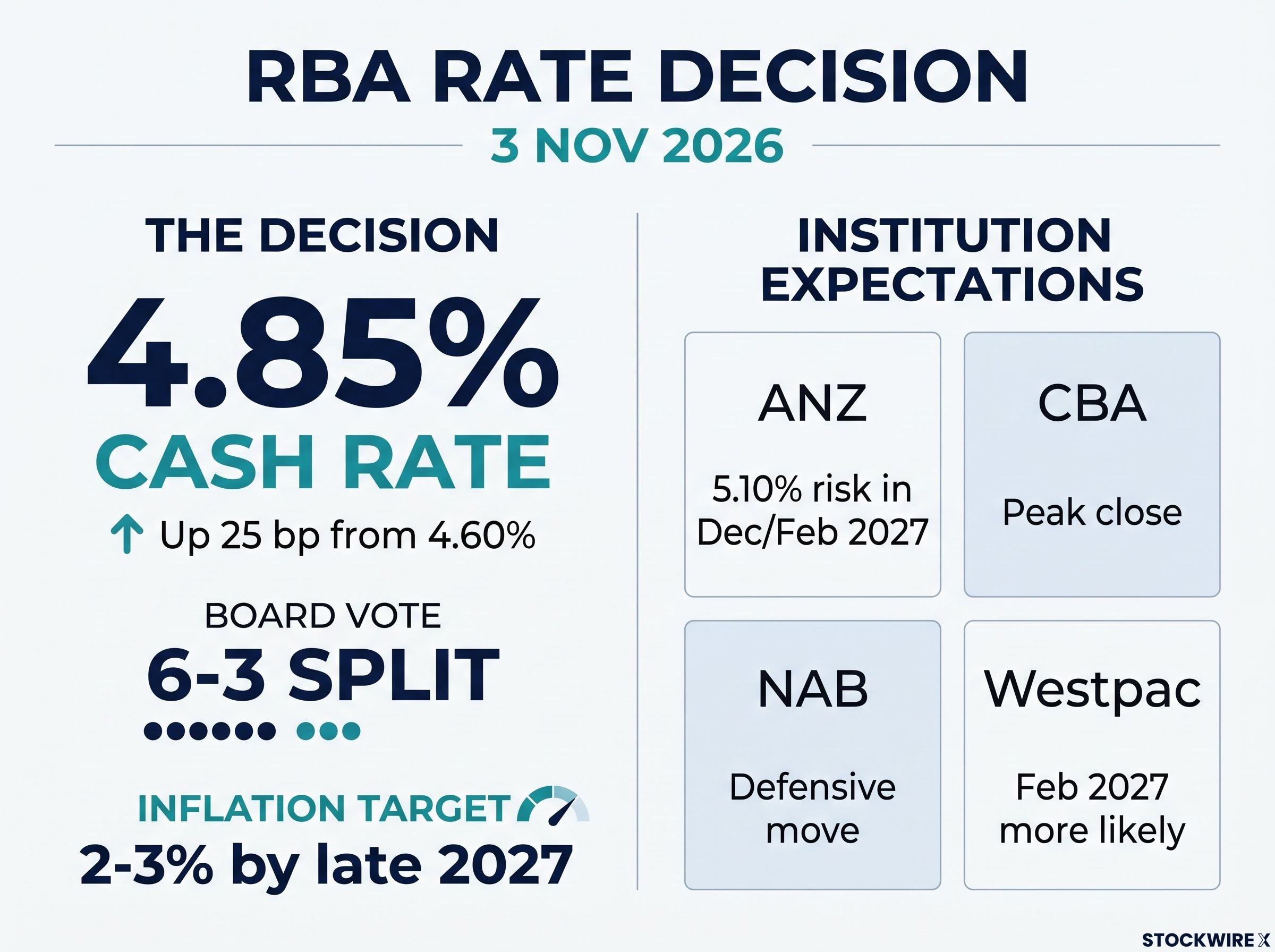
The board raised the cash-rate target by 25 basis points, from 4.60% to 4.85%. A basis point is 0.01 percentage point. The vote split 6-3, and the RBA pushed back its inflation path. It no longer expects inflation to reach the top of the 2-3% target band until late 2027, about three quarters later than previously forecast.
The statement left little doubt about the board’s reasoning:
RBA policy statement “Given the revised inflation outlook and the continuing upside risks, the Board judged that a further tightening in financial conditions is warranted to support the return of inflation to target.”
So why did the currency fall? The hike was almost fully expected. Markets implied about an 88% probability beforehand, and 30 of 32 economists in a Reuters poll had forecast it.
After the decision, AUD/USD fell as much as 0.35% to US$0.6974, near a two-week low, before trading around 0.6975-0.6980. That followed a separate session on Monday 2 November, when FXStreet reported a fall of nearly 0.5%.
This is a “sell-the-fact” move. The term describes a price falling after an event that traders had already priced in. With the hike banked, attention shifted to what comes next, and Governor Michele Bullock signalled that pausing to assess the data was probably the best next step, while leaving room to move again if needed.
That guidance lowered the expected path of Australian rates. Trading Economics pointed to the divided decision and limited hawkish guidance as the factors weighing on the dollar.
Earlier in the cycle, RBA statement language that stepped back from explicit tightening conditionality was flagged as the trigger that could compress short-end yields and weaken the AUD within a single session.
What the 6-3 vote signalled
Bullock said the three dissenters placed more weight on downside risks and wanted more information after four earlier increases. A board that close to a split makes a December follow-up less certain than 4.85% alone suggests.
Economists agree the RBA needed to respond. Where they part ways is the endpoint.
| Institution | View on the hike | Expected next move |
|---|---|---|
| ANZ | A “necessary increase” | Material risk of 5.10% in December or February 2027 |
| CBA (Belinda Allen) | An “insurance hike” | Peak close; December rise not ruled out |
| NAB | Shifted from hold to hike after the CPI release | Defensive move; underlying inflation above forecast |
| Westpac (Luci Ellis) | Expected the November rise | February 2027 more likely if another move is needed |
What this tells you is that a currency trades on the surprise, not the decision. If you hold unhedged overseas assets or are planning travel, the guidance and the vote count matter more than the rate itself.
When big ASX news breaks, our subscribers know first
How strong US data pushed gold toward US$3,900
The second story started in the United States, and it unfolded as a sequence.
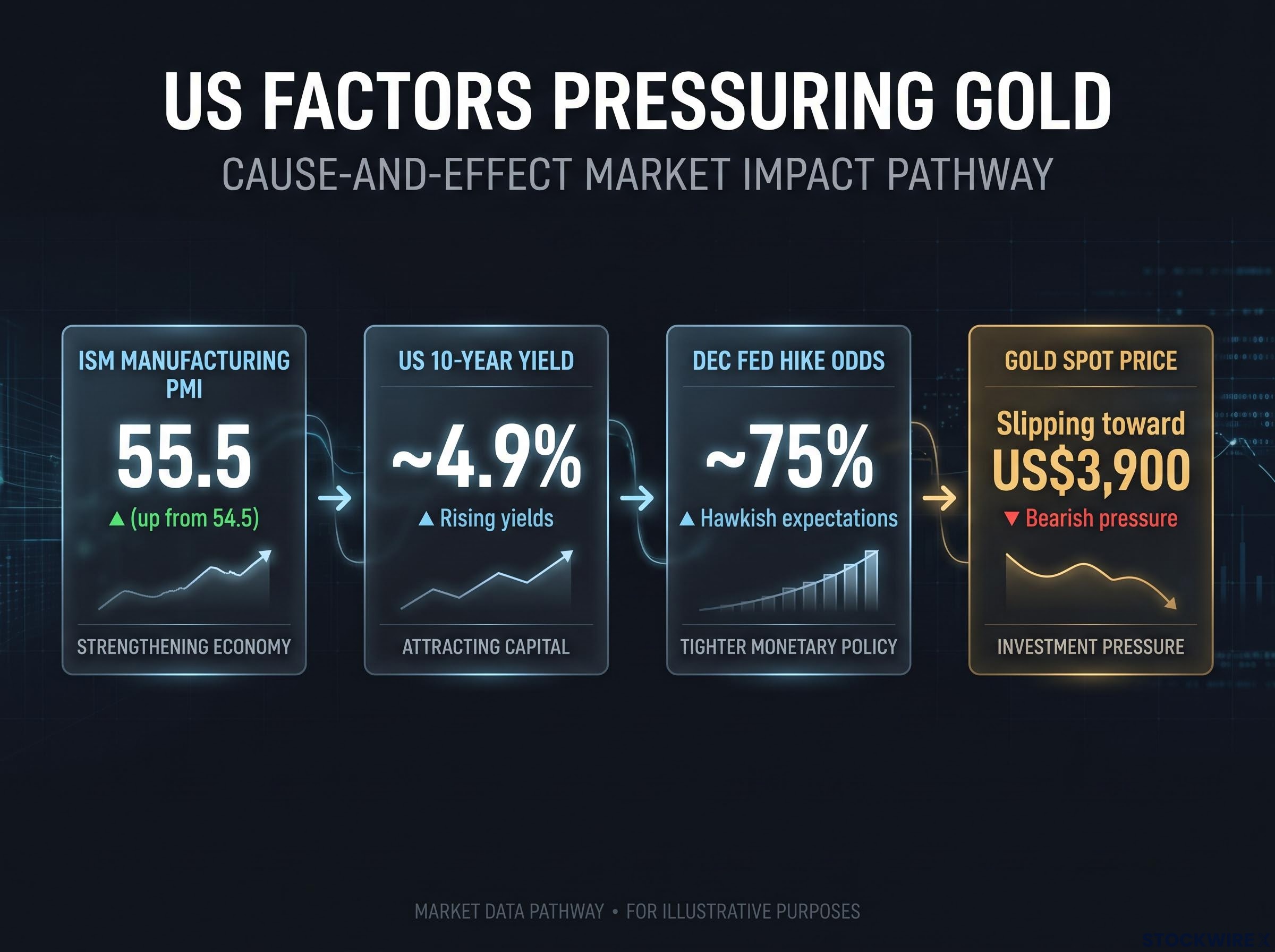
- The data beat. The ISM Manufacturing PMI for October came in at 55.5, up from 54.5, above consensus and the tenth consecutive month of expansion. Readings above 50 signal growth.
- Yields firmed. The US 10-year Treasury yield sat around 4.9%.
- Fed pricing jumped. CME FedWatch showed about a 75% probability of a December 25 bp hike, up from roughly 88%-91% odds of a hold in late October.
- Gold came under pressure. FXStreet reported gold slipping about 1% toward US$3,900 on Tuesday on hawkish Fed expectations.
| Indicator | Latest figure | Why it matters |
|---|---|---|
| ISM Manufacturing PMI (Oct) | 55.5 (Sept: 54.5) | Signals resilient US activity |
| ISM input prices | 75.2 (from 77.9) | Easing but still historically high cost pressure |
| US 10-year yield | About 4.9% | Raises the cost of holding gold |
| December Fed hike odds | About 75% | Market expects tighter US policy |
Gold’s path into this week matters. It hit a one-year low of about US$3,870.27 on 30 October, then bounced around 2% on Monday. CNBC put spot gold near US$3,900.90, and some reports had it near US$3,940-3,955 in Asian trading on 3 November before the Tuesday slip.
That rebound came after a sharp sell-off, so part of it was dip buying. It did not confirm a change in trend.
The US dollar told a similar story. The dollar index touched a one-month low near 101.40 on Monday, recovered after the ISM release, and traded above 101.70 early Tuesday.
Timestamps for the figures above:
- AUD/USD and RBA reaction: Tuesday 3 November, Asian hours
- Gold one-year low: 30 October
- Gold rebound and dollar index low: Monday 2 November
- Gold slip toward US$3,900: Tuesday 3 November (FXStreet)
For you, this means gold’s near-term direction is being set by US yields and Fed expectations far more than by Martin Place. The US data calendar is the one to watch.
How do interest rates move currencies and non-yielding gold?
Both moves run on the same logic, and once it is clear you can apply it to any rate decision.
How rates move a currency
The currency channel works in three steps:
- Higher domestic rates raise the return on deposits and short-term bonds in that currency.
- Investors may move capital toward that higher-yielding market.
- The currency rises if markets expect the higher rate to last or climb further.
Step three carries the weight. A hike that was already priced in, paired with cautious guidance, can actually lower the expected path of rates, which is exactly what happened to the AUD.
The RBA is only one of five simultaneous forces acting on the Australian dollar, alongside iron ore, Chinese demand, global risk sentiment and the trade balance, which is why a single decision rarely dictates the currency’s direction.
Why gold is sensitive to yields
Gold pays no coupon or dividend. Its opportunity cost, meaning the return you give up by holding it, is whatever interest-bearing assets offer instead.
World Gold Council The council identifies opportunity cost as a major driver of gold, which tends to look more attractive when yields fall or the dollar weakens. It has also noted that higher real yields can restrain investment flows.
Real yields are nominal yields adjusted for inflation. Because gold is priced in US dollars, a stronger dollar also makes it costlier for other buyers.
What weighs on gold:
- Rising nominal and real yields
- A stronger US dollar
What supports gold:
- Falling yields and a weaker dollar
- Inflation concerns and geopolitical risk
- Official-sector purchases
That last support is large right now. The World Gold Council reported central bank purchases of 321 tonnes in the quarter, up 42% and the highest since late 2024.
On 3 November, Australia’s expected rate advantage narrowed while US yields and Fed hike odds rose, a squeeze on both the AUD and gold. Higher yields raise the bar for gold, but they do not guarantee a decline when central banks keep buying and Fed pricing can reverse.
What the RBA hike and Fed debate mean for Australians
The market pattern translates into very different outcomes depending on where you sit.
| Group | Effect of a higher cash rate | Key thing to watch |
|---|---|---|
| Mortgage holders | Higher repayments; a further 25 bp adds about $107 a month on a $700,000 loan | Next RBA meeting and guidance |
| Savers | Higher deposit returns, subject to bank pass-through and inflation | Next RBA meeting |
| Share investors | Can support bank margins; weighs on leveraged and growth-sensitive companies | RBA guidance and US data |
| Currency-sensitive investors | Weaker AUD lifts import costs and AUD value of unhedged foreign assets | AUD/USD around 0.7000 |
| Gold holders | Australian rates alone are not decisive | US data, yields and FedWatch |
The household backdrop is already strained. Roy Morgan data cited in market coverage put mortgage stress near 32% after four hikes in 2026, and Reuters noted the latest move came as unemployment rose to a five-year high.
If you have a variable mortgage, the RBA’s December guidance is your key signal. If you hold gold or unhedged US assets, US data will move your position more than anything said in Sydney.
A weaker Australian dollar works in the opposite direction to the 2025-2026 rally, which had acted as a headwind for unhedged international ETFs such as IOO and VGS held by Australians.
What could change the picture
A 6-3 board is a real qualification on any December call. Three members already think the risks to jobs and growth justify waiting.
The 75% Fed pricing is a market estimate, not a commitment. Weaker US jobs, inflation or activity data could pull yields and the dollar lower and lift gold, while central bank buying keeps a floor of demand under the metal regardless.
Reading the next move: three signals worth tracking
The pattern is consistent across both markets. A priced-in hike with cautious guidance left the AUD weaker, while strong US data and firmer yields pressured gold.
Three signals will tell you whether that holds:
- The RBA’s December guidance. Incoming inflation and jobs data will show whether the dissenters or the hawks gain ground.
- US data and CME FedWatch pricing. A drop from 75% would ease pressure on gold.
- Key levels. Watch AUD/USD against 0.7000 and gold around US$3,900.
These levels are 2-3 November 2026 snapshots, and this is analysis of the current mechanism rather than a forecast. Economist views on future rate moves are speculative and subject to change based on market developments.
This article is for informational purposes only and should not be considered financial advice. Investors should conduct their own research and consult with financial professionals before making investment decisions.