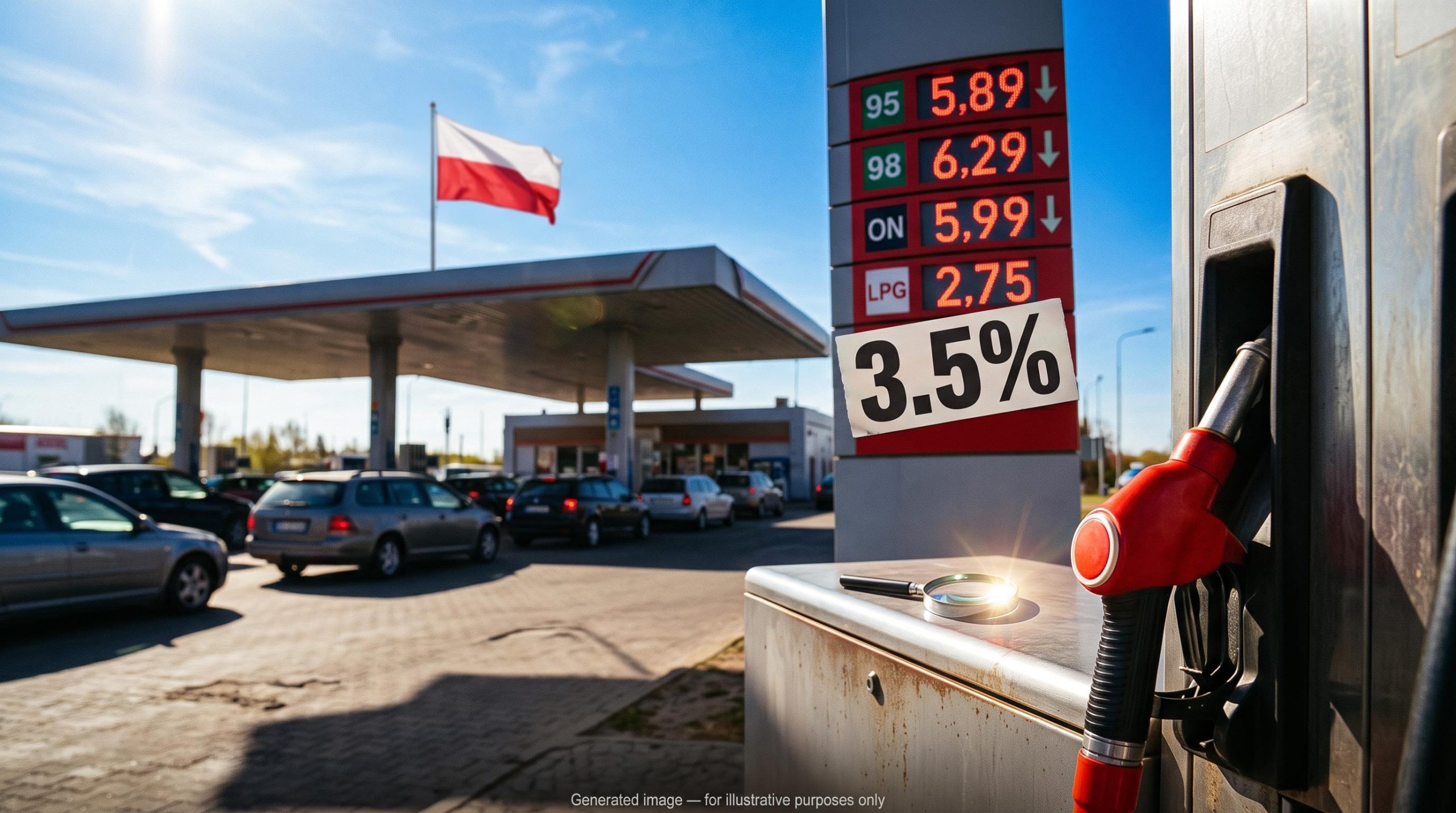
Poland’s October inflation figure looks like good news at first glance. The flash reading came in at 3.5% against a consensus of 3.7%, a clear undershoot. Yet a large share of that drop came from a government tax decision at the fuel pump, not from any easing in the price pressure that runs through wages, rents and services.
Commerzbank strategist Tatha Ghose contends that the reading mainly reflects a short-lived fuel-tax measure, and that real price pressure has not actually cooled. In his view, the miss will probably delay tightening by the National Bank of Poland (NBP). It is not evidence that the inflation problem is solved.
The timing makes this matter. The figure was published days before the NBP’s Monetary Policy Council (MPC) decision on Wednesday 4 November 2026. How you read it shapes your view of where Polish interest rates are heading and what that means for the zloty.
Here is how to separate a tax-driven headline move from underlying inflation, and why a softer print can still leave the tightening case intact and the currency under pressure.
What did October’s flash CPI actually show?
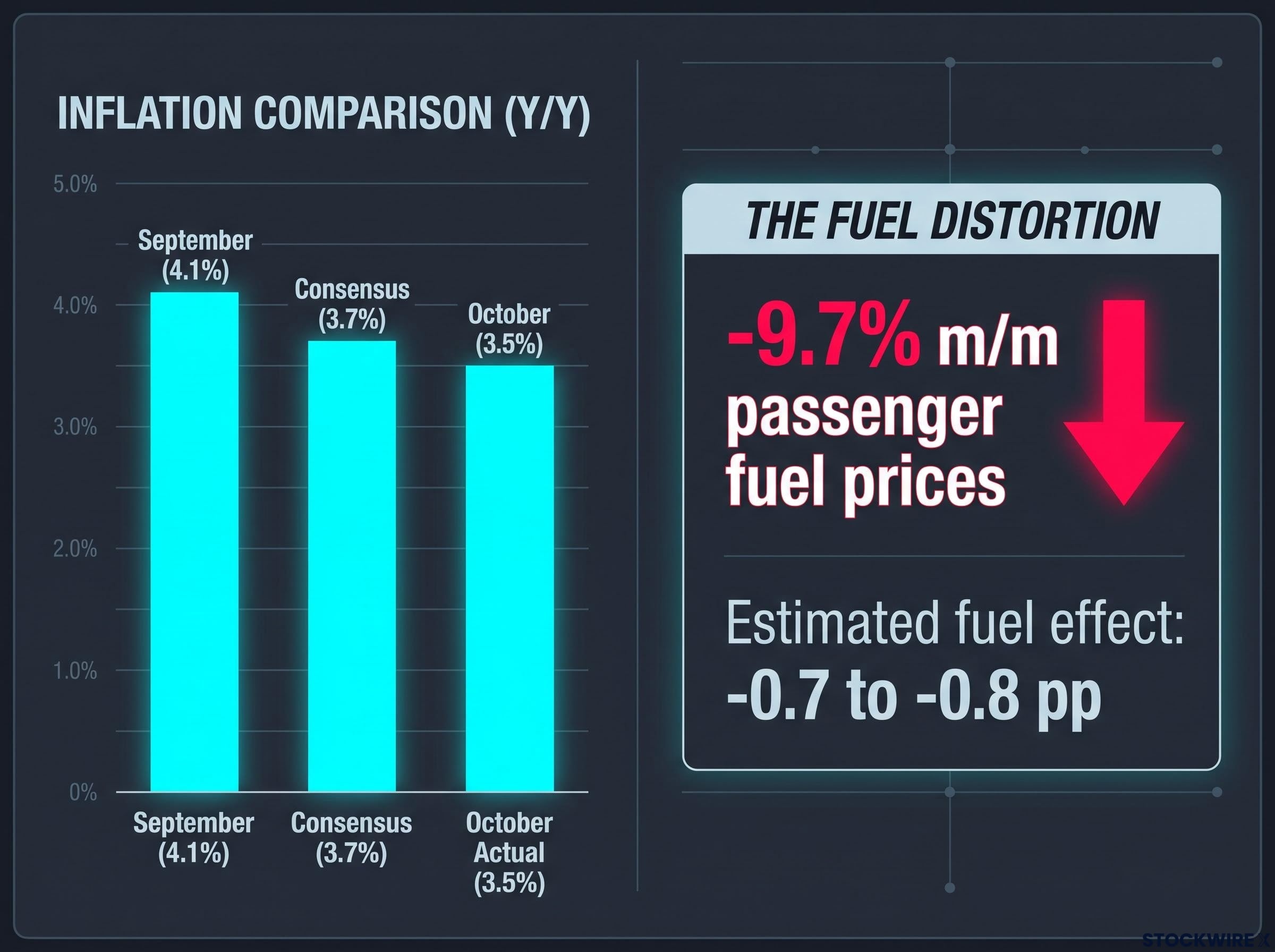
On paper, the release looked like a welcome surprise. Statistics Poland (GUS) published its flash estimate on Friday 30 October 2026. It showed headline consumer price inflation (CPI) at 3.5% year-on-year, down from 4.1% in September and 0.2 percentage points below what forecasters expected.
The month-on-month numbers look contradictory but are not. Commerzbank prefers the seasonally adjusted figure of -0.3%, which strips out regular calendar patterns. The official unadjusted flash showed -0.4%. These are two different measures of the same month.
Then comes the fuel line.
| Metric | Reading | Source / comment |
|---|---|---|
| Headline CPI, October | 3.5% y/y | GUS flash, down from 4.1% in September |
| Consensus forecast | 3.7% y/y | Market expectation before release |
| Month-on-month, seasonally adjusted | -0.3% | Commerzbank’s preferred measure |
| Month-on-month, unadjusted | -0.4% | Official GUS flash |
| Passenger fuel prices | -9.7% m/m | Largest single driver of the print |
| Fuel effect on annual inflation | About -0.8 pp | Commerzbank estimate; Pekao puts it near 0.7 pp |
Passenger fuel prices fell 9.7% in a single month. Commerzbank estimates that alone shaved about 0.8 percentage points off annual inflation, while Polish bank Pekao puts the effect slightly lower at about 0.7 points. The estimates differ at the margin, but both agree the effect is large.
Commerzbank’s read Ghose describes the October reading as a misleading indicator of underlying inflation trends, because a fuel-tax intervention drove the fall in pump prices.
Strip out the fuel effect and the October figure would have landed near or above consensus. That tells you 3.5% is a poor guide to underlying momentum, and you should be wary of treating it as a turning point.
Poland is not alone in this pattern. US data showed a similar misleading headline CPI in August, where gasoline accounted for over a third of the monthly increase while core inflation sat at a five-year low.
When big ASX news breaks, our subscribers know first
Why a temporary fuel tax cut distorts the inflation signal
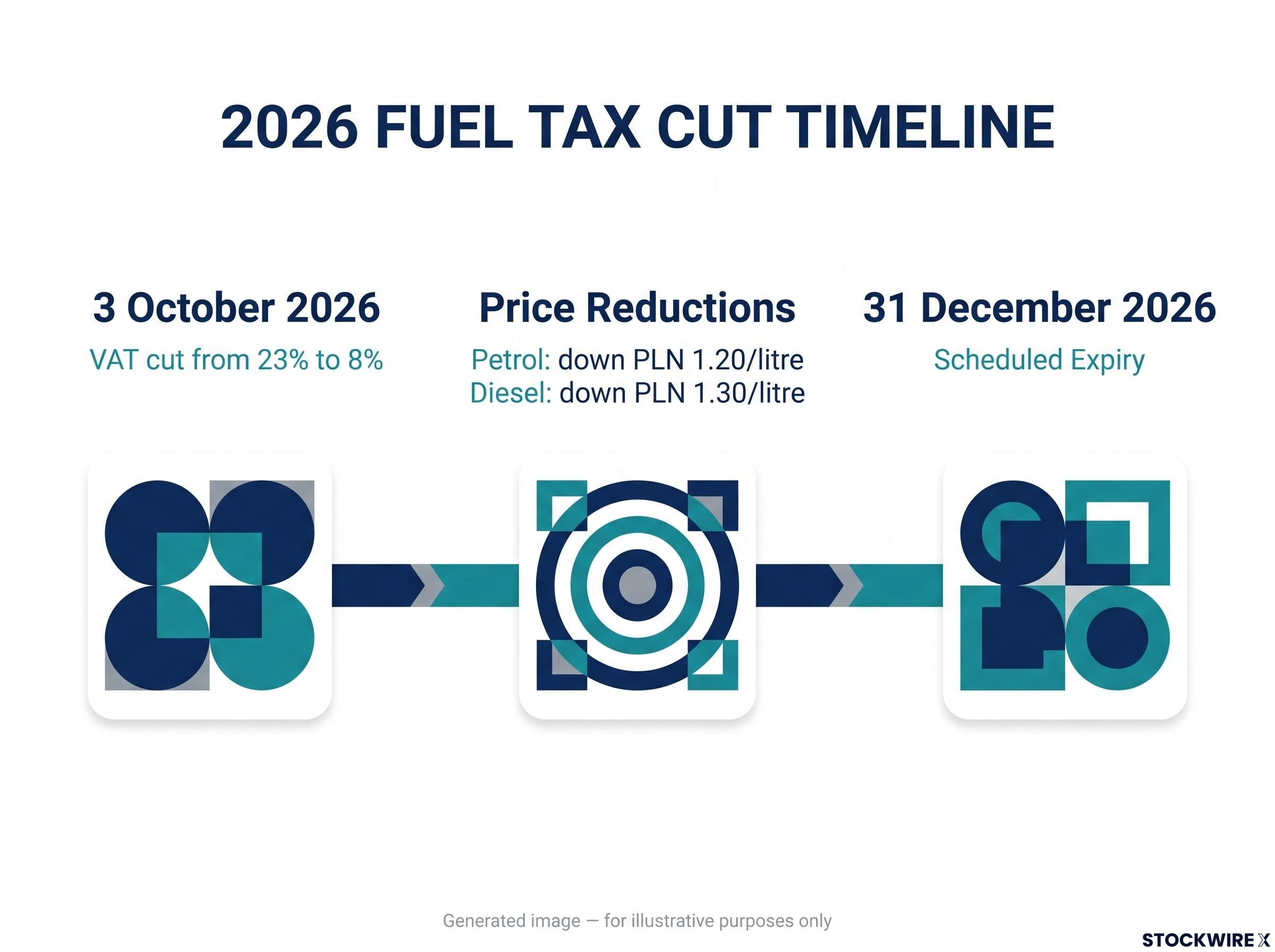
The fuel fall was not a market event. According to reports, the government cut VAT on liquid fuels from 23% to 8% and reduced excise duties, with the measures scheduled to run from 3 October to 31 December 2026. Deutsche Bank cited pump price reductions of about PLN 1.20 per litre for petrol and PLN 1.30 for diesel.
The distortion follows a simple sequence:
- The first-month effect is mechanical. Lower taxes cut pump prices immediately, and headline CPI falls with them.
- Headline moves more than core. Fuel sits outside the NBP’s core measure, so the headline drop overstates any improvement in underlying inflation.
- Expiry creates a base effect. When the cut ends, prices can jump back, and the yearly comparison worsens even if oil prices are unchanged.
- Extension only postpones the problem. It keeps headline CPI lower for longer but moves the adverse comparison to a later date.
Headline versus core in one minute
Headline inflation measures price changes across the full basket of goods and services households buy. Core inflation is the same measure with food and energy removed, because those prices swing sharply and often for reasons unrelated to domestic demand.
Since fuel is excluded from core, the tax cut barely touches it. Preliminary estimates suggest core held steady or eased: Pekao put October core below 3%, while Capital Economics saw it broadly stable near 3%. These are early readings, and the official NBP figure is due on 16 November 2026.
What happens when the cut expires
A base effect occurs when this year’s figure is compared with an unusually low or high figure from a year earlier. Once the tax relief ends, pump prices rise back toward normal and annual inflation climbs, with no new pressure in the economy at all.
Commerzbank expects an extension to be likely, though none had been confirmed as of today. Pekao and Deutsche Bank both point to the end of the CPN fuel-relief programme and higher household energy tariffs as sources of renewed inflation. Poland saw a similar pattern with temporary VAT and price supports during the 2022-24 inflation episode.
The lesson travels well beyond Poland. A tax cut changes the price level, not wages, rents, services or pricing power, so a falling headline driven by policy says little about whether inflation pressure has actually eased.
What does this mean for the NBP and the case for tightening?
For Wednesday’s meeting, the softer print makes the decision easy. The reference rate sits at 3.75% after the MPC held at its 6-7 October meeting, and a core reading near or below 3% gives the Council little reason to move now.
The harder question is what comes after. Post-expiry inflation, wage growth and fiscal pressure all keep a later hike in play, and most institutions now place it in early 2027.
| Institution | Date | View on NBP | Expected timing |
|---|---|---|---|
| Commerzbank | 2 Nov 2026 | Hold supported; macro backdrop favours eventual tightening | Tightening postponed |
| Pekao | 1-2 Nov 2026 | November hike odds sharply lower; up to 75 bp of tightening | Around the turn of 2026/27 |
| Capital Economics | 30 Oct 2026 | Hold at 3.75% in November | Hike more likely in 2027 |
| ING | 8 Oct 2026 (pre-CPI) | Two 25 bp hikes if the energy shock persists | Q1 2027 |
| Deutsche Bank | Oct 2026 | Tax cuts push the hike back, assuming no extension | Q1 2027 |
Policymakers have hinted at what would force their hand. As relayed by Pekao, MPC member Marcin Zarzecki listed possible triggers for tightening:
- Renewed weakness in the zloty
- Inflation above 3.5% for at least three months
- Wage growth of 7% year-on-year or more
Fellow member Ludwik Kotecki suggested the Council would react more forcefully if higher energy prices fed second-round effects into core inflation. Second-round effects occur when an initial price rise spreads into wages and other prices.
Whether energy costs feed into wages and services depends on how fast second-round effects build; the indirect channel through logistics and supply chains typically operates on a 6-12 month lag, so core data can look calm for a while.
The evidence is not one-sided. Some commentary reads core near or below 3% as partly genuine disinflation, which would weaken the hawkish case. These views are forecasts and remain subject to change as new data arrives.
What this tells you is that a hold is not a policy pivot. The data that would trigger tightening is wages, core and the zloty, so those are the numbers to watch rather than the headline.
Why the zloty may underperform despite a “good” inflation surprise
Lower inflation is usually expected to help a currency, since it protects purchasing power. Commerzbank argues the opposite applies here.
Commerzbank on the zloty Ghose predicts continued weakness for the zloty because of uncertainty over politics and the central bank, and does not see the inflation surprise offering the currency any lift.
The chain from a soft print to a weaker currency runs through interest rates:
- Hike odds fall. A temporary CPI drop lets the MPC delay tightening.
- Rate support weakens. Investors expecting higher Polish rates scale back those bets.
- Carry fades. Carry is the return earned from holding a higher-yielding currency, and it shrinks if the NBP sits still while other central banks look more predictable.
- Pressure builds. Pekao noted the strong US dollar was already pushing the zloty lower, with EUR/PLN near 4.39 and USD/PLN near 3.93 around today.
Fiscal concerns add another layer. The fuel programme is estimated to cost about PLN 5.3 billion, against roughly PLN 4 billion from the windfall tax meant to fund it. Pekao also warns that waiting for clear second-round effects could force a larger adjustment later.
There is a counterview. Pekao argues a higher rate path could eventually support the zloty, and a November NBP projection showing inflation above target, or easing political risk, could shift sentiment.
The takeaway for you is that currencies respond to expected rate paths and credibility, not a single CPI print. A benign-looking number can still be zloty-negative.
What to watch from the 4 November decision to the fuel tax expiry
October’s 3.5% headline is largely a tax effect. It gives the NBP cover to hold this week, but it does not remove the case for tightening once the relief fades.
Four dates now carry more weight than the flash print:
- 4 November: the NBP decision and its updated inflation projection
- 16 November: the official October core inflation release
- Before 31 December: any decision to extend the fuel measures
- Upcoming wage data: measured against the 7% year-on-year threshold Zarzecki flagged
When you judge where Polish rates and the zloty go next, weigh core inflation, wages and the currency above the headline figure. The policy distortion will unwind; the underlying pressure is what decides the path.
This article is for informational purposes only and should not be considered financial advice. Investors should conduct their own research and consult with financial professionals before making investment decisions. Past performance does not guarantee future results. Financial projections are subject to market conditions and various risk factors.