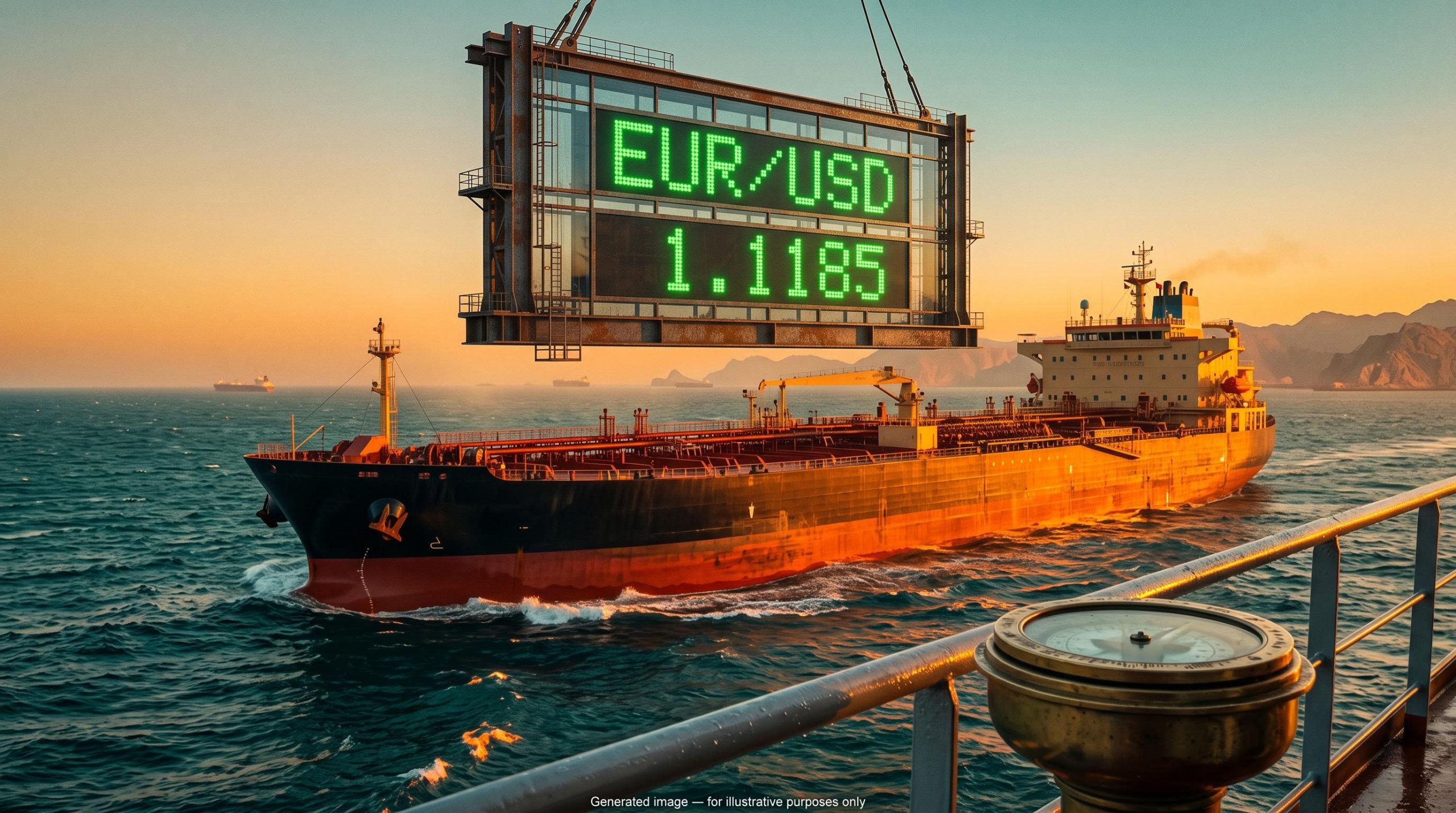
German retail sales fell 2.0% in September, against a forecast of a 0.4% rise, yet the euro climbed. By the European open, EUR/USD had pushed up to around 1.1185, a move that looks backwards if you read only the German headline.
That disconnect is the signal worth studying. It points to a week when the same data point can push the euro in opposite directions, depending on whether markets are watching oil, interest rates or risk appetite.
It is Monday, 2 November 2026. Brent crude is trading around $110 a barrel, and the coming days bring US midterm elections, two ISM surveys, Eurozone flash inflation, a speech from European Central Bank (ECB) President Christine Lagarde and US payrolls.
Here is how to read oil, US politics and the data calendar as one connected picture rather than a string of unrelated headlines. You will also get a practical map for each catalyst between now and Friday.
Why did the euro rise on a sharp German retail sales miss?
The German numbers were genuinely poor. Destatis data showed spending dropped sharply in September, wiping out most of August’s gain.
| Measure | Reading | Comparison |
|---|---|---|
| September, month-on-month | -2.0% | +0.4% expected |
| September, year-on-year | -2.3% | August revised to -0.3% from -0.4% |
| August, month-on-month | +1.2% | Revised from +1.3% |
On a normal morning, a miss that size would weigh on the euro. Instead, EUR/USD traded at roughly 1.1185-1.1188, up about 0.2%-0.27%, holding inside Friday’s range and above last week’s highs near 1.1100.
The explanation sat in the oil market.
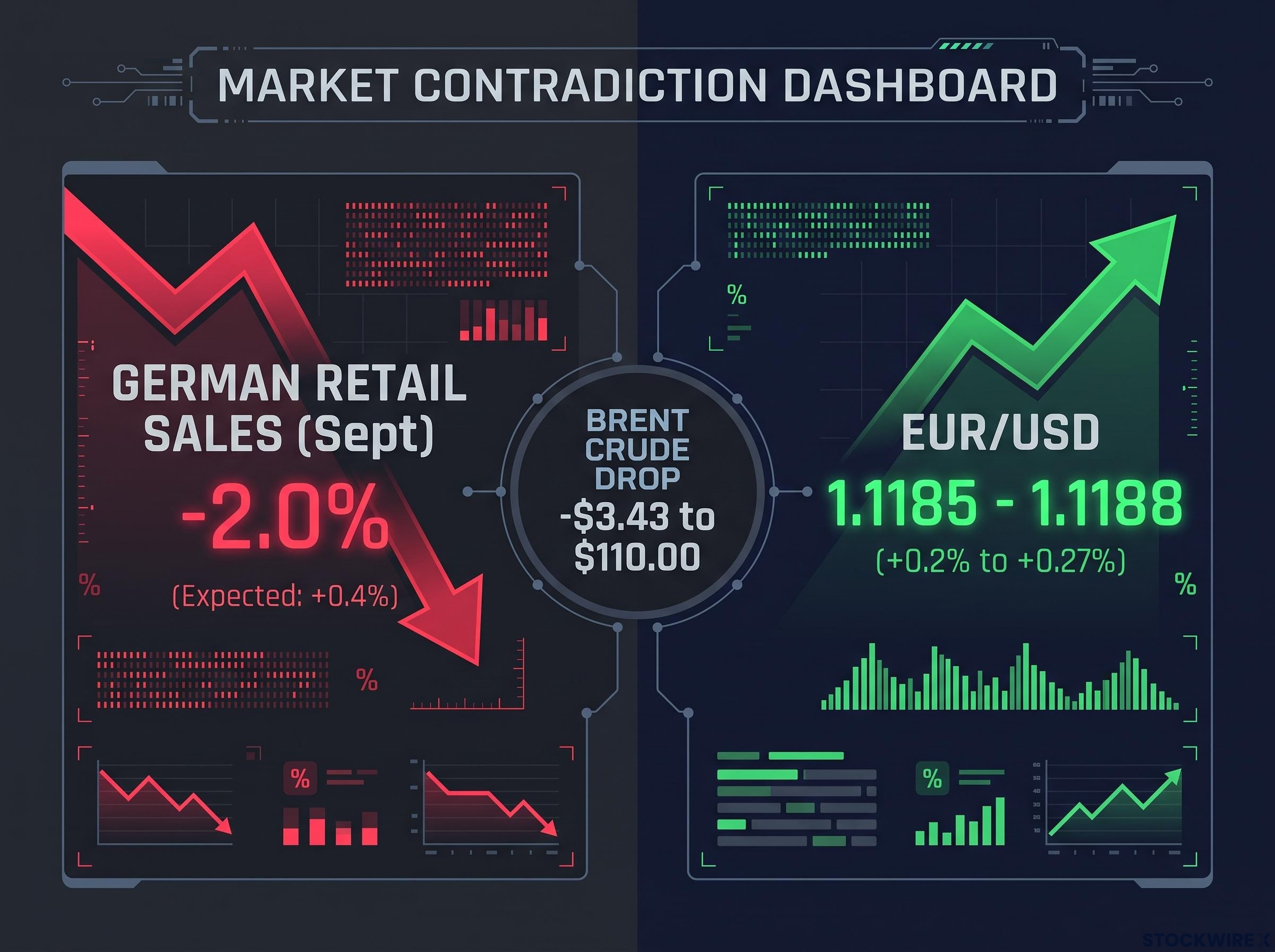
Reuters reported Brent fell $3.43 to $110.00 by 0712 GMT, a drop of more than 3%. FXStreet described the decline as over 2%, a gap that reflects timing and the measure used rather than any real disagreement about direction. The trigger was Qatar-mediated diplomacy aimed at ending the US-Iran conflict and restoring stable shipping through the Strait of Hormuz.
The diplomacy itself is far from settled. Iranian Foreign Minister Abbas Araghchi said talks were continuing and making progress, but no final agreement had been reached and there were no direct US-Iran negotiations. A reported proposal to reopen the Strait within two days remains exactly that: a proposal.
Because OPEC’s declining pricing power leaves a smaller share of supply under coordinated control, diplomatic progress on Hormuz can move crude prices more than any cartel quota decision.
What this tells you is simple but easy to forget. A headline data miss does not guarantee a currency fall, so before reacting to any release, check what else moved that same morning.
When big ASX news breaks, our subscribers know first
How does lower oil support the euro, and when does it stop working?
The euro area buys far more energy than it produces. When oil gets cheaper, the region pays fewer euros for the same barrels, and that improvement carries through the whole economy.
Three forces explain most euro moves across timeframes: ECB policy, inflation and trade balances. Oil sits behind all three, which is why a cheaper barrel can outweigh a weak domestic data print.
Economists call this the terms of trade: the price of what a country sells abroad compared with the price of what it buys. The ECB frames the issue directly.
ECB framing The central bank describes higher energy prices as a terms-of-trade deterioration for a net energy importer, cutting household real incomes and corporate profits, and notes that lower energy prices can improve the terms of trade.
Cheaper oil reaches the euro through four channels:
- Household purchasing power. Lower fuel and heating bills leave more income for other spending.
- Firms’ input costs. Businesses pay less for imported energy, which protects profit margins.
- Trade balance. A smaller energy import bill improves the region’s external financing position.
- Headline inflation. Energy prices feed straight into the inflation rate, so falling oil eases price pressure.
ING’s 2026 FX outlook argued that lower oil and gas prices could lift EUR/USD fair value from around 1.15 toward 1.20. Fair value is an estimate of where a currency should trade based on economic fundamentals rather than short-term flows.
There is a qualifier. Markets treated Monday’s drop as a shrinking conflict premium, not as a sign of collapsing global demand. Oil falling because the world economy is weakening would not carry the same euro support.
When the oil link reverses
The mechanism runs in both directions. Renewed escalation or fresh disruption in the Strait of Hormuz would worsen the trade balance, squeeze real incomes and push inflation higher.
Because the Iran talks remain unconfirmed, that reversal is a live possibility. For you, the euro’s oil sensitivity means Iran headlines are a euro driver this week, and a breakdown in talks is a risk to watch rather than background noise.
How could the US midterms move the dollar and EUR/USD?
Tuesday’s elections add a second driver. Polls favour Democrats to win Congress amid voter frustration over living costs and energy prices, while the Senate looks tight. The dollar opened the week softer as attention turned to the vote.
The policy backdrop shapes every outcome. The Federal Reserve held its target range at 3.75%-4.00% on 28 October, with two officials preferring a hike, while the ECB deposit rate stands at 2.50%.
| Scenario | Likely rates effect | EUR/USD tilt | Source |
|---|---|---|---|
| Republican control or sweep | Higher issuance and term premia; 10-year above 5.5% | Initially lower | ING; AllianzGI |
| Democratic win | Lower expected deficits could ease yields; 10-year still close to 5.5% in a sweep | Mixed | ING; Karl Schamotta (Corpay) |
| Split Congress | Gridlock restrains spending; 10-year around 5.25%-5.5% | Ambiguous at first | ING; Michael Hartnett (BofA) |
| 2027 funding and debt-ceiling disputes | Volatility around the 11 December 2026 deadline and a possible mid-2027 standoff | Potentially higher if confidence in US fiscal management slips | Reuters; Schroders; AllianzGI |
The views genuinely conflict. ING stresses yield-led dollar support under Republican control, as heavier borrowing pushes Treasury yields up. Karl Schamotta of Corpay argues a Democratic win could briefly support the dollar by reducing uncertainty around aggressive fiscal, trade and foreign-policy moves.
That leaves the same result capable of pushing the dollar either way.
What history says
Past elections offer little comfort to anyone hunting a fixed playbook. Endowus found the 10-year yield fell more often than it rose after recent midterms, and the broad dollar index was lower six months later after four of the five midterms from 2006 to 2022, averaging a 1.2% decline.
The read you should take is that the result matters less than how yields and risk appetite respond to it. On Wednesday morning, watch Treasury yields before trusting a “Republicans win, dollar up” reflex.
Which data releases could decide the week, and how should you read them?
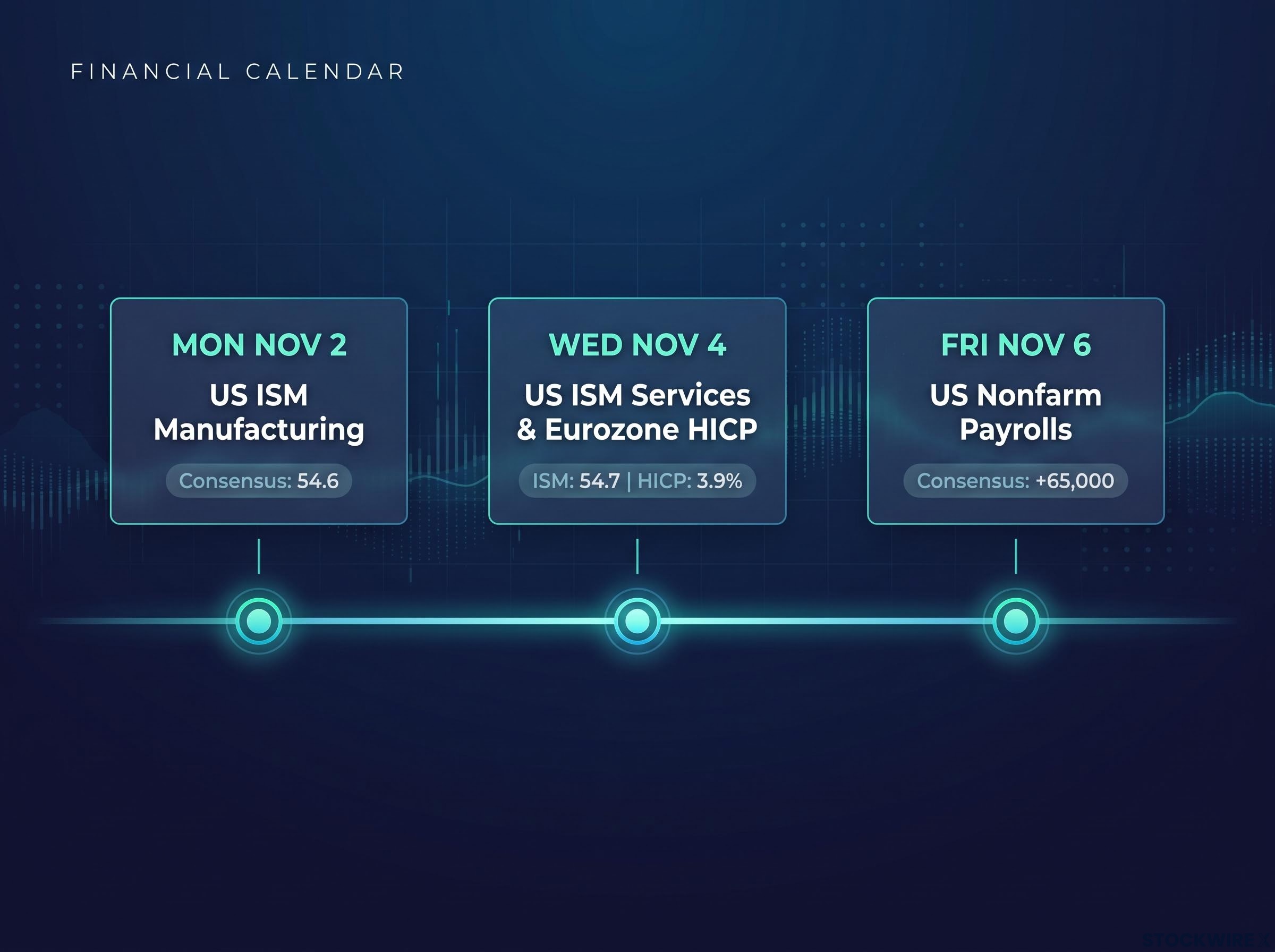
The calendar builds steadily toward a heavy back half. Monday brings US ISM Manufacturing and the HCOB Eurozone Manufacturing PMI, Tuesday brings Eurozone unemployment, and Wednesday 4 November stacks US ISM Services, the Eurozone Services PMI and flash inflation together. Lagarde speaks Thursday, then Friday 6 November delivers Eurozone retail sales and US payrolls.
| Release | Consensus | Prior |
|---|---|---|
| US ISM Manufacturing (Oct) | 54.6 | 54.5 |
| US ISM Services (Oct) | 54.7 | 54.9 |
| US nonfarm payrolls (Oct) | +65,000 | +29,000 |
| US unemployment rate (Oct) | 4.2% | 4.2% |
| Eurozone flash HICP headline (Oct) | 3.9% | 3.8% |
| Eurozone flash HICP core (Oct) | 2.5% | 2.5% |
| Eurozone unemployment | Not available | Not available |
Eurozone inflation and Lagarde
The ECB held on 29 October, warning the energy shock would keep headline inflation above target while describing underlying inflation as broadly stable. Wages support that view: compensation growth slowed to 3.3% in Q2 from 3.6%, and the ECB wage tracker points to 2.5%-2.8% later in 2026.
So the real question for Wednesday is whether inflation stays energy-led or spreads into core and services. Marchel Alexandrovich of Saltmarsh Economics said the October decision left a December hike firmly in play, while the ECB itself sounded more cautious. Lagarde’s Thursday remarks may show which reading she favours.
A poll of economists found most expect a December hike to 2.75% rather than any October move, with inflation near 3.8% and oil above $100 removing the usual too-weak-to-hike argument.
Payrolls and the Fed
The +65,000 payrolls consensus sits only modestly above September’s +29,000, so even a moderate surprise could shift Fed expectations.
| Data outcome | Policy implication | EUR/USD effect |
|---|---|---|
| Hot euro headline with higher core or services | Higher chance of an ECB hike | Euro-positive |
| Hot headline, stable core and wages | ECB may look through the energy spike | Initial gain could fade |
| Cool inflation, lower core or services | Less pressure to tighten | Euro-negative |
| Strong US payrolls or wages | Delays Fed easing; yields rise | EUR/USD-negative |
| Weak payrolls, rising unemployment | Raises Fed easing expectations | EUR/USD-positive |
| Weak payrolls with strong US inflation | Ambiguous stagflationary signal | Direction unreliable |
A warning sits underneath the grid. Weak payrolls usually hurt the dollar, but a broad risk-off move can lift it as a safe haven, and strong euro inflation can reverse if markets read it as growth damage. Treat each release as a test of a specific question, and wait for yields to confirm a first move before trusting it.
These scenarios are speculative and subject to change based on market developments. This article is for informational purposes only and should not be considered financial advice. Investors should conduct their own research and consult with financial professionals before making investment decisions.
A short checklist for reading a headline-heavy week
The method comes down to three steps you can repeat for every headline.
- Identify the dominant driver. Ask whether oil, politics or data is doing the work on the day, not which headline is loudest.
- Trace the channel. Oil moves the euro through the terms of trade, elections through Treasury yields, and data through ECB and Fed rate expectations.
- Check for confirmation. A first move that yields and risk sentiment do not back up is vulnerable to reversal.
Monday’s session is the live example. The euro brushed off a sharp German miss because cheaper oil mattered more, yet that support rests on Iran talks that remain unconfirmed.
Expect headline-to-headline reversals through Friday. No single release, election result or diplomatic update is likely to settle the direction of EUR/USD on its own.