
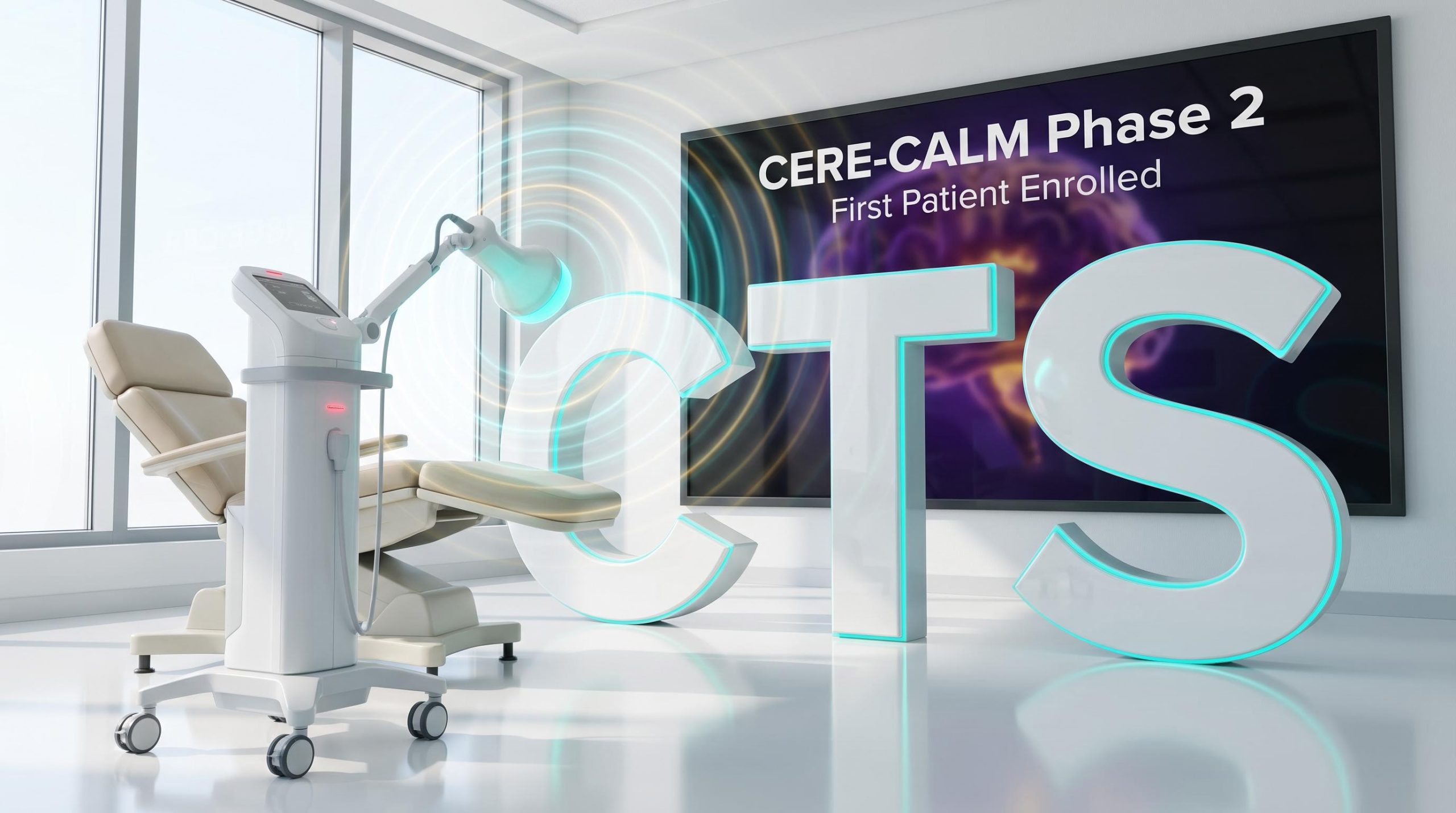
First patient enrolled in Ceretas Phase 2 CERE-CALM Alzheimer’s trial
Ceretas Limited (ASX:CTS) has enrolled the first patient in its Phase 2 CERE-CALM trial, a clinical milestone for its portable, non-invasive therapeutic ultrasound platform. The Phase 2 Alzheimer’s trial is evaluating low-intensity focused ultrasound neuromodulation for behavioural and psychological symptoms of dementia (BPSD).
The announcement, dated 29 October 2026, sets out the following trial parameters:
- 66 patients targeted (minimum 60)
- Randomised, double-blind, sham-controlled design
- Trial described as fully funded
- Completion anticipated in H1 CY28
The Company states that $3.4 million of its IPO proceeds is allocated to CERE-CALM.
Dr Rachel de las Heras, CEO/MD
“The enrolment of our first patient in CERE-CALM represents an important milestone for Ceretas as we advance our therapeutic ultrasound technology through clinical development.”
The company also noted that CERE-CALM is designed to build on Phase 1 findings through a larger, placebo-controlled study. For investors, enrolment moves Ceretas from trial preparation into active patient treatment and data generation.
When big ASX news breaks, our subscribers know first
Inside the CERE-CALM trial design
Trial structure and endpoints
CERE-CALM is a Phase 2 randomised, double-blind, sham-controlled trial. A sham procedure is a placebo, which allows researchers to compare outcomes between treated and untreated groups.
| Feature | Detail |
|---|---|
| Population | Adults aged 50 and over with probable Alzheimer’s disease and BPSD |
| Randomisation | 2:1 to active treatment or sham control |
| Treatment schedule | Six treatments over 12 weeks: four weekly sessions followed by two monthly sessions |
| Primary endpoint | Change in Neuropsychiatric Inventory (NPI) total score, baseline to week 6, active treatment versus sham control |
| Secondary endpoints | Caregiver distress at week 6 and week 12, durability of treatment effect at week 12, and overall safety and tolerability |
The trial is listed on the Australian and New Zealand public clinical trial registry under code ACTRN12626000738325.
Where recruitment is happening
Patient recruitment is underway at Cognivus Research in Sydney. Recruitment at St Vincent’s Hospital in Sydney and the John Hunter Medical Research Institute is expected to commence shortly.
Additional sites could support the pace of enrolment across the multi-site Australian study.
Understanding focused ultrasound neuromodulation and BPSD
Three concepts sit behind the trial.
- Neuromodulation: a technique used to influence the activity of nerves and neural circuits in the brain.
- How the technology works: Ceretas’ technology delivers low-intensity ultrasound waves through the skull to specific areas of the brain, without requiring surgery. It is designed to influence neural activity in targeted circuits and does not rely on medication to produce a therapeutic effect. It is being developed as a portable treatment platform.
- BPSD: behavioural and psychological symptoms of dementia, including agitation, aggression, anxiety, depression and apathy. They affect over 90% of patients with Alzheimer’s disease and are associated with increased hospitalisation and earlier admission to residential aged care.
The company describes an area of substantial unmet clinical need. It states that drug-based treatments can have limited effectiveness for certain symptoms and may be associated with significant side effects, particularly in older and more vulnerable patients.
Ceretas is investigating whether focused ultrasound neuromodulation could provide an additional, non-invasive treatment option. Any potential differentiation from drug-based approaches depends on safety and effectiveness being demonstrated.
Investment case: Phase 1 foundation and market opportunity
CERE-CALM follows a first-in-human Phase 1 study undertaken in 2024 by researchers at The University of Queensland’s Queensland Brain Institute (QBI). The study involved 12 patients with Alzheimer’s disease and found the treatment to be fast, safe and well tolerated, with preliminary signals of improvement in behavioural symptoms. The results were published in Brain Communications in December 2025.
The technology is based on more than a decade of research at The University of Queensland and QBI.
On market size, Alzheimer’s is the most common cause of dementia, which impacts 57 million people globally, with a new case diagnosed every 3 seconds.
The Ceretas device acts on brain tissue via two mechanisms: neuromodulation, and blood-brain barrier opening, which may facilitate clearance of disease-associated proteins and enhance delivery of therapeutic agents to the brain. CERE-CALM evaluates the neuromodulation approach for BPSD.
QBI researchers are separately running a Phase 2 AGIFUS trial (ACTRN12626000687392) evaluating the same technology in Alzheimer’s-related agitation. That trial is funded independently by Queensland Health and is distinct from CERE-CALM.
Ceretas is also progressing development of a next-generation therapeutic ultrasound device, supporting its longer-term objective of a scalable, non-invasive treatment platform for Alzheimer’s disease and other neurological conditions.
What happens next for Ceretas
Two stated milestones lie ahead.
- Additional site recruitment: recruitment at St Vincent’s Hospital in Sydney and the John Hunter Medical Research Institute is expected to commence shortly, as Ceretas progresses enrolment across the clinical sites.
- Trial completion: the trial is anticipated to complete in the first half of CY2028. Results are intended to inform the next stage of clinical development, including the design of subsequent studies and engagement with regulatory authorities regarding the requirements for potential approval.
The company describes CERE-CALM as fully funded, with $3.4 million of IPO proceeds allocated to the trial.
Don’t Miss the Next Healthcare Breakthrough
Get breaking ASX healthcare and biotech news delivered within minutes of release, complete with in-depth analysis. Join 20,000+ investors receiving FREE alerts from Big News Blast. Click the “Free Alerts” button to stay ahead of the market the moment news breaks.