
In its Q3 2026 quarterly update presentation, Cyclopharm outlined US revenue of A$1.62m as consumables drive 76% of sales
In its Q3 2026 quarterly update presentation, Cyclopharm outlined record Q3 US revenue of A$1.62m for the quarter ended 30 September 2026, up 124% on Q3 2025 and 45% on Q2 2026. Management highlighted that 76% of Q3 US sales came from consumable orders at existing sites, up from 58% in Q2.
The company also noted 84 US Technegas systems installed, up from 46 at 31 March 2026. Recurring consumable orders are now the main driver of US sales, according to the figures presented.
Key figures from the update, all unaudited:
- A$3.8m US revenue over nine months, already 40% above the whole of 2025 (A$2.7m)
- A$25.9m group revenue year to date, up 13.7% from A$22.8m in the same period of 2025
- A$9.6m cash at 30 September 2026
When big ASX news breaks, our subscribers know first
Financial strength and falling cash burn
Management outlined a continuing decline in cash burn, with average monthly net cash burn falling to A$0.9m in Q3 2026. The company noted that receipts can be lumpy month to month, but described the trend as clear.
| Period | Average monthly net cash burn | Change |
|---|---|---|
| 2H 2025 | A$1.8m | n/a |
| 1H 2026 | A$1.3m | Down from A$1.8m |
| Q3 2026 | A$0.9m | Down from A$1.3m |
The company pointed to four reasons for the decline. US revenue of A$3.8m over nine months included Q3 sales that were 80% patient consumables at roughly 95% margin.
A global base of Technegas in 66 other markets and Third-Party Distribution funds the rollout. Each new installation adds recurring revenue through the same US commercial team, and 110 systems were already built, paid for and landed in US inventory at 30 September.
US growth quarter by quarter
Management described Q3 as the largest US revenue quarter yet, with the installed base up 83% in six months. Revenue figures below are in A$m, unaudited, and totals may not add due to rounding.
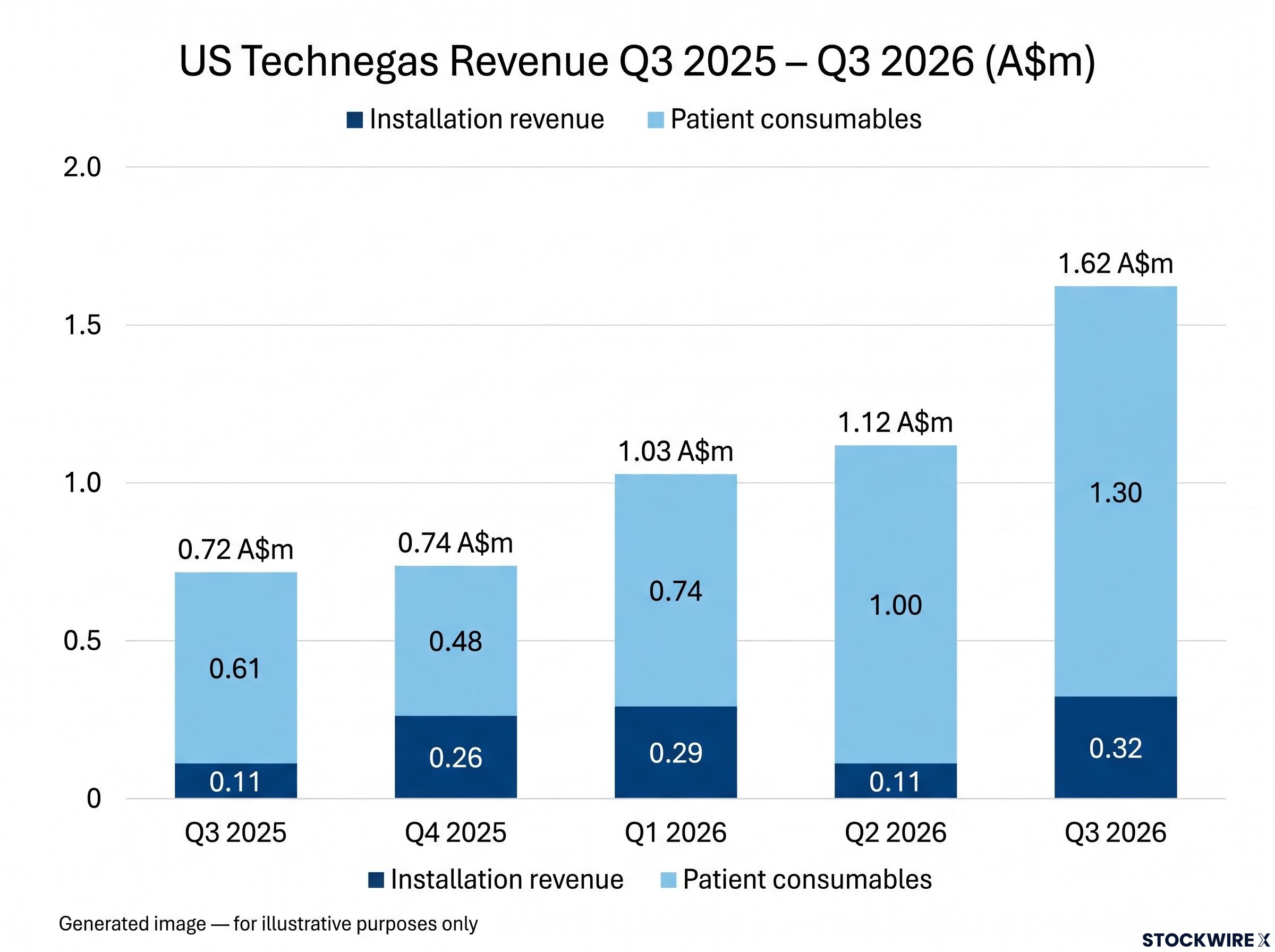
| US Technegas revenue (A$m) | Q3 2025 | Q4 2025 | Q1 2026 | Q2 2026 | Q3 2026 |
|---|---|---|---|---|---|
| Installation revenue | 0.11 | 0.26 | 0.29 | 0.11 | 0.32 |
| Patient consumables | 0.61 | 0.48 | 0.74 | 1.00 | 1.30 |
| Total | 0.72 | 0.74 | 1.03 | 1.12 | 1.62 |
The presentation highlighted the following drivers:
- 44 systems installed in nine months, more than 2024 (17) and 2025 (23) combined
- New deals created rose 3.5 times to 328 in Q3, from 487 customer meetings
Management said growth is weighted to the second and fourth quarters, as US hospital capital decisions cluster ahead of budget year-ends (30 June and 31 December). Q2 delivered 24 installations against 6 in Q1, and 13 of Q3’s 14 installations landed in September.
How the 2026 guidelines are moving the pipeline
The presentation centred on the joint SNMMI/EANM/ACNM/ANZSNM procedure guideline for ventilation-perfusion pulmonary scintigraphy, published 29 July 2026. It is the first update to US lung scintigraphy guidance since 2012 and names Technegas “generally preferred when available”.
Key points of the guideline, as presented:
- Technegas is “generally preferred when available”, in the guidelines’ own words on the choice of ventilation agent.
- It directs the move from planar to SPECT and SPECT/CT imaging.
- Breast dose is up to 70× lower than CTPA, with five patient groups named for whom V/Q is preferred.
- It sets out Beyond PE applications, including CTEPH, grading COPD and asthma, surgery and transplant.
- It names AI quantification as an emerging complement.
In China, the Chinese Thoracic Society and six partner bodies named Technegas “the preferred radiopharmaceutical” in October 2026, with Recommendation 1 agreed with 100% consensus.
Management noted that every US installation to date was won before the guidelines, making Q3 the first read of their effect. The first selling season with the guidelines in hand began after Labor Day (7 September).
Between 12 August and 30 September 2026, the company reported pipeline movement as follows:
- Committee review up 71%, from 109 to 186 primary sites
- Contract review up 61%, from 44 to 71 primary sites
- Locations on hold down 30, from 220 to 190, as paused projects reopened
- 1,877 engaged locations, about 36.5% of the 5,139-site US market
What is Technegas and why do hospitals adopt it?
Technegas is a lung ventilation imaging agent. Carbon nanoparticles labelled with technetium-99m are made on site, and the patient inhales them in 3 to 6 breaths, in under a minute.
The agent behaves like a gas and reaches the alveoli, where oxygen is exchanged. SPECT imaging then shows ventilation in 3D, and combined with perfusion imaging it forms the V/Q scan.
The company compared Technegas with the alternatives:
- Xenon-133 needs a negative-pressure room and a gas delivery and trapping system, and ties up the camera for about 15 minutes.
- DTPA droplets clump in the central airways, creating hotspots that leave more scans indeterminate, worst in obstructive disease. Administration on a DTPA nebuliser takes 3 to 5 minutes.
- Technegas needs no infrastructure beyond the generator.
On economics, the company outlined a hardware purchase of US$0, as Cyclopharm owns, installs and services the generator. Year-one cost is US$14k (US$7k install plus US$7k access fee), with about 25 patients a year to break even on planar imaging. SPECT/CT V/Q adds US$906 more per study than planar V/Q at Medicare 2026 rates.
Breakeven and unit economics are Company estimates. The model is razor-razorblade: the system is placed once, per-patient consumables are used on every scan, and every component is made by Cyclopharm.
Market opportunity and Beyond PE
Management put the US core market at US$180m a year from about 2,000 primary target sites, with about US$90m still using Xenon-133. Market sizes are Company estimates.
The company also pointed to more than US$1B in Beyond PE applications, covering COPD, asthma, CTEPH, surgery and transplant. These sit within the existing broad USFDA label (NDA 022335, approved 2023), which the company said requires no new approval and no large registration trials.
The Macquarie University COPD study is the clearest test of the Beyond PE thesis, using AI-guided functional lung imaging in a 34-patient cohort to assess Technegas in severe disease where few interventional options exist.
On land and expand, the 84 systems sit in 44 health systems across 22 states, with 49 of 84 in the Top 200 US hospitals. Some 54% of revenue-generating US sites are expansion units.
Multi-site hospital agreements such as the 11-location deal with the University of Pennsylvania Health System show how expansion units follow a first installation, with each site adding installation, service and consumable revenue.
The presentation closed with a four-point investment case:
- Guideline-backed and globally recognised, with more than 85% share in major markets outside the US
- Real growth, with 44 systems installed in nine months
- Momentum building, with committee review up 71%
- Growth on one broad label
What management flagged ahead
The presentation noted that the Technegas transitional pass-through payment applies to mid-2027. It states that it does not provide earnings or installation guidance.
Don’t Miss the Next Healthcare Breakout
Join 20,000+ investors getting FREE breaking ASX news delivered to their inbox within minutes of release, complete with in-depth analysis. Click the “Free Alerts” button at StockWire X to stay ahead of the market and see healthcare news the moment it breaks.