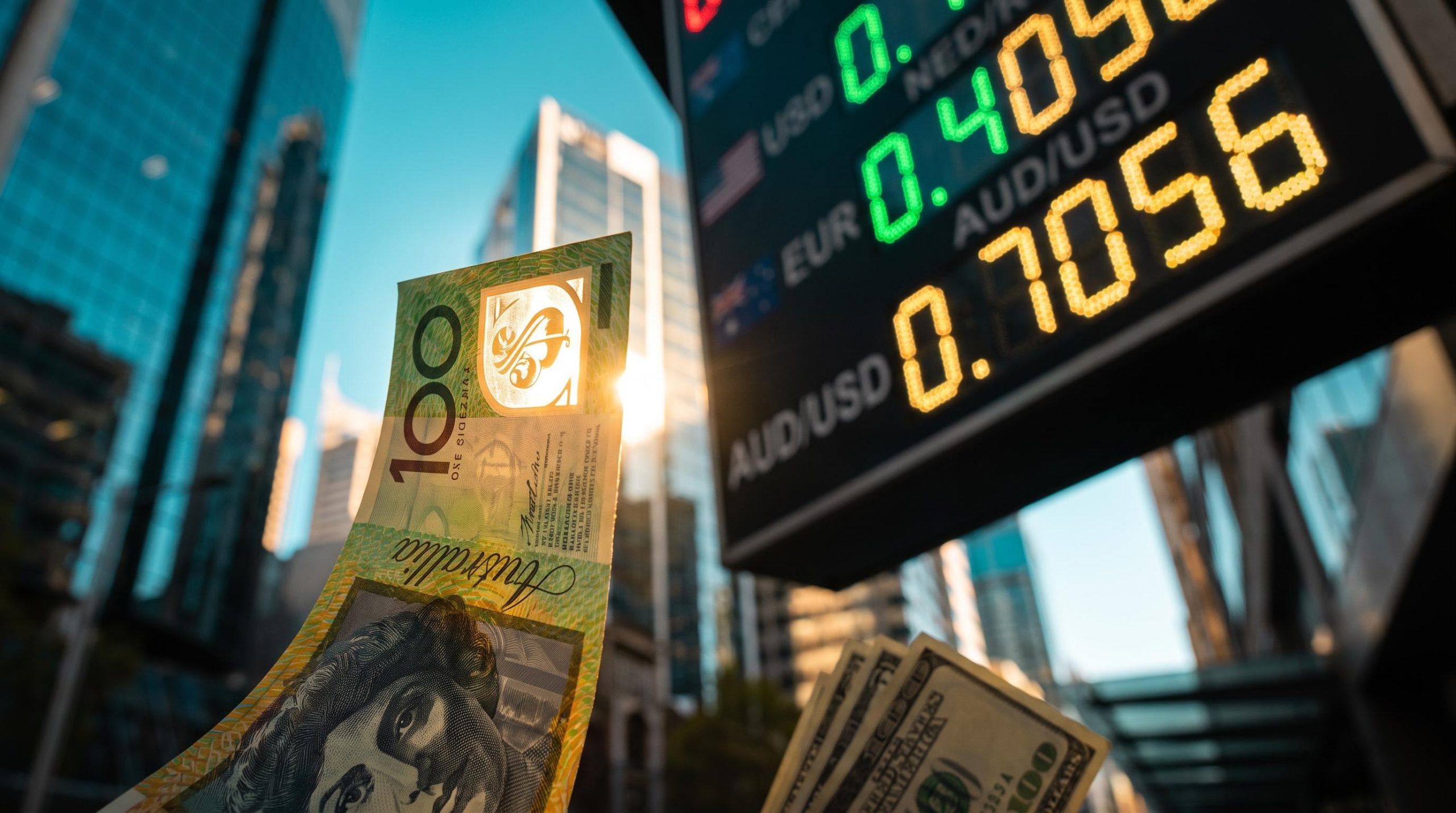
The US Federal Reserve held its benchmark rate at 3.75%-4.00% on 28 October, and two officials voted for a hike. The Australian dollar still climbed to about US$0.7056, its highest level in a month. That move shifts the AUD/USD forecast away from Washington and toward what the Reserve Bank of Australia (RBA) does next.
A Fed that sounds worried about inflation usually supports the US dollar. This time the Aussie went the other way.
That matters if you pay for imported goods, book overseas travel or hold US-dollar investments. A higher Australian dollar makes US-priced goods cheaper and trims the value of US assets in local terms.
Two levels are being quoted. FXStreet reported the 0.7056 intraday high, while the RBA’s official 4:00 p.m. AEST display showed 0.7034. The two figures come from different points in the session, so they do not contradict each other.
Here is what drove the move, what is holding the currency up, and the signals that will show whether the rally can last.
Why did the Australian dollar rise when the Fed sounded hawkish?
On paper, the reaction looks backwards. The Fed split its vote, two officials wanted a hike, and the statement leaned on inflation risk. The Australian dollar rallied anyway.
What the Fed said
- Rate: held at 3.75%-4.00%
- Vote: 10-2 to hold
- Dissenters: Governor Lisa Cook and Cleveland Fed President Beth Hammack, both preferring a 25 basis point hike (a basis point is one-hundredth of a percentage point)
- Activity: expanding at a strong pace
- Inflation: described as elevated, against the Fed’s 2% objective
- Uncertainty: elevated, partly because of geopolitical developments
The Fed said it would wait for more information before judging whether a hike was appropriate.
The Fed’s October rate decision also matters well beyond currencies, since the choice between a one-and-done hike and a multi-hike cycle shapes the outlook for US-dollar assets such as gold.
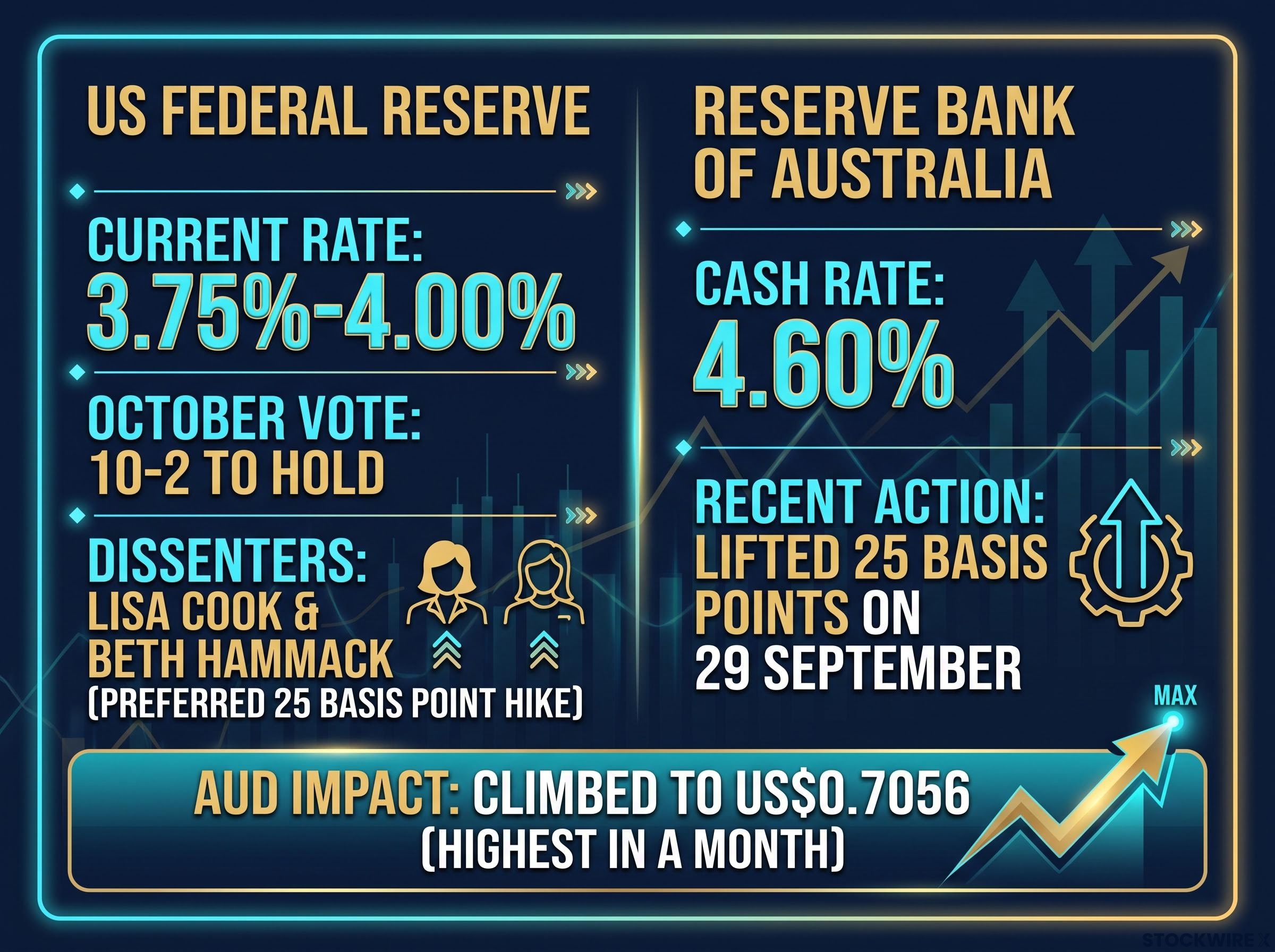
The vote split Ten officials backed a hold and two wanted an immediate hike. The statement kept inflation “elevated” in the Fed’s own words.
How the market read it
Markets priced what the Fed did, not what it hinted at. The hawks wanted a hike and did not get one. No named strategist has been linked to the move to 0.7056. The mechanism is still visible: a hold that falls short of what the hawkish wing wanted can lift AUD/USD, especially when Australian inflation is running hot.
The rate gap does most of the work. The RBA cash rate sits at 4.60%, above the entire Fed range, and higher rates draw capital toward the currency that pays more.
Deutsche Bank had expected the hold. Its economists also judged that Fed messaging could stay hawkish, and they saw scope for another 50 basis points of tightening across December and March.
So the Aussie did not rise because the Fed went soft. It rose because Australian rates are higher, and the Fed held off on the hike that would have narrowed that gap.
What is driving the RBA, iron ore and China side of the AUD story?
The rate gap starts at home. That is also where the strongest support comes from.
Rates and inflation at home
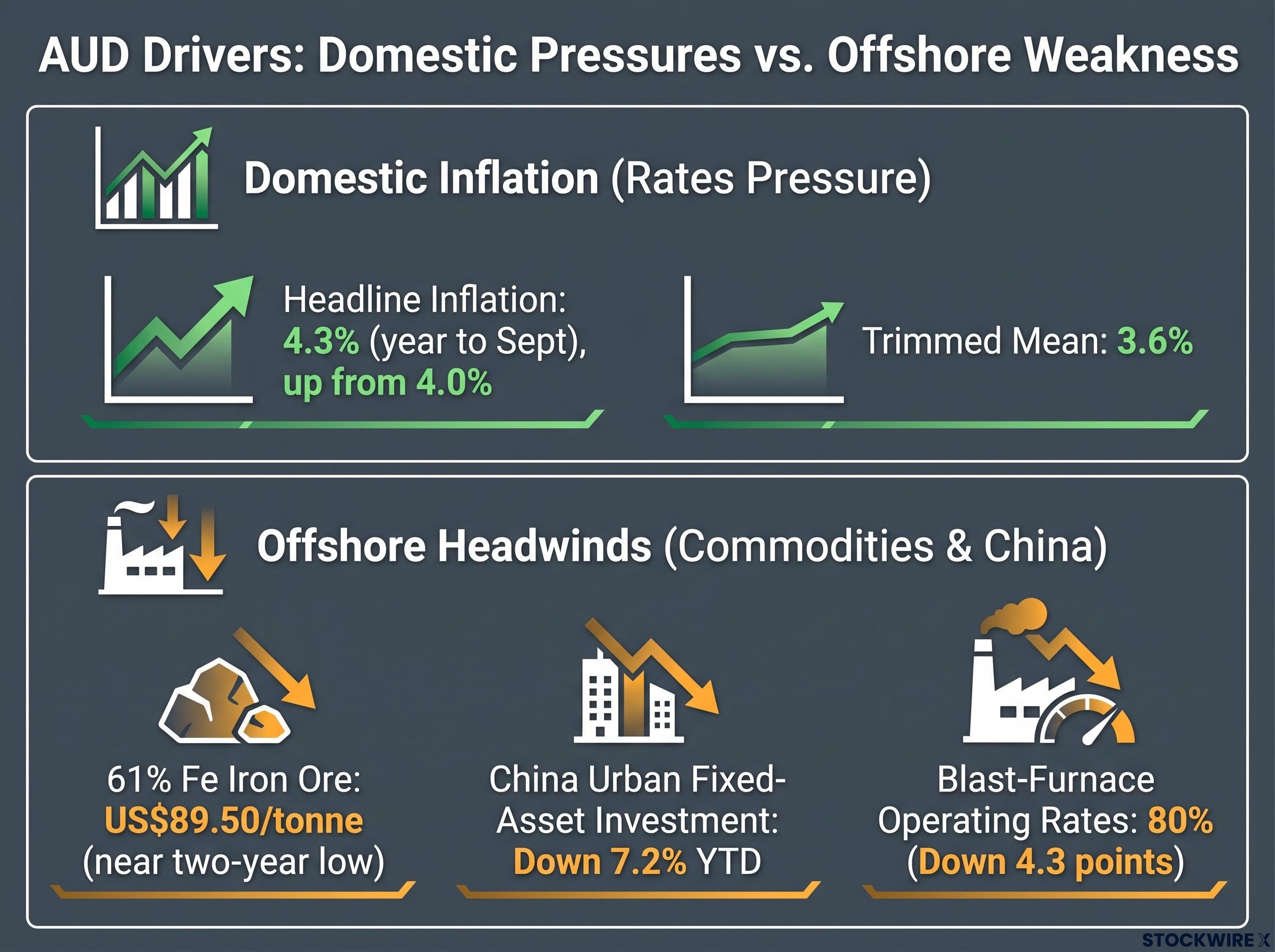
The Australian Bureau of Statistics reported on 28 October that headline inflation reached 4.3% in the year to September, up from 4.0% in August. Monthly prices rose 0.8% in original terms and 0.6% seasonally adjusted. The trimmed mean, which strips out the most extreme price moves to show underlying inflation, rose to 3.6% from a revised 3.5%.
The trimmed mean is the RBA’s preferred gauge, and its climb above the 2-3% target band even as headline inflation fluctuates explains why the Board has kept tightening on the table.
The RBA had already lifted rates by 25 basis points to 4.60% on 29 September, and the decision was unanimous. Markets now put roughly two-in-three odds on another hike on 3 November. TD Securities expects a move to 4.85% and expects it to be the last of the cycle.
Iron ore and China abroad
Overseas, the support is thinner. Benchmark 61% Fe iron ore fell to US$89.50 per dry tonne, roughly a two-year low, and Chinese futures slipped to 665.50 yuan a tonne.
Shipment volumes are not the problem. China imported 109.82 million tonnes in September, and imports for January to September were up 4.1% year on year. Steel conditions are the weak point. Blast-furnace operating rates sit at 80%, down 4.3 points, urban fixed-asset investment is down 7.2% year to date, and port inventories remain historically high.
Westpac pointed to Chinese steel exports above 10 million tonnes for a fifth straight month. It warned that weaker activity and stockpiles should eventually weigh on Australian export earnings.
| Driver | How it moves AUD | Current reading | Direction of pressure |
|---|---|---|---|
| RBA policy | Higher rates attract capital | 4.60%, November hike in play | Supportive |
| China demand | Stronger growth lifts demand for Australian exports | Investment down 7.2% year to date | Negative |
| Iron ore | Higher prices lift export income (about $118 billion a year, 2021 data) | US$89.50/t, near two-year low | Negative |
| Trade balance | Surpluses strengthen the currency | August surplus $495 million, down $856 million; September figure not yet available | Weakening |
| Risk sentiment | Risk-on favours AUD, risk-off favours USD | Fed flagged elevated geopolitical uncertainty | Mixed |
For you, this means the currency’s strength rests on interest rates more than on export earnings. That leaves it more exposed to any shift in RBA expectations.
What does the AUD/USD forecast look like from here?
The forecasters agree that Australia has the rate advantage. They disagree on how much further the RBA will tighten.
| Source | Forecast or view | Date |
|---|---|---|
| Admiral Markets (citing banks including NAB) | 0.71-0.75 for 2026 | 28 October 2026 |
| PrimeXBT | About 0.6900 by December 2026, range 0.6642-0.7158 | 28 October 2026 |
| TD Securities | Hike to 4.85% supports AUD near term while the Fed holds | 28 October 2026 |
| NAB | RBA on hold through 2026 | 21 August 2026 (predates September hike) |
NAB’s August call has been overtaken by the September hike. PrimeXBT flags a convergence risk: the rate advantage stops widening if the RBA cycle ends and the Fed resumes hiking.
TD Securities on the RBA TD expects a further hike to 4.85% and sees it as the final move of the tightening cycle.
The main risks to the current support are:
- RBA peak: if November is the last hike, the yield advantage stops growing
- US data surprises: strong inflation or jobs figures could revive Fed-hike pricing and lift the US dollar
- Iron ore and China: further price falls or weaker steel demand would erode export income
- Global supply: rising seaborne shipments could deepen the iron ore surplus
- Risk-off shocks: geopolitical stress, which the Fed itself cited, tends to favour the US dollar
The forecasts cluster around today’s level and differ mainly on the RBA’s path. Treat 0.70 as a zone where rate expectations, not a settled trend, decide the next move.
Past performance does not guarantee future results. Forecasts are subject to market conditions and various risk factors.
What the rally settles, and what the 3 November RBA meeting could change
The Aussie’s lift reflects a rate advantage that the Fed’s hold left intact. It is not a broad vote of confidence in Australia’s export base, which is softening as iron ore slides and Chinese steel demand weakens.
Three variables now decide whether 0.70 holds: the RBA decision on 3 November, incoming US data, and the direction of iron ore. A hike would extend the rate gap for now. Signs that the cycle has peaked would expose the currency’s weaker commodity footing.
Consecutive tightening moves have made the RBA’s guidance a key swing factor, with the Board preserving optionality on whether another hike follows and leaving AUD sensitive to each data release.
If you have US-dollar costs or exposure, the practical question is whether to act before or after the RBA meeting, knowing the outcome could move the rate in either direction.
This article is for informational purposes only and should not be considered financial advice. Investors should conduct their own research and consult with financial professionals before making investment decisions.