
Ten-year gilt yields sit above 5.4%, among the highest returns on offer from any major government bond market. Yet the buyers stepping up are mostly British, while foreign investors in UK gilts are holding back. A high yield, it turns out, is not enough to pull overseas money in.
That matters because overseas holders own around one-third of outstanding gilts, according to the Office for National Statistics (ONS). When a buyer base that large goes quiet, it changes how much the UK pays to borrow.
The timing is sharp. The Budget lands today, 28 October 2026, and BNY strategist Geoff Yu has just argued that foreign demand is restrained by uncertainty over Bank of England (BoE) tightening and sterling volatility. His point is that overseas investors are not selling. They are simply not buying much.
Here is the framework for judging what an overseas buyer weighs before committing to a country’s bonds, and the specific conditions Yu believes would bring that money back.
Restrained buying, not a sell-off: what the gilt data actually shows
The easy headline is that foreigners are fleeing the gilt market. The evidence does not support it. Yu’s reading is narrower: domestic investors are buying more gilts while overseas interest stays restrained, and recent data indicate foreign selling is not rising.
What the data shows
The indicators point to a market leaning heavily on domestic and balance-sheet demand, with price doing the work to clear supply:
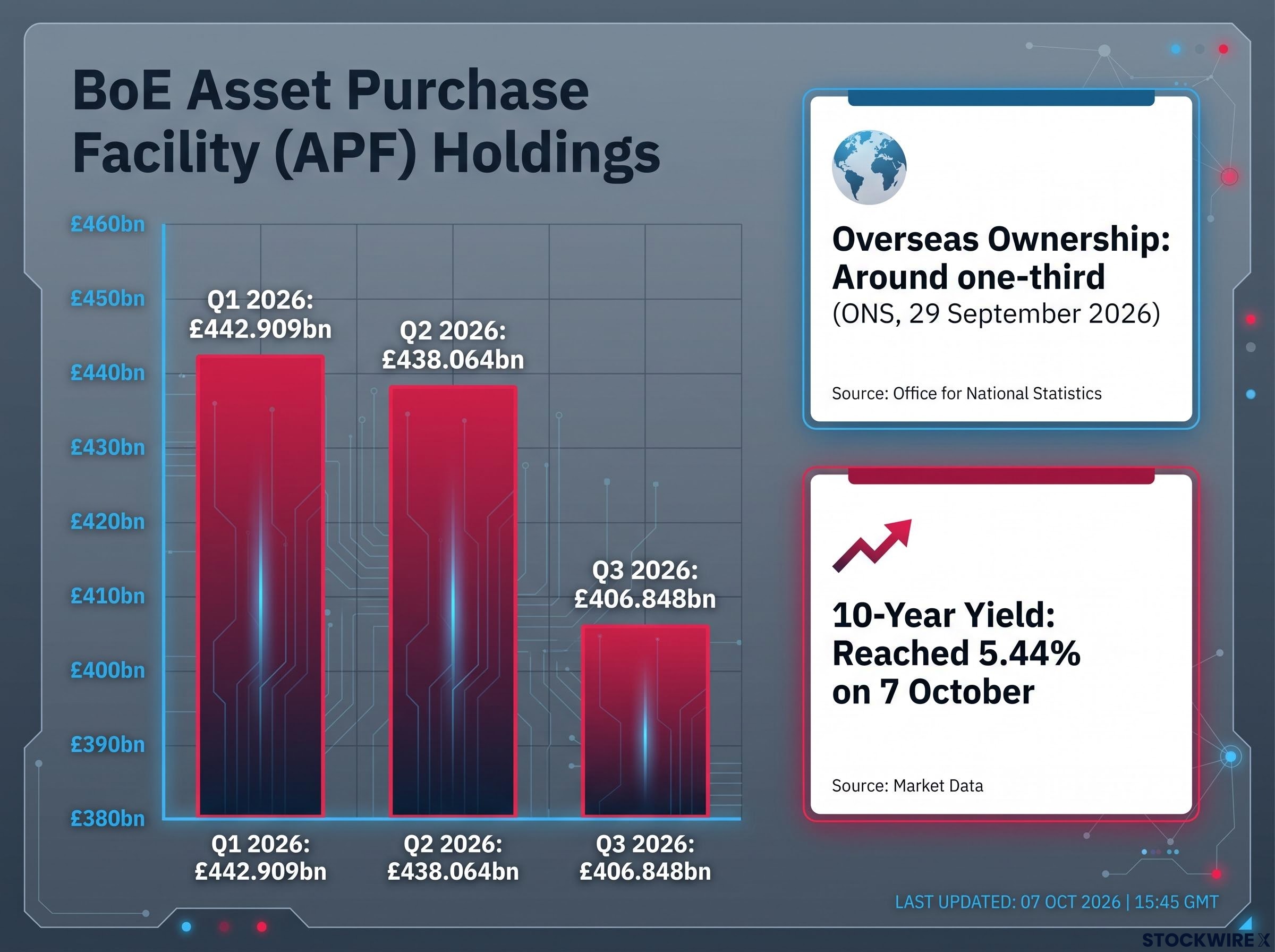
- Overseas investors hold around one-third of outstanding gilts (ONS, 29 September 2026).
- BoE Asset Purchase Facility (APF) gilt holdings fell to £406.848bn in Q3 2026, from £438.064bn in Q2 and £442.909bn in Q1 (ONS, 21 October 2026). The APF is the BoE’s portfolio of bonds bought under quantitative easing, now being run down.
- The 10-year yield reached 5.44% on 7 October (Reuters) and held above 5.4% pre-Budget.
- Yesterday’s five-year auction sold £4.5bn at 5.036%, the highest five-year borrowing cost since 2008.
- The record £14bn syndication in September 2025 drew orders above £141bn, but domestic investors took 60%, a share Reuters described as low for a longer-dated deal.
BNY’s view Geoff Yu expects cross-border interest to stay subdued until the path of rate differentials between the BoE, the Federal Reserve and the European Central Bank becomes clear.
What it cannot show
There is no recent, like-for-like breakdown of foreign versus domestic net purchases. The divergence Yu describes rests on indicators and commentary, not a clean flow series, so it should be read as a direction rather than a measured gap.
Still, the shape is clear enough. When a third of a market sits overseas and that third stops adding, domestic buyers and price carry the load. That is why yields have to stay high to clear supply, and why your mortgage rate and the Chancellor’s tax choices both feel the pressure.
Because bond prices and gilt yields move in opposite directions, a buyer base that stops adding forces prices lower and yields higher, which feeds straight into the cost of public borrowing.
When big ASX news breaks, our subscribers know first
How a foreign buyer judges a gilt: yield, hedging and rate differentials
So why would a 5.4% yield fail to tempt an investor in New York or Frankfurt? Because the overseas buyer asks a different question: what do I actually earn in my own currency?
The return maths
For a non-UK investor, the gilt yield is only the starting number. It gets adjusted for currency moves, or for the cost of hedging, which means paying to lock in an exchange rate so currency swings do not affect the return. The result is then compared with what the same money could earn elsewhere.
Before buying, the prospective return must compensate for:
- Uncertainty over where the BoE’s rate path ends.
- Unpredictable sterling returns for an investor who does not hedge.
- The cost of hedging sterling exposure.
- A potentially rising fiscal and term premium, the extra yield investors demand for holding longer-dated debt.
- Competition from US, euro-area and other sovereign bonds.
Currency risk is not theoretical. Sterling fell as much as 1.6% against the dollar during the January 2025 gilt sell-off, and it dipped to about $1.318 in early October before recovering to $1.339 by 21 October. A move of that size can wipe out months of interest for an unhedged buyer.
Why the rate path is the swing factor
The three central banks sit close together, but their expected paths diverge:
| Central bank | Current rate | Latest decision | Expected path |
|---|---|---|---|
| Bank of England | 3.75% | Held 6-3 on 29 July 2026; three members wanted 4% | Markets priced about four 25 bp hikes over a year; Yu expects one |
| Federal Reserve | 3.75%-4.00% | 25 bp hike in September | 94 of 100 economists expect a hold this week; nearly 60% see a 4.00%-4.25% peak |
| ECB | 2.50% deposit rate | Two summer hikes | KBC forecasts 2.75% in December and 3.00% in March 2027 |
A basis point (bp) is one hundredth of a percentage point. BoE Chief Economist Huw Pill signalled scepticism about the four-hike pricing on 14 October, siding with Yu’s view that markets have gone too far. Until that gap closes, no overseas buyer can confidently estimate the differential. If you hold any sterling asset, this is the lesson: yield is half the story for a foreign buyer, and currency uncertainty can erase it.
The BoE’s 6-3 split, with Pill, Greene and Mann pressing for a hike, shows how contested the rate path is, and that contest is precisely what stops a foreign buyer from pricing the differential with confidence.
Over-priced hikes or a genuine risk premium? Two readings of the gilt market
If the rate path is the swing factor, the obvious fix is for markets to price fewer hikes. That is one reading. A second says the problem runs deeper.
Interpretation A, held by BNY and echoed by Pill, argues markets over-price BoE tightening. Reprice toward one hike and front-end gilts rally, the differential becomes predictable, and foreign buyers return.
Interpretation B says yields reflect more than Bank Rate. Monex Europe views fiscal risk as underpriced given thin headroom, with a bearish sterling bias into month-end. Handelsbanken‘s Tommy von Brömsen flagged concern on 8 October about UK debt and a rising term premium. A Reuters dealer survey suggests the 2027-28 gross financing requirement could rise by £27bn to about £334bn.
HSBC on the Budget HSBC suggested on 19 October that investors might avoid long sterling positions until fiscal measures, yields and credibility can be properly assessed.
Some pressure is not British at all. Morgan Stanley noted yesterday that gilts sold off alongside Australian and Canadian bonds while Italian yields climbed. In January 2025, PIMCO‘s Peder Beck-Friis argued much of the gilt yield rise reflected US Treasury moves.
| Reading | Supporting evidence | What would confirm it |
|---|---|---|
| A: Markets over-price BoE hikes | Yu expects one hike; Pill sceptical of four | Repricing toward one hike lifts gilts and overseas demand |
| B: Fiscal and term premium drive yields | Monex, Handelsbanken, 5.036% five-year auction, rising financing needs | Long yields stay high even as hike pricing softens |
The practical test is simple. If the BoE story softens and long yields stay stubborn, the issue is fiscal credibility, and a gentler central bank alone will not bring foreign buyers back. Today’s Budget is the first live check.
What would bring foreign money back: Yu’s conditions, France and the precedents
Yu does offer a route back, though it is demanding.
Yu’s three conditions
A broad recovery in overseas flows, in his view, needs:
- A weaker trade-weighted pound, measured against a basket of currencies.
- Credible fiscal policy.
- Real yields, returns after inflation, that have clearly peaked.
All three are required. A weaker pound on its own improves the entry price but cuts the value of existing holdings and can signal fading confidence in policy.
The French wildcard
France complicates the picture. The 10-year OAT yield hit 5.1415% on 22 October, the highest since June 2002, before easing to 4.976% on 26 October. The spread over German Bunds reached 158.67 bp in early October, the widest since November 2011, and sat around 146-152.5 bp late in the month. Moody’s held France at Aa3, and non-residents own 59.7% of tradable French government bonds.
Yu sees scope for a marginal shift out of the euro area into the UK. But broad European stress can lift risk premia across all sovereign markets. Sterling’s 16-17-month high against the euro, up roughly 2.6% in a month, reflects a weaker alternative more than fresh confidence in Britain.
Investors weighing the French wildcard will find our full explainer on the French bond spread useful, as it sets out the ECB backstop conditions that decide how far European stress can spread.
What history suggests
| Episode | What happened | What drew capital back or kept it away |
|---|---|---|
| 2022 mini-Budget | Unfunded tax cuts sparked a gilt and sterling crisis | Weak pound plus high yields repelled buyers until policy was reversed |
| January 2025 | 30-year yields hit a 26-year high | PIMCO saw a US-driven shock and stayed positive |
| April 2025 | Global duration sell-off | Five-year auction nearly three times covered on high yields |
| November 2025 Budget | Extra headroom, fewer long-dated auctions | Vanguard restored a long-gilt position |
The pattern is consistent. Overseas demand is price-sensitive, not permanently absent, and it returns when a shock looks global or the fiscal framework improves. No single trigger has been enough.
What to watch after today’s Budget, and what would change the picture
The evidence points to relative restraint, not rejection. Domestic and public-sector demand is absorbing supply while overseas buyers wait for clarity on the BoE’s terminal rate, sterling, fiscal credibility and real yields. Neither the Budget outcome nor the BoE-Fed-ECB differential is known yet, and Yu’s recovery scenario is conditional, not a forecast.
Foreign investor participation in auctions is one of the key signals for UK debt sustainability, alongside the debt-to-GDP trajectory and fiscal rule adherence, because it shows whether political noise is turning structural.
The signals worth tracking:
- How gilts and sterling react to today’s Budget.
- Whether BoE pricing drifts toward Yu’s single hike.
- Signs that real yields have peaked.
- Auction cover ratios and future ONS readings on the overseas share.
This article is for informational purposes only and should not be considered financial advice. Investors should conduct their own research and consult with financial professionals before making investment decisions. Forecasts and forward-looking views cited are speculative and subject to change with market developments.