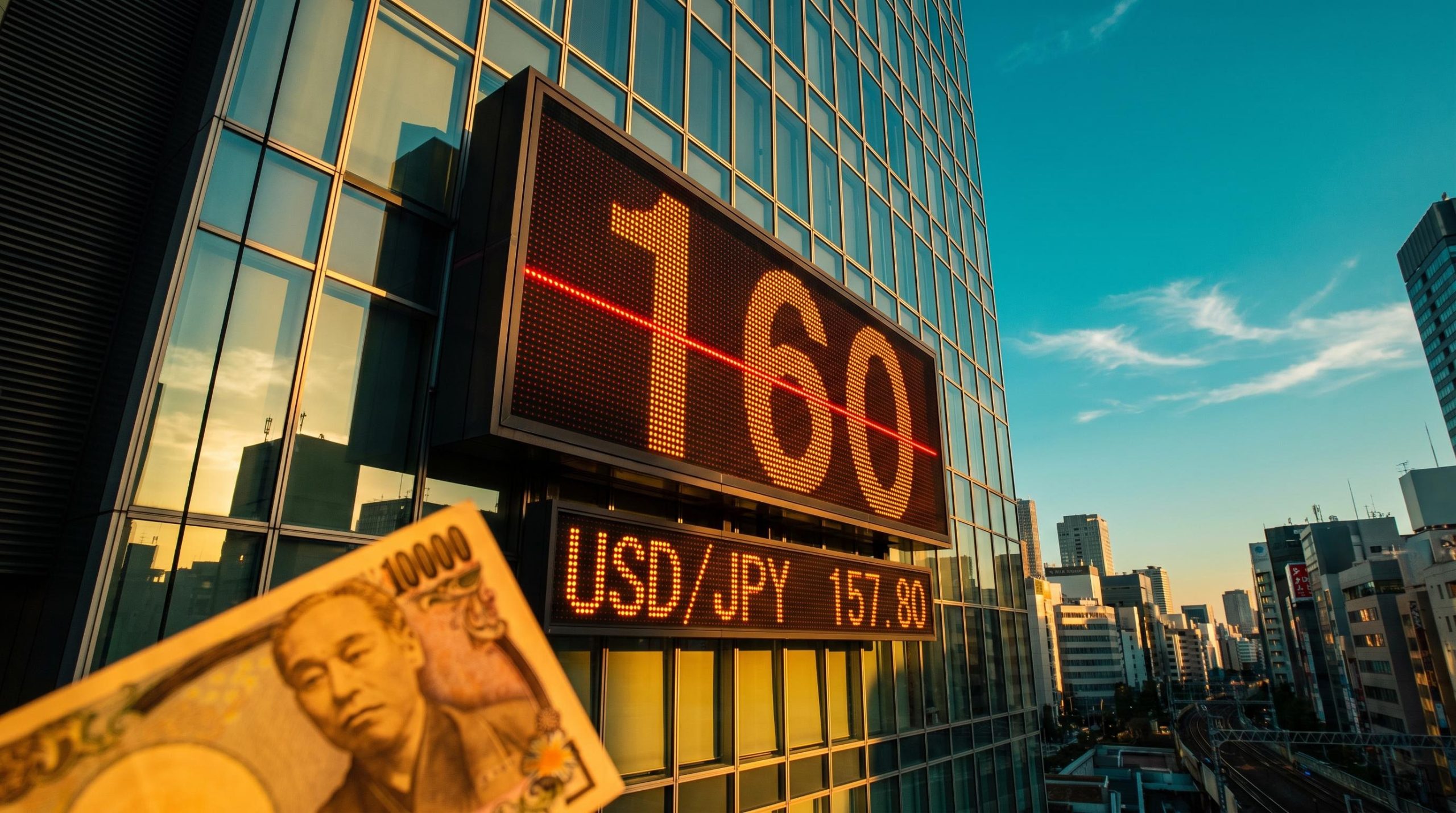
Finance Minister Satsuki Katayama promised “bold” action in the currency market again on 27 October 2026. The yen barely flinched. With USD/JPY sitting in the ¥157-¥158 area, MUFG argues the market is still some distance from the ¥160 line where Tokyo’s warnings have historically turned into actual yen-buying.
That gap between words and action sits at the centre of any serious USD/JPY forecast right now. The yen briefly rallied to ¥156.08 on 22 October as an AI-driven equity sell-off sent investors looking for safety, then resumed its slide as tech stocks recovered.
Friday’s Bank of Japan (BoJ) communication lands in the middle of this setup. Markets already price a December rate hike at roughly 80%, according to MUFG, so the decision itself matters less than the tone.
This analysis shows you where the real intervention zones sit, what Governor Kazuo Ueda needs to say to move the pair, and which scenarios could break the current range.
Why does MUFG think Tokyo will wait until USD/JPY nears 160?
Katayama’s language has escalated. Her 27 October pledge of “bold” or “decisive” action was the latest in a series of warnings, yet USD/JPY traded between roughly ¥156.90 and ¥157.80 that day, according to GO Markets.
MUFG’s read is blunt. The yen has resumed its decline, and the market remains well short of the point where rhetoric becomes yen-buying.
MUFG’s core view (27 October 2026) ¥160 is the obvious level at which official warnings could turn into actual intervention.
There is a caveat. Japanese officials have never published a numerical trigger, so ¥160 is a level the market perceives, not one Tokyo has committed to defending.
The history explains why traders treat it seriously. Intervention means the Ministry of Finance (MoF) selling dollars and buying yen to push the currency higher, and in each recent episode Japan acted after a threshold was breached, not before.
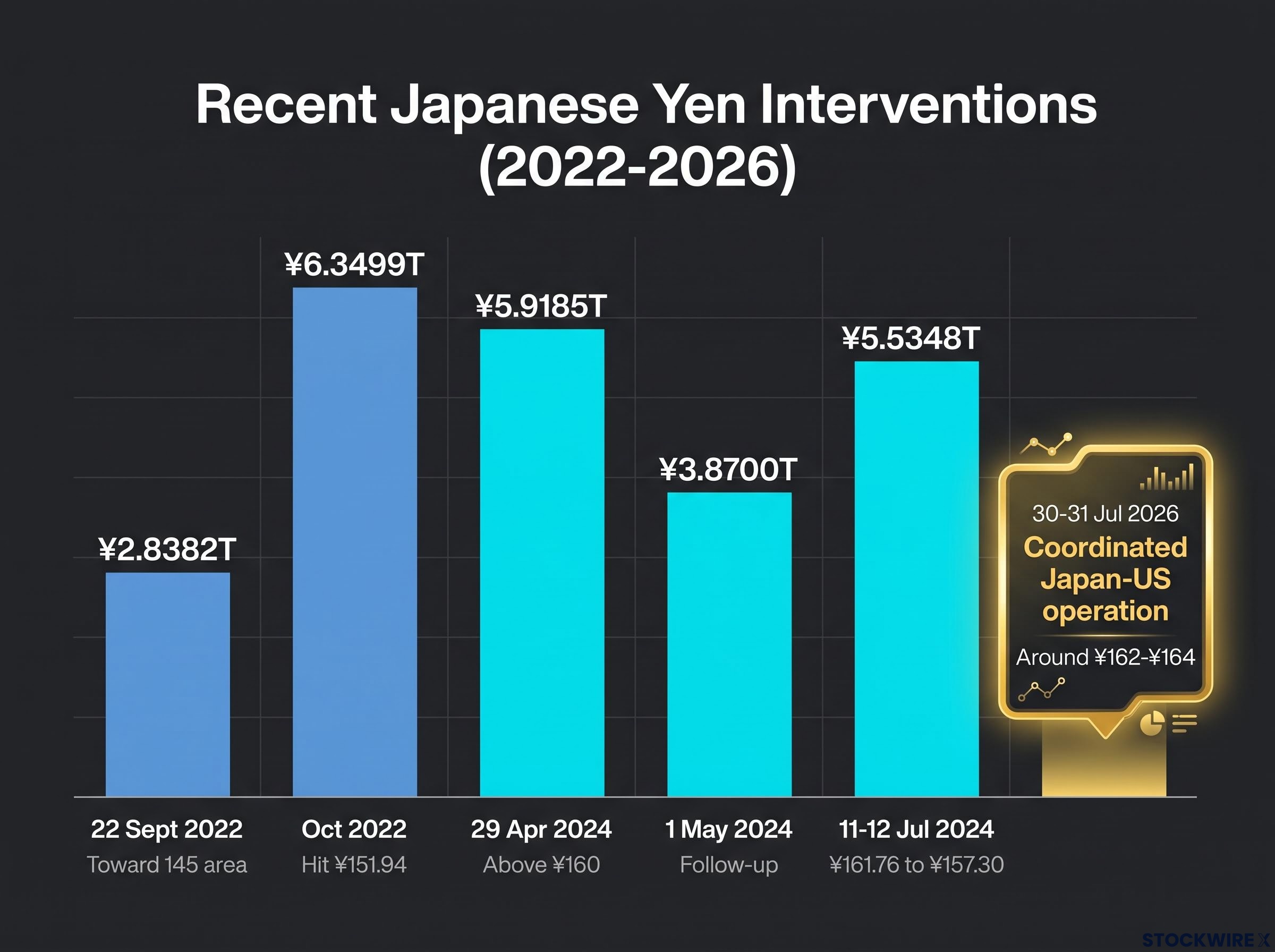
| Date | Amount | USD/JPY context |
|---|---|---|
| 22 September 2022 | ¥2.8382 trillion | Yen weakening toward the 145 area |
| October 2022 | ¥6.3499 trillion (MoF) | Pair hit ¥151.94, a 32-year yen low |
| 29 April 2024 | ¥5.9185 trillion | Briefly above ¥160 (about ¥160.245) |
| 1 May 2024 | ¥3.8700 trillion | Follow-up yen buying |
| 11-12 July 2024 | ¥5.5348 trillion | About ¥161.76, then fell to ¥157.30 |
| 30-31 July 2026 | Coordinated Japan-US operation | Reported around ¥162-¥164 |
The pattern is consistent: Tokyo lets the round number break, then moves. For you, that means verbal warnings at ¥157 are a weak signal on their own. The real risk starts at and beyond ¥160, and that is where positioning becomes dangerous.
Two threshold zones, not one
The ¥160 line works as a warning zone, the place where official language is likely to sharpen. Actual intervention has more often clustered in the ¥162-¥165 band, including this July’s coordinated operation.
Every one of these thresholds is an institutional view, open to revision the moment Tokyo changes its tolerance.
When big ASX news breaks, our subscribers know first
What does Friday’s BoJ signal need to say to move the yen?
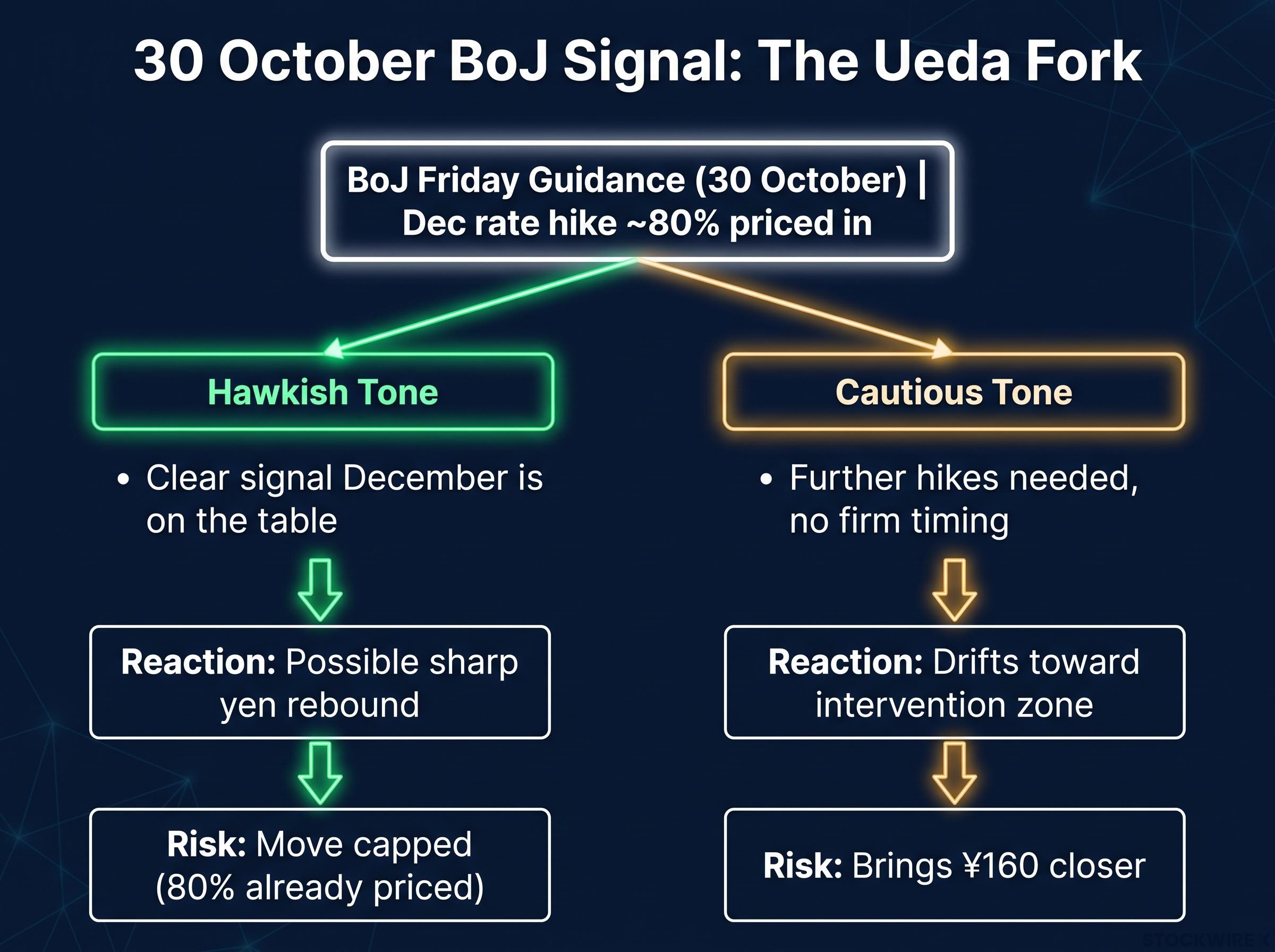
Friday, 30 October, is a fork. Ueda either signals clearly that December is live, or he hedges.
The setup favours hedging. The policy rate sits at 1.25% after the September hike, a 31-year high, and markets expect a hold this week with a move to 1.50% possible as early as December.
Ueda’s recent comments lean hawkish on substance:
- Underlying inflation is “quite close” to the 2% target
- Middle East tensions, strong AI-related demand and yen weakness could push inflation above target
- The BoJ will not tolerate an overshoot, and anchoring inflation around 2% has become more important
Yet his style is cautious. According to Reuters, he may avoid committing to December because inflation, wages, US policy and global risk conditions all still need assessment. MUFG expects the BoJ to signal that further hikes are needed without locking in timing.
| Scenario | What Ueda says | Likely USD/JPY reaction | Risk |
|---|---|---|---|
| Hawkish | Clear signal that December is on the table | Possible sharp yen rebound | Move capped because about 80% is already priced |
| Cautious | Further hikes needed, no firm timing | Pair could drift back toward the intervention zone | Brings ¥160 and official action closer |
The cautious outcome looks more likely, and it is not neutral. Because the hike is mostly priced, the tone of Ueda’s guidance, not the decision, is what will set the pair’s direction this week.
How do rate gaps, US yields and AI jitters push the yen in opposite directions?
Start with the carry trade. A carry trade means borrowing in a low-interest currency and investing the proceeds in a higher-yielding one, pocketing the difference.
The yen has long been the funding side of that trade. The transmission works in four steps:
- Higher US yields relative to Japanese yields raise the return on holding dollars, so investors borrow yen to buy dollar assets, supporting USD/JPY.
- A hawkish BoJ narrows that gap, making yen funding costlier and yen positions more attractive.
- Strong US data, inflation worries or fewer expected Federal Reserve cuts lift Treasury yields, which supports the dollar.
- Risk-off conditions can reverse the trade, as investors cut leveraged positions and buy back the yen they borrowed.
Step four is where it gets complicated. On 22 October, the AI-driven sell-off pushed the yen up as much as 0.4% to ¥156.08, its strongest in more than a month, and Reuters reported it ranked among the best-performing major currencies that week.
MUFG’s Lee Hardman Halpenny said the yen had shown some of its older safe-haven behaviour, a hint of how it might respond to a larger AI correction. Goldman Sachs went further.
Goldman Sachs (via The Business Times, 26 October 2026) The yen has become a more effective hedge against an AI-related market shock, and short USD/JPY could serve as a hedge for a broad growth shock.
The bigger risk sits in the carry trade itself. An AI correction could trigger unwinds, a Fed shift toward easing could lower US yields, and a December BoJ hike would raise Japanese yields. The differential would narrow from both ends, producing a larger yen rally than current spot levels suggest.
When the safe haven fails
Then came 27 October. As tech stocks and risk appetite recovered, the yen gave back its gains and USD/JPY climbed back toward ¥157.80.
The haven role is conditional. If a sell-off lifts US yields, or sparks a scramble for dollar liquidity, the yen can weaken even while investors are nervous.
What this tells you is that the same “markets fall” headline can mean opposite things for USD/JPY. Ask what is driving the sell-off before you assume the yen will rally.
Which forecasts and risks could break the 155-162 range?
Put the major houses side by side and the disagreement is striking.
| Institution | View | Horizon | Basis |
|---|---|---|---|
| MUFG | 155, 153, 151, 149 | Q4 2026 to Q3 2027 | Gradual decline, bearish-yen bias retained |
| Goldman Sachs (September) | ¥158, ¥155, ¥150 | 3, 6 and 12 months | Intervention risk limits upside |
| Goldman Sachs (July) | ¥165 | 12 months | High US yields, fiscal concerns, slow BoJ tightening |
| J.P. Morgan | ¥164 | Q4 2026 | Bullish dollar call |
| UBS | ¥160 | December 2026 | Dollar holds near the warning zone |
Thresholds diverge just as widely. Brent Donnelly of Spectra Markets sees intervention odds rising near ¥160 and substantially higher around ¥162, while IG’s Tony Sycamore suggested officials could set a new line near ¥165-¥166. A former BoJ official, cited by Reuters, sees a ¥155-¥162 range.
Nomura (Reuters, 3 August 2026) Japan may hold up to ¥30 trillion of intervention capacity and could aim to push USD/JPY toward at least ¥154 to trigger momentum selling toward ¥150.
Five risks decide which camp proves right:
- Intervention surprise: Tokyo need not wait for a round number
- US data and Fed repricing: strong data revives dollar demand; a dovish Fed speeds yen gains
- BoJ messaging: a hawkish surprise could pull the pair sharply lower
- Japanese fiscal pressure: doubts about discipline can weaken the yen even as the BoJ tightens
- Limited durability of intervention: the July 2024 operation moved the pair from about ¥161.76 to ¥157.30, but did not remove the rate differential
A spread from ¥149 to ¥164 tells you no single forecast deserves your full trust. Work with ranges and trigger events instead of a point estimate.
What to watch after Friday, and what the ¥160 line does and does not tell you
The three threads interact. A cautious Ueda plus firm US yields pushes the pair toward ¥160 and official action; a hawkish tone or a broad AI-driven carry unwind pulls it away.
Remember that every threshold here is an institutional view, not policy. Track these signals:
- Ueda’s tone on 30 October and whether December pricing holds near 80%
- US Treasury yields after major US data releases
- Spot distance from ¥160, and any shift in Katayama’s language
- Whether AI-related equity weakness spreads into a wider carry unwind
Reading the yen’s next move without trusting any single line
The ¥160 level is a market-perceived warning zone, not a promise from Tokyo. Ueda’s tone is the swing factor this week, and risk sentiment decides whether the yen behaves as a haven or a funding currency.
The next decision points are clear: Friday’s guidance, the December BoJ meeting, and any approach toward ¥160. Watch how those three interact before treating any forecast as settled.
This article is for informational purposes only and should not be considered financial advice. Investors should conduct their own research and consult with financial professionals before making investment decisions. Past performance does not guarantee future results. Forecasts cited are institutional views, speculative and subject to change based on market developments.