
When National Australia Bank (NAB) confirmed it would cut up to 2,500 roles, much of the commentary filed it under “AI replaces bankers”. NAB itself never said that. Chief Executive Andrew Irvine talked about becoming simpler and more efficient, and Westpac went further, stating its own latest cuts were not driven by AI.
That gap between the popular story and the banks’ own words is where the investment signal sits.
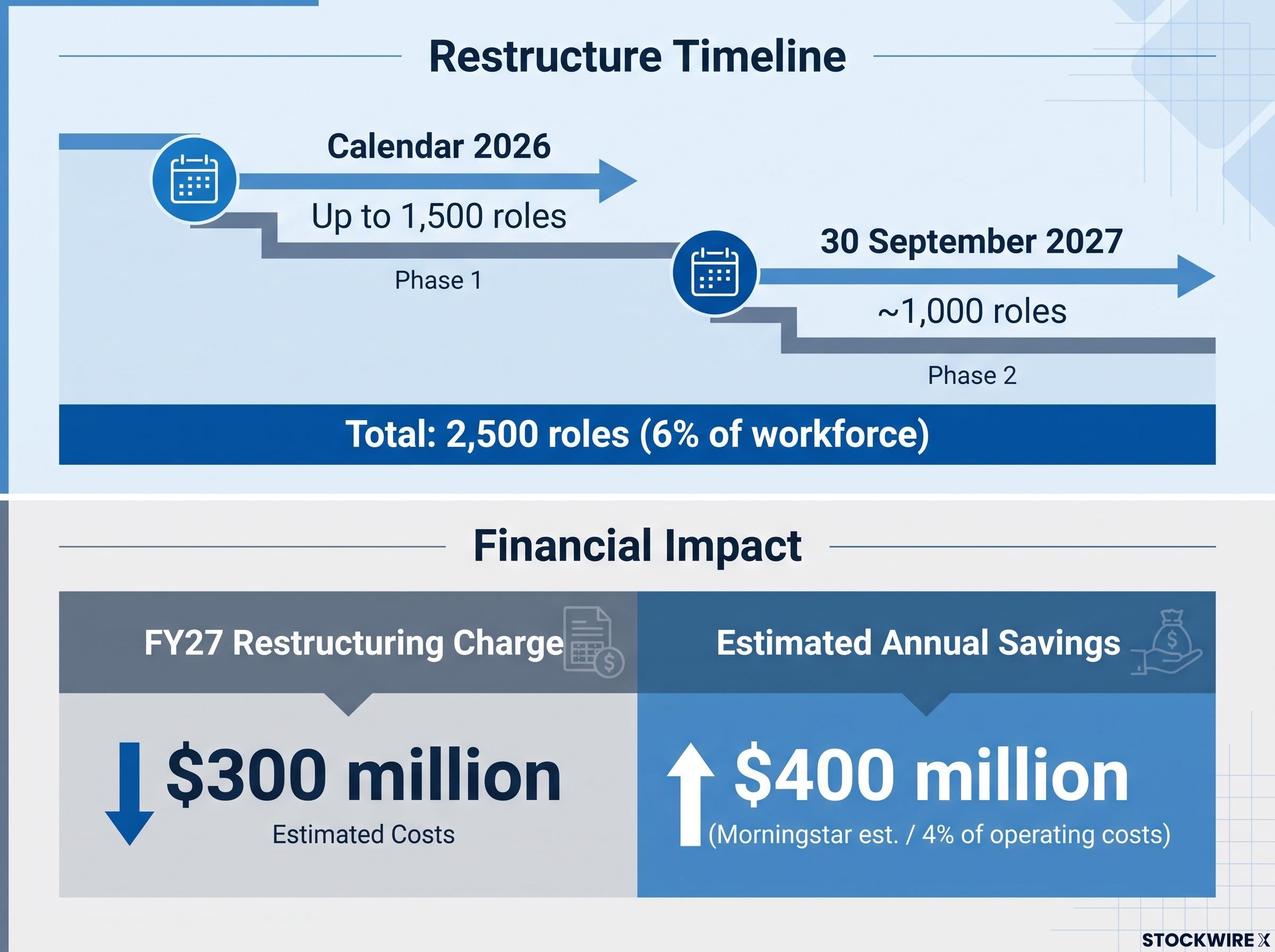
The facts are straightforward. NAB plans to remove up to 2,500 roles, about 6% of its workforce, and expects a pre-tax restructuring charge of about $300 million in FY27. Westpac has cut more than 250 roles since the start of October.
Both moves landed as the Reserve Bank of Australia (RBA) lifted the cash rate to 4.60% and home-lending demand softened. This analysis is current as of 27 October 2026.
Here is a practical way to read a bank job-cut announcement: whether it points to genuine efficiency or to a revenue problem that cost cuts can only partly cover.
Is this really about AI? What NAB and Westpac actually said
The assumption is easy to make. Banks are investing heavily in technology, jobs are disappearing, so AI must be doing the replacing. The banks’ own statements do not support that link.
NAB’s stated reasons
NAB’s ASX communication framed the cuts as a response to several pressures at once. AI was not named as the direct cause. The reasons NAB gave, compared with the reason commonly assumed:
- What NAB cited: simplifying its operating model, reducing duplication, more challenging economic conditions, competition, rising customer expectations and broad technological change
- What NAB said the savings are for: freeing capacity for business banking, deposits, proprietary home lending and technology investment
- What headlines assumed: a standalone AI-replacement programme
The timing is staged: up to 1,500 roles by the end of calendar 2026, and about 1,000 more by 30 September 2027, the end of NAB’s FY27.
Westpac’s phased cuts
Westpac moved in two steps. Earlier in October it restructured 174 positions across Risk, Institutional Banking and Finance: 102 redundancies and 72 transfers to comparable roles. About 140 further roles followed in the week of 19-22 October.
Westpac on the latest cuts The bank described the roughly 140-role reduction as part of a broader organisational restructure and said it was not AI-driven.
Independent reporting puts the total at more than 250 redundancies since early October, but Westpac presents these as separate processes. That separation matters, because a single headline number can make a series of smaller restructures look like one sweeping programme. Context from elsewhere adds to the picture: ANZ has reportedly flagged a headcount reduction of about 3,500, a figure not independently confirmed.
The ABC on 21 October questioned whether AI is being used to explain a broader cost and demand problem, a risk often called “AI-washing”. Capital Brief reported on 26 October that NAB’s AI performance and transparency rankings slipped in the Evident AI Index, raising questions about execution.
When a bank does not credit AI itself, treat AI-led headlines as a hypothesis to test, not a foundation for an investment thesis.
Investors exploring whether AI can genuinely lift bank earnings should read our deep-dive into the AI cost thesis for Australian banks, including Macquarie’s profit uplift estimate.
When big ASX news breaks, our subscribers know first
The revenue problem behind the cost lever
If AI is not the main driver, the lending data suggests what is. Start with NAB’s own numbers.
In its August trading update, NAB reported that Australian home-lending applications fell 15% quarter on quarter in the June quarter. Investor applications dropped 17% and owner-occupier applications 14%.
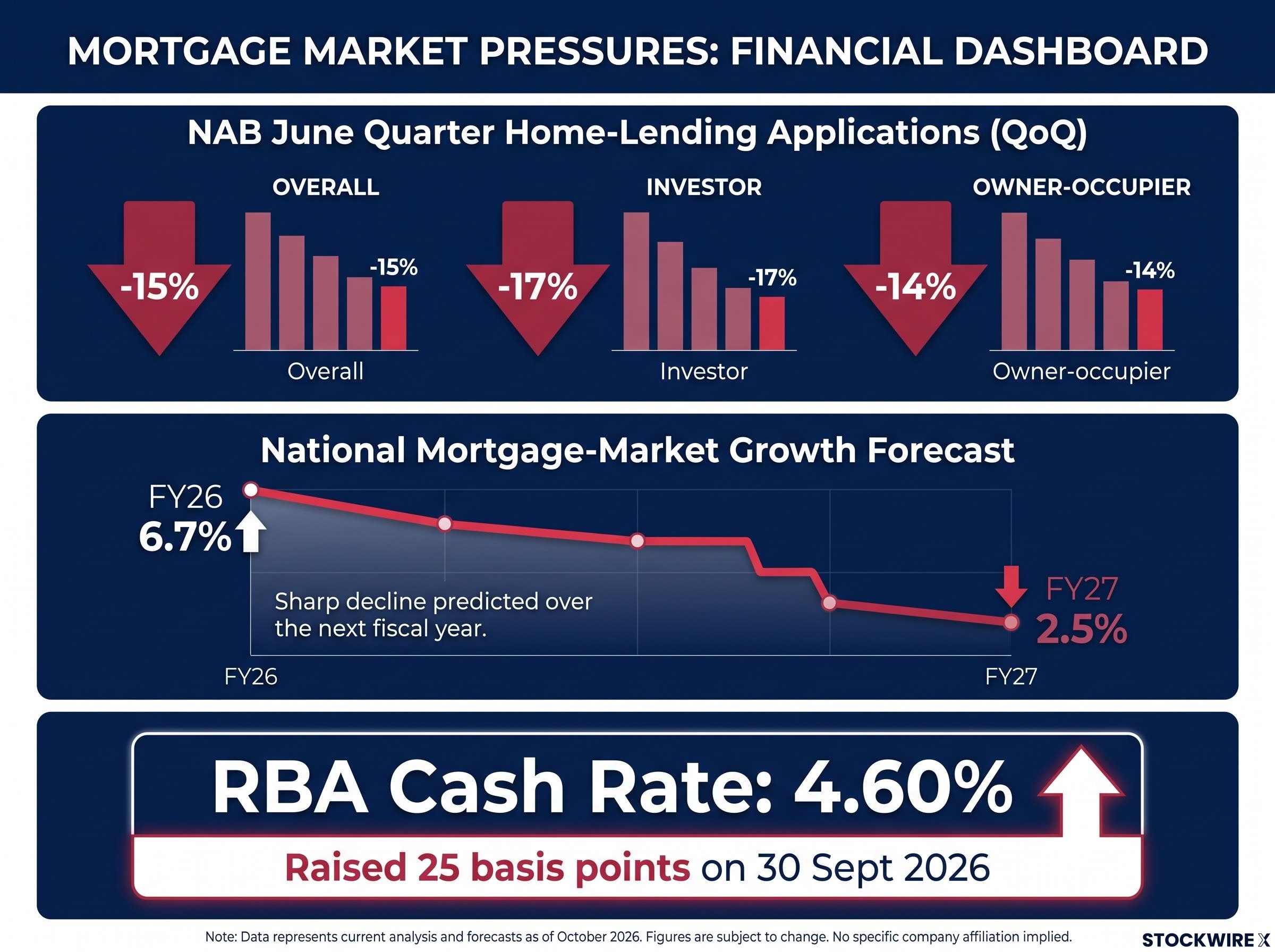
NAB’s mortgage-market forecast National mortgage-market growth slowing from 6.7% in FY26 to 2.5% in FY27.
Then add the RBA. The Board raised the cash rate by 25 basis points to 4.60%, effective 30 September 2026, its fourth increase this year. A basis point is one hundredth of a percentage point, so 25 basis points equals 0.25%. The September minutes recorded a sharp fall in new housing-loan commitments, led by investors, and house prices declining more than expected.
The mortgage application collapse has been driven largely by investors, with policy changes to negative gearing and SMSF borrowing cited as catalysts, which helps explain why demand is falling faster than rates alone would suggest.
| Indicator | Latest reading | Source | What it signals for banks |
|---|---|---|---|
| NAB home-lending applications | -15% QoQ (June quarter) | NAB trading update | Fewer new loans entering the book |
| Mortgage-market growth forecast | 6.7% to 2.5% (FY26 to FY27) | NAB | Slower top-line growth ahead |
| RBA cash rate | 4.60% | RBA | Higher rates dampen borrowing demand |
| Mortgage payments to disposable income | About 10% | RBA minutes | Borrowers stretched, though arrears remain low |
Higher rates do not simply widen bank margins here. They suppress demand while competition for the remaining quality borrowers stays intense. Morningstar described revenue growth slowing, credit growth moderating and mortgage competition limiting the top line.
Some commentary has pointed to the US-Australia rate differential, but no named analysis links it to this episode. The directly reported mechanisms are domestic.
The sequence leads to one conclusion. Cost cuts cannot restore loan growth, so a bank cutting costs into a shrinking mortgage market is defending earnings, not signalling a growth reset.
Do the FSU’s 10,000 lost jobs square with official employment data?
The two sets of numbers seem to point in opposite directions. The Finance Sector Union (FSU) estimates more than 10,000 banking jobs have disappeared over the past two years, according to Reuters and Investor Daily on 22 October. Its concerns about remaining staff include:
- Heavier workloads for employees who stay
- Added pressure on service and operational teams if cuts continue
- Risk of longer waiting times, more errors and more complaints
Meanwhile, official data show the broader industry growing.
| Measure | Latest figure | Scope | Source |
|---|---|---|---|
| Banking jobs lost | More than 10,000 over two years | Bank roles only | FSU |
| Financial and Insurance Services employment | 559,600 (Aug 2026, up 4.8% YoY); 558,700 (Sep 2026) | Whole industry | ABS |
| Employees with paid leave | 87.7% (Aug 2026 quarter) | Whole industry | ABS |
| Total jobs / unemployment | 16.7 million (up 0.6%, June 2026) / 4.7% (Sep 2026) | Economy-wide | ABS |
The resolution is scope. The Australian Bureau of Statistics (ABS) industry figure includes insurance, funds management and fintech, so bank losses can sit inside sector-wide growth. A 50,000-job figure, about 9% of the workforce, has also circulated, but it came from an illustrative chart, not a forecast.
A headline job-loss figure describes one slice of the workforce, and broad employment data can mask concentrated pain. Neither number alone tells you the economy is weakening.
Why bank shares can rise on cost cuts, and why NAB’s did not
The standard logic says cost cuts should lift a bank’s valuation, for five reasons:
- Lower operating expenses once severance costs pass
- A better cost-to-income ratio, which measures how much a bank spends to earn each dollar of revenue
- An offset to net interest margin compression, meaning the narrowing gap between what a bank earns on loans and pays on deposits
- Capacity to reinvest in business lending, deposits, proprietary mortgages and technology
- Potential earnings upgrades if analysts view the savings as recurring and credible
Morningstar estimated gross annual savings of about $400 million, around 4% of operating costs, against the one-off $300 million charge. On paper, the payback is attractive.
A better cost-to-income ratio is the cleanest test of whether job cuts work, because it shows how far lower expenses improve returns relative to peers; if revenue shrinks at the same pace, the ratio barely moves.
Morningstar’s assessment NAB is pulling the cost lever as revenue growth slows, credit growth moderates and mortgage competition limits the top line.
How the market actually reacted
Some early commentary claimed NAB shares rose on the news. Market reports say otherwise. NAB fell nearly 2.5% on 20 October, per Reuters, or 2.8% to $38.795, per Investing.com, while the ASX 200 slipped 0.7%. The stock sits about 28% below its high.
Westpac, by contrast, rose 0.4% to $35.68 on 22 October, though it remains about 7.6% lower year to date. Investors appear to have focused on what could erode NAB’s savings:
- Weaker business-loan growth
- Further margin compression
- Lower fee income
- Higher loan losses
- Execution failures, service strain and redundancy costs dragging on near-term earnings
A checklist for reading the next announcement
Ask whether the savings clearly exceed the charge, whether they are recurring, which way revenue is heading and how much execution risk the cuts create. A rising share price is not automatic, and a falling one is not necessarily wrong. Past performance does not guarantee future results, and projected savings are subject to market conditions and execution risk.
What the restructuring does and does not tell you
The evidence points to structural efficiency pressure meeting weak revenue growth, not a clean AI-replaces-workers story. AI may enable some gains, but the banks’ own statements do not establish it as the main driver.
The episode looks more like earlier bank restructuring cycles than a new AI event. No reliable Australian post-GFC comparison of share and earnings outcomes was found, so lean lightly on any 2009 analogy.
The variables worth monitoring:
- NAB’s FY27 charge and delivery of the first 1,500 cuts
- Mortgage application trends
- RBA cash rate decisions
- Any service or control issues at the banks
Those signals, rather than the headline job count, will show whether the cost lever is protecting earnings or simply buying time.
This article is for informational purposes only and should not be considered financial advice. Investors should conduct their own research and consult with financial professionals before making investment decisions.